Granny’s Grave buried in bureaucracy

OPINION
[dropcap style=”font-size: 60px; color: #DC943C;”] T [/dropcap]here are not a lot of memorials to women in Warrnambool: in fact compared to the ovals, parks, plaques, sculptures, plinths and pioneer boards that have been devoted to civic-minded and influential men, there is barely anything at all.
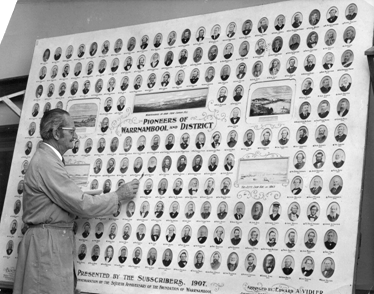
The historic Warrnambool Pioneer Board appears to have set the standard and has become as famous for its omissions as its inclusions.
Put together in 1907, the 3m x 2m board features 204 individual photographs of Warrnambool’s pioneers and not one of them is a woman. In an almost humorous twist, the board itself was assembled and illustrated by a woman, Lillian Foyle, but nobody remembers her name compared to those who feature in the circular frames.
You would think that more than 100 years on things might have changed considerably, but it appears not.
I am happy to stand corrected, but the only high-profile monuments to women that come to my mind easily are the contemporary Val Bertrand Stadium in west Warrnambool and the 110-year-old Granny’s Grave in the sand dunes off the bike/walking track in east Warrnambool.
And the Granny’s Grave site is looking increasingly worse for wear.
[dropcap style=”font-size: 60px; color: #DC943C;”] D[/dropcap]espite being passed by thousands of people every year, including tourists who are encouraged to visit the grave, the monument is covered in rust stains, the paintwork is peeling and chipped, the metal surround is completely out of character with the grave, and the site is surrounded by weeds.
There is also no interpretive plaque or information about “Granny”, other than the few – and as it turns out, incorrect – lines etched into the basalt headstone, even though the Warrnambool City Council announced earlier this year that a plaque would be in place by the end of June.
It is now the middle of October, and I have become tired of asking the council when the plaque might be coming and no doubt they have tired of me too.
Bluestone wrote earlier this year about the fascinating story behind the “Granny” who lies in Granny’s Grave – Agnes Ruttleton – and how she has come to represent all of the faceless and nameless women who were among the very first to come to a scrap of a town called Warrnambool in the hope of a better life.
Agnes was never a rich woman, and she died in poverty at the age of 60 in 1848, but there was something about her indefatigable, pioneering spirit that more successful and wealthy citizens like Richard Osburne thought was worth commemorating. He lobbied for years to have the approximate site of her burial marked by an official grave.
The council knows this is a special site, but the wheels turn extremely slowly when it comes to preserving key elements of our past.

[dropcap style=”font-size: 60px; color: #DC943C;”] A [/dropcap] 2008 management report into the city’s public art and cultural assets concluded way back then that Granny’s Grave needed “significant restoration”, including replacing the rusted handrail, ongoing weeding and, with the help of expert advice, cleaning the stone surface, removing the rust stains and re-patching and re-coating the concrete as required.
The handrail has been replaced, but that’s where work has stopped.
I wonder if the council – and us, as residents – would be so accepting of the situation if the memorial marked a returned soldier, a famous footballer, or a founding father of the town?
The council recently voted to apply heritage planning controls over the Granny’s Grave site and I was slightly stunned that it hadn’t already been covered.
Councillor Jacinta Ermacora summed it up when she said the heritage protection process not only for Granny’s Grave, but for dozens of other sites around Warrnambool had “taken far too long”. Given the process began in 1983 – when the council first realised its heritage controls were hopelessly out of date – Cr Ermacora is being generous.
Why is it like this?
Why does it take so long for any action to be taken on preserving our heritage and, when it is, it is often half-finished and then abandoned?
It appears that we are so focussed on the “now” that we have lost sight of preserving the characters and essence of our past.
Agnes is certainly a rare character from our past who deserves her proper place in our story.

[button link=”http://the-terrier.com.au/subscribe-2/” type=”icon” icon=”heart” newwindow=”yes”]If you would like early access to Opinion pieces, please subscribe to Bluestone.[/button]
 Find more Opinion here…
All words, no funding, for Fletcher Jones story
Grappling with the work of a predator
Unravelling the mystery of art commissions
Lack of schooling a ticking bomb in south-west