It will soon cost $70 to register your dog – and here’s why
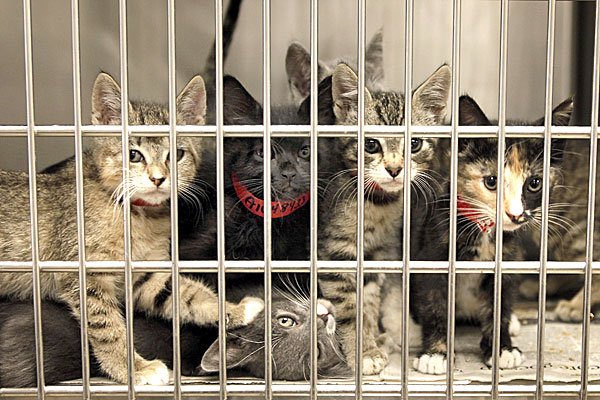
More than 10,000 cats a year are left at the RSPCA across Victoria, part of the reason for a 300% increase in pound management fees. Image: Stockimage.

The Terrier – Carol Altmann

WARRNAMBOOL ratepayers are in for a shock next year (2019) when it comes to putting out their rubbish and registering their pet, as the rising cost of our throwaway society starts to bite.

As has been reported elsewhere, garbage collection fees in Warrnambool are set to climb by $70 to $356 a year, while in neighbouring Moyne Shire the fee is rising by $21 to $493 a year*.

On top of this, pet owners in Warrnambool are expected to see dog and cat registration fees rise by up to almost 40%.

If the draft Warrnambool City Council budget goes ahead, in 2019 it will cost $70 to register your desexed dog and $59 for a desexed cat. (Last year it cost $52 and $41.)

The fee for a non-desexed dog will rise from $166 to $210 and a non-desexed cat will cost $177, up from $130.

And herein lies the problem, because these fee hikes are directly connected to the cost of keeping animals that are either discarded, given up, or need to be rehoused via the Warrnambool pound.

(I hasten to add that not all animals passed to the RSPCA are ‘unwanted’, including those that need to be rehoused due to changing personal circumstances such as illness or divorce.)

While WCC owns the Braithwaite St pound, it has for many years been out-sourced to the RSPCA and late last year the RSPCA dropped a bomb: it was no longer going to run its pound services at a loss and its fees were going up by 300%.

300%!

As council spokesman Nick Higgins explained, the WCC was paying around $112,000 a year, but under its new contract with the RSPCA this will almost triple to $328,632 in the next financial year**.

The following year it will rise to $413,016 and by 2020-21 it will be around $425,000.

This is getting close to half a million dollars a year to run the pound and, it appears, the cost will only keep rising.

So while it might be $70 to register your dog next year, by 2020-21 it could feasibly be $100.

There is no doubt it is expensive to humanely care for and re-house animals and the RSPCA says it had little choice but to reflect this in its fees.

RSPCA Victoria Head of Operations, Tegan McPherson:

Over the past two years, RSPCA Victoria has been carefully analysing every council pound contract we tender for, and submitting tenders with a pricing structure that reflects the true cost of caring for animals admitted from each municipality and shire.

This represents a change from our previous approach, which was to share the cost of care with councils.

We are committed to ensuring that we run every council pound contract on terms that enable us to provide outstanding animal welfare on a cost-neutral basis. This way, we can ensure our limited funds are best invested in reducing cruelty and neglect, and cutting the number of surrendered and homeless animals right across Victoria.”

So what is the answer here?

Do we keep upping the fees and fines in Warrnambool each year to cover what will soon be a half million dollar a year operation, or do we look at this problem more broadly, and find other ways to encourage registration and de-sexing?

Recycling is no longer seen as a long-term solution to our growing waste problem, as international markets dry up. Image: ABC Radio

AT the moment, it seems, those who do register their pets will be seriously subsidising those who don’t: animal registrations will bring in $270,000 this financial year and, with the fee increase, $445,000 in the next.

I can’t help but see the parallels between our seeming inability – as a wider community – to value animals enough to ensure they don’t end up producing litters of unwanted offspring or not getting a dog that we have no time to train, or buying a kitten that is ignored once it grows into a cat…and our producing increasing tonnes of garbage.

In both cases, we expect someone else to deal with what we discard.

Recently there has been a lot of talk about the recycling crisis and China refusing to take our recyclable plastics and paper.

To be precise, China has refused to take recyclables that are even slightly contaminated (ie.mixed in with other stuff).

But the question remains as to why we would want to keep relying on China, or any other country, to keep taking our waste? If they pull the pin, what do we do then?

The answer, which some states are taking more seriously than others, is to no longer see recycling as the God of waste management, but to stop the waste being produced in the first place.

Plastics are flooding our oceans and need to be stopped at the source by changing manufacturing and consumer habits. Image: Good Will Nurdle Hunting/Tangaroa Blue

THE WCC put out its waste management strategy last December, which reflects this idea and covers everything from reducing plastic bags to the simple act of picking up your dog’s poop. It will also shortly start a trial of the organics composting service, FOGO, which is already up and running in Moyne Shire and Bendigo and elsewhere.

As the wheels grind slowly within government, the good news is that good stuff continues to happen at a grassroots, community level.

Colleen Hughson, who I wrote about recently in a piece on the plastic pollution spill at Shelly Beach, is now part of a project involving the global environmental group Tangaroa Blue, and others, to look at the plastics turning up on our local beaches.

A series of public workshops will be held in Warrnambool and Portland from later this month to talk about where the plastics are coming from, and how we can help stop it at the source. You can find out how to get involved here.

Tackling environmental waste and animal welfare issues is not new, but the dramatic fee rises we are seeing at a local level provides a serious wake-up call that we all need to get involved with finding the solutions –  or expect to pay a price.

* Less than half of Moyne’s ratepayers use the garbage collection due to their remote locations. The higher cost compared to WCC reflects a wide geographic area with fewer customers.

** Moyne Shire used to share the cost of the WCC pound but, following a request from WCC to contribute significantly more from 2018-19, is now using the Southern Grampians Shire pound.


My child, how can I protect you?

Carly Cram Photography: Tree Fingers Carly Cram Photography

This piece was submitted by a local woman who signed the petition to remove the Rolf Harris mural from the Lighthouse Theatre in Warrnambool. I have kept her name anonymous, but want to thank her for her courage.

Last month I had a dream about Donald Trump. In this dream we were deep in conversation at a crowded function and I was trying to impress him with my intelligence. Mid-conversation, however, he leant across and grabbed me on the breast.

In shock, I pulled away and started shouting ‘he grabbed my breast, he grabbed my breast’. Expecting the room to react with outrage, my calls were instead met with deathly silence, before everyone returned to what they were doing.

Business as usual.

I burst into tears and was led outside by my best friend and confidante where, with such weary sadness, I cried ‘I’m just so tired of fighting.’

This dream encapsulated a lot for me. It summed up my lifelong battle with sexual assault and abuse. From fighting off men at the pub, to keeping secrets hidden for 15 years. From being told ‘you shouldn’t have let him do that to you’, to my fight with PTSD, depression and anxiety. From the heartbreaking story of a friend who held her secret for another 20 years after being told she was ‘making it up’, to the deafening silence that followed after I screamed at a man at a crowded market for following me and relentlessly pinching my bum.

Two things had just happened around the time of my Trump dream. The #metoo campaign had gathered steam, and while I was interested and a little excited, I was largely cynical and reluctant to take part.

I wasn’t convinced that putting myself out there and making myself vulnerable was going to change anything. After all, we have known for a long time now that one third of all girls will be sexually assaulted by the time they are eighteen, but what steps have we made to address this? What difference would this campaign make? And why should abused women have to lead the charge?

Around the same time, my eight year-old daughter was sexually assaulted. An older man on the street reached out and grabbed her on the vagina, right in front of me. He seemed to see her as some kind of sexual delight, and not as our gorgeous, creative and intelligent kid who embraced life with all her kind heart.

My heart broke for my daughter that day, and I still don’t know if it will ever fully heal. While I knew the statistics, I still believed I held a powerful weapon with my past experience and knowledge of sexual assault. I wanted so much to believe that my passion for protecting her from what I had to endure would be enough to get her through. If I educated her well, if I gave it to her straight and didn’t hush it up or try to gloss over it, she would get through life unscathed.

It turns out I couldn’t even get her to double figures.

The harsh reality of the pervasiveness of sexual assault this time brought me to my knees. In quiet moments to myself I sobbed so hard I didn’t think I would ever stop. The injustice of growing up a female suddenly became very real, and very personal.

It was my response to the incident that plagued me afterwards. Because how did I respond? With silence.

I walked her calmly away and did not confront this man for fear of making it worse for my daughter. And in the days to come it dawned on me that this is what we have done as women. We have stayed silent, to keep the peace, for the families sake, for the community’s sake, to make it in a man’s world.

And in turn, silence has been internalised as some totem of virtue or stoicism in women. The more silent a woman in her pain, the stronger she is. Instead of voicing our outrage, we have used all our collective energy to heal the victims, to sit with them through their confusion, sadness and pain.

But while we have stayed silent, we have left a gaping hole in the ability to challenge men for their behaviour, or to challenge them to be leaders in the change we so desperately need.

Eventually it was a counsellor who helped me to see the tiny speck of positive in our experience. Carrying all the guilt in the world on my shoulders, she allowed me to see that the response we gave our daughter after her sexual assault could be vital in her recovery.

Immediately after it happened I took her to a safe place, gave her a big cuddle and told her that it was nothing about her, or her behaviour, that made him do that. I told her that it was his sick behaviour that was the problem, and that unfortunately stuff like that just happens sometimes, but that she will be ok.

I also told her that we were here for her any time she needed us. The psychologist assured me that our past history of openly communicating with our daughter since she was born, like talking about the hard stuff when it came up, and never letting silence linger, would ensure she knew she could approach us at any time.

Her words also reinforced what I had learnt from the fabulous Professor Caroline Taylor, who has spent years researching and working with children who had been through the court system for sexual abuse and assault.

While only a tiny three percent of cases ever make it to conviction, she found that the process, regardless of the outcome, could be a cathartic one for young people as long as they felt supported and that their story was heard by someone, be it a police officer, lawyer, or family member.

Indeed, the power of hearing a person’s story and sharing their pain can never be underestimated. As a telephone counsellor, I cannot count the times people have said they just need someone to hear their pain, not solve their problems.

So while we chip away at a society that has allowed men too much privilege for too long, and while many of us will be faced with the cold hard fact that we cannot always protect our children no matter how hard we try, perhaps we can take a little comfort in knowing that responding to an abused child with listening, support and unconditional love can be hugely powerful, even if it is at the wrong and sad end of the sexual assault spectrum.

Despite our incredibly painful experience, I am still increasingly hopeful for the future. I do feel a change in the air.

Since the #me too campaign, another sexual predator in Don Burke has been outed, and now allegations against Donald Trump are finally being taken seriously.

I have hope that our daughters will live and flourish in a time where a sexual predator who thinks that ‘grabbing women on the pussy’ is part and parcel of money and fame is not elected by men and women as the leader of the most powerful country on earth.

We need to keep reinforcing to women and girls that speaking up and speaking out is brave, and that silent stoicism, while once a coping technique, is no longer necessary.

And we need to meet this bravery with corresponding support and outrage. I have hope that if ever my daughter was to dream about being outraged by her sexual assault, the whole function room would stand up and shout ‘ME TOO’.


Petition launched to advertise CEO position

W’bool City Council CEO Bruce Anson has been in the role for 11 years. Image: WCC.

A petition has been launched asking the W’bool City Council to advertise the position of its CEO for the first time in 11 years*.

As far as I know, it is the first time such a petition has been launched in Warrnambool and it comes from a position of pure frustration.

While some might see it as a direct attack on the sitting CEO Bruce Anson, I see it as a predictable response to the secrecy that surrounds one of the most important and well-paid civic jobs in our city.

As I wrote recently, the WCC last month voted in secret to award Mr Anson a pay rise that increased his salary package to around the equivalent of $6000 a week.

This includes super and a car and doesn’t include tax, but even if we halved that package to $3000 a week, it is still an eye-watering amount to most of us.

Maybe, as I have said before, Mr Anson deserves every dollar that he earns.

And maybe, after 11 years in the job, he is still the best person to lead our city into the future. (The current contract expires next January).

But the bottom line is that Mr Anson works for us – the people of Warrnambool – and we deserve to know far more about the CEO position and his performance than we do now.

All we have been asking for is greater transparency: nothing more, nothing less.

And yet the WCC continues to act as if we have no right – us pesky journalists and annoying ratepayers – to even ask.

The petition now asks the question in a way that can’t be ignored.

It will be revealing to see how the new councillors respond.

* The petition can be signed at 150 Liebig St (next to Kathmandu) from 11am – 2pm Mon-Sat, and is also located in several local business. It is being organised by David Thompson, partner of former WCC election candidate Christine Thompson.


After Don and Harvey, can we stick with Rolf Harris?

Mixed messages: rather than get rid of a mural painted by sexual abuser Rolf Harris, the W’bool City Council opted to cover it up. Image: ABC South-West.

What message does this black perspex send to women and girls in Warrnambool?

To me, it screams hypocrisy.

At a time when sexual predators – who also happen to be famous – are finally being outed for the scum that they are, surely Warrnambool can no longer hold on to this.

For those not familiar with this piece of black perspex, it is covering a kitschy mural painted spontaneously by Rolf Harris on a wall behind the scenes at the Lighthouse Theatre, way back in 1986.

A lot has changed since 1986.

We now know that Rolf Harris is a sexual abuser, down there with the likes of Harvey Weinstein, Don Burke, Lewis CK, Kevin Spacey, Bill Cosby and others who have finally been outed as the grubs so many people knew them to be.

In Harris’s case, his disgusting crimes – for which he has been jailed – were against young girls. Kids.

And yet Warrnambool is sticking with Rolf.

We are still making excuses.

We have not yet had the courage, it seems, to actually paint over this work but to let it remain covered up, like a dirty little secret for somebody else to deal with down the track.

In the light of what is coming out now about Weinstein and Burke, does that “nothing to see here” approach sound familiar?

That decision was made on our behalf by a majority of the Warrnambool City councillors in 2015 who, using logic I still can’t understand, saw the covering up – rather than complete removal – as a sign of support for victims of sexual violence.

The main argument was that this mural was ART! and all ART! – even a slap-dash mural by a convicted child molester – is worth preserving at all costs.

Really?

Would we seriously consider hosting a gardening talk by Don Burke at the Lighthouse Theatre? Or a film night in honour of Harvey Weinstein, because, hey, their talents are quite separate to their being sexual abusers?

Fortunately a lot has changed since 2015.

We now have a new council. And we have now entered a time – AT LAST – when the powerful and the famous are no longer being given social immunity because of their particular talents, personality, wealth or likeability.

And right this minute, the council itself has the perfect opportunity to correct its mistake of hiding this mural and instead make a strong, symbolic gesture that we, as a city, do not tolerate sexual abusers – no matter who they are.

How?

Well, I saw on Facebook this morning that Connect Warrnambool (which is run by the WCC) is proudly supporting 16 Days of Action to support Gender Equality (#16days) and it talks about things like promoting respect for women and increasing women’s safety and well-being.

All very stirring stuff, but such words, without action, are as hollow as Peter Dutton’s heart.

So here is my idea for Connect Warrnambool, and it is one that I have been pushing since 2015:

  1. borrow a Makita drill and remove the screws that are holding up the perspex on the Harris mural;
  2. ask for willing volunteers to come and run a paint roller right over the space (you will be inundated, Connect Warrnambool, I promise);
  3. invite a young woman artist to paint a fresh mural and;
  4. lastly, install the black perspex on the stage at the W’bool Civic Green and let little kids draw their art all over it.

What a message to say that we are absolutely serious about respect for women and girls.

I have my painting overalls ready…


Jackie Carruthers and I are ready to roll!


Historic trees could have been saved

Opinion/Analysis by Carol Altmann

[dropcap style=”font-size: 35px; color: #8cc7d0;”] D [/dropcap]o you remember the two giant Norfolk pines that were cut down at the Warrnambool Police Station late last year?

I do, because I couldn’t believe the Warrnambool City Council didn’t try harder to save them – but, as I have since learned, they actually ignored their own advice to let the chainsaws in.

Here is a photo of what we are talking about, taken after the limbs were cut off in preparation for their full removal last August:

The two mature Norfolk pines being prepared for removal in August 2016.

These weren’t just any old trees.

The pair had historical links to the beautiful Church of England property next door (built in 1855) and were considered so important by the council that they were specifically mentioned in the planning permit issued in 1996 for the new Warrnambool Police Station in Koroit St.

In particular, the trees were not to be “removed, destroyed or lopped” without written consent from the council.

The new station opened in 1999 but, it appears, had immediate problems with drainage and flooding which to me says more about a poor build in the first place rather than the position of the two trees.

In 2005, a member of Victoria Police – I don’t know who, because names have been redacted from the Freedom of Information documents I received from the council – sent the council an email, saying the pine trees were continuing to cause water damage to the new building and needed to go.

“All advice we have and our own observations tell us that out problems will continue whilst the trees remain in place. I seek approval to remove both of them forthwith,” he/she wrote.

Two weeks later in November 2005, a council officer wrote a detailed response on behalf of the council’s Built Environment Committee.

The most important paragraph of that letter is this:

“…the trees have a positive contribution to the streetscape, have demonstrated historical links with the church property next door, clearly the intention of the endorsed plans is to retain the trees and therefore the removal of the trees should only be considered as a last resort.” (my emphasis)

Crucially, the council also recommended the police obtain a Structural Engineer’s report on what could be done to either the building (eg. adding more gutters) or to the trees (eg. root barriers) to fix the problem.

The council even offered the police a free arborist service and access to its Heritage Advisor.

But neither happened. In fact, nothing happened.

Fast forward five years to 2010 and the police wrote to the council again and – again – asked how it could get rid of the trees.

This time, however, there was no detailed response, but a six-line letter from a different council officer to that who responded in 2005.

And this time, the historic trees were suddenly considered dispensable because they might – might – cause problems.

“Given the retention of the trees is likely to be problematic, Council does not object to their removal,” he/she wrote. (My emphasis).

It is hard to get a sense of the size of the remaining tree stumps, but you could stand on them and stretch out your arms and your fingertips. I hope that helps.

I am not sure when a written permit expires, but it took a further six years before it was used to cut down two Norfolk pines that were apparently causing so much trouble.

No wonder so many people were shocked – at no time has there been any public information or discussion about the trees, despite their significance.

Instead, a six-year-old permit, issued behind closed doors and by a different group of councillors (if they knew about it at all), was enough.

I have tried to talk to the police about why they removed the trees now, more than 10 years after they were considered a dire problem. They didn’t respond.

As such, I am unable to confirm one story doing the rounds that the space will be used for extra car parking.

Surely not.

Now some of you will be shrugging your shoulders and saying, oh, they were just trees, but to me this sequence of events reveals so much about the weakness of our planning laws, the way decisions are made in private and then how they are pitched to the public.

As custodians of our natural and built heritage, we can surely do better than this.

[box]You can see all of the Freedom of Information documents relating to this story here and here.[/box]

This is the first of three Terrier pieces that will be free to access. If you would like continued access, please become a paying supporter by clicking the box below.

Donate