Sharp points to bigger airport burden for WCC ratepayers
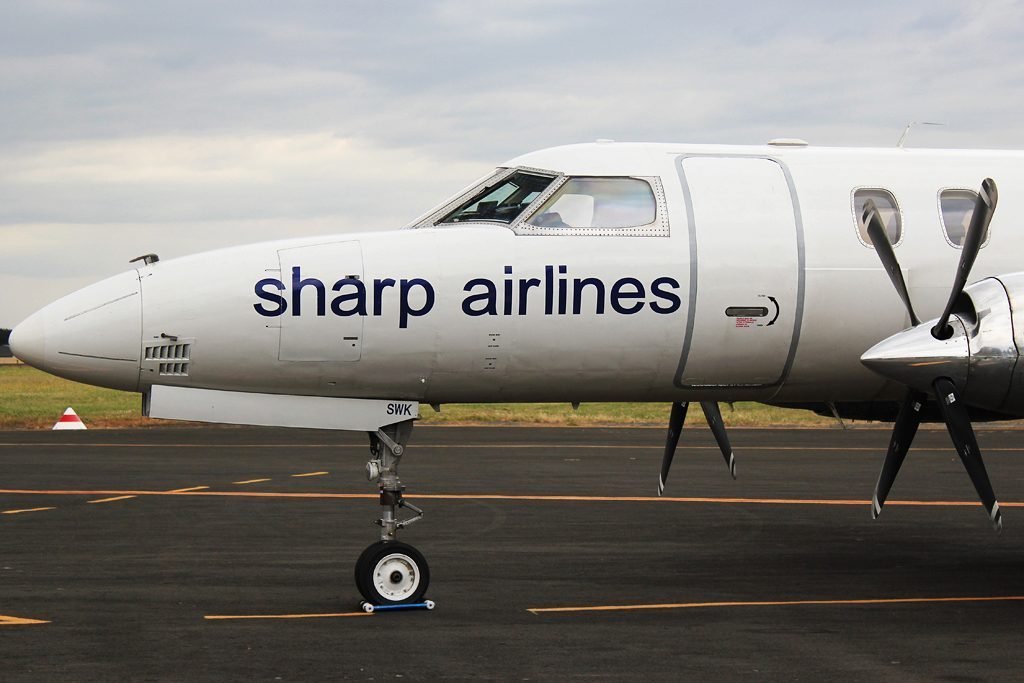
A $75,000 WCC funding package for Sharp Airlines has raised much broader questions about why the Warrnambool Airport runs at a loss. Image: Sharp Airlines.

Carol Altmann – The Terrier

Here’s a twist on the $75,000 given to Sharp Airlines by the cash-strapped Warrnambool City Council  – Sharp Airlines didn’t ask for the money.

No, it was offered to Sharp as part of a $300,000 package to try and keep the passenger service to Essendon flying beyond last January when it was due to close because of insufficient numbers.

So this money wasn’t a “bail out” for Sharp Airlines, but an unexpected bonus.

The package was put together by the State Government, which in turn asked for contributions from Warrnambool, Glenelg and Moyne councils – only Warrnambool and Glenelg said yes.

Warrnambool ratepayers didn’t know a thing about any of this until the local newspaper broke the story in early January, right smack bang in the middle of the council announcing it wanted to break the rate cap and lift rates by 4.5% because it was slowly going broke. No wonder they wanted to keep it quiet.

The WCC wouldn’t say at the time how much it had given Sharp, but ironically the $75,000 figure was revealed privately to a focus group of ratepayers who were invited by the council to discuss the need for a rate rise.

As one of those ratepayers told me later, they were shocked to learn that the council could have said no.


Sharp Airlines, as a business, doesn’t need rescuing.  It operates other routes from other airports quite successfully, but the Warrnambool to Melbourne passenger route was not proving  profitable since its relaunch in 2015.

Like any business, the airline made a decision that after four years of making a loss, it was time to pull the pin, but if the State Government was offering a package to help turn things around, Sharp would happily try.

Sharp Airlines CEO Malcolm Sharp is refreshingly up front about all of this.

“We have never asked for and have never before received any government assistance, but we certainly appreciate the support,” he says.

Mr Sharp says passenger numbers have improved slightly since January, but a final decision will be made in the next six to eight weeks. The key is whether more business passengers get on board.

What the Sharp Airlines deal has done, however, is expose a much bigger problem with the airport which, unbelievably, runs at a loss that is picked up by – you guessed it – Warrnambool ratepayers.


So we have an airline receiving council money that it didn’t ask for, while that same council runs the airport at a loss. No wonder the budget is stuffed.

This loss is despite a $4.3 million upgrade of the airport just three years ago that included $750,000 of WCC money and was supposed to see the airport zoom into the future with more hangars being built, more flights, more businesses setting up….

Three years on, WCC ratepayers are still having to meet the average shortfall in income of around $200,000 a year.

Does this sound familiar to you? If you have been following the Flagstaff Hill $3 million sound-and-light-show debacle, it should.

A big upgrade, all bells and whistles, media photos, high-vis vests and handshakes….and then ratepayers keep footing the bill.

Despite running at a loss, the WCC still has virtually no user-pays fees for the airport.


While we are being whacked for parking, pet registrations and green waste, Midfield Meats International, for example, pays about $50 a week or $2600 a year to rent space for an airport hangar (the hangars themselves are privately built and owned).

There are also no aeroplane parking fees or landing fees, despite around 15,000 takeoffs and landings at the airport each year.

If the WCC charged, say, $50 a pop per landing and takeoff, there is a neat $750,000 a year … which just happens to be how much it hopes to raise through breaking the rate cap.

Head. Wall. Bang.

As it is, WCC is one of only two of the 79 councils right across Victoria to apply for permission to bust the rate cap. We can only hope the Essential Services Commission sees right through this and says no.

If you would like to see The Terrier keep digging up, sniffing out and chewing on local issues, please consider throwing something in the tip jar.

Terrier Tip Jar


Snow White, the Seven Dwarfs and the city of WooBoo

Snow White and the seven elected members of WooBoo, including Grumpy, all working to make life better for its citizens.

Carol Altmann – The Terrier

This is a budgetary fairytale based on fact. The numbers are real, the names are not.

Once upon a time, in the town of WooBoo, there was a town leader, Snow White, who was paid more than $310,000 a year to work for the seven dwarfs who had been elected by the people of WooBoo to look after WooBoo and help it prosper.

Exciting things were happening in WooBoo under Snow White’s leadership.

There was a big, money-losing festival for children, there was a maritime museum with few boats but a new $3 million sound-and-light show that promised to lure carloads of tourists, there were parties at the racecourse, new public toilets, new parking meters, pretty roundabouts and still lots of money left over for the WooBoo Council to spend on consultants, credit cards, conferences and staff development.

Most of the seven dwarfs were ecstatic, except for Grumpy. Every council has a Grumpy, and Grumpy was seen as a troublemaker.

“Can we afford all this?” Grumpy would ask. “Does this all add up? Why don’t some of these figures make sense?”

“Of course we can,” said Doc and Happy in unison. Unlike some of the other dwarfs, they had represented the Town of WooBoo for many years and had grown fond of Snow White and her team of highly paid helpers.

Mayor Sneezy was equally as enthusiastic: “WooBoo is aspirational, sophisticated and cosmopolitan and I wish people would stop being so negative!”

The spending went on. Sometimes it was on necessary but boring things, like $5.5 million for a drainage system to avoid parts of WooBoo flooding.

The glittering, shiny upgrade of Justice von Liebig St started at $15 million…..

And sometimes it was for sparkly things, and the biggest of all was the $15 million upgrade of the main street of WooBoo, with shiny new pavements, new trees, new lights, drinking fountains, more flowers and planter boxes and a much narrower road with so many pedestrian crossings that WooBoo drivers could no longer take their eyes off the road for a second.

The people of WooBoo were happy to see their tired main street being given the full Ritz treatment, even if they privately wondered what was going to happen to the other town streets with their peeling buildings and broken footpaths.

Don’t worry, they were told, celebrate the rise of wonderful Justice Von Liebig St!

Meanwhile, in the MelBoo office of the chief money watcher, the Victorian Auditor-General, a little red light was flashing.

It had been flashing quietly every year since 2014-15 and it warned a “high risk” situation was developing. This high risk was that the Town of WooBoo did not have enough money of its own to fund its operations, once it removed all the one-off gifts and grants from Grandma and Grandpa Government.

In particular, the Auditor General found WooBoo might have trouble paying to repair and replace things once they wore out, like footpaths and playgrounds and bridges.

Excuse me, is that a cliff? No, surely not?

The red light blinked, but in the town chambers of WooBoo the party went on until, one day in late 2018, it stopped.

By then, Grandma Government had put her foot down and capped rates so councils could not just keep asking ratepayers for more. Instead, annual rate rises would be capped at between 2% and 2.5%.

By then, the money-losing WooBoo children’s festival had been axed abruptly. By then, it was becoming clear that the carloads of tourists were not going to the maritime museum.

The seven dwarfs had to absorb some hard truths.

One of these was that the WooBoo capital works budget for 2017-18 had blown out by a whopping $6 million from $17.6 million to $24.6 million.

A big part of this was dressing up Justice Von Liebig St, the cost of which had grown from $15 million to around $19 million, including $8 million that would need to come from the citizens of WooBoo.

The big drainage project had also been in trouble, with the first contractor going broke and the final cost still not known until it is all finished.

On top of this, recycling fees had skyrocketed, the cost of keeping a pet had shot up, parking in WooBoo was more expensive, rates would still rise, and there was still not enough money for all the old roads, pavements and playgrounds to be repaired.

Things were suddenly not so good.

Snow White at her farewell function before taking early retirement and moving to her seaside castle.

Grumpy thumped the table and yelled “I told you so!” and this time Mayor Sneezy agreed with him.

Happy and Doc, being astute in the art of public relations, told the people of WooBoo that they were committed to tackling a crisis that they had “inherited” and the only way to do this was to ask the people what they thought, ignore that, and then seek to bust the rate cap anyway.

The three other dwarfs, who were still trying to get their heads around it all, nodded in agreement.

And so, dear reader, hi-ho, hi-ho, off to the Essential Services Commission we go.

And what of Snow White?

Ah, she sensibly retired early to her castle by the seaside, from where she watches the hard-working people of WooBoo rise up and prepare to march past the empty grounds of the maritime museum, and down the glittering, gridlocked avenue of Justice Von Liebig St, named, as it so happens, for the German industrial chemist who invented fertiliser to replace cow dung.

The End.

[For those who want to go deeper, you can find the Auditor-General’s red light here on the WCC’s adjusted underlying result, page 79. The WCC 2018-19 budget is here. You can find the capital works details at item 4.5.1 on page 45.]


Adam Kempton: 12 reasons why not to break the rate cap

By Adam Kempton

Lawyer, former Liberal MLA for Warrnambool, provocateur, West Highland Terrier

1. Unfair burden: Rates are in essence a regressive tax. That means they affect people with lower incomes greater than high income earners . If you are a pensioner and the rate cost to you increases by one dollar, then the impact on you is greater than the millionaire whose rate increases by one dollar. This means the rate increase imposes a disproportionate tax penalty on low income people.

Does the council want to be a council for the rich?

This, in essence, is stealing from the poor to give to the rich.

2. There has been no increase in pensions or wages for many years, so why should council increase its revenue way ahead of the community?

3. Local council ( and other tiers of govt ) more or less have a guaranteed flow of revenue ( taxes/rates) , unlike other people and sectors of the economy.

4. The new Chief Executive needs to be given a go in finding savings in reforming council so no increase is necessary.

5. The results of the community consultation poll, which strongly opposed the rate increase, were discarded.

6. There is a federal election in May. The council does not know the positive or negative impacts of a change in Federal Government on its rate/revenue position.

7. It will be a massive embarrassment if the Minister or Essential Services Commission – to which the council applies for the increase – rejects your application for the increase.

8. The rate increase sends a bad signal to the community that says the council will always take the soft and easy approach by increasing its revenue, rather than seeking to find efficiencies.

9. Opposing a rate increase signals the council is applying the same principles that the private sector and households impose upon themselves in the same situation.

10. Is there, or has there been, a long-term (say 10 years ) strategy in which this rate increase would fit?

11. What consideration has this proposed rate rise being given in the context of the massive infrastructure proposed spend for this area? And what consideration has been given in the event that infrastructure spend does not occur?

12. What account has been taken of the economic downward pressure on the area through the milk price and cost pressure in the important dairy economy? This has serious effects right through all sectors of the local economy.

The Terrier is taking a closer look at how we went from budget stability to a budget emergency. It is a slog through some pretty dry data, but worth it. Stay tuned for updates.


WCC ignores public opinion and pushes to break rate cap

The Terrier – Carol Altmann

LAST DRINKS: Tonight (25/2/19) the W’Bool City Council voted 5/2 to try and raise rates above the cap because we are apparently in deep financial do-do.

It is just three months since W’bool City Council CEO Bruce Anson retired – he spent 11 years at the helm, passing each performance review with flying colours, and earning a salary package that toward the end was close to $320,000 a year.

You earn this kind of money for a reason – to keep the ship in shape.

We are now being told we can’t afford to renew our infrastructure, basic things like bridges and footpaths. We are being told we might need to cut services, because we are ‘aspirational’ and want things like a new library and a better sports oval.

There has been so, so much waste and it has happened on Mr Anson’s watch.

Loud applause to Cr Peter Hulin and Mayor Tony Herbert for voting against this rate rise, in favour of a forensic audit of council spending and costs.

An audit is so long overdue.

I hope the Essential Services Commission – which has to approve the rate rise above the cap – sends this strong message to the council too: you can’t keep asking ratepayers for more, when you have wasted so much along the way.

The time for reckoning has come.

The Terrier is taking a closer look at how we went from budget stability to a budget emergency. It is a slog through some pretty dry data, but worth it. Stay tuned for updates.


It’s official: Warrnambool is being fleeced for dog rego fees

Dog registration fees have skyrocketed in Warrnambool for reasons which are unclear. Image:Dog Health

Carol Altmann – The Terrier

Thanks to some great digging by all of the terriers out there, we now know that Warrnambool is the second most expensive place in the whole of Australia to register your desexed dog.

The most expensive place is Bayside Council, the council that covers the multi-million dollar suburbs around Brighton, Melbourne. It charges $78.

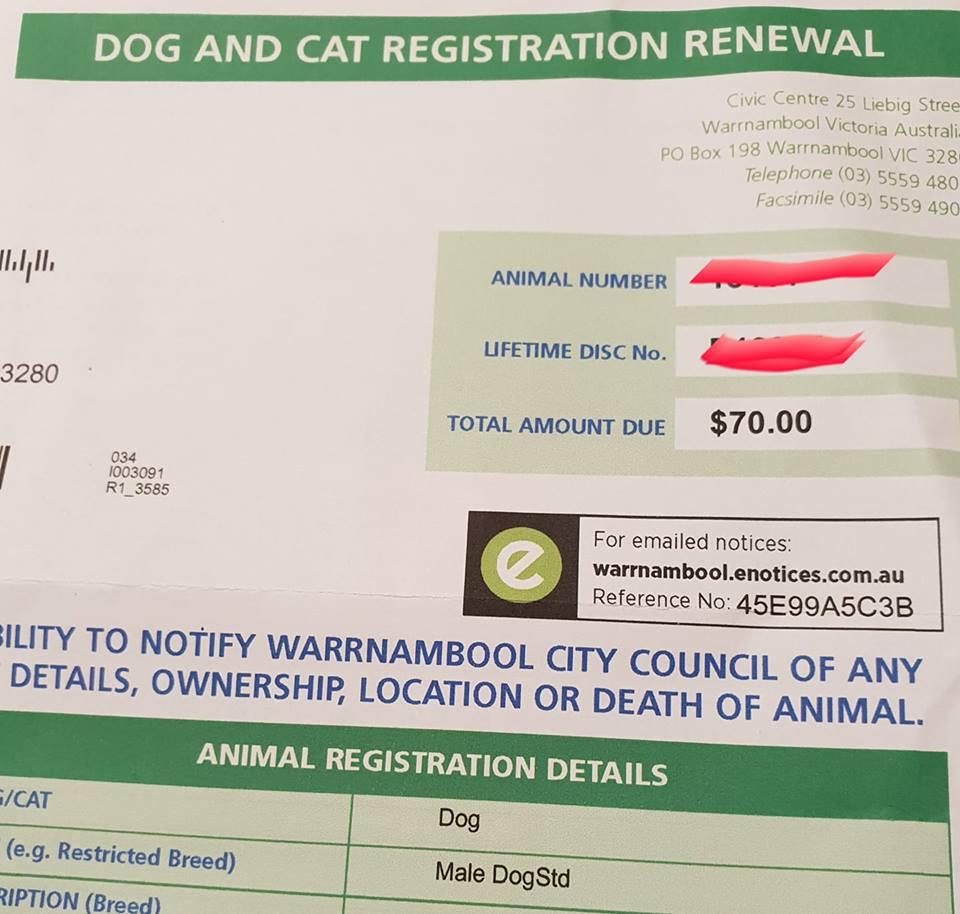
Our council will this year charge $70, up from $54 last year, because of a 300% increase in costs passed on by the RSPCA that runs the Warrnambool City Council-owned pound on behalf of the council.

In 2017, the council put out a tender to run the pound for the next three years and got only one response, which was the RSPCA.

Despite the RSPCA jacking up its fees by a whopping 300% this year to $331,918, this monopoly option was still chosen by the council as the best option.

As a result, we are now paying more than just about everyone, including councils the same size as Warrnambool:

Warrnambool: $70

Ballarat City: $40

Greater Bendigo: $45

Greater Geelong: $41.40 

Greater Shepparton: offering discounted fees to encourage registration: fee $32. Normally $40

Horsham Rural: $42

Latrobe City (Traralgon): $43

Mildura Rural: $44

Wangaratta Rural: $43

Wodonga: $50


Now look at how we compare with our neighbouring councils:

Moyne Shire: $39

Glenelg (Portland) Shire: $35


Until last year, Moyne Shire shared the costs of the Warrnambool pound, but decided a 300% increase was off the scale, so it looked elsewhere. It now uses the Southern Grampians Shire pound in Hamilton.

In Port Fairy, it costs $39 to register your desexed dog and in Hamilton, it costs $43.50.

Glenelg Council was similarly cost savvy. In 2016, the RSPCA in Portland told Glenelg Council it would have to increase its pound fees by 400%, The council effectively said “don’t be so ridiculous”, the RSPCA backed down and the council still uses the pound.

In Portland, it costs $35 to register your desexed dog: half of what Warrnambool is expected to pay just 90km down the road.

Let’s now go further afield.

Humane pound services are essential, but registration fees are also becoming a disincentive. Image: Lostdogs

Greater Bendigo Council this year announced it was taking back control of its pound from the RSPCA because of the rising costs over which, of course, it would continue to have no control. Bendigo charges $45 per dog.

There is an RSPCA shelter in Castlemaine, but the council there (Mt Alexander Shire) doesn’t use it and runs its own pound. It costs $46 to register your desexed dog in Castlemaine.

There is also a big RSPCA shelter in Burwood East, but the local council there (City of Whitehorse) switched from the RSPCA to Animal Aid in 2017. It costs $55 to register your desexed dog in Burwood.

There is also an RSPCA shelter in Wangaratta, but the council there uses the pound run by the city of Albury/Wodonga. It costs $43 to register your desexed dog in Wangaratta.

There is also an RSPCA shelter in Ballarat, but in 2017 the Ballarat council moved across to the new, government-run Ballarat Animal Shelter. It costs $43 to register your desexed dog in Ballarat.

There is another RSPCA shelter in the City of Casey, in Melbourne, but that council uses the Cranbourne Animal Shelter and Lost Dogs Home. It costs $54.50 to register your desexed dog in the City of Casey.

Do you see a pattern here? I don’t know what is going on within the RSPCA that has seen it move to a “full cost recovery model” for its pound services, but it hasn’t gone down well.

Except in Warrnambool, where we are sticking with the RSPCA and going solo. We didn’t even try and stare the 300% price hike down, like Glenelg.


The council did, apparently, look at the cost of running the pound again itself, but decided the RSPCA was the better option. Really? At the second highest cost anywhere in Australia?

We have to trust the council on this, because the cost of the alternative – running the pound itself – has not been made public.

Bill shock: W’bool dog owners who last year paid $54 are getting a surprise in the mail this year.

This year the cost is $70 per desexed dog, but that will most likely increase in the next two years, when the RSPCA will jack up the price again to $417,146 and then $429,666 in 2020-21.

On a simple measure of equity, it is grossly unfair that pet owners of Warrnambool who do the right thing and register their dogs will pay the second highest fees in Australia.


On a broader level, it exposes an inequity across Victoria, which is yet to follow the lead of  WA, NSW and South Australia, where there is one set government fee, whether you live in Port Pirie or Port Adelaide.

In WA, a desexed dog costs $20. In SA it is $40 and in NSW, $57.

When you look at these fees, you can only conclude that we are paying far too much in Warrnambool and nobody has explained why. (You can sign an online petition via the link above).

There is also now zero incentive for anyone to register their new dog in Warrnambool. Why would you?

What this means is that instead of reducing the problem of unregistered dogs, this fee hike will only add to it, creating even more business for the pound. How ironic.

If you would like to see The Terrier keep digging up, sniffing out and chewing on local issues, please consider throwing something in the tip jar.

Terrier Tip Jar