Air issues expose deteriorating state of W’bool Art Gallery
Carol Altmann – The Terrier
Interesting to see the W’bool City Council must now spend $530,000 to replace the air-con system at the art gallery, which has been limping along on one leg for some time.
Like the poor old library across the road, the poor old art gallery has been neglected to the point where it no longer meets modern standards.
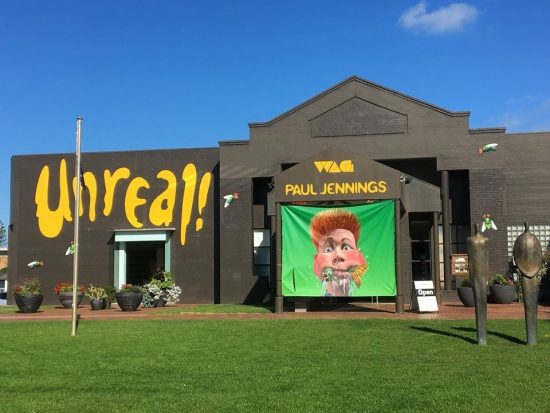
We have missed out on major national and international touring shows because the air quality system has not been up to scratch, which might explain why the Paul Jennings and Damon Kowarsky exhibitions each stayed open for more than six months.
Just like the library, this sad state of affairs is not the fault of the gallery director and staff, who have had to make do with what they have been given.
Take, for example, the fact that the art gallery – in 2019 – still doesn’t have a decent online database.
As a result, most of us have no idea what is even in the collection and, despite the most recent shows “Rich Pickings” and “Wanderlust”, most of it remains hidden.
The council agenda for tomorrow night’s meeting reveals that in just the last 12 months, since the council agreed to fix the gallery’s air-con system, it has failed numerous times and $20,000 has been spent patching it up.
Why have our two main cultural institutions been allowed to run down into this state?
Is the hosting of AFL practice matches at Reid Oval, or spending millions propping up Flagstaff Hill, or spending countless dollars on endless studies of the harbour considered a greater priority? Sadly, yes.
At least the poor old library will soon be replaced with a shared complex with TAFE, although I am not convinced that this is the best long-term solution.
Maybe we could follow the lead of other cities and instead of maintaining separate institutions like in the past, we combine the art gallery, library and a museum into a new state-of-the-art building to replace the existing art gallery.
The Civic Green remains the perfect location for such a contemporary cultural centre (and there is plenty of room for parking right next door).
Such a landmark building would also restore Warrnambool’s reputation as a leader in exhibiting and promoting arts and culture, which it was when the gallery opened in 1986.
Personally, I would much rather see this than AFL practice matches at Reid Oval, and I am Port Power fan.
Analysis: The wrecking of the Warrnibald
A stunning portrait of former art teacher Ollie Morgan, by Megan Cheyne, is among the 16 portraits vying for this year’s Warrnibald prize (detail).
Analysis – Carol Altmann
[dropcap style=”color: #a5cecd;”] I[/dropcap]t sounds almost inconceivable, but the wonderful and extremely popular Warrnibald portrait prize has been wrecked within just 12 months of falling under the control of the Warrnambool Art Gallery.
How?
By quietly turning it into a “prestigious” art prize where many of the local artists of all abilities and ages who entered will not have their works shown.
Indeed those works deemed not good enough have already been returned to the artists who took the time and effort to capture someone from the local community who they considered worthy of being painted.
As a result, only 16 of the original 26 entrants are on display – spread thinly across the gallery space and under ambient lighting – and in contention for the $2000 main prize and $2000 People’s Choice Award.
But it is not about missing out on the chance to win a sizeable prize donated by WDEA (Western District Employment Access) that has disappointed those artists and supporters who contacted Bluestone in disgust – it is about the spirit of the prize being ruined.
[dropcap style=”color: #a5cecd;”] A[/dropcap]s one artist said, the person she had chosen to paint was bitterly disappointed that she wouldn’t be able to take her family and friends along to see her finished portrait on the walls of the Warrnambool Art Gallery.
Another amateur artist said that she was embarrassed to have her work rejected after being encouraged to enter by a friend for the first time after being convinced it was “a lot of fun”.
To add insult to injury, those who missed out had to forfeit their $30 entry fee.
DONATE
Anyone who knows the history of the prize knows that it was never meant to be a professional art prize where only the best artists get to have their work exhibited.
It was the polar opposite.
Under the control of WDEA, which runs the Artlink program for people with disabilities, anyone who wanted to “have a go” at painting the portrait of someone who they believed deserved recognition for their contribution to the local community was urged to do so.
It meant lesser known and amateur artists got to hang their work alongside some of the region’s best talents.
It also meant, even more importantly, that the “quiet heroes” of our community – neighbours, volunteers, charity workers – could be honoured alongside the higher profile people of our region.
It was a winning formula, with the Warrnibald attracting people who might not normally even visit a gallery, but would do so to see paintings of faces they might know.
Matthew Clarke’s portrait of artist and art teacher, Glenn Morgan, is among the final 16 portraits chosen for display.
[dropcap style=”color: #a5cecd;”] W[/dropcap]hen WDEA passed the hosting of the prize to the Warrnambool Art Gallery, it did so with every expectation that the spirit of the prize would continue and, in 2015, it did: all 40 entries were displayed at WAG.
[box]This in 2015: “All entries will be accepted for inclusion in the exhibition, except in the case of there being more than 50 entries. In this instance, the Judges will determine the final selection. Artists whose work is not exhibited will have their entry fee refunded.” (emphasis added)
And this in 2016: “The final exhibition will be selected from received entries. Works are not automatically included, and entry fees are forfeited if an artwork is not selected for display.” (emphasis added) [/box]
And with that, the whole thing changed from inclusion to exclusion.
So how did this happen and who changed it?
We asked the new gallery director Vanessa Gerrans and in an emailed reply she said:
“While the Warrnibald has always had an element of fun, it also carries a certain prestige and showcases the talent within our region. With this in mind, WAG and WDEA decided to compile a shortlist for exhibition in 2016.
“Via the application form, artists submitting portraits were informed that not all works would automatically be included in the final exhibition. This is a standard format in competitive exhibitions such as the inspiration for this exhibition – the Archibald Prize.
“The passionate debate that surrounds which works are included, the selection of the winner by the guest judge and the work identified as the Peoples Choice provides great opportunity for discussion and robust expression of points of view. And ensures the relevance of this event.”
Ms Gerrans mentions that WDEA agreed to the shortlisting process, but Bluestone has been told that WDEA was stunned and angry to learn that only 16 paintings had made the cut.
[dropcap style=”color: #a5cecd;”] S[/dropcap]o who picked the shortlist?
“Usual curatorial processes were applied to selection,” Ms Gerrans said via email.
We can only assume that WAG curator Gareth Colliton had to be excused on the grounds of a conflict of interest, given that one of the 16 portraits selected was that by last year’s winner, the sublimely talented Madeleine Peters, who Mr Colliton now employs at his new gallery business, Wisharts, in Port Fairy.
I want to stress that this is no reflection on Madeleine’s work – it more than deserves to be there – but for Mr Colliton to exclude himself would surely be in line with normal Warrnambool City Council protocols.
The winner of the 2016 Warrnibald portrait prize, as judged by Hamilton Art Gallery director Sarah Schmidt will be announced at the Warrnambool Art Gallery tomorrow night (Friday 29/7/16).
It will be a packed house, no doubt, but to my mind the glaring blank spaces on the walls reflect the holes in the prize: the surprise, joy and communal spirit that is now missing from the Warrnibald.
Let’s hope that spirit returns next year.
[box]Bluestone is currently working subscription-free, ie. I write for nothing because I believe independent media is so important to this region, if you would like to make a contribution to keep our pulse ticking while we rebuild for 2017, you can do so here.[/box]
[dropcap style=”font-size: 60px; color: #A5CECD;”] T [/dropcap]he new director of the Warrnambool Art Gallery Vanessa Gerrans will judge this year’s South West International Women’s Day Art Prize.
Women’s Health and Wellbeing Barwon South West, which is organising the prize for a second year, said it was delighted to secure Ms Gerrans as this year’s judge for the event, following in the footsteps of renowned Portland artist Carmel Wallace who judged the inaugural event in 2015.
Women’s Health executive officer Emily Lee-Ack said Ms Gerrans was a perfect fit with the aims and aspirations of the women’s prize, which will be announced at The Artery on February 26 (there is still time to enter – see end of story).
“We are privileged to welcome a curator to the judging role. Vanessa’s broad experience and passion for women’s art will be an amazing asset to this year’s prize, following on from the generous contribution of inaugural judge Carmel Wallace last year,” Ms Lee-Ack said.
“As an organisation that works to advance gender equality in all areas of life, we are delighted to have leading women in the arts in our region to take on this important role.”
Ms Gerrans said she was similarly delighted to be involved.
“It is a privilege to part of a process that promotes Australian women artists and champions awareness and cultural diversity in the region,” she said.
“I greatly admire female artists for their skill and enormous capacity for depth of expression…I expect the judging will be a very enjoyable challenge.”
This year’s prize offers $2000 cash for the winner – up from $1500 for the inaugural event – with the winning work to be acquired by Women’s Health and Wellbeing Barwon South West and also featured on the cover of its annual report for 2016-17.
A $1000 cash prize will be awarded to the runner-up, with another $1000 cash prize for best emerging artist.
Bluestone Magazine is also, for the first time, sponsoring the People’s Choice award of $250.
This year’s theme for the prize is ‘Hope’ and local women artists have until January 28 to enter.
[box]The South West Women’s IWD Art Prize will run at The Artery from February 26 to March 13, 2016. For detailed information about how to enter please visit the website here.[/box]
Metamorphosis, by Derek Giles, as it was on the side of the Fletcher Jones factory in Warrnambool. Image courtesy of the Warrnambool Art Gallery.
By Carol Altmann
A simple question – “what ever happened to…” – has uncovered a story about the retrieval of a well-known sculpture taken from Warrnambool, while also shining a light on the artist who made it.
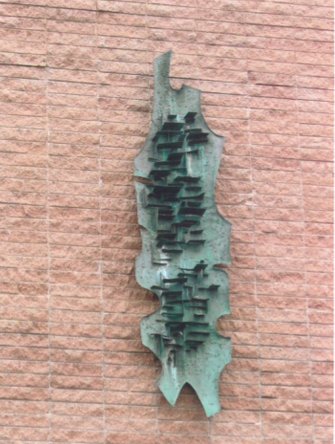
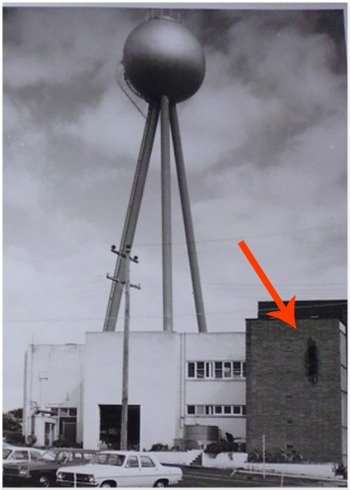
The 3 metre tall copper sculpture, Metamorphosis, was installed on the eastern wall of the Fletcher Jones factory in Warrnambool on August 1, 1967 – the same year as the famous silver ball water tower was built just metres away.
The pair looked down on the factory workers, East Warrnambool school kids and passersby for more than 25 years until the collapse of Fletcher Jones saw the business taken over by Pelaco and the buildings sold to the Warrnambool City Council.
Bluestone recently posted a 1967 photo of the silver ball and sculptureto the Facebook page, Save the Silver Ball and Fletchers Gardens, which prompted a question from one follower: “whatever happened to that sculpture?”
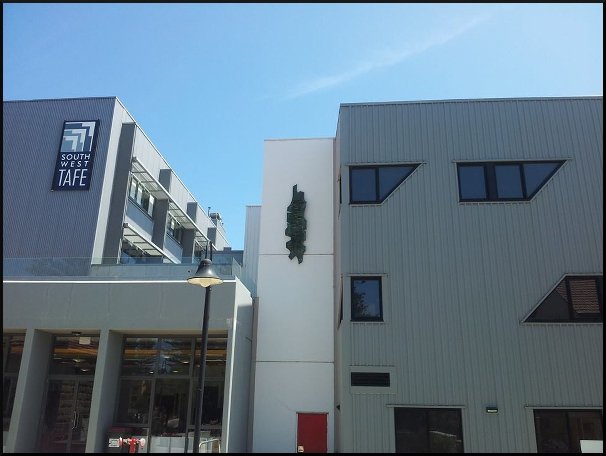
Before long, the answer was provided by Lesena Selvage: it sits on an eastern wall of the South-West TAFE building, overlooking Gilles St, which is just one letter away from the name of the artist who created Metamorphosis, Derek Giles.
But what has never been revealed, until now, is that the sculpture was taken from Warrnambool to Melbourne and it was only through the dogged determination of the late David Jones, son of Sir Fletcher, that it was returned.
The Metamorphosis sculpture shortly after being installed on the site in August 1967 – the same year as the silver ball water tower was built. Image: Ralph Jones collection, courtesy of Melbourne University Archives.
Letters penned by David Jones reveal that he became aware by early 2007 that the sculpture had been removed by Pelaco and shipped to its factory in Maidstone, Melbourne.
While David didn’t name Pelaco, he urged the council to do all it could to ensure the sculpture was returned from “the company”.
“As chairman of (the City Art Advisory) committee and because of my past association with the Pleasant Hill establishment, I express my deep concern that this object has been taken from Warrnambool,” he wrote to then chief executive of council, Lindsay Merritt in February 2007.
“My understanding of the sale of the Pleasant Hill site to the WCC in the early 90s was that the infrastructure including the buildings and the gardens were transferred into the ownership of the city. I cannot imagine why the company could or should have formed the view that they had ownership of this sculpture.
“I request that you take whatever action is necessary to recover the sculpture and that the City Art Committee select a new site for the work.”
By December that same year, little progress had been made, despite the issue being raised by the City Art Committee at least four times.
Since 2009, the sculpture has been on permanent loan from the Warrnambool City Council to South-West TAFE and now overlooks Gilles St. Image: Lesena Selvage.
It appears a clearly frustrated David Jones did what any self-respecting supporter of local arts would do and approached the media to apply a little more heat to the flame.
A story ran in the local newspaper on 28 December 2007, asking people to help locate one of the city’s “most unusual artworks” that had “gone missing”.
“It’s 40 years old, a unique piece and worth several thousand dollars, but more importantly it’s owned by the citizens of Warrnambool and we should make every attempt to recover it,” David is quoted as saying.
The story ended with a request for “anyone with information” to contact the council or David, even though both knew exactly where the sculpture was.
David’s tactic clearly worked, because within 12 months the sculpture was back home – we are not sure how it was finally retrieved – and discussions were underway with the City Art Committee as to where it should be displayed.
South-West TAFE was chosen because of Derek Giles’ links to the art school.
It has long been thought that Derek Giles was an art teacher at the Warrnambool Technical College (now TAFE), but in fact he was a primary school teacher who lived with his wife and young family near the Fletcher Jones factory and who studied art as a mature-age student.
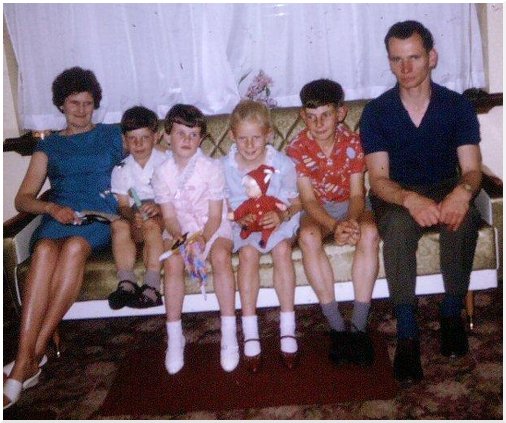
The artist, primary school teacher Derek Giles, with his wife Meryl, who worked for David Jones, and his young family around the time of the commission. David Giles is next to his father. Image courtesy of David Giles.
I actually helped Dad build it,” said Derek’s oldest son, David Giles, by phone from Melbourne.
“It was put together in our garage (in Emma Ave) and I would hold bit this and that bit, while Dad kept saying ‘don’t look at the flame, don’t look at the flame,'” he laughed.
David, one of four children, was in Grade 6 at the time and, from what he understands, the commission came about through his mother, Meryl.
“My mother worked as a secretary to David Jones for about 12 months and I think one of Dad’s penultimate assignments for his art course was to produce a work, so Mum approached David to see if Dad could make him a sculpture,” he said.
Derek Giles, who was born in Melbourne, taught in primary schools around the south-west in the 1960s, including Port Fairy Consolidated and Warrnambool Primary School, but always had a penchant for art and worked across a range of mediums.
“Metamorphosis is a wonderful connection to Warrnambool for the whole family: it is a real focal point,” David said.
“As kids, we always thought of it as Dad’s sculpture…(but) not really being art aficionados, we joked that he had made a high-rise for the birds, because they used to love to roost in the horizontal panels when it was mounted on the wall.”
Derek Giles died in 1993, at the age of 58.
There is little doubt that had David Jones not pushed for the return of Metamorphosis, it would have been gone for good, with the Pelaco factory at Maidstone since closed.
Later this year the Giles family will complete the final vision that both they, and David, had for the sculpture, which is to install a simple plaque naming him as the artist.
I would like to acknowledge retired art academic Ross Gray and Warrnambool Art Gallery Curator Murray Bowes for their assistance with this story.
Why doesn’t W’bool have a major art prize?
Winners of the inaugural South-West IWD Women’s Art Prize, Marion Manifold, left, Claire Drylie, second from right, and Megan Radley with judge, Dr Carmel Wallace, centre. Image: Bluestone Magazine.
Analysis – Carol Altmann
[dropcap style=”font-size: 60px; color: #A02F2F;”] M [/dropcap]ost of us probably haven’t heard of the Tatiara District Council and I certainly hadn’t until I stumbled across its $12,000 biennial art prize.
The acquisitive prize began in 2013 and offers $10,000 to the winner, plus another $2000 shared across a range of categories: this is a $12,000 investment by a council with a population of around 7000 people spread across places including Keith and Bordertown.
Further afield, in the red-dust steel town of Whyalla (popln: 20,000), there is a biennial City of Whyalla Art Prize offering a total of $28,000 courtesy of the local council and some serious support from the local mining companies.
And if we cast our eye around regional Victoria, we can find, for example:
Australia’s most prestigious ceramic prize – the $50,000 Sidney Myer Fund Australian Ceramic Award – hosted at the Shepparton Art Gallery;
the $20,000 Guirguis New Art Prize hosted every two years by Ballarat Art Gallery (and funded by a local surgeon);
and the fantastic Corangamarah Art Prize, a $7500 acquisitive prize organised by Colac Health and Red Rock Regional Theatre and Gallery.
In Warrnambool, however, the council doesn’t fund or facilitate any art major prize and has no immediate plans to do so.
And despite our city being home to some very wealthy individuals and businesses by virtue of inheritance, hard work or both, they appear to be a miserly bunch when it comes to supporting a major art prize.
SCOPE Galleries director Dr Liza McCosh, left, with guest judge for last year’s Art Concerning Environment award, Marita Smith, director of Gallerysmith North Melbourne. Image: Bluestone Magazine.
[dropcap style=”font-size: 60px; color: #A02F2F;”] T [/dropcap]he most lucrative Warrnambool-based art prize, as it stands, is the biennial SCOPE Art Concerning Environment Award ($5000 first prize) organised since 2012 by SCOPE Galleries owner, Dr Liza McCosh, who has set a standard that few others have chosen to follow.
Instead, apart from a few notable exceptions, most of the private support for the arts comes from the estates of past benefactors – such as the Fletcher Jones Foundation, and Gwen and Edna Jones Foundations – or from generous souls who live elsewhere, like Professor Barbara Van Ernst and Geoff Handbury.
Over the years, Warrnambool has had some highly respected art prizes, such as the Henri Worland Memorial Print Prize in the 80s and 90s.
The most recent was the New Social Commentaries Art Prize – a biennial $15,000, acquisitive prize hosted by the Warrnambool Art Gallery (WAG) and funded by the FJ Foundation from 2004 until 2008. Unfortunately, in 2008, a controversy over the awarding of the prize saw it lose much of its lustre.
Shortly after WAG director John Cunningham was appointed in 2010, he announced the prize was being reviewed. It has not been seen – or replaced – since.
The council won’t allow John to speak to me directly, and he has since announced he is leaving Warrnambool to take up a new position, but council spokesman Nick Higgins said there was “no plan” to replace it.
In the gap, it is not surprising that two, smaller art prizes have been embraced enthusiastically by the local art scene.
Where the Warrnibald began: former Artlink teachers and artists Gayle Clark, left, and Jenny Altmann, with artist Alex Rees. Image: Bluestone Magazine.
[dropcap style=”font-size: 60px; color: #A02F2F;”] F [/dropcap]irst, the inaugural South West IWD Art Prize organised by Women’s Health and Wellbeing Barwon South-West and the IWD Alliance saw a record crowd pack into The Artery for its launch earlier this year.
Despite the predictable, put-down comments from some men about it being limited to women artists, this $1500 acquisitive prize has the potential to grow into something very special for Warrnambool, along the lines of a mini Portia Geach Memorial Award that has become so prestigious, artists are thrilled just to be long-listed.
With more funding – and perhaps a catchier title – the women’s art prize could easily become a premier art event for south-west Victoria and The Artery.
Similarly, the Warrnibald portrait prize is so perfect for Warrnambool – because of our links to father and son John and Joseph Archibald – that I can’t believe it hasn’t been running for decades.
It was the brainchild of Gayle Clark, who formerly worked at Artlink, which is run by WDEA to help disadvantaged people or those with disabilities. The first Warrnibald was held in 2012 and attracted a full house.
When WDEA closed the Artlink gallery in 2014, it looked like the popular Warrnibald would go too, but thankfully the Warrnambool Art Gallery has seen the merits of hosting this prize in 2015, even if the council has failed to throw any money into the prize pool.
So we have two art prizes, still in their infancy, just begging to be nurtured with philanthropic, business or council dollars to cement their place in our art calendar.
Can we do it – or will Tatiara District Council leave us looking like a bunch of tight wads?


 More Opinion and Analysis: