Time stands still in Reicha’s store

reicha-cobden_
Reicha’s drapery store in Cobden is, like its sister shop in Terang, a throwback in time to when retail was all about customer service, running up an account and trying things on.

Words and photos by Carol Altmann

[dropcap style=”font-size: 60px; color: #DC943C;”] L [/dropcap]ong before online shopping and well before Target and K-Mart, there were places like Reicha’s in Terang, a clothing and haberdashery store that sold a bit of everything.

That “everything” includes things like buttons, bras and balls of wool; shoes, zippers, sunglasses and hats; hankies, dressing gowns, school uniforms and reels of cotton in every conceivable colour.

It is the sort of shop where customers can still run up an account and the wooden front counter has been polished smooth by the hundreds of hands with which it has made contact over the past 55 years.

But now Reicha’s, like so many stores of its kind that have already disappeared, is hanging on by a thread.

michael reicha
Michael Reicha, the son of store founder Les Reicha, has kept the store going since his mother’s retirement but now feels it is coming into its last chapter.

[dropcap style=”font-size: 60px; color: #DC943C;”] O [/dropcap]wner Michael Reicha, who has worked in the family business for 26 years, is now 56 years old and while he has children of his own, he is a realist and knows their future will not be in the shop.

“We are losing the generations from our shops. They are no longer being passed on like they were because everything has changed with how we shop and where we shop, and so much of it is now online,” he says.

subscribe button10

Reicha’s survives on the back of a base of loyal customers and providing, as Michael describes it, “the sort of personal service that you can’t get online, where people can see, feel and try something on and bring it back if they are not happy with it”.

The day of Bluestone’s visit, one of those regular customers was buying a rose pink dressing gown for her elderly mother, while another was browsing the lines of women’s tops. It might not be described as “jumping”, but it was steady.

reicha-cobden_11
A rotating stand full of ladies hankies. Just one of the many original items that are still used in the store.

[dropcap style=”font-size: 60px; color: #DC943C;”] M [/dropcap]ichael’s co-worker Linda Kenna, who grew up in Terang, remembers when the two-storey shop had separate counters for men’s and women’s clothing, and the place was bustling with people buying balls of wool and lengths of fabric to make their own clothes.

“One whole wall was packed just with balls of wool,” Michael adds, laughing, “which is hard to imagine now”.

The story behind Reicha’s is one of tenacity and tragedy.

The business was started by Michael’s father, Les Reicha, a Lebanese migrant who originally settled in Geelong and – like Sir Fletcher Jones before him – bought a hawker’s van and travelled around the western district in the 1940s and 50s, selling his wares.

“He used to come down and sell clothing to the farmers and spend the night at the Noorat Hotel,” Michael says.

“Dad loved this area, loved the people, and so eventually he moved here and started in a shop across the road before buying this shop.”

reicha-cobden_pair
Michael Reicha and employee Linda Kenna who grew up in Terang and remembers visiting the store as a child, when it was in its prime.

[dropcap style=”font-size: 60px; color: #DC943C;”] T [/dropcap]ragedy struck, however, in 1973 when Les drowned at Peterborough while fishing. He left behind his wife, Elaine, and four children, including Michael who was aged just 13.

Elaine, who is still living, continued on with the business in Terang and a smaller shop in Cobden, while also raising her young family.

“I don’t know how she did it on her own, but Mum kept the shop going even with four kids,” Michael says.

And while Michael expects “Reicha’s” will come to a close when he eventually retires, he is pragmatic rather than nostalgic.

“It is coming to an end…and while it is a battle sometimes, it is still a good battle,” he says, smiling.

reicha-cobden_21
All buttoned up: Reicha’s is still a place for haberdashery and those who like to make their own clothes.

[box]Reicha’s Drapery is at 74 High St, Terang, in the 1916 Kelly Building’s which are set to be freshened up as part of a Corangamite Council owner incentive program. Reicha’s also have a store at 16 Curdie St, Cobden. No website and no Facebook page but drop in to either shop to see retail as it used to be.[/box]

newsletter Why Not StonesYou might also enjoy…


Sign of the times for Mortlake icon: Golsworthy’s

Turning in to the Turn In Motel

Deep into the cellars of KM Lynch
Little old shoe leads to a humble war hero

Oh Biba, look at you now!


The pot, the shell dolly and the bower bird

plaques
Where to look first? The Drylie home in Warrnambool is an eclectic museum of pieces from the 1950s and 60s and a smattering of whatever catches their eye.

ARCHIVED

Bluestone columnist and architect CLINTON KRAUSE previously worked in Daylesford before relocating his business to Warrnambool. Clinton explores the retro styles that gives our region so much character.

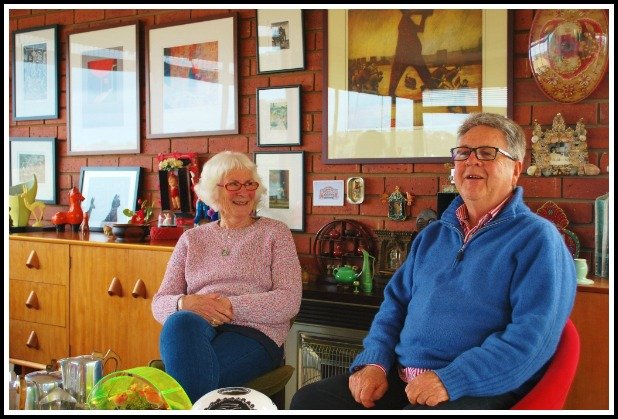
With family roots going back to the settlement of Port Fairy and a long association with retailing in the region, Claire and Tony Drylie are well known throughout the district.

Claire’s emergence as an artist has also brought her work to the attention of our arts community and her intriguing dioramas assembled from religious iconography, retro kitsch and other plastic flotsam and jetsam also just happen to provide a hint of the private lives of this dynamic couple.

I recall my first visit to their home as a visual feast of colour, chaos and clutter that nearly threatened to overwhelm the senses.

It is as if Tony and Claire are actually residing within one of Claire’s complex art assemblages.

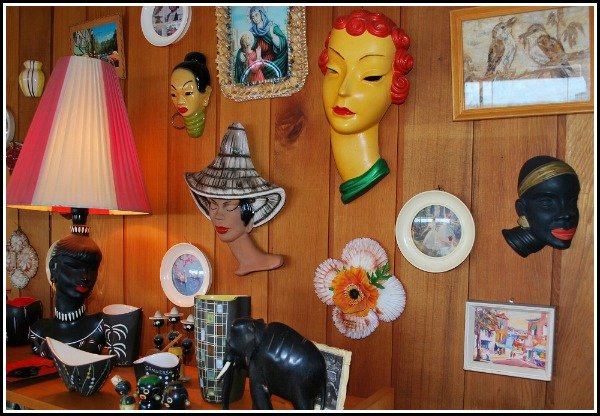
An extensive collection of pottery, retro furniture and art sits cheek-to-cheek with the ephemera of kitsch tourism souvenirs, plastic dolls and other miniatures.


Grouped collections of hats, pottery, clocks, genie bottles, cats, Madonnas, donkeys, lamps, ice buckets, and tea sets occupy every available nook and cranny.

The mayhem extends out into the garden where a mob of concrete kangaroos greet you at the entry, metal work sculptures adorn every wall, and pots of every size and colour contain curiously shaped cacti and other exotic plants.

claire and tony
Claire and Tony Drylie. The pair began their collecting with just one ceramic pot from Tasmania and ended up running their own store of collectibles.

To say that ‘Tony and Claire “like to collect” is an understatement and I set about uncovering the origins of this passion.

“It started with a pot in Tasmania,” reveals Claire.

Knowing nothing about Australian pottery at the time, she was captivated by the strong colours of the glaze and the unusual soft and rounded form.

Further research lead to an appreciation and interest in Australian pottery which sparked the pursuit of unusual, quirky and interesting pieces.

This lead to regular visits to local auctions and garage sales throughout the southwest, where the couple’s interest expanded to other areas such as retro furniture, wall art, ceramics and anything that had a certain style or quality of design.

shrine
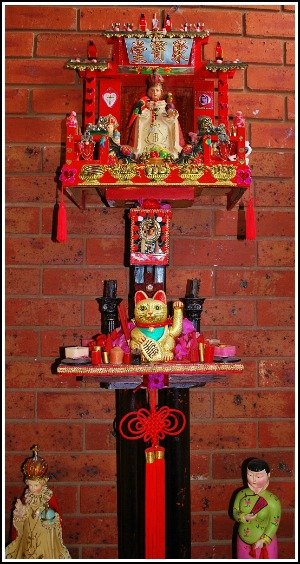
One of Claire’s distinctive assemblages – made from pieces picked up at auctions, op-shops and by friends – which invite the viewer’s own interpretations.

Claire’s artistic eye for great design and a bargain was put to good use when she started selling pieces at a small stall in the Drill Hall at Port Fairy.

Whilst hugely popular with the buyers, Claires mix of retro, kitsch and shabby was at odds with the “serious and staid”  antique collections of the other stallholders and when a chance came to open her own shop back in Warrnambool, the couple jumped at it.

With Tony out the back restoring timber furniture and Claire filling the walls of the commodious space in Fairy Street, their business ‘Alternative Antiques’ became a must-visit destination amongst tourists and locals alike.

Fast forward to 2010 and with the couple having kept the supply and restoration of  inventory going for well over 10 years, it was time to move on.

The shop had become such an institution that Claire recalls loyal clientele actually getting a bit “bolshy” and emotional when told that the couple were winding down.

shell art
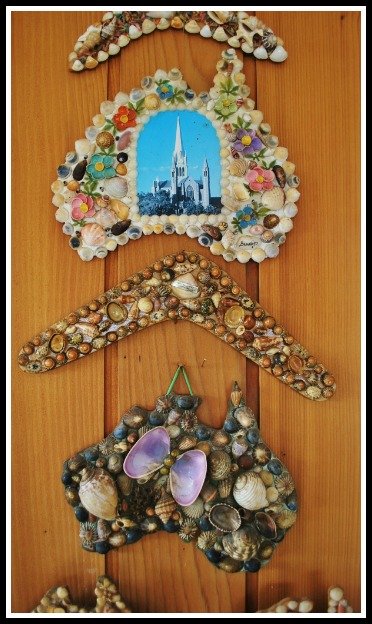
After being denied the opportunity to own a shell dolly as a child, Claire has more than made up for it with a huge collection of shell memorabilia with a twist of kitsch.

During the years of the business, a vast repository began to accumulate – a common practice at most auctions is to offer the best pieces thrown in together with ‘job lots’ of items that are impossible to sell.

Claire’s boundless creative energy found a use for all this detritus and she began to experiment with boxed dioramas of religious items, small scale figures and other items that, when assembled, create a narrative for the viewer to explore and interpret.

She is now establishing herself as an artist with the ongoing exploration and evolution of these unique installation pieces and was awarded the runner up prize at the inaugural Southwest International Women’s Day Art Prize in 2015.

This knack for arrangement has been given full flight in the styling of their home and the walls are adorned with montages and groupings of both themed and disparate objects which all seem to come together in a visually pleasing symphony of colour, form and wit.

Oh, and the story of the shell dolly?

Well, there was a girl down the road who had the most beautiful doll young Claire had seen and despite insistent pleas to her mother, it was dismissed as being far too kitsch and common to be bestowed as a gift.

All is good now though, because Claire has a whole shelf of shell dollies, and shell boomerangs, and souvenirs, and hats, figurines, seats, vases, masks, radios, lamps, pots , prints, cushions, caravans, clocks, tea sets, dinnerware, ice buckets, robots…………………………………………

Clinton-Krause


Sign of the times for Mortlake icon

Glass curtain walling to the facade is shaded by a timber sunscreen and deep overhangs (800x507)
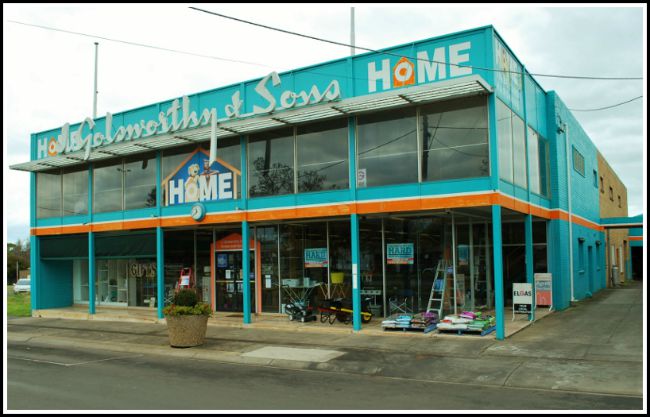
The Golsworthy and Sons hardware store in Mortlake is a classic example of 1960s architecture that has remained largely in tact since it was first built. Image: Clinton Krause.

Bluestone columnist and architect CLINTON KRAUSE previously worked in Daylesford before relocating his business to Warrnambool. Clinton explores the architectural styles that gives our region so much character.

Anyone passing through Mortlake would be familiar with the eye-catching facade of ‘Golsworthy and Sons’ Hardware Store at the eastern end of the main street.

Built in 1962, the building is testament to the optimism and buoyancy that arose from the regions prosperity during the post war boom in settlement and farming in the region.

The family dynasty of four generations took over the local hardware shop in 1930 and embarked on successive expansion of both the business and the premises, culminating in the appointment of Melbourne architects Montgomery, King and Trengove to create the cutting-edge, modernist mecca that endures to this day.

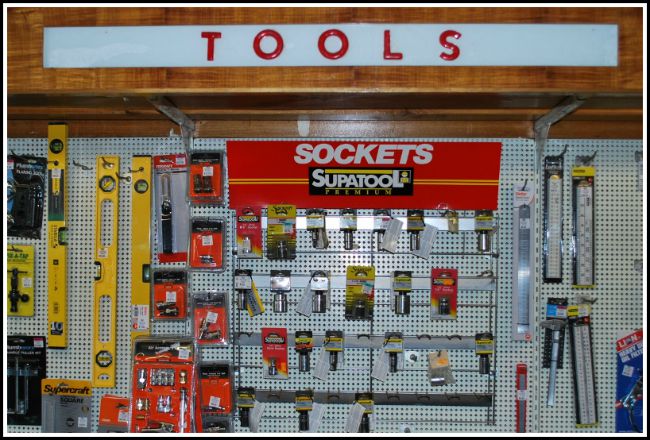
tools sign
Neat as a pin: Custom designed pelmets designate the allocation of goods. Image: Clinton Krause.

More than a thousand people attended the opening ceremony in November 1962, partaking in afternoon tea on the upper floor.

The ‘Mortlake Gazette‘ of that month proudly boasts: “It is doubtful if there is any store in the country the would be the equal of the new building and it compares more than favourably with any Melbourne store”.

Locals, however, were less enamoured, and Eric Golsworthy, third heir of the hardware empire, repeatedly refuted naysayers who claimed that the shop was too big and too expensive for the likes of Mortlake.

It turns out that Eric’s timing was just right and the new business flourished during the good times brought on by the post-war building boom , the influx of residents to the district during the Government’s Soldier resettlement program and the healthy market price for wool.

At one stage the company employed 25 people and the building arm of the business was engaged to build many of Mortlake’s notable public buildings including the Police Station, Ambulance Station, Shire Offices, preschool and infant welfare centres to name just a few.

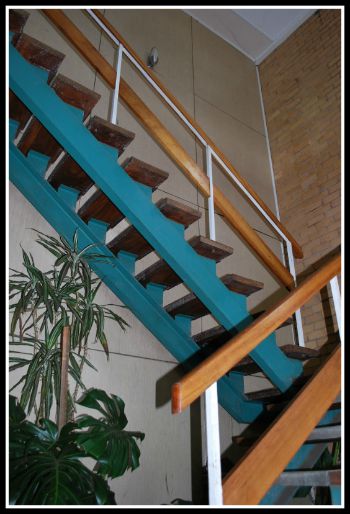
atrium
A plant-filled atrium and stair leads to the upper display floor.

Chatting with the current owners, Rod and Betty Golsworthy, it is clear that the halcyon days are over and that the end of a long and successful family enterprise may be drawing to a close.

I am sitting in Rod’s office and I can’t help but feel that I may be on set for an episode of the classic series, ‘Madmen’.

We are seated in 60’s armchairs surrounded by rich blackwood timber wall panelling at a custom designed timber desk with curvaceous lines and stick legs.

On the floor is grey and blue checked linoleum and out through the glass partitioning, the banks of fluorescent pelmet lights still do their job of visual ‘ razzle dazzle’ across the shop floor.

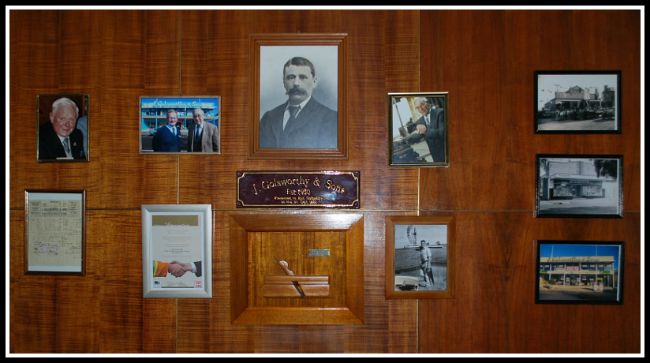
Three generations of the Golsworthy family along with a loyal longserving employee are proudly displayed. (800x436)
Three generations of the Golsworthy family along with a tribute to a loyal, long-serving employee are proudly displayed. Image: Clinton Krause.

Rod proudly shows me the “wall of fame” – a commemoration of the Golsworthy business reign, from James who founded the business in 1930, to Ernest , then Eric and through to Rod.

A photo of employee Arch Grant celebrates 60 years of loyal service. There is a lot of history here to take in.

An exploration of the shop reveals original cabinetry and display stands, building details and even the original architects’ coloured perspective rendering for the proposal.

The stairwell leading to the upper floor is a stylistic statement of floating steps, indoor planter bed and wall panelling all within a glass atrium – very groovy.

The shopfloor is still packed with tools , equipment, hardware and home decor and it is not hard to imagine the days when tradies lined the long counter with their scribbled lists for wire, screws and “2-b-4’s”.

It becomes clear to me while reminiscing with Rod and Betty how both this shop and the Golsworthy family are such a pivotal part of the community fabric and the cultural history of Mortlake.

It is a real delight to discover such an intact “time capsule” of 60’s architecture and design.

In the building itself – the shopfittings, photos , news articles and even the original architectural plans – there is a rich record of an entrepreneurial spirit that has left an indelible imprint on this small rural town.

Clinton-Krause


This treasure mixes it with the best

mixmaster

[box] As part of our Treasures section, we will make a monthly visit to Tony and Luke at Ozone Bazaar in Koroit St, Warrnambool (who are great supporters of Bluestone Magazine) to see what intriguing items they have picked up locally.[/box]

[dropcap style=”font-size: 60px; color: #E6E600;”] W [/dropcap]ell before the Thermo-mix, Bamix and Kitchen-Aid, there was the Sunbeam mixmaster.

Just about every kitchen across south-west Victoria had one of these tucked in the kitchen cupboard from the 1940s to 70s, but to find one today in buttercup yellow, with matching bowls and even the instruction booklet is rare indeed.

Even more miraculous is the fact this 1950s model is still in working order: it is hard to imagine any modern kitchen device lasting for 50 years!

Did your mother have one of these?

Ours did…and in my case (Carol), it was white, with the big dial on the end that you could turn to match the recipe – cakes, cream, mashed potato etc. The mixer would roar into life, puffing a cloud of slightly oily smoke into the room, which served as a reminder that Mum needed to put a drop of Singer sewing machine oil into its mechanism.

The best bit, of course, was at the end when Mum would undock the beaters, hopefully covered in cream, and hand them to us kids to lick. Some simple pleasures don’t change.

mixmaster ad

You can read our earlier story on Luke and Tony at the Ozone Bazaar, or find them on Facebook here.


ozone


[button link=”http://the-terrier.com.au/subscribe-2/” type=”icon” icon=”heart” newwindow=”yes”] Do you enjoy Bluestone? Please subscribe here to help Bluestone thrive.[/button]

You might also enjoy…


Warrnambool aquarium souvenirs a shellshock

New book – “Warrnambool: This is home”

What’s the story behind this treasure? Paper mache heads

Tony’s collection is top drawer: Tony Drylie

Old Holden that just keeps rollin’ 


What’s the story behind this treasure?

ozone heads_3

[box] As part of our Treasures section, we will make a monthly visit to Tony and Luke at Ozone Bazaar in Warrnambool (who are great supporters of Bluestone Magazine) to see what intriguing items they have picked up locally.[/box]

[dropcap style=”color: #a5cecd;”] T [/dropcap]hese somewhat ghoulish little heads caught our eye, especially as there was a whole basket of them staring out into space.

Ozone Bazaar co-owner Tony Turnley picked these up from a secondhand dealer in Edenhope and believes they date from around the 1950s. The cardboard heads were attached to a bag of sweets and, after the sweets were all eaten, the heads could be saved and used as puppets.

Hmmmm….

Not sure if these faces would bring fun or fear to a child, but they are certainly now very collectable and sell for between $5 and $10 a pop.

If you know any more about these creatures, or perhaps you even owned one, please let us know!

You can read our earlier story on Luke and Tony at the Ozone Bazaar, or find them on the web here and Facebook here.


ozone


[button link=”http://the-terrier.com.au/subscribe-2/” type=”icon” icon=”heart” newwindow=”yes”] Did you enjoy this story? Please subscribe here to help Bluestone thrive.[/button]

Stones Smile newsletterYou might also enjoy…


Tony’s collection is top drawer: Tony Drylie

Old Holden that just keeps rollin’ 

Nothing minor about this Mini

T-shirt captures the infamous ‘Cri

A coat of many memories: Di Clanchy

The smallest violin in Warrnambool