Pave paradise, put up a parking lot: saving our beaches
Carol Altmann – The Terrier
I have written a lot about racehorses this week, and for good reason, but there is one big question which still hasn’t been fully explored by the community: do we want to see Lady Bay become a permanent racehorse training facility?
Somehow this important question has been lost, despite the racing industry slowly and steadily claiming a bigger and bigger footprint on what is our main public beach.
That footprint is about to become permanent*.
Plans are afoot to build a $520,000 extension to the Pavilion carpark that will see an extra 33 carparks, plus another nine, double-length carparks for horse floats and long vehicles, plus a $100,000 wash-down facility for racehorses, all on what is Crown Land.
The Warrnambool City Council plans to spend $220,000 on this carpark/washdown set up and the Warrnambool Racing Club will contribute $400,000: more than half a million dollars in total.
Make no mistake, no club agrees to spend $400,000 without some sense of long-term security.
This means even more bitumen and concrete at Lady Bay over what is now sand and vegetation.
And it comes at a time when our animal species are dying out at an unprecedented rate which, even if you are not a soy-latte-sipping-snowflake-leftie-rabid-vegan-terrorist-activist-greenie (or whatever else is the insult these days), has to be of concern.
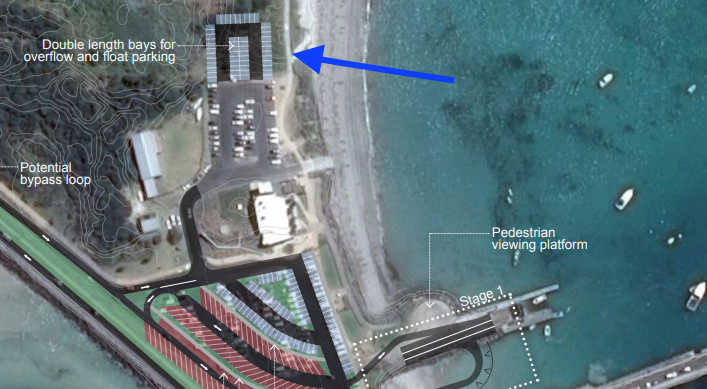
The carpark is being funded as a priority under the Warrnambool Harbour Masterplan and will be used exclusively by the racing club in the mornings.
“The car park would be available for horse-on-beach activities during morning periods and would be the area designated for that use,” says council spokesman Nick Higgins.
“It is this aspect that has triggered their (WRC’s financial) contribution.”
As to how long this agreement is for and what else will be funded in the future, that is all still under negotiation as part of the bigger plan to have racehorses training at Lady Bay and Levy’s Beach.
Which comes back around to the question: do we want our public beaches to become a permanent racehorse training facility?
We need to have this debate, because once the carpark is there, it isn’t moving.
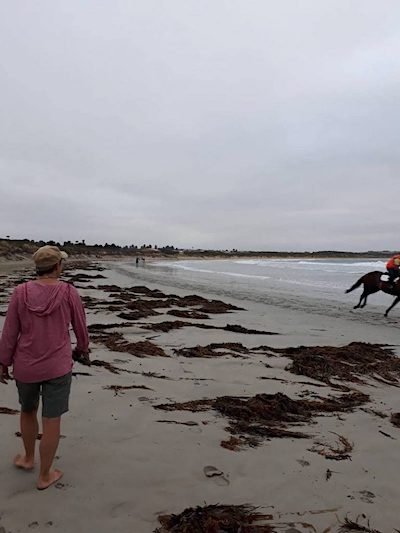
It is a question which troubles a lot of people.
This includes the people who want to support local trainers, or love racehorses, or love watching horses swimming at Lady Bay – or maybe all three – but don’t want to see Lady Bay, or Levy’s Beach, turned into an extension of the racecourse.
These people just want to be able to walk on the beach, at any time of day, without worrying.
And they do worry, because when you mix large numbers of highly-spirited racehorses with the public, dangerous things happen.
Like last Thursday, the day of the Grand Annual Steeplechase, when a skittish racehorse being led into the water broke away from its handler and bolted down the beach.
A member of the public walking his dog had the foresight to raise his arms high and managed to stop the horse from belting further toward the surf club.
A couple of weeks ago, a similar thing happened: a racehorse cut loose and took off across the carpark toward the breakwater.
No wonder those who walk along the beach in the morning, do so with eyes in the back of their heads.

As one woman who walks most mornings said to me today, she is astonished the horses are allowed to run the length of the beach, all the way to the surf club.
“On the days when there are no racehorses at Lady Bay, it is just so peaceful and I was amazed at how different it felt, psychologically, to not have to worry.”
This woman is among those who have felt genuinely nervous as a clutch of racehorses have galloped past – “like they are in a race”.
And yet this woman, like so many other beach users I have spoken to about this issue, feels torn.
She can see the beauty in horses swimming. She finds most of the riders friendly and has no problem with people enjoying horse racing as a sport, but racehorses taking over a public beach? That is a bridge too far.
“If I had a choice, though, I would rather see them stay at Lady Bay than go to Levy’s Point, because the environment out there is even more important,” she says.
So this is the terrible choice that we have been given: do you wish to sacrifice this beach or that beach?
I can’t disclose this woman’s name, but I can assure you – if it helps to underscore the point – that she is not a soy-latte-sipping-snowflake-leftie-rabid-vegan-terrorist-activist-greenie.
She is just an everyday Warrnamboolian, worried about what is happening to our beaches at a time when we need, more than ever, to be protecting our natural spaces.
She is not alone.
* If there was any doubt about the deal being done here, you can refer back to a report in the minutes of the 1 Oct 2018 council meeting on p330: “The process has also given Council the opportunity to negotiate a reduction in horse numbers on Lady Bay and to require the Warrnambool Racing Club (WRC) to make a funding contribution towards the construction of a new bespoke car park for horse training adjoining the existing car park at the Pavilion.”
If you would like to see The Terrier keep digging up, sniffing out and chewing on local issues, please consider throwing something in the tip jar.