Nuts: the W’bool City Council has sparked a near riot with its crazy plan to hit market stall holders with a new $600 a year fee.
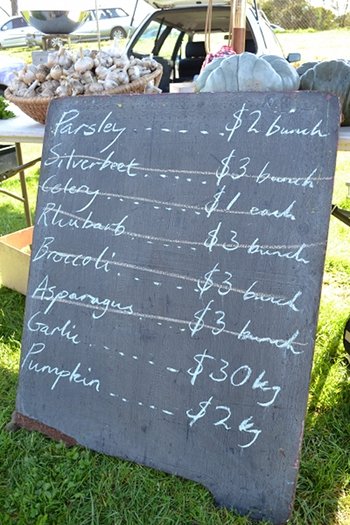
The fee is part of a new ‘itinerant traders’ policy that hits the soy candle sellers, fresh bread makers, vegie growers, jam makers, sock knitters and everybody else who makes Warrnambool come alive through the market scene.
Anyone who has ever done a market stall knows it is incredibly hard yakka with an uncertain return, depending on the day. These hard working, early rising, earthy, organic, wonderful folks are not a threat to Warrnambool’s retail scene for god’s sake – they add to it!
They now face paying $600 a year, $350 for six months or a hefty $125 for just 48 hours.
Not only will the new policy, as it stands, hit individual stall holders, the person running the market must pay a $1500 fee.
The council says it is trying to create a level playing field for permanent traders. What a load of cods. These traders aren’t worried about the rhubarb chutney sellers, they want timed free parking in parts of the CBD. If the WCC wants to help permanent traders, it should act immediately on the trader petition signed by almost 3000 people, asking for this very thing.
Honestly, who comes up with these ideas? We could, of course, just wave all visitors straight through to Port Fairy, where the market culture is huge.
WCC also says it is bringing W’bool in line with other councils, but this is not correct. Other councils, like Glenelg and Moyne, have itinerant trader fees, but they don’t apply to market stall holders who are part of a single event on council land, ie. the equivalent of our Lake Pertobe, or the Civic Green.
I have been inundated by market stall holders absolutely stunned by this attempt to whack them on the head.
All of them helped to bring our foreshore alive over the summer and hopefully made a few dollars in the process – good on them – and this is the charming thankyou note from our council.
If you would like to support our market folk, drop Mayor Tony Herbert a line at therbert@warrnambool.vic.gov.au and tell him what you think of this idea, or you can respond to the council survey on its website: http://www.yoursaywarrnambool.com.au/draft-itinerant-tradin…
The former Sam’s Warehouse store at Bayside Plaza is one of many shops lying empty in Warrnambool’s CBD and beyond, reflecting the steady decline in business confidence.
OPINION
[dropcap style=”font-size: 60px; color:#A02F2F;”] Q [/dropcap]uite a bit has been written about the latest Warrnambool Business Confidence Survey that tests the pulse of local businesses, but nobody has been prepared to say that it reflects a city in deepening trouble.
The spin put on the 2014 results by the Warrnambool City Council is that business confidence has “stabilised”, in that the steady decline since 2011 has levelled out and while things are not good, at least they are no worse than last year.
And while nobody wants to be the bearer of bad news, this is a bit like saying that the Titanic is still sinking, but it’s going down more slowly.
Statistics are hard to make sexy, but the number crunchers at Deakin University who analysed the results of the 344 respondents don’t mince words.
They found what they call “a highly statistically significant difference” between how Warrnambool businesses feel about the future compared to those in other Victorian regional cities like Ballarat, Bendigo and Geelong.
The difference was this: in 2011, 63% of local businesses felt they were either faring ‘good’ or ‘excellent’ compared to other cities, but in 2014 only 49% felt this way, which was a further slide from 55% in 2013 and 58% in 2012.
The researchers consider this “a continual and significant decline” but us lesser mortals might just call it terrible.
The latest business survey reflects a lack of confidence in Warrnambool’s outlook compared to other regional cities.
[dropcap style=”font-size: 60px; color: #A02F2F;”] A [/dropcap]t the same time, in 2011 only 11% of businesses described their future as looking fair or poor. This year, that figure has almost doubled to 21%.
Again, this is not good news.
The survey also revealed “a significantly worsening trend” when it came to business owners looking at opportunities for further investment in their business in the next 12 months. More than half (51%) said that their prospects were low to very low.
Then there was the sobering response to this very simple question:
“What is your confidence in Warrnambool’s business environment over the next twelve months?”
In 2011, 43% of people said high to very high. This year, that number had almost halved to only 24% and another 26% said “low to very low”, with the rest feeling pretty average.
Is this what we aspire to for our beautiful city? To have business confidence levels that are low to very low, or average?
Sails flapping in the wind: the struggling Bayview Plaza reflects a much larger problem facing the city.
[dropcap style=”font-size: 60px; color: #A02F2F;”] T [/dropcap]he sense of melancholy is not just confined to retailers – the business professional and commercial services industry is as equally distressed.
In 2011, a cheerful 77% of people working in this field felt either “good” or “excellent” compared to their regional counterparts, but this has since tumbled to just below 50%.
But even they look upbeat compared to the service, electricity, gas, construction and wholesale sector. Again, in 2011, a healthy 71% of respondents said they felt “good” or “excellent” – today that has plummeted to only 30%.
All of these figures might be interpreted by spin doctors as signs of “stability”, but they can be more truthfully described as pretty shocking.
And this is where we get to the troublesome part, because when the council refuses to name up the reality of the sentiment out there in the wider businesses community – as revealed by their own surveys – then nothing is done to confront it and change it.
Instead, the issue is reduced to fact sheets and media releases that tell us things are “stable” and we all breathe a sigh of relief and move on, because to point out the problems leaves you exposed to claims of being negative, or “only making it worse”.
Yet none of us can avoid the obvious signs of decline: like the ‘for lease’ signs all over town, the loss of locally owned businesses that have been around for decades, the vacuous arcades that cannot be filled, the depressing state of Bayside Plaza with its vandalised toilets, and its torn shade sails flapping in the wind over Merri St.
[dropcap style=”font-size: 60px; color: #A02F2F;”] W [/dropcap]hat is needed is not a head in the sand approach, hoping things might just right themselves, but a wide-ranging, open, community discussion on what is not working, why and how we can all work to improve it.
It is not as simple, unfortunately, as whacking traders with a new promotional levy or sprucing up two blocks of Liebig St.
While the Liebig St upgrade is a welcome rejuvenation of at least one part of the main street, it is a little like reupholstering the lounge chairs on the Titanic.
The harder questions to ask and to answer are those like these:
* what sort of retail mix do we want in the CBD and how can we encourage this mix?
* are commercial rents too high compared to other regions?
* what can be done to assist more small business start-ups?
* would more people shop in the CBD if there was free, timed parking?
* do the almost-empty arcades need to be remodelled or removed?
* how can local businesses be assisted to sell online? (Only 46% do and this has not changed in four years.)
I would like to see the council host a Warrnambool 2020 forum where we map out, as a community, a vision for our CBD by 2020 and how we can all work together (business operators, landlords, the council, thinkers, artists) to start turning the boat around before even more passengers jump ship.
[button link=”http://the-terrier.com.au/subscribe-2/” type=”icon” icon=”heart” newwindow=”yes”]If you would like early access to Opinion pieces, please subscribe to Bluestone.[/button]
An attempt to unite Warrnambool traders through a new marketing levy has run off the rails: perhaps it is time to start fresh?
OPINION:
[dropcap style=”color: #a02f2f;”] A [/dropcap] ballot will soon be held on whether Warrnambool traders should pay a special levy to fund a $600,000 marketing plan by Commerce Warrnambool, but the main game – to unite the traders as one – has already been lost.
Traders for and against the annual levy are deep in their trenches and, no matter how the ballot falls, there will be bitterness on at least one side.
Even the ballot process itself is fundamentally negative: rather than relying on enough traders to vote for the levy, it will go ahead unless enough traders vote against it. Hence there is now a very active and growing grassroots campaign by the Warrnambool Traders Action Group asking traders to be sure they object.
Given this no-win situation, I would suggest it is time to scrap the levy idea and start over.
It is three weeks since Bluestone Magazineexposed the full extent of the plan by Commerce Warrnambool (a chamber of commerce) to ask the Warrnambool City Council to attach a levy to 1346 commercial and industrial properties based on their capital improved value.
The levy, which would rise by 5 per cent each year for the next five years, would fund Commerce Warrnambool to operate as a major promotional and marketing body for the city.
Of the $600,000 to be raised, around $200,000 will be used for administrative and professional development costs, $100,000 will go toward an annual infrastructure project, and the remainder will be used for a range of promotional and marketing activities.
Regardless of its intent, however, the roll-out of the levy plan has so far been a dismal failure.
The slogan produced by the Warrnambool Traders Action Group.
[dropcap style=”color: #a02f2f;”] D [/dropcap]espite Commerce Warrnambool saying it had contacted hundreds of people about the idea, a large number of traders, including several high-profile businesses, said they knew nothing about it until they read it in Bluestone, onFacebook, or after it was tabled as a fait accompli at the May 19 council meeting.
These traders fall into two broad camps:
i) those who object to paying any more than what they already do in council rates and various tourism levies;
Last week, the city of Geelong was held up as an example of how a trader levy for marketing and promotion can work very well, but the Geelong model is run completely differently to that being proposed for Warrnambool.
The City of Geelong has operated a trader levy since 2001, but it is a very different model to that proposed for Warrnambool. Image: www.g21.com.au
[dropcap style=”color: #a02f2f;”] I [/dropcap]n taking a closer look at Geelong, there is a template for how things could work here.
First, the Geelong Chamber of Commerce has nothing to do with the special levy: it does not collect it, spend it, administer it or receive a cent from it.
Instead, the Geelong Chamber of Commerce – which has been running for about 160 years – is an independent body funded through memberships, corporate partners and fundraising events and does all of the things that a business group aims to do, such as networking and lobbying.
Second, the Central Geelong marketing levy, as it is called, is collected by the City of Geelong Council and is administered by a special committee set up within the council.
The Central Geelong Marketing Committee is made up of 12 volunteer representatives from local businesses and sectors, plus one councillor, and supported by a four-person executive team that is employed by the council, including CEO Jodie Reyntjes. (You can read more here).
The committee manages a levy that in 2012-13 raised $671,000 and the process appears entirely transparent and fully accountable: they hold monthly public meetings, upload their monthly minutes and produce an annual report.
Indeed, in 2009, Ms Reyntjes wrote an interesting presentation that underscored the importance of being able to measure the success of the levy in real and meaningful ways: right down to counting the number of pedestrians in the city on a given day.
Such an approach avoids unnecessary duplication of staff and projects, and sits the levy within an established civic framework rather than trying to replicate this framework outside the council and from the ground up.
The Central Geelong levy has been running since 2001 – although not without its detractors – but its ongoing survival and successes indicates that it is doing something right.
Could we learn something from our coastal cousins?
[The promotional video above was made by the Warrnambool City Council in 2011. It reflects the type of work that Commerce Warrnambool now wants to be paid to do.]
OPINION
[dropcap style=”color:#A02F2F;”] S [/dropcap]hortly after we started Bluestone Magazine last year, I wrote a piece about the importance of transparency, accountability and a preparedness to ask the hard questions of those tasked with running our city.
At that time, I lamented the fact that people who were prepared to put their head above the sand dunes and ask the prickly questions were often howled down as being trouble makers, out-of-touch, or holding the city back.
Judging by the response to the Warrnambool traders who have stood up and challenged a proposal to hit them with a new levy, little has changed.
The men in suits have again rallied to remind the rest of us of who they think should run this city and that we best shut up and let them get on with it.
That has certainly been the tenor of the argument as to why Commerce Warrnambool, a volunteer body of around only 100 members, should be allowed, via the Warrnambool City Council, to whack every trader with a special fee to raise $600,000 for promotions and marketing.
The proposed fee, which is based on property values, would run for five years and increase by 5 per cent each year.
Traders have every right to ask questions – and lots of them – especially when the finer details about this levy have been so vague.
Most traders are more concerned about the high overheads of doing business, not adding to those expenses.
[dropcap style=”color:#A02F2F;”] A [/dropcap]s was revealed when we first wrote about this issue last week, numerous traders, including several high-profile business operators, said they knew nothing about the levy until it was presented to council as a virtual fait accompli.
Instead of questions being asked of Commerce Warrnambool as to why its communications strategy had obviously fallen short, the guns were turned on the traders.
In its editorial on Friday, the local newspaper spoke of the perils of conservatism, of traders ‘tying themselves in knots’ and failing to embrace change, and that, as a city, Warrnambool really needed to grow up. (As an aside, the paper has failed, thus far, to mention that its General Manager, Tim Lewis, is a general board member of Commerce Warrnambool. Update: a new board has since been elected and no longer includes Mr Lewis. He does, however, remain a member of the organisation.)
These traders are the same people who have busted their guts renovating the often rundown CBD properties that they are forced to rent at prices which can be on par with those charged in suburban Melbourne. (Indeed I know of one hairdressing salon that floods each time it rains, but the property owner refuses to upgrade the plumbing.)
These traders have stripped back floors, painted walls, installed tearooms, hired staff, filled out myriad paperwork for everything from an A-frame to window signage and now, for their sins, they work long and exhausting hours in the belief that they have something to offer Warrnambool: and they do.
But apparently they could do being doing even better, if only they each paid another tax.
The Wonderful Warrnambool campaign is among those already funded by the WCC. Image: Warrnambool City Council.
[dropcap style=”color: #A02F2F;”] S [/dropcap]o let’s look at how this $600,000 would be used and how many innovative ideas it might fund.
According to Commerce Warrnambool documents, it is broken down into something like this:
$150,000 for an executive officer and associated costs
$110,000 for “branding” of Commerce Warrnambool and a website
$130,000 for local promotional events – from speedway, to whales, to Christmas decorations
$100,000 for an annual infrastructure project of some description.
(plus, although it is not specifically mentioned, an extra $15,000 for WCC to handle the levy)
Using these figures, just over a third of the levy – $230,000 – will be spent each year on local promotions and physical works. So far, I can see little difference from what is already being done via the WCC, the Great South Coast Group and the Great Ocean Road Regional Tourism Board.
No wonder traders want to ask a lot more questions and three that come to the top of my mind immediately, are:
i. who will decide how the money is spent?
ii. what are their qualifications or experience to do so?
iii. how will the success of the projects be measured and by whom?
Commerce Warrnambool (and some councillors) have pointed to Swan Hill as a shining example of how the levy can work, so let’s have a closer look at that.
The city of Swan Hill is being used as an example of how the levy can work, but it has not been all smooth sailing.
[dropcap style=”color: #A02F2F;”] P [/dropcap]eter McNabb and Associates, who were paid a large chunk of the $35,000 in public funds that Commerce Warrnambool received last year, developed the Swan Hill levy model, so it mirrors what is planned for Warrnambool.
The levy has been in place in Swan Hill since 2002 to support a group called Swan Hill Inc, but that doesn’t mean it is popular.
The council received more than 380 written submissions, including 318 from people directly affected by the impost. Of the 318, 177 people (24%) supported it, and 141 (19%) didn’t – hardly an overwhelming endorsement.
The council went ahead with the levy, but not without its internal critics, such as Cr Gary Norton who was quoted by the local paper as saying:
“Swan Hill Inc has been operating for 10 or 12 years and what have they achieved? Lots of shops and businesses? Lots of empty shops?”
Cr Norton said Swan Hill Inc had not been effective enough in what he believed was a difficult financial climate for local business in Swan Hill.
“If we’re going to attract new businesses we need to reduce our overheads,” he said.
“High rates are killing the region. I urge council to squash this.”
You could swap the words Swan Hill for Warrnambool and the sentiment, for some, would be the same as Cr Norton’s.
So here’s an idea: why not tax the property owners, rather than traders who are being charged a levy based on a property value for a building that – in most cases – they don’t even own?
Then we might get a sense of how popular this idea really is among those with power.
[button link=”http://the-terrier.com.au/subscribe-2/” type=”icon” icon=”heart” newwindow=”yes”] Did you enjoy this story? Please subscribe here to help Bluestone thrive.[/button]


 You can find earlier Opinion pieces here…


 More Opinion pieces…

