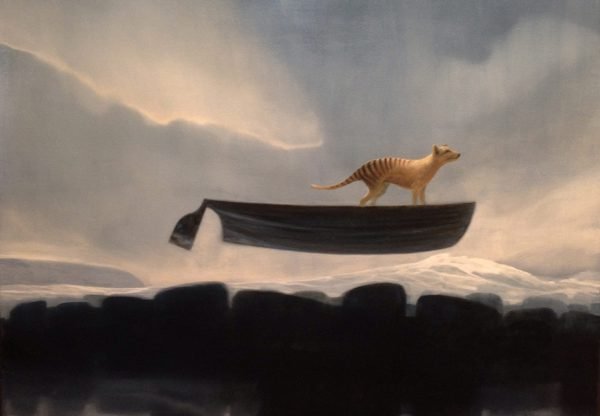
Original painting, oil on canvas, Graeme Altmann. (Altmann Studios, Highett, Melbourne.)
Carol Altmann – The Terrier
On days like this, we need hope.
On days like today, when we see laws passed that allow even greater damage to our wild coast than what we have already inflicted, it would be so easy to just give up, because the battle is exhausting.
But on days like today, when I need to draw deep on hope, I think of my late uncle Alf Altmann.
In March 1970, almost 50 years ago, Alf attempted to become the first person to row solo across Bass Strait, from Tasmania to Victoria, in a home-built kayak.
He built that kayak piece-by-piece in his garage under his home on Riverview Tce, here in Warrnambool.
To train for this epic journey of more than 200km, he would row out to Deen Maar, (Lady Julia Percy Island) and, once or twice, he carried native saplings in his boat to plant on the barren island.
The saplings never survived. Neither did my uncle. His attempt to cross Bass Strait ended just 1.5 miles from the Victorian coast. So near. So close.
And when I think of his story, I think of an anecdote that stays with me each day as I do my bit to try and turn around decisions that hurt our local environment more than protect it.
“Why do you bother taking those saplings with you?” someone asked Alf. “Nobody will see them out there.”
“I see them,” Alf replied. “I know they are there, and that is all that matters.”
This painting is how my artist brother, Graeme Altmann, often captures the essence of Alf’s journey: a boat, suspended above the turbulent sea, with the proud thylacine pointing toward an unknown future.
We can’t change the mistakes of the past. Alf never came home. The thylacine is gone. But I keep trying to do what I can, whatever I can, to turn other mistakes around.
Because we know. And we see. And that is what matters.
Revealing the eye of the tiger: Peter Clayfield
Photographer – and collector – Peter Clayfield in his mini musuem of a lounge room: “I have always been what you might call acquisitive”.
[dropcap style=”color: #a5cecd;”] P[/dropcap]hotographer Peter Clayfield lives on the edge of a cliff which, on a clear day, has the sort of view that stretches all the way to Tasmania – well, almost.
The invisible thread that connects his home overlooking the Southern Ocean to the rugged coastline of north-west Tasmania is symbolic, as Peter has a self-confessed obsession with the thylacine (Tasmanian tiger) and has devoted a large part of his life to collecting imagery of the animal.
“It started when I was about 15 and my parents bought me a book about the thylacine and from that point I was hooked,” he says.
Peter now owns more than a dozen books on the subject and, perhaps more importantly, a couple of hundred pieces of thylacine imagery including lithographs, 19th Century etchings, hand-coloured engravings, antique prints and more modern incarnations that he has collected from around the world.
“The thylacine is a very potent symbol of the environmental movement and this is part of its appeal to me, that symbolism,” he explains.
The poster to be used for Peter’s collection of thylacine material that will be exhibited at the Warrnambool Art Gallery later this month.
[dropcap style=”color: #a5cecd;”] A[/dropcap] substantial chunk of Peter’s collection is now with the Warrnambool Art Gallery in preparation for his exhibition that opens on July 25 and will run concurrently with the Glenn Morgan retrospective.
“Recapturing the tiger: a personal collection of thylacine imagery from past and present” is a departure from what most people have come to expect from Peter’s exhibitions, which normally showcase his exquisite photography.
An alumni of the now defunct Warrnambool Institute/Deakin University Diploma of Visual Art, Peter has exhibited over the past 30 years in just about every gallery in Warrnambool – past and present – and is known for his ability to transform every day urban landscapes, people and objects.
“Those art classes in the 80s opened up a new world to me about the possibilities with photography, especially by being exposed to the great photographers and artists in the US and Europe,” he explains.
Peter recalls, in particular, how the head photography lecturer Ian Cosier would stock the campus library with books by photographers that came to be major influences on his work, including Diane Arbus, Henri Cartier Bresson and the wonderfully named Ralph Eugene Meatyard.
Peter’s photography is known for capturing the unusual in the usual, like these topiaries draped in protective netting.
[dropcap style=”color: #a5cecd;”] P[/dropcap]eter now has a collection of books by these same artists, among many others, that line the walls of his cosy lounge-room which is, in itself, a work of art because of the many rare and beautiful objects that he has accumulated. Thylacines are only a part of it.
“I have always been what you might call acquisitive,” he says with a soft laugh.
It is difficult to describe the scope and diversity of what has caught Peter’s eye over the years, but imagine squashing the Smithsonian Institute into a small cottage and you are getting close.
Among his eclectic tastes are tribal masks and carvings, delicate silver spoons, palm-sized ceramic bowls, select pieces of Australian pottery, charms, chimes and dozens of animal and religious bells that create the most wonderful sounds.
Peter’s house on the edge of the world where, on a good day, you can almost spot Tasmania.
[dropcap style=”color: #a5cecd;”] T[/dropcap]he complete Peter Clayfield Collection may well be an exhibition of the future, and deservedly so, but for the moment the spotlight will remain on the thylacine which, some believe, still exists in parts of north-west Tasmania.
Does Peter?
He pauses to consider his answer.
“Definitely in the 60s and 70s, yes, but those areas in which it was living have since been heavily logged,” he says.
“I guess I have a faint hope that it might still be surviving in those very remote areas, but it is only a faint hope.”
[box] Recapturing the tiger will be officially opened at the W’bool Art Gallery on July 25 by Dr Carol Freeman, author of Paper Tiger: a visual history of the thylacine.[/box]
[button link=”http://the-terrier.com.au/subscribe-2/” type=”icon” icon=”heart” newwindow=”yes”] Did you enjoy this story? Please subscribe here to help Bluestone thrive.[/button]


 You might also enjoy…