Setting sail on the good ship Terrier in 2021
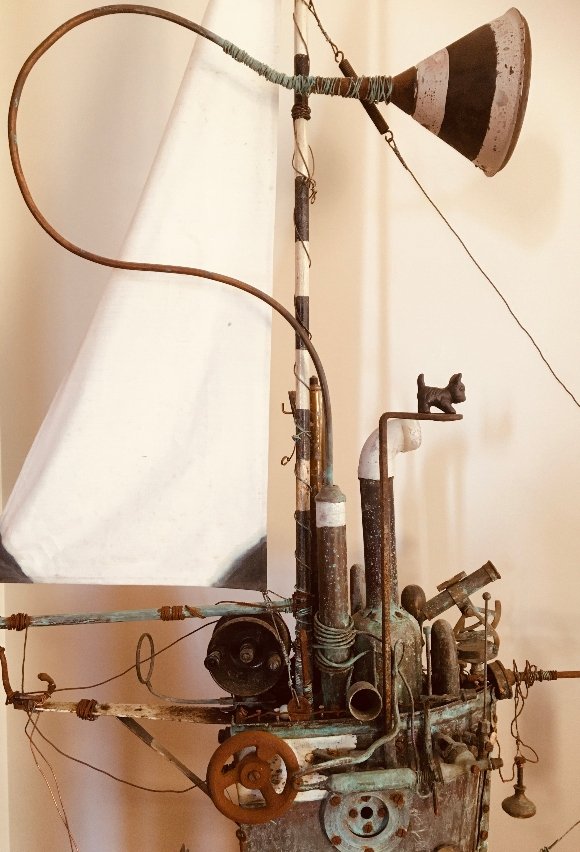
2021 will be a year of both diving deep into ongoing projects and setting sail into new ones – junk boat by Graeme Altmann; Terrier from a friend.

Carol Altmann – The Terrier

Ahoy there from the good ship Terrier and a Happy New Year + 17 days!

What lies ahead for The Terrier in 2021? New voices, a new project and tackling unfinished business.

I spent the summer break recovering from last year, which was exhausting and exacting and yet full of so much change, and also thinking a lot about this year.

After much thinking and sleeping and walking and talking and more thinking, I am ready for a year of diving deep into unfinished business and setting sail into new waters.

There are a couple of important stories that remain unfinished for me.

These stories take time, often a very long time, and I never know for sure where they might end, but I always know when I have reached the end, and I am not there yet.

There is also unfinished council business from last year, including the sacking of former Warrnambool City Council chief Peter Schneider, which goes before the Supreme Court on 1 February to determine if he was denied natural justice and should be reinstated.

Running alongside this is the Local Government Inspectorate investigation into the acting WCC CEO Vicki King being re-hired – by delegation – for another five years to her old job.

The outcome of both cases has the potential to change the face of the new council, and will tie off – one way or the other – the shadow that has lingered over 25 Liebig St since July last year when Mr Schneider was given the boot.

I plan to share other voices, including that of Jim Burke, who many of you will remember ran in the WCC election. Jim is a long-time council watcher and a guy with an overflowing bookshelf and a brain to match.

Jim will continue to write on his own Facebook page about council issues and analyse what it all means for Warrnambool with the intelligence and insight that comes from watching every  council meeting, and poring over the hundreds of pages of documents that lie behind every worthwhile story.

I am rapt that Jim has agreed to let me share his work as the new council is given a chance to settle and find its feet.

There are other writers I also hope to bring into the fold to help me tackle other unfinished business, such as the $40 million Wannon Water treatment plant upgrade near Thunder Point which has been on pause since the EPA responded to public concerns and demanded a raft of extra information.

I hope in 2021 that The Terrier can be a platform for many voices, not just my own, as we continue to dig into the issues and ask the hard questions and keep pressing for answers.

I also have a new project, which is actually a project I have been quietly working on for years, but this year it will finally come to the surface – the restoration of Alf Altmann’s kayak and my revisiting his journey for a book that I have been wanting to write for at least a decade.

Alf was my uncle who, in 1970, attempted to be the first person to row solo from Tasmania to Victoria in a kayak he built by hand here in Warrnambool. He nearly made it, drowning just 1.5 miles offshore from the Gippsland Lakes.

I now have his kayak and this year it will be restored by boatbuilder Garry Stewart in Port Fairy and, thanks to Dean Montgomery, will eventually be displayed in the Warrnambool Motor Museum at the former Fletcher Jones factory.

So this year I will also be spending some time in Tasmania, building and writing a story that is worth telling.

My younger brother and artist, Graeme Altmann, has donated one of his incredible “steam punk junk ships” (pictured above) to help me raise funds for the restoration which I will be documenting here. You will have a chance to own this gorgeous boat and be a part of this story.

Welcome to Terrier 2021.

It is so great to have you on board.



Jess Chatfield: fighting for Framlingham forest

The Terrier – Carol Altmann

Young Gunditjmara woman Jess Chatfield speaks from the heart about her fight to save Framlingham forest and the Hopkins River from a bluestone quarry that is proposed for land nearby.

This 8min work was created by Jess under the guidance of Warrnambool’s best digital storyteller, Colleen Hughson, who is an extraordinary teacher.

This digital storytelling mentorship was funded by the Judith Neilson Institute for Journalism and Ideas, who generously supported an idea put forward by The Terrier and which has now come to life.

Jess is a natural storyteller and it has been a privilege to be a part of this mentorship and to learn so much from Jess and her family along the way. I am going to miss our Fridays, but this will not be the last you hear from Jess, I just know it.


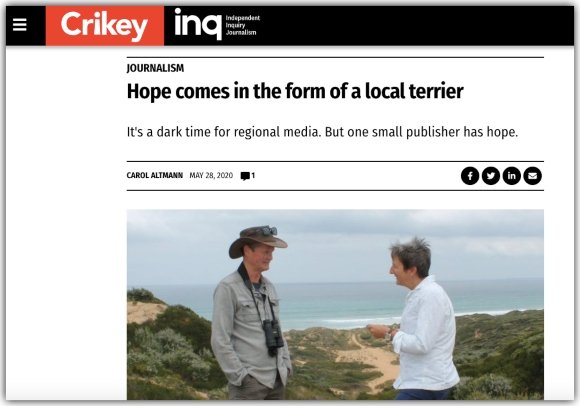
Crikey! The Terrier springs forth as the paper giants fold

A screenshot from today’s edition of Crikey following the announcement that News Ltd will cut hundreds of jobs from regional newsrooms.

Carol Altmann – The Terrier

[The following piece first appeared in Crikey (www.crikey.com.au) on 28 May 2020. If you are not already a subscriber to Crikey, please give its 21-day free trial a go. Crikey is 20 years young and still a trailblazer in quality, online journalism.]

If the arrival of the internet left regional newspapers staggering and dazed, it will be the fallout from COVID-19 that could finally kill them — after what has already been a long, slow death by a thousand cuts.

And yet there is hope for maintaining a media voice in our country towns and I am proof of that hope.

I returned to my home town of Warrnambool, in south-west Victoria, and started what has since morphed into The Terrier, a wholly online, extremely nimble, one-person operation that I run from the front room of my house.

I use a website and social media to reach my readers, who have grown from a few hundred to more than 4500 followers in a city of 35,000 people, and seen The Terrier move from the periphery to become an influential voice in the community.

The secret to the growing success of The Terrier has been to keep my overheads extremely low and my connection with the readers extremely high.

In so doing, I have had to throw out a lot of my old concepts of what journalism must be and adapt to what the reader now wants it to be, which is to not only tell them what is happening, but why and what — if necessary — we can do about it.

This doesn’t mean throwing out all of the essential skills of journalism — fact gathering, research, interviews, composing well-written pieces without spelling mistakes. What it does mean is no longer being afraid to advocate, or take a side, or express a point of view.

I found this uncomfortable at first, but I have since come to learn that my readers don’t want me to simply repeat what their friends have already “reported” to them on social media about a car accident in the main street; they want me to dig deeper into the power structures of their home town and to be their eyes and ears. To be, in other words, their terrier.

At the same time, I invite the reader in to be part of the chase.

They report to me on what they have found, read, heard and investigated themselves, so that I have not one terrier on the case, but many, with me the ultimate fact checker. We are doing a great job.

In fact two of the biggest stories to come out of Warrnambool in the past 12 months were both products of The Terrier, with one now the subject of an ombudsman’s investigation.

But how do you make any money, I hear you ask? I rely on contributions from readers through my tip jar which has also been gathering strength, but I know such a model needs more than tips to be viable in the longer term.

To me, a combination of dramatically reducing overheads, reader support, government support, tax deductibility and philanthropy holds the key to financial viability.

Resource sharing and collaborations are another critical step that we are yet to take, with old journalistic rivalries given priority over the needs of the readers we purport to serve.

What I have found most interesting through the whole journey of The Terrier, is that the reader doesn’t want more bells and whistles from me in what is already a noisy world.

I don’t use video, I am pondering a podcast, and I don’t even have a regular publishing schedule beyond a loose “two or three times a week”.

The key is that I keep it simple and it works.

This is where regional journalism can go and indeed must go if it’s to survive, and I am loving being a part of it.

Carol Altmann is a journalist and the publisher of The Terrier.


Historic trees could have been saved

Opinion/Analysis by Carol Altmann

[dropcap style=”font-size: 35px; color: #8cc7d0;”] D [/dropcap]o you remember the two giant Norfolk pines that were cut down at the Warrnambool Police Station late last year?

I do, because I couldn’t believe the Warrnambool City Council didn’t try harder to save them – but, as I have since learned, they actually ignored their own advice to let the chainsaws in.

Here is a photo of what we are talking about, taken after the limbs were cut off in preparation for their full removal last August:

The two mature Norfolk pines being prepared for removal in August 2016.

These weren’t just any old trees.

The pair had historical links to the beautiful Church of England property next door (built in 1855) and were considered so important by the council that they were specifically mentioned in the planning permit issued in 1996 for the new Warrnambool Police Station in Koroit St.

In particular, the trees were not to be “removed, destroyed or lopped” without written consent from the council.

The new station opened in 1999 but, it appears, had immediate problems with drainage and flooding which to me says more about a poor build in the first place rather than the position of the two trees.

In 2005, a member of Victoria Police – I don’t know who, because names have been redacted from the Freedom of Information documents I received from the council – sent the council an email, saying the pine trees were continuing to cause water damage to the new building and needed to go.

“All advice we have and our own observations tell us that out problems will continue whilst the trees remain in place. I seek approval to remove both of them forthwith,” he/she wrote.

Two weeks later in November 2005, a council officer wrote a detailed response on behalf of the council’s Built Environment Committee.

The most important paragraph of that letter is this:

“…the trees have a positive contribution to the streetscape, have demonstrated historical links with the church property next door, clearly the intention of the endorsed plans is to retain the trees and therefore the removal of the trees should only be considered as a last resort.” (my emphasis)

Crucially, the council also recommended the police obtain a Structural Engineer’s report on what could be done to either the building (eg. adding more gutters) or to the trees (eg. root barriers) to fix the problem.

The council even offered the police a free arborist service and access to its Heritage Advisor.

But neither happened. In fact, nothing happened.

Fast forward five years to 2010 and the police wrote to the council again and – again – asked how it could get rid of the trees.

This time, however, there was no detailed response, but a six-line letter from a different council officer to that who responded in 2005.

And this time, the historic trees were suddenly considered dispensable because they might – might – cause problems.

“Given the retention of the trees is likely to be problematic, Council does not object to their removal,” he/she wrote. (My emphasis).

It is hard to get a sense of the size of the remaining tree stumps, but you could stand on them and stretch out your arms and your fingertips. I hope that helps.

I am not sure when a written permit expires, but it took a further six years before it was used to cut down two Norfolk pines that were apparently causing so much trouble.

No wonder so many people were shocked – at no time has there been any public information or discussion about the trees, despite their significance.

Instead, a six-year-old permit, issued behind closed doors and by a different group of councillors (if they knew about it at all), was enough.

I have tried to talk to the police about why they removed the trees now, more than 10 years after they were considered a dire problem. They didn’t respond.

As such, I am unable to confirm one story doing the rounds that the space will be used for extra car parking.

Surely not.

Now some of you will be shrugging your shoulders and saying, oh, they were just trees, but to me this sequence of events reveals so much about the weakness of our planning laws, the way decisions are made in private and then how they are pitched to the public.

As custodians of our natural and built heritage, we can surely do better than this.

[box]You can see all of the Freedom of Information documents relating to this story here and here.[/box]

This is the first of three Terrier pieces that will be free to access. If you would like continued access, please become a paying supporter by clicking the box below.

Donate