Oh what a tangled web we weave in Warrnambool
Carol Altmann – The Terrier

Tight knit: I had plans to write today about the W’bool City Council election campaign being in full swing – it started with the knifing of the CEO and has gathered full strength now that Cr Mike “The Real Chief” Neoh starts popping up in the paper with all manner of either un-costed, outlandish or recycled ideas from years ago…..BUT…..

BUT this is too good not to share.

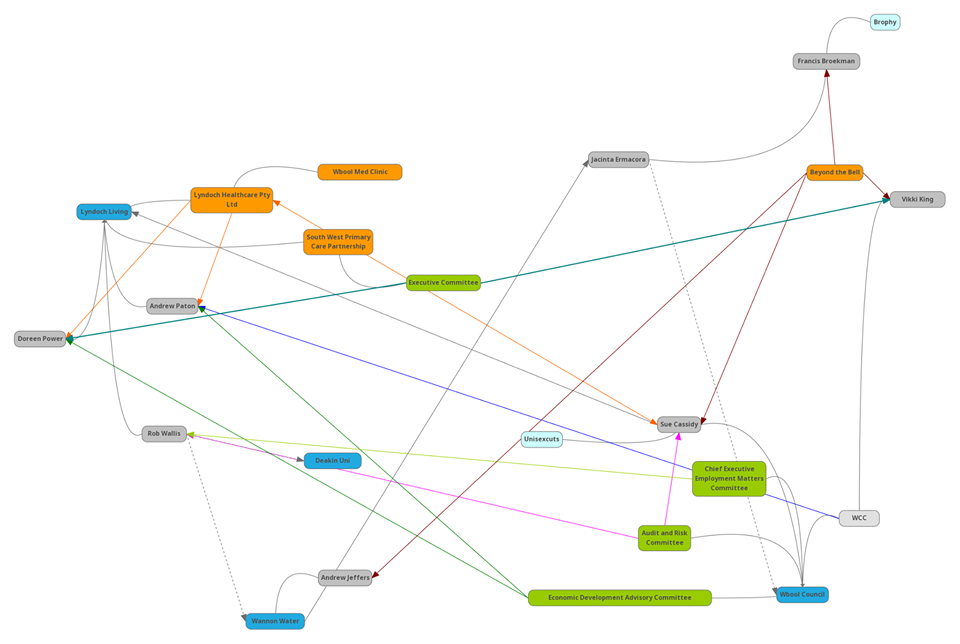
It’s a visual map put together by a reader showing a tiny corner of the spider web that operates in Warrnambool between our public boards, public institutions and authorities.

It’s the same map I sketched out in words last week on this page.

Wow! It looks like an FBI crime map, where the victim is Warrnambool, strangled by the thin, tight cord of mutually beneficial connections.

And this is only the merest skim across the surface of the ties between Lyndoch Living and WCC.

It doesn’t even touch on many of the most sought after boards and executive spots including the Warrnambool Racing Club, MPower, South-West TAFE, South West Healthcare, Wannon Water, Brophy, Regional Development Australia Barwon South West, Leadership Great South Coast, the Liberal Party, the Labor Party and all of the various partnerships, hook ups and cross fertilisation that happens behind the scenes.

Boiling steadily beneath the surface is a soup of new names and old, both well-known and less so, like Anson, McKenna, Philpott, Gaston, Ermacora, Rule, Waterhouse, Power, Nelson, Lane, Lee-Ack, Broekman, Cassidy, Boyle, Jeffers, Neoh, Wallis…around and around and around we go.

I will pluck out just one as an example: Steven Waterhouse. I don’t know Steven Waterhouse, but according to Linkedin he is General Manager at Wannon Water, Chair of South West TAFE, and Deputy Chair Warrnambool Racing Club. That’s a trifecta!

I am sure many regional cities could draw a similar map, but is it a good thing, or is it stifling? Is it mentoring, or is it controlling? Is it about maintaining power or sharing it?

All of these questions are swirling around my head as we prepare to vote for our next council.

This election, more than ever, is a chance for change at least within one public institution – a chance to break the mould. A fresh start, with fresh names, who you will come to know in coming weeks.


It is going to take a lot of hard work for these faces to bust through: to garner even a small corner of the thousands of dollars of free publicity that Cr Neoh, for example, has enjoyed for his recycled ideas, but I am hoping they can do it.

I don’t want someone on council who will have been there 20 years. That’s unhealthy in any democracy.

And I don’t want someone who is the puppet of someone else. That’s also unhealthy in any democracy.

If we want change, we are going to have work hard for it. I am ready and I hope you are too.


Young creatives: Bronwen Rose and ugly beauty

bronwen rose_12
Warrnambool artist Bronwen Rose in the TAFE studio: “I want my art to be unsettling and for people to talk about it; I want it to have an ugly beauty.” Image: Carol Altmann

By Carol Altmann

[dropcap style=”font-size: 60px; color: #DC943C;”]T[/dropcap]he greatest compliment you could pay young artist Bronwen Arnold, who works under the name Bronwen Rose, is that you find her work disturbing.

Because that is exactly what she wants it to be.

“I am fascinated by a world where everything is beautiful and everything hurts,” she says.

The 20-year-old, who was raised in Dunkeld but now lives in Warrnambool, believes that art should take the viewer out of their comfort zone by twisting the familiar with the unexpected. Hence most of her works, be they digital painting, traditional painting or sculpture, look appealing at first glance: but then reveal a darker side.

Doe-eyed, pixie-faced characters are missing limbs, or have been disembowelled. Eyes are bloodshot, teeth are crooked, skin is disfigured.

It doesn’t make for pretty work, but it is absolutely memorable in that it is confronting, yet clever.

“A lot of (artists) in Warrnambool are inspired by coastal scenes and while they are beautiful to look at, and you can say ‘that is nice’, that is the end of the conversation,” Bronwen explains.

“I want my art to be unsettling and for people to talk about it; I want it to have an ugly beauty.”

bunny boy (paolo) digital painting
Bunny Boy (Paolo), digital painting. Damaged and imperfect beauty is a recurring theme in Bronwen’s work. Image: Bronwen Arnold.

[dropcap style=”font-size: 60px; color: #DC943C;”]B[/dropcap]ronwen is in her second year of a Diploma of Visual Arts at South-West TAFE where her teachers include the wonderful Jeanie Gleeson whose work explores the boundaries between comfort and discomfort and what is regarded as “beautiful” art. (See our earlier story on Jeanie here).

Another influence – or even a hero – for Bronwen is contemporary artist Patricia Piccinini, whom she met while volunteering at the Warrnambool Art Gallery during Patricia’s recent exhibition that, despite its confronting themes, was among the gallery’s most popular.

“I love how people react to Patricia’s work. One of my jobs (as a volunteer) was to invite people to touch this little furry, strange critter (made by Patricia) that I was carrying around and most people refused to even touch it,” she laughs.

While Bronwen may sound like a dark thinker, she is in fact the opposite.

Her preference for wearing black, the striking arm tattoos on the soft underside of her forearm, and a 24mm gage tunnel in her ear (kind of like a sleeper on steroids) belie the fact she has an easy laugh, and the down-to-earth charm of a young woman who grew up in the country.

“My parents bought the Dunkeld Post Office which is, like, as old as old (it dates back to the 1850s), and I grew up there. Yep, in a post office,” she smiles.

With my little eye: Mixed Media Assemblage.
With my little eye, mixed media assemblage. Pieces of dolls house furniture and others created by hand contributed to this scene that looks both cute, yet chaotic. Image: Bronwen Arnold.

[dropcap style=”font-size: 60px; color: #DC943C;”]B[/dropcap]ronwen also admits that her favourite colour is not black or blue, but pink, rose pink.

“My bedroom looks like an explosion of grandma florals – pink everywhere – with my collection of teapots all around the place,” she shrugs.

This is not the space of a tortured soul, but someone who loves playing with the juxtapositions of life: the gaps between pretty and ugly; black and pink; teapots and tattoos.

Her next series of work will explore skin and its many variations. Bruises, birthmarks (Bronwen has one), discolourations, pigmentations, freckles, albinism and a condition called vitiligo, where patches of dark skin lose their pigment, will all come under scrutiny.

“I saw a woman once who had vitiligo, and she had the most chocolate, velvet skin with white patches. She was absolutely amazing, so beautiful. She looked absolutely beautiful,” Bronwen explains.

I wondered how many times that particular woman had been told, because of her imperfection, that she was “absolutely beautiful”?

And therein lies the secret to the work of Bronwen Rose.

Mica's Street (acrylic on canvas).
Mica’s Street (acrylic on canvas). Image: Bronwen Arnold.

[box]Bronwen is the recipient of the Lukasz Chomentowski sponsored studio space at The Artery, Warrnambool. She will be part of Arts on the Grass at the Fletcher Jones Garden Christmas Market, Sunday December 14, 11am-3pm and you can also view more of her work on the South West Arts Atlas.[/box]

[button link=”http://the-terrier.com.au/subscribe-2/” type=”icon” icon=”heart” newwindow=”yes”]Bluestone is aiming for 500 subscribers. If you enjoyed this story, please click here to become one![/button]

newsletter Why Not StonesYou might also enjoy…


Young creatives: The mythology of Alex Jones

Young creatives: Indigo Crabbmor a year on

New women’s art prize unveiled for IWD

Developing a passion for vintage cameras

Recycled timber shapes a new life: Sarah Carrucun


End of the line for fine art at Sherwood Park

rashleigh
Last man standing: Graphic design and illustration lecturer Mark Rashleigh is the only staff member remaining in the former School of Art and Design at Sherwood Park, Warrnambool. (Artwork: Untitled (landscape), Martin Jones).

[dropcap style=”font-size: 60px; color: #A5CECD;”] M [/dropcap]ark Rashleigh is the last man standing at what was once a flourishing School of Art and Design at Sherwood Park, Warrnambool, and, come mid next year, he too will be gone.

It is indicative of how much things have changed that Mark, a lecturer in graphic designer and illustration, now has an office in the Faculty of Business and Law at the Deakin University campus because the former visual arts studios are closed due to various structural concerns.

A similar, if metaphorical, corrosion has also claimed the art school that will officially end next year after starting life under the former Warrnambool Institute of Advanced Education in Timor St (now South-West TAFE) in the late ’60s, before relocating to the Sherwood Park campus in the 1980s. There, as a university degree, it became part of the Deakin merger.

“When I first started here, in 1985, there were about 13 staff teaching a very broad visual arts degree that included painting, sculpture, art history, photography, print making, graphic design and ceramics,” Mark, who will retire in June, said.

At that time, the teachers – most of whom were established artists – would mount joint exhibitions, maintaining a tradition that began when the school first started.

A document held by the National Libraries of Australia, for example, records some of the names in a joint staff/student exhibition held at the City of Hamilton Art Gallery in November 1970 and it reads as a virtual who’s who of the early South-West Victorian arts scene: Ken Daniel** (lecturer), Ron Quick (lecturer), Graeme Birt (lecturer), David Wormald, John Elphick, Jill Fitzgerald, Jennifer McConnell, Christine Taylor, Ken Saddler, John Rogers, Trevor Morrison, Peter Bond, Lilian Baxter, Alan Murdoch, Frank O’Brien, Chris Carroll, Gary Sparks, Judith Lovell, Gary Heath, Lorrain Callow, Michele Hill.


altmanngraeme
Beginnings; A teenage Graeme Altmann surrounded by some of his early paintings created in the former School of Art and Design studios at Sherwood Park. Photo: John (Jack) Wilkins.


[dropcap style=”font-size: 60px; color: #A5CECD;”] I [/dropcap]n its prime, the airy studio space at Sherwood Park was alive with the sound, movement and colour of artists in action and gave the campus its energetic heart, usually to the beat of a paint-splattered cassette player set up in a corner.

Students pursuing somewhat more subdued degrees in economics, marine biology or primary school teaching could wander over and see what the “hippies” of the campus were up to.

The halcyon days of the 70s, 80s and 90s, however, crashed into the economic rationalism of the 2000’s when university degrees around Australia were no longer about providing knowledge and skills, but also a financial return.

In this new climate, art schools were in a hopeless position.

And while Mark can’t speak about Deakin directly, he can reflect on the challenge facing all visual art degrees.

“A visual arts degree is a quasi-industrial process: they cost a lot to run. There is the high cost of the studio spaces, and the high cost of running courses for small groups of students, because that is how the learning happens, in small groups, not in a large lecture theatre,” he said.

Skilled staff who leave or retire are not replaced, and, suddenly, painting is no longer available, or sculpture, or perhaps print making, and the degree is reduced to a husk.


barbara fulton
Room to move: Artist Barbara Fulton with some of her large canvases in the painting studio in the 1980s. Image: John (Jack) Wilkins.


[dropcap style=”font-size: 60px; color: #A5CECD;”] A [/dropcap]t the same time, Australians love art: according to the ABS, more than a quarter of us visit a gallery or museum at least once a year.

“The returns on the investment in art schools and courses cannot be measured in dollars, but in what we get back – as a culture – from the artist,” Mark said.

Yet Mark remains optimistic. As he closes the door on his career, and that of the school, South-West TAFE is refocussing its visual arts courses at its new location in the Timor St complex.

The wheel has turned full circle.

“Art changes its address, but it’s not going away,” Mark said.

** Ken Daniel established the art school at WIAE in 1970. When the school amalgamated with Deakin University around 1985, he was appointed Dean of the fine arts across all Deakin campuses.

 Logo Smile newsletter If you enjoyed this story, you might enjoy:


Emerging artists make colourful impression

A spotlight on creators this Christmas

Hot glass melts hearts: Robert Gatt and Freya Marriott

Finding inspiration in the natural world: Jill Edwards

No time limit on this wearable art: Helen Bunyon

Immersed in Meg’s magic: Limestone Gallery, Port Fairy