Sweet potatoes: how Purcell pushed Britnell over the line
Carol Altmann – The Terrier

Ah, the sweet irony of politics. Independent candidate James Purcell, having tried his darnedest to edge Liberal Roma Britnell out of her seat, ended up being the one who kept her in it.

Remember a few weeks ago we talked about the importance of potatoes, aka preferences? (If you missed that explainer, you can find it here).

Having had a good close look at the numbers now that the state election result for the south-west has been finally declared, it all came down to James Purcell’s bag of potatoes as to whether Labor won, or Liberal.

It was that close.

To win, Roma Britnell needed every single potato/preference she could get her hands on.


Unlike in other years, the Liberals didn’t start with a huge truckload of first-preference votes: Labor’s Kylie Gaston started with 10,074 and Roma received 13,296. James Purcell was next in line with 6763.

In a big old blue-ribbon Liberal seat like the south-west, this is extraordinary and a sign of just how on-the-nose the Liberal Party is right now. (Keep it up, south-west! We have a federal election next year.)

As the distribution of the preferences began, it really was neck-and-neck the whole way between Kylie and Roma, as you can see by this image:
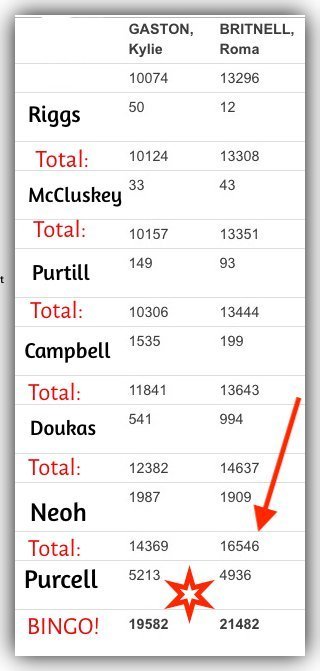
After the distribution of all the preferences from Terry Riggs (Socialist), Mike McCluskey (Independent), Joseph Purtill (DLP), Thomas Campbell (the Greens), Jim Doukas (Country Liberal Party) and even right down to Michael Neoh (Independent), the two main candidates were still only a couple of thousand votes apart.

All that remained to be distributed was James Purcell’s preferences.

Oh the tension, the drama! Which way would it go?

Would the south-west defy every single prediction before the poll and elect a new member?


Would we have an ALP local member for the first time in 2000 years? (I exaggerate, but you get the picture).

You can see by the numbers that, in the end, James’s preferences were split almost 50-50, but MORE went to Kylie than to Roma… just not quite enough to get her past Roma.

If another 1000 of Purcell’s potatoes had dropped into Kylie’s bag, she would now be sitting in Parliament House at the top of Spring St.


It was that close.

James did not quite do what he set out to do, which was to win the seat, but he achieved what we all hoped he would do, and that was to help make this seat marginal.

As predicted by the ABC’s number cruncher Antony Green on election night, the south-west is now on a margin of less than 4% at 3.8%. (Until November 24, it was on a margin of 11%).

What are we going to do with this gorgeous little margin next time around, in 2022?

Are we going to relax back into the easy chair and put all of our potatoes back into one big blue bag with “Liberal safe seat” written across the front?

Or are we going to push it even further and go for a real change?

We might never get the same chance for another 20 years.

One thing is for sure, there will be a swag of candidates all lining up to try and drag that margin back even further and I suspect James Purcell will be among them.



Ten local takeaways from the state election

Ten little local takeaways from the amazing state election, as of 9.30am this morning:

1. Roma Britnell’s primary vote has nose-dived from 15,486 to 12,240. Just by way of comparison, Dr Denis Napthine’s primary vote last time he ran was 23,234.

2. The ALP’s Kylie Gaston received 9250 primary votes There was a swing away from the ALP, but preferences from the independents flowed thick and fast to Kylie, which made this seat a very, very close race.

3. Independent James Purcell had an amazing result with 6387 primary votes. This put him well ahead of Independent Michael Neoh (3440) and Country Party Jim Doukas (3100) and the Greens Thomas Campbell (2231). 

4. The Liberals started on a very fat 11% margin in the south-west – that should be more than halved by the end of the count, making us marginal.

5. This election has not been kind to the Greens.

6. Preferences will see Liberal hold this seat, but not by nearly as much. A couple of thousand votes may be all that separates Roma from Kylie in the end.

7. The independents have shown that there is a mood for change in our neck of the woods. (We are, after this poll, more Liberal Lite rather than deep indigo blue.)

8. It is now up to us to make sure we maintain that mood. 

9. What does this all mean for Wannon MP Dan Tehan (Lib) at the next federal election? He must be feeling nervous! Who will the ALP endorse to take him on in a few months time?

10. Don’t ever think that your one little vote doesn’t count – it does.


Purcell, potatoes and why the Liberals will win (again)

Upper House Independent for the south-west James Purcell took a gamble on winning a seat in the Lower House at the next state election, but old rivals have blocked his path. Image: ABC News

By Carol Altmann

For a few weeks there, I really thought the impact of the independents might see a changing of the guard in the south-west at the state election on November 24, but, no, the Liberals are on track to win yet again.

How I would love to see our seat change hands – just this once – or at least become marginal, just so we know what that feels like.

But as former south-west candidate and self-confessed political junkie Roy Reekie sets out in detail in his blog, it all comes down to simple maths and the maths is firmly on the side of a victory for Roma Britnell and the Liberal Party.

There are two reasons for this:

1) As a safe Liberal seat, the Liberal Party already starts miles ahead of everyone else. At the 2015 by-election, with few people even knowing who Roma Britnell was, she was still the first choice of 40% of voters. Remember, she only needs 50.1% of votes to win.

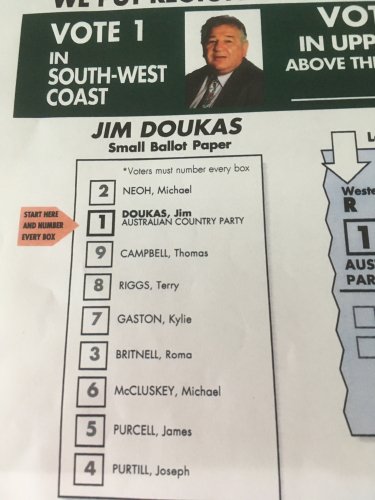
2) Former Moyne Shire mayor Jim Doukas, who apparently doesn’t like independent candidate, Upper House MP and fellow former mayor James Purcell very much, is set to be the queen maker via his preferences.

Former Moyne Shire mayor Jim Doukas has blocked his former colleague’s James Purcell’s run for the lower house by preferencing the Liberal’s third and Purcell fifth.

Just a quick primer on preferences, for those who are not political junkies and find the whole thing totally confusing.

In a nutshell, who you vote for first is critical, but also who you put second, third, fourth, fifth etc is just as important because these votes can decide who actually wins.

How? Well, imagine the election as a foot race where each candidate starts with a sack of golden potatoes (aka first-preference votes) and the person holding the majority of potatoes at the end, wins.

The person with the least amount of golden potatoes drops out of the race first, but their potatoes don’t go to waste. No! They are instead distributed to the others who are still in the race.

This dropping out of candidates and distributing of their potatoes/preferences goes on until there is one winner with a big fat sack of spuds (aka a majority).

Using this analogy, Roma Britnell, as the sitting Liberal candidate in a safe seat, will start on November 24 with a hefty bag of potatoes – she had 15,486 of them as a newcomer in 2015 and only needed another 4000 or so to have a majority.

Country Party candidate Jim Doukas last time started with around 4000, which is substantial, so you can see why where he decides to direct his preferences really matters: everyone wants his potatoes!


Unfortunately for James Purcell and Labor’s Kylie Gaston and the Greens’ Thomas Campbell, Mr Doukas has decided to direct his spuds first to Michael Neoh and Roma Britnell, in that order. James Purcell is a lowly fifth on his preference list.

Just remember, Roma doesn’t need that many extra spuds to crack that magical 5o%-plus-one mark and Jim is now her greengrocer.

James Purcell must be spitting chips. This was not how it was supposed to play out when he decided to take the leap from the Upper House to run for the Lower House.


It was always going to be a tough haul for James to get close to beating Roma, but if all of the “others” banded together and agreed to share their votes via preference deals, then maybe he at least had a half chance as a “I’m-not-Liberal-but-I-am-conservative” candidate.

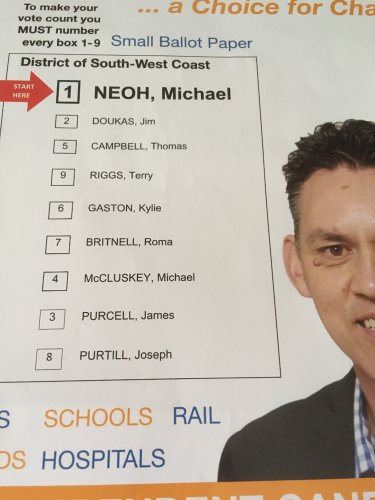
Make us marginal: Former National candidate now independent Michael Neoh has relegated Roma Britnell to seventh, behind the ALP.

At least independent and former Warrnambool mayor Michael Neoh has done his bit to try and shake the south-west from its slumber and, in so doing, has performed a 360-degree twist in allegiances that would leave any head spinning.

In 2015, Michael ran for the National Party after failing to win preselection for the Liberals, and it was his preferences that helped get Roma Britnell safely over the line (ahead of the aforementioned Roy Reekie).

This time, however, Michael is running his own race and Roma has been dropped to 7th on his preference list behind the ALP’s Kylie Gaston – ouch! – you can see why they say there are no friends in politics!

So what does this all mean?

Well, I think the most we can hope for is that the influence of the independents sees the south-west shift from being safe to not-so-safe and maybe even a tiny bit marginal.

This would be a victory for all of us, even Liberal voters, because we all know that it is the marginal seats that have better roads than ours, better trains than ours, more funding for projects like hospitals and schools and libraries, and – above all – a genuine sense that our vote can never be taken for granted, and that, dare I say, is no small potatoes.

If you haven’t voted yet and want to help make this seat marginal, vote for one of the independents, the Greens or the ALP. For a much more detailed analysis of how things could play out, please read Roy’s blog here (written before the preference deals were announced). Roy crunches the numbers like nobody can.


Milking it: how Crs Neoh and Gaston can be councillors AND wanna-be MPs

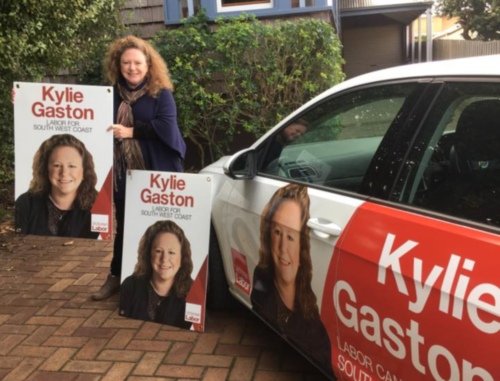
Former Warrnambool mayor, Warrnambool City Council and ALP candidate Kylie Gaston in full campaign mode. Image: Kylie Gaston ALP for South West Facebook page.

By Carol Altmann

Here is a legal loophole that is so big, you could drive a truck through it: you can be a local councillor AND run for parliament at the same time.

That is, of course, unless your council draws up a policy that says you can’t.

The Warrnambool City Council has no such policy.

This is why former Warrnambool mayor Kylie Gaston could announce way back in May that she was running for Labor at the next state election on November 24 which, at that time, was still six whole months away.

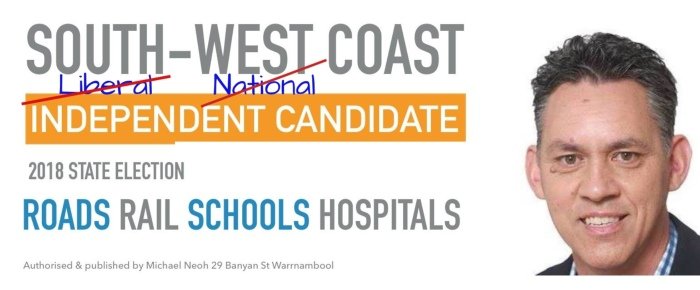
And it is why former Warrnambool mayor Michael Neoh could announce this week that he will run as an Liberal National Independent at the same election, which is still two months away.

Neither he nor Cr Gaston have to step aside.

In fact, technically, they don’t have to step aside until nominations for the state election close on November 8. (Independent nominations close on November 9, so Cr Neoh gets an extra day).

That is another six weeks away.

Having attempted Liberal preselection in 2015, then running as a National candidate, Cr Michael Neoh is now running as an independent in the 2018 state election.

The current Local Government Act allows this, largely because it still hasn’t caught up with the modern way of doing things, where loads of wanna-be MPs are launching their political careers via the grassroots of local councils.

There is nothing wrong with a person running for local council with a view to bigger things – that’s called ambition – but there is a massive conflict of interest when you decide to run for a state election and hold on to your council spot.


When are you speaking to the media as a councillor? When are you speaking as a candidate? Do the public spot the difference? (I doubt it).

And how can your council profile, all of the free publicity and the behind-the-scenes-access to council business not be anything but a massive boost in an election campaign?

Michael Neoh has been in this territory before, back in 2015, when he ran as an Independent Liberal National candidate while still Mayor of Warrnambool.

The council didn’t ask him to step aside, so he didn’t.

Here is what Cr Neoh said to me in an email at the time:

“I have a campaign car that I use and also non-council equipment.

I am following the MAV policy in regards to taking leave of absence and I do not use mayoral invited functions to campaign.

If I meet with stakeholders outside of Council duties and as a candidate, I make it very clear that I am an election candidate and are not representing council.”

Having seen Cr Neoh get away with it, Cr Gaston has since been following the same map, with her Labor-Party-emblazoned car parked in the WCC carpark while she performs, as Cr Neoh did in 2015, her council duties.

Again, neither Cr Gaston nor Cr Neoh are breaking any rules or laws, they are simply doing what they are allowed to get away with.

Like any savvy politician, they are milking every opportunity to maintain their public profiles, and the council is a perfect platform.


The Victorian Local Government Association is on to this.

It put out eight guidelines for councils, asking that they develop their own rules to manage councillors who run for state or federal parliament.

The guideline that nails it is this: “The taking of leave of absence immediately after nominating as a candidate until the conclusion of the election campaign”.

Simple, huh?

Don’t expect the councillors themselves to suggest the Warrnambool City Council write such a policy. Two of our seven already benefit from not having such a thing in place.

It is up to ratepayers – again – to say this is not good enough, that we are not interested in subsidising councillors’ political aspirations and that we want their mind firmly on the job of running our council, not how they can move on from it.

If you would like to support local, independent journalism, please consider making a contribution below. Thankyou to all of you who have already done so. 


Donate


Why I am running: Michael McCluskey, Indpt

mccluskey
There is not just one vet running for South-West Coast at the next state election. Independent Michael McCluskey plans to bring his science and economic skills to the political arena. Image: Supplied.

[box]In the lead-up to the Nov 29 state election, Bluestone Magazine invited candidates from the three major parties – Liberal, ALP and Greens – to tell us why they were running for the seat of South-West Coast. Michael McCluskey is an Independent candidate who contacted us with his response to this same question. He has chosen a question and answer style.[/box]

[dropcap style=”font-size: 60px; color: #A5CECD;”] W [/dropcap]hy have you decided to run? 

I have held a long term frustration with the way our political system operates, particularly in regard to the lack of science-based, ‘bigger picture’ thinking amongst our politicians. The quote ‘A statesperson thinks about the next generation whilst a politician thinks about the next election’ rings very true to me.

What skills do you believe you can offer the community and the electorate? 

I believe my diverse background, in particular my strong grounding in science, would be an invaluable asset to our current political system. Initially I worked as a dairy farm hand for 3 years before joining the Federal public service as an Employment Officer.

After leaving this role I then went to spend the next 24 years as a veterinarian, serving the agricultural industry and then later the equine (horse) industry. I have also completed extra university study with units in Psychology and Economics, and obtained entry into the Australian College of Veterinary Scientists.

What are the main issues affecting our community?  

I believe the main issue affecting us is the level of violence within the community. Until we more effectively deal with this issue our four main well beings – economic, social, environmental and animal well being – will never realise their full potential.

Domestic_Abuse
Violence in our community, including family violence, must be tackled if we are to progress across a range of areas. Image: www.stylemagazine.com.

[dropcap style=”font-size: 60px; color: #A5CECD;”] W [/dropcap]hat other issues are important to you?  

Health care– Currently our pets and racehorses receive access to a better healthcare system than what most humans do, particularly in relation to surgery waiting lists. A well funded and wisely operated health system, with timely access to needed care will bring greater economic and social well being both in the short and long term.

Education– If we look at any community throughout the world there is little doubt access to education is a key determinant of how well a society functions, both economically and socially. Whether one takes a trade, university or other creative pathway, we need to do all we can to maximise access to these pathways, including restoring the TAFE system.

Public transport– an efficient, well funded public transport system, along with the provision of quality roads will produce a significant boost to the economic, social and environmental well being of all our communities.

Fracking for natural gas mining– the known short term and unknown long term risks associated with injecting many millions of litres of chemically laden fluids into the ground/aquifers outweighs the potential benefits. It took politicians nearly 80 years to acknowledge lead in petrol was harmful to our children. For the sake of our grandchildren we can’t afford to wait another 80 years on this issue.

[dropcap style=”font-size: 60px; color: #A5CECD;”] W [/dropcap]hy didn’t you run through a political party? 

My concern is once in the party system, the ability to speak one’s mind and act with one’s head and heart can be stifled, which for me defeats the purpose of being in politics in the first place. If we can’t vote with our conscious on every issue, are we really being true to ourselves and to our electorate?

How can we fund these important issues you have raised? 

Reducing wastage within our system is one key component. $100 wisely spent is better than $1000 poorly spent. Tapping into some of the billions of dollars entering our superannuation system presents an opportunity as well. It would help fund vital projects in healthcare, education and public transport, as well giving super funds a safe, alternative asset class in which to invest in. In the ‘chase for yield’ there is already concerns about asset prices being pushed beyond fair value due to pent up investment demand.

[button link=”http://the-terrier.com.au/subscribe-2/” type=”icon” icon=”heart” newwindow=”yes”]Bluestone is aiming for 500 subscribers. If you enjoyed this story, please click here to become one![/button]

Stones Smile newsletterYou might also enjoy…

Why I am running: Thomas Campbell, the Greens

Why I am running: Roy Reekie, ALP