Letters: Region suffers as training kitchens stand idle
[box]We encourage readers to write a letter to Bluestone Magazine if you have something to say, or a special event to promote. Write to us at editor@bluestonemagazine.com.au.[/box]
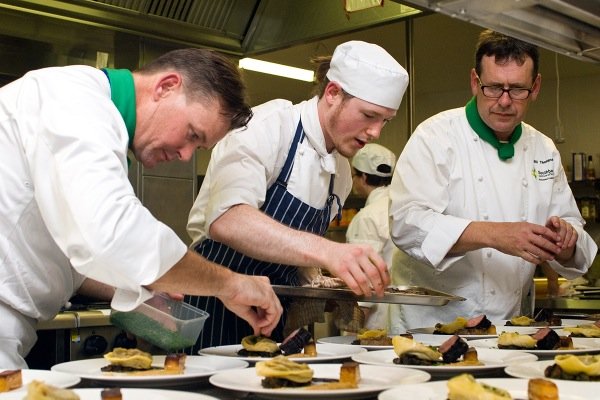
Apprentice chefs in the south-west are having to travel to Geelong for their TAFE classes and access to commercial training kitchens. File shot: Queensland TAFE.
[dropcap style=”font-size: 60px; color: #8F9F59;”] D [/dropcap]ear Editor,
I am writing to you on behalf of many voices within South West Victoria regarding an issue that can no longer be ignored.
Quality training for those in our local community who wish to fulfil their dream of becoming a successful chef in our region is out of reach.
Our hospitality industry is growing in leaps and bounds, but trained professionals are nowhere to be found.
Why?
We no longer offer cookery students a place to blossom and learn paramount skills here in Warrnambool or surrounds.
How do I know this? I drop my partner off at the Warrnambool train station each Monday morning at 5:30am to go to the city of Geelong to attend the Gordon TAFE to fulfil her dreams.
This has serious consequences.
Serious consequences for individuals, industry and the communities here within South West Victoria.
I hear of many people from Warrnambool, Portland, Hamilton, Horsham who work within the industry and then have to source the time, energy and money to travel to the city of Geelong to the Gordon TAFE to undertake their full day cookery classes.
Safety and knowledge for the student, productivity for the local food establishment, and long term community benefit are all suffering from cookery training no longer being offered through South West TAFE.
A once bustling TAFE restaurant now sits empty. Another industrial-sized kitchen at Brauer College sits awaiting eager hands once more. Two ‘A’ class facilities left to gather dust and cobwebs.
We are a progressive and fast growing city and region. We must demand quality tertiary education for those who wish to better themselves. We have an obligation to individuals, industry and the community to provide high level training and skills within our fast growing and highly popular food and hospitality industry here in this region.
No longer as a community can we remain complacent with this current situation.
Action is needed now before we all become losers in this current no winner scenario.
Roxanne Thomson, Warrnambool.
[box]You can write to us at editor@bluestonemagazine.com.au Please include a full name, address and contact number. Letters are published at our discretion and may be edited for length or clarity.[/box]
Metamorphosis, by Derek Giles, as it was on the side of the Fletcher Jones factory in Warrnambool. Image courtesy of the Warrnambool Art Gallery.
By Carol Altmann
A simple question – “what ever happened to…” – has uncovered a story about the retrieval of a well-known sculpture taken from Warrnambool, while also shining a light on the artist who made it.
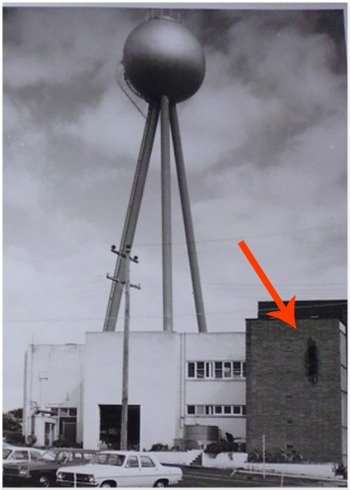
The 3 metre tall copper sculpture, Metamorphosis, was installed on the eastern wall of the Fletcher Jones factory in Warrnambool on August 1, 1967 – the same year as the famous silver ball water tower was built just metres away.
The pair looked down on the factory workers, East Warrnambool school kids and passersby for more than 25 years until the collapse of Fletcher Jones saw the business taken over by Pelaco and the buildings sold to the Warrnambool City Council.
Bluestone recently posted a 1967 photo of the silver ball and sculptureto the Facebook page, Save the Silver Ball and Fletchers Gardens, which prompted a question from one follower: “whatever happened to that sculpture?”
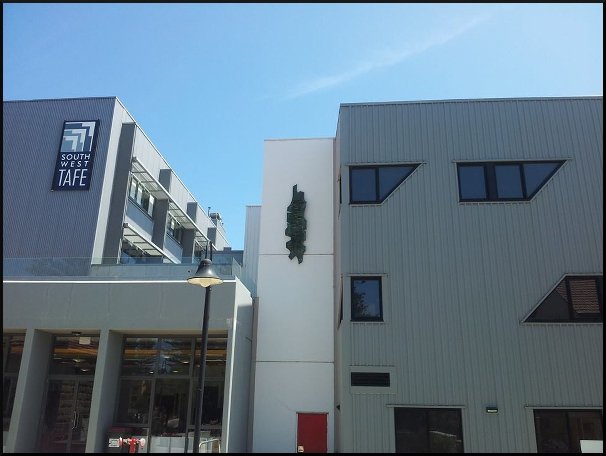
Before long, the answer was provided by Lesena Selvage: it sits on an eastern wall of the South-West TAFE building, overlooking Gilles St, which is just one letter away from the name of the artist who created Metamorphosis, Derek Giles.
But what has never been revealed, until now, is that the sculpture was taken from Warrnambool to Melbourne and it was only through the dogged determination of the late David Jones, son of Sir Fletcher, that it was returned.
The Metamorphosis sculpture shortly after being installed on the site in August 1967 – the same year as the silver ball water tower was built. Image: Ralph Jones collection, courtesy of Melbourne University Archives.
Letters penned by David Jones reveal that he became aware by early 2007 that the sculpture had been removed by Pelaco and shipped to its factory in Maidstone, Melbourne.
While David didn’t name Pelaco, he urged the council to do all it could to ensure the sculpture was returned from “the company”.
“As chairman of (the City Art Advisory) committee and because of my past association with the Pleasant Hill establishment, I express my deep concern that this object has been taken from Warrnambool,” he wrote to then chief executive of council, Lindsay Merritt in February 2007.
“My understanding of the sale of the Pleasant Hill site to the WCC in the early 90s was that the infrastructure including the buildings and the gardens were transferred into the ownership of the city. I cannot imagine why the company could or should have formed the view that they had ownership of this sculpture.
“I request that you take whatever action is necessary to recover the sculpture and that the City Art Committee select a new site for the work.”
By December that same year, little progress had been made, despite the issue being raised by the City Art Committee at least four times.
Since 2009, the sculpture has been on permanent loan from the Warrnambool City Council to South-West TAFE and now overlooks Gilles St. Image: Lesena Selvage.
It appears a clearly frustrated David Jones did what any self-respecting supporter of local arts would do and approached the media to apply a little more heat to the flame.
A story ran in the local newspaper on 28 December 2007, asking people to help locate one of the city’s “most unusual artworks” that had “gone missing”.
“It’s 40 years old, a unique piece and worth several thousand dollars, but more importantly it’s owned by the citizens of Warrnambool and we should make every attempt to recover it,” David is quoted as saying.
The story ended with a request for “anyone with information” to contact the council or David, even though both knew exactly where the sculpture was.
David’s tactic clearly worked, because within 12 months the sculpture was back home – we are not sure how it was finally retrieved – and discussions were underway with the City Art Committee as to where it should be displayed.
South-West TAFE was chosen because of Derek Giles’ links to the art school.
It has long been thought that Derek Giles was an art teacher at the Warrnambool Technical College (now TAFE), but in fact he was a primary school teacher who lived with his wife and young family near the Fletcher Jones factory and who studied art as a mature-age student.
The artist, primary school teacher Derek Giles, with his wife Meryl, who worked for David Jones, and his young family around the time of the commission. David Giles is next to his father. Image courtesy of David Giles.
I actually helped Dad build it,” said Derek’s oldest son, David Giles, by phone from Melbourne.
“It was put together in our garage (in Emma Ave) and I would hold bit this and that bit, while Dad kept saying ‘don’t look at the flame, don’t look at the flame,'” he laughed.
David, one of four children, was in Grade 6 at the time and, from what he understands, the commission came about through his mother, Meryl.
“My mother worked as a secretary to David Jones for about 12 months and I think one of Dad’s penultimate assignments for his art course was to produce a work, so Mum approached David to see if Dad could make him a sculpture,” he said.
Derek Giles, who was born in Melbourne, taught in primary schools around the south-west in the 1960s, including Port Fairy Consolidated and Warrnambool Primary School, but always had a penchant for art and worked across a range of mediums.
“Metamorphosis is a wonderful connection to Warrnambool for the whole family: it is a real focal point,” David said.
“As kids, we always thought of it as Dad’s sculpture…(but) not really being art aficionados, we joked that he had made a high-rise for the birds, because they used to love to roost in the horizontal panels when it was mounted on the wall.”
Derek Giles died in 1993, at the age of 58.
There is little doubt that had David Jones not pushed for the return of Metamorphosis, it would have been gone for good, with the Pelaco factory at Maidstone since closed.
Later this year the Giles family will complete the final vision that both they, and David, had for the sculpture, which is to install a simple plaque naming him as the artist.
I would like to acknowledge retired art academic Ross Gray and Warrnambool Art Gallery Curator Murray Bowes for their assistance with this story.
Young creatives: Bronwen Rose and ugly beauty
Warrnambool artist Bronwen Rose in the TAFE studio: “I want my art to be unsettling and for people to talk about it; I want it to have an ugly beauty.” Image: Carol Altmann
By Carol Altmann
[dropcap style=”font-size: 60px; color: #DC943C;”]T[/dropcap]he greatest compliment you could pay young artist Bronwen Arnold, who works under the name Bronwen Rose, is that you find her work disturbing.
Because that is exactly what she wants it to be.
“I am fascinated by a world where everything is beautiful and everything hurts,” she says.
The 20-year-old, who was raised in Dunkeld but now lives in Warrnambool, believes that art should take the viewer out of their comfort zone by twisting the familiar with the unexpected. Hence most of her works, be they digital painting, traditional painting or sculpture, look appealing at first glance: but then reveal a darker side.
Doe-eyed, pixie-faced characters are missing limbs, or have been disembowelled. Eyes are bloodshot, teeth are crooked, skin is disfigured.
It doesn’t make for pretty work, but it is absolutely memorable in that it is confronting, yet clever.
“A lot of (artists) in Warrnambool are inspired by coastal scenes and while they are beautiful to look at, and you can say ‘that is nice’, that is the end of the conversation,” Bronwen explains.
“I want my art to be unsettling and for people to talk about it; I want it to have an ugly beauty.”
Bunny Boy (Paolo), digital painting. Damaged and imperfect beauty is a recurring theme in Bronwen’s work. Image: Bronwen Arnold.
[dropcap style=”font-size: 60px; color: #DC943C;”]B[/dropcap]ronwen is in her second year of a Diploma of Visual Arts at South-West TAFE where her teachers include the wonderful Jeanie Gleeson whose work explores the boundaries between comfort and discomfort and what is regarded as “beautiful” art. (See our earlier story on Jeanie here).
Another influence – or even a hero – for Bronwen is contemporary artist Patricia Piccinini, whom she met while volunteering at the Warrnambool Art Gallery during Patricia’s recent exhibition that, despite its confronting themes, was among the gallery’s most popular.
“I love how people react to Patricia’s work. One of my jobs (as a volunteer) was to invite people to touch this little furry, strange critter (made by Patricia) that I was carrying around and most people refused to even touch it,” she laughs.
While Bronwen may sound like a dark thinker, she is in fact the opposite.
Her preference for wearing black, the striking arm tattoos on the soft underside of her forearm, and a 24mm gage tunnel in her ear (kind of like a sleeper on steroids) belie the fact she has an easy laugh, and the down-to-earth charm of a young woman who grew up in the country.
“My parents bought the Dunkeld Post Office which is, like, as old as old (it dates back to the 1850s), and I grew up there. Yep, in a post office,” she smiles.
With my little eye, mixed media assemblage. Pieces of dolls house furniture and others created by hand contributed to this scene that looks both cute, yet chaotic. Image: Bronwen Arnold.
[dropcap style=”font-size: 60px; color: #DC943C;”]B[/dropcap]ronwen also admits that her favourite colour is not black or blue, but pink, rose pink.
“My bedroom looks like an explosion of grandma florals – pink everywhere – with my collection of teapots all around the place,” she shrugs.
This is not the space of a tortured soul, but someone who loves playing with the juxtapositions of life: the gaps between pretty and ugly; black and pink; teapots and tattoos.
Her next series of work will explore skin and its many variations. Bruises, birthmarks (Bronwen has one), discolourations, pigmentations, freckles, albinism and a condition called vitiligo, where patches of dark skin lose their pigment, will all come under scrutiny.
“I saw a woman once who had vitiligo, and she had the most chocolate, velvet skin with white patches. She was absolutely amazing, so beautiful. She looked absolutely beautiful,” Bronwen explains.
I wondered how many times that particular woman had been told, because of her imperfection, that she was “absolutely beautiful”?
And therein lies the secret to the work of Bronwen Rose.
Mica’s Street (acrylic on canvas). Image: Bronwen Arnold.
[box]Bronwen is the recipient of the Lukasz Chomentowski sponsored studio space at The Artery, Warrnambool. She will be part of Arts on the Grass at the Fletcher Jones Garden Christmas Market, Sunday December 14, 11am-3pm and you can also view more of her work on the South West Arts Atlas.[/box]
[button link=”http://the-terrier.com.au/subscribe-2/” type=”icon” icon=”heart” newwindow=”yes”]Bluestone is aiming for 500 subscribers. If you enjoyed this story, please click here to become one![/button]
 Older letters here…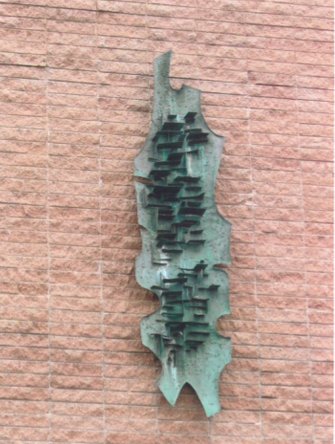


 You might also enjoy…