Don’t drop the ball on FJ’s silver icon

OPINION – Carol Altmann
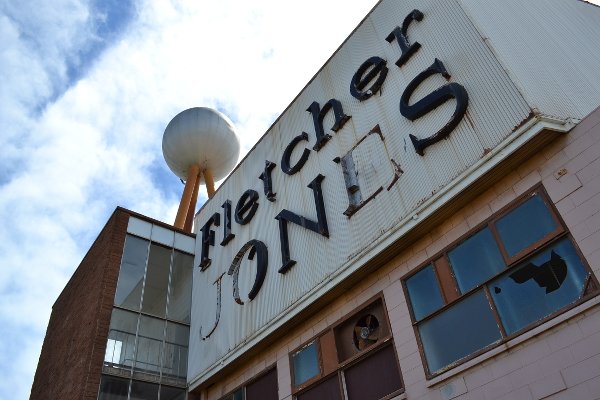
[box] The campaign to restore the Fletcher Jones silver ball is gathering pace, amid questions of whether it is still structurally safe. The group working to save the ball held its first think-tank last week to map out a strategy.[/box]
[dropcap style=”font-size: 60px; color: #A02F2F;”] I [/dropcap] want to offer some words of reassurance about Warrnambool’s iconic Fletcher Jones silver ball: it will not suddenly topple off its perch and roll down Lava St.
Ralph Jones, an engineer and the son of Sir Fletcher, was much smarter than that. He made sure that the water tower not only looked fabulous, but was engineered to withstand Warrnambool’s excoriating weather.
According to those who worked on the ball, it sways a few centimetres in the wind and this is not a bad thing, as it means it bends to weather, rather than chests it like a brick wall.
The ball also has legs that extend into the silver ball itself (see photo above), and this means it can’t roll away unless all three pylons were rusted through and, as of its last thorough inspection in 2010, there was no suggestion of this being even remotely close.
Now that we have cleared that up, the question remains as to why this magnificent, retro, visionary and unique piece of industrial art that has watched over Warrnambool and welcomed its visitors since 1967, is being left to rust.

[dropcap style=”font-size: 60px; color: #A02F2F;”] D [/dropcap]espite being heritage listed for its local and state significance, the job of caring for the silver ball has fallen into the too-hard basket all because its most recent owner, Ian Ballis, went into receivership in 2012.
The financial misfortune of just one man has been enough to throw the future of an iconic Warrnambool landmark into jeopardy.
There was no plan B.
The ball is not about to topple over, but it does need annual inspections and on-going repairs, as required, to keep it from rusting in Warrnambool’s sea air. It has also not been painted for many, many years.
Given how shabby it looks these days, no wonder some people consider it an eyesore and question whether it is worth saving.
But the Save the Silver Ball and Fletcher Jones Gardens group thinks differently.

[dropcap style=”font-size: 60px; color: #A02F2F;”] T [/dropcap]his motivated bunch of people know that if the silver ball is removed, Warrnambool will lose an irreplaceable part of its skyline and its social heart.
The group held a think-tank last Thursday to brainstorm ideas to save the ball and a lot of the discussion was around how much it would cost to maintain each year, where to find a crane for the work, and how to raise funds for all of these things.
In trying to answer these questions, it is worth looking back at recent history.
The Warrnambool City Council owned the Fletcher Jones site from 1992 to 2007 and, I presume, had a maintenance plan in place for the ball during those 15 years. How much did this cost and what work was involved? Could it continue this work if the community helped to off-set some of the expense, as is happening with the $4 million redevelopment of the Reid Oval football park?
There is a precedent with the Fletcher Jones silver ball for such an arrangement.

[dropcap style=”font-size: 60px; color: #A02F2F;”] A [/dropcap]fter the site was sold to Ian Ballis in 2007, the council continued to pay for the illuminated cross to be hoisted onto the silver ball each Christmas up until 2010, when the cross was removed completely.
For those three years, Keppel Prince Engineering donated the use of a crane, so perhaps Keppel Prince would consider donating a crane again for annual inspections and maintenance work?
And maybe Hammonds Paints, Ponting Bros or even Bunnings might consider subsidising the cost of the paint and other materials?
If one thing is certain, it is the ball will only be saved through creative – not mainstream – solutions.
The Save the Silver Ball group is already working on ideas for a public fundraising campaign and a spring picnic. I really like the idea of a reviving an annual Christmas picnic in the fabulous Pleasant Hill gardens, with food, musicians, market stalls and a treasure hunt for the kids, with a portion of the proceeds to go toward annual maintenance of the ball.

[dropcap style=”font-size: 60px; color: #A02F2F;”] A [/dropcap]nd then there is crowd-sourcing through online fundraising sites like Pozible, where author Regina Lane recently raised $15,000 in a matter of months to write the story of Saving St Brigid’s at Crossley.
If we can find $4 million for an upgrade of a football oval, and $2 million for steeplechase horse racing in Warrnambool, surely we can’t give up on the silver ball because it might cost 10, 20 or even 30 thousand dollars a year to maintain?
The greatest travesty would be to see the ball pulled down because of a perceived lack of money: what is lacking is not money, but positive, creative thinking and a large dose of motivation.
And the Save the Silver Ball group has this in spades.
Far from giving up, as our local newspaper appears to suggest we do, the fight has only just begun because the silver ball does not belong to Ian Ballis, or the council, or the State Government or Heritage Victoria – it belongs to all of us and we each need to do what we can, however small, to help keep the ball in the air.

[box] Bluestone Magazine is committed to the campaign to save the best of the Fletcher Jones site. Please join the 500-plus people at the Save the Silver Ball and Fletcher’s Gardens Facebook page to be part of this effort. [/box]
 You might also enjoy ….
Mini FJ’s silver ball to shine again for festival
Fletcher Jones site taken off the market
The Save Fletcher Jones campaign
Close Flagstaff Hill; save Fletcher Jones
Fabrication: Flaunting Fletcher


 You might also enjoy…


