Roma Britnell: law reform needed to better protect women
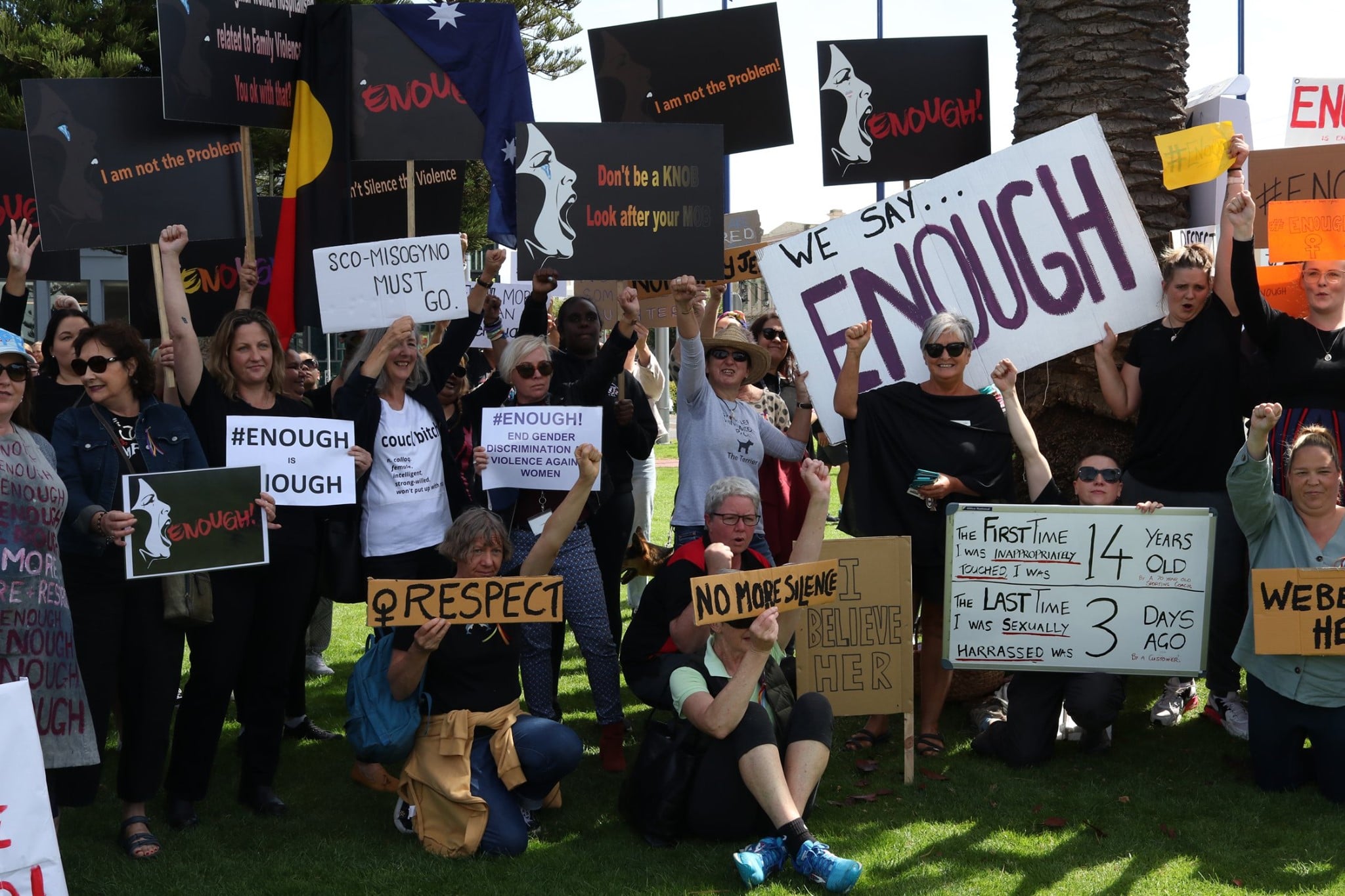
Hundreds of people turned out for the March4Justice gathering on the Warrnambool Civic Green. Image: Emily Bissland/ABC South-West Victoria.

This is a slightly edited version (for brevity) of South West Victoria MP Roma Britnell’s speech to State Parliament on 18 March 2021, following the March4Justice rally:

Ms BRITNELL (South-West Coast) (14:44): I rise to speak on the Cemeteries and Crematoria Amendment Bill 2021. The purpose of this bill is to protect affected persons against further significant harm, pain or suffering that may be caused as a result of the exercise of a right of interment…

This bill effectively has come about as a result of a shocking case of the murder of a woman by her husband. A headstone was placed on her grave which had ‘In loving memory’ or words to the effect that her husband was respectful, and there was nothing further from the truth. It was upsetting for her children, her family, her brothers, her sisters. Obviously it was completely inappropriate.

Not only that, but the man who murdered her, her husband, had the right to in time, when he died, lie beside her. So it makes complete and utter sense to change that for those who have been, like in this case, murdered, harmed, and in some cases it even applies to a victim of sexual assault, where a family member may be able to lie beside them. That is completely wrong, and this bill goes exactly to where that needs to be changed. This discussion actually happened before Karen’s death. In 2016 the Victorian Law Reform Commission made a recommendation. That was five years ago, so it is a real shame that it has taken the government this long to fully adopt—which is what we are doing here—those recommendations. It is simple, and it has been far too long coming.

This makes me think about what we are really doing to support women. Are we doing enough? Clearly we are not.

Not when you see the figures that my colleague the member for Lowan just raised in her speech around the people who are victims of family violence. They are on the increase. Violent crime stats just out today demonstrate the increase in family violence, not decrease, of those cases that are being reported to police. It is just not okay. Women have the right to feel safe. They have the right to feel safe wherever they are, be it at work, be it on the street or be it at home. Are we doing enough? Clearly we are not.

I was at the March 4 Justice just this week with my colleagues, and I back the fact that we as a group of community members, as females together—both sides of this house—must work together. Colleagues—be it my male colleagues, my female colleagues—we can all do so much more…

There was a real white-hot anger at that rally, and I could feel the women just so intent on making a change. You can understand the anger, particularly from women who were present who have been abused. Sexual assault is a really serious crime, and we are not seeing the results in convictions that we see in other serious crimes like murder. Why is that?

I am reminded of when I was at school in year 11 studying legal studies, and I remember learning about momentous change that was happening in the legal system where, for the first time—and I learned this I reckon in 1983—women, instead of being in the box facing their perpetrator, could actually do what was called a hand-up brief. The very fact that it was called a hand-up brief or is still called a hand-up brief—I know it is a fairly common legal term still; I am not sure if it is the right one anymore—is kind of bizarre in itself.

What it means is that women, instead of facing their perpetrator, could write their report and hand it in as a written format rather than as a verbal format in front of the perpetrator—a great and momentous change. But it made me think: have we done enough? I know we have got the Royal Commission into Family Violence results and we have had 227 recommendations, 64 of which are still to be implemented, but have we really actually looked at what we can do?

I suggest we get the legal minds of this state and perhaps this country together—the brightest and best—and look at the meaningful reform we really need to have so that we get the convictions just like we get in other serious crimes. Because it makes no sense that we are not getting the same level of convictions. It is not that the women are making it up, it is not that it is not true; it is that we need to find ways to support them.

There must be an opportunity for us to look around the Western world and see how other nations are perhaps doing it better. I am not saying we should undo the very important rules of law that we have in place, the foundation of our very democracy, but I am wondering: have we really put those minds together and formed a panel that can actually do that review?

I think it is time we made a difference, and I believe that meaningful reform is absolutely possible. I had in my office just a few weeks ago a woman who was terrified for her safety. The intervention order that she had out on her husband was coming to an end. I do not want to give any more details than that, but it struck me as strange that she was relying on that IVO. She was terrified for her life and she gave me lots of reasons and stories that made me also very concerned about her life. The very fact that she was being put into such a fearful place really sent a chill down my spine. I wrote to the minister that day with a sense of urgency, via email, which obviously is instant. I am actually still waiting to hear back, and I think it was three weeks ago. So we must be able to do better.

I know we have got to support our women, and sexual abuse, murder and being treated like this woman was—with absolute fear—is no way for any human being to live.

I think the bill does do one thing that will help change what has happened to Karen, and I pay my respects to the family for the pain and suffering that they have gone through, which no family should have to go through. But it is time, well and truly past time in fact, to make these changes. I hope that we do more than make these changes in this legislation, but we look at the figures today of 1800-plus people being treated by ambulance call-outs in the 2019–20 year that are victims of family violence where 30 per cent of children are actually witnessing these events.

We need to support women so they can call these situations out early, know that they will get help and not be like another woman who came to my office having left a marriage situation where there was a lot of emotional violence and withdrawing of ability to see friends and withdrawing of finances. Four years later she said to me, ‘I’m couch surfing and I really did think, given all the support they talk about for women, that I would at least be supported with a home’. After 3½ years of couch surfing, for the last six months she has joined up with her friend, pooling their funds and living in motels. But she is on a national disability insurance scheme package. She cannot drive. She has to walk to services that do a great job, she said, supporting her. She cannot move out of the area because those support services are critical for her disability. But come May when we have the May races in Warrnambool, when the motels are full, she is out on the street.

And that is just last week’s story.

How many stories do we get in our offices where we are just not doing enough? She left her husband in that abusive situation—it was not physical abuse, it was emotional abuse but fairly significant—believing that she would be supported, because that is what we say to women these days. But it is not; it is just not happening enough and that was why the rally occurred.

We can do more, and my suggestion is we get the best legal minds in our nation together, particularly in the state of Victoria, and lead the way of finding better ways to support women. That hand-up brief, the example that I spoke about, was 35 years ago at least. So I think it is time for change, and there are ways to do that.

[Note, this is an uncorrected proof from Hansard, so may have minor changes in the final published version.]


Saying “enough” to sexual violence against women and girls

Carol Altmann – The Terrier

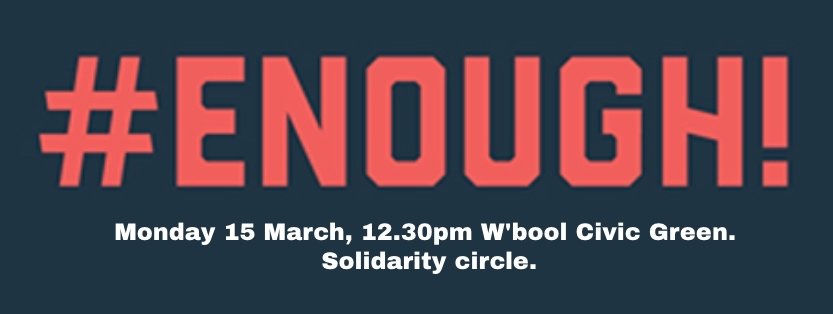
Standing up: In the absence of any other events that I have (so far) seen planned in Warrnambool for the #enough national event happening next Monday, 15 March, I am planning one.

It will be simple, but it will – I hope – still have meaning.

Next Monday, 15 March, I am asking everyone who wants to express support for women and girls in the ongoing battle against sexual violence and sexual assault to meet at the Civic Green from 12.30pm to 1pm for what I am calling a circle of solidarity.

We will stand 1.5m apart, as is the new norm, in a circle. If three people turn up, it will be a small circle. If more people turn up, it might be a little bigger. If lots of people turn up, we may even need two circles.

There will be no speeches, but bring a sign with the #enough hashtag or whatever else you would like to say.

As I say, this is a simple protest, but I cannot let the events of the past few weeks pass without standing in solidarity with those who have spoken up and said “enough”.


Harris mural a lost opportunity to take a stand

jenny altmann- smaller
‘Autumn’ painting: acrylic, gouache and pen, by Jenny Altmann. Image reproduced courtesy of Jenny Altmann.

Analysis – Carol Altmann

How extraordinarily healing and beautiful something like this work by local artist Jenny Altmann would have looked at the Lighthouse Theatre instead of a Rolf Harris mural covered in black Perspex, apparently forever.

Imagine if an artist like Jenny (disclosure: my former sister-in-law), whose art often deals with themes of healing from sexual abuse, had been asked to replace what has become an embarrassment for our city?

Warrnambool City Council, on our behalf, would have made headlines around Australia for its courage in grasping a rare opportunity to send a symbolic message to all survivors of sexual assault that we, as a community, will stand with you over and above any cult of personality.

Such a message would be particularly powerful given Warrnambool has more than double the state average rate of child abuse: 16.5/1000 compared to 7/1000.

But last Monday night we blew it and we deserve headlines like this one.

For all of the bluster about censorship, separating the art from the artist, and fears of replacing the mural being the “the thin-edge-of-the-wedge”, the decision really boiled down to one of celebrity.

The only reason the mural is remaining is because it was painted by Rolf Harris – who is actually better known for his entertainment than his art – but nobody has had the courage to say it.

This was not about preserving all art at all costs.

In fact, less than two hours after deciding to keep the mural, the council was praising its spectacular upgrade of the Lake Pertobe maze, where old murals (painted by children?) were replaced by the works of street artists.

Unfortunately these children were not as famous as Rolf Harris.

And, as I have already written, local indigenous artist Fiona Clarke saw her mural at the Ozone carpark removed to make way for apartments, and nobody blinked an eye.

Unfortunately Fiona is not as famous as Rolf Harris.

sheffield harris
The Sheffield Council had the white paint out and over a Rolf Harris mural on the side of the Sheffield Archives building in the UK shortly after his conviction. Image: BBC News.

In the art world and beyond, murals come and murals go and the Sheffield Council in the UK had no qualms – after Harris’s conviction on 12 counts of sexual assault – about painting over one of his murals on the side of the Sheffield Archives building.

An even earlier Harris mural, at the Sheffield swimming pool, had already been lost when the pool was demolished.

Removing a mural does not erase Harris’s crimes or stop sexual assault, but it is a symbolic gesture that sexual predators deserve nothing more than our disgust for the ruin they can inflict on their innocent victims.

Many of the people who wanted to see the Harris mural replaced are survivors, but to “out” yourself as a survivor in a regional city is enormously difficult because, often, the shame is still there and, in many cases, the perpetrator (even the dead ones) still garners respect.

I thought that the majority of our councillors absolutely understood this and, indeed, Cr Jacinta Ermacora (who earlier worked as a social worker at the South West Centre Against Sexual Assault) lifted my spirits when she told the council meeting that:

“One of the hardest things for survivors is to see their abusers continue their life in the community, unaffected, still respected in their community and sometimes even community leaders, while they, and their children, suffer and survive in confidential silence.”

I felt like leaping out of my chair and applauding.

But just as it appeared as if Cr Ermacora was about to crush the reputation of people like Harris hard under her heel, she went on to argue for all the reasons that the mural should remain, including that its future was irrelevant to the bigger picture of preventing sexual assault.

And then this:

“I don’t believe we should indulge in an angry, lynching squad armed with paint rollers, because that says more about ourselves than it does to our sensitivity and acknowledgement toward local survivors,” she said.

I have always admired Cr Ermacora as a strong woman who has achieved great heights in local government, but I still cannot understand where this attack was coming from, particularly when many members of of this metaphorical “lynching squad” were survivors.

Crs Sycopoulis, Gaston and Neoh have been equally as disappointing, falling somewhere between respecting survivors, not wanting to “destroy” art and finding a compromise that appears to have cheered no-one.

Only Crs Peter Hulin and Brian Kelson argued for removal and so the mural will remain, under black Perspex, for time immemorial, although I doubt anybody really believes that.

If this was really a victory for art, why is nobody celebrating?


Harris mural: who is listening to the survivors?

rolf-harris-daily-mirror
It is nine months since Rolf Harris was convicted on child sex charges, but the official debate over the future of his council-owned mural in Warrnambool is yet to begin. Image: sbs.com.au

Analysis – Carol Altmann

I must admit that I thought it would have happened by now: that the Warrnambool City Council would have asked survivors of sexual assault what they thought should be done with the Rolf Harris mural at the Lighthouse Theatre.

Especially given that the council met last night (23/2) for its briefing – which is closed to the public – and was asked to adopt a recommendation at its meeting next Monday (2/3) that the mural be kept, but covered by black perspex, as it is now.

It is nine months since the council knew it had a problem on its hands, when Harris was convicted and sentenced in the UK on a string of sexual offences against young girls.

It is three months since his avenues of appeal lapsed.

But as of today, Tuesday February 24, only one person from within the entire council and its elected officials had bothered to contact the South Western Centre Against Sexual Assault or Emma House Domestic Violence Services to ask their opinion. (That was Cr Peter Hulin).

In the meantime, in light of his conviction, Harris’s works have been removed from public galleries around the world, his impromptu mural in a Melbourne paint shop has been painted over, he has lost his place in the Australian Recording Industry Association hall of fame, he has been stripped of a fellowship in the British Academy of Film and Television Arts and, as of earlier this week, was no longer an Officer and Member of the Order of Australia.

In Warrnambool, however, the council has apparently made up its mind to keep the mural without consulting anyone.

Rolf Harris mural
The Harris mural in the Lighthouse Theatre loading dock has been temporarily covered with black perspex. Image: Warrnambool City Council.

We contacted SW CASA manager Mary Clapham today for her thoughts on the mural.

This is Ms Clapham’s written response in full:

“Previous comments by the South Western Centre Against Sexual Assault as part of the public discussion of whether or not the local mural painted by Rolf Harris should be removed, have highlighted the very real possibility of this mural causing significant additional distress for people who have previously been impacted upon by the sexual abuse of children by paedophiles.

Many people, if not necessarily a victim themselves, may have been a parent, brother, sister, friend or relative of a child who was sexually abused and bear witness to the devastating impact it has upon individuals and families.

With sexual assault being as prevalent as it is within most communities (1 in 3 women and 1 in 6 men are abused before the age of 18 years), the community discussion currently being generated will include the voices of people who have been impacted upon by sexual assault and these are the people who have a right to be asked and listened to regarding the next steps for the Rolf Harris mural.

Regardless of the assigned artistic virtue of an art installation, an integral part of the public display of art is the honour associated with having that work displayed.

The Warrnambool City Council has rightly negated the honour previously afforded to Rolf Harris by covering up the Warrnambool mural. The South Western Centre Against Sexual Assault supports no community honour being afforded to any perpetrator of sexual violence against children, including Rolf Harris.”

rolf mural
The mural painted by Harris in 1986 – the time some of his offences took place. Image: Jeremy Lee, ABC South-West Victoria.

We also contacted Emma House manager Pat McLaren to ask her opinion.

“We would like to see it painted over. It needs to be painted over so that it is obliterated forever, just like Frank Penhalluriack did in Melbourne without any problems whatsoever,” Ms McLaren said by telephone.

“This not censorship: this is about taking a stand against pedophilia.

“It is a piece of art on council property. It is not a piece of art that is bought and sold. Council needs to take a stand against sexual assault and grooming and all of the other things that Rolf Harris has been convicted of: these are not allegations, these are crimes proven in a court of law.

“The Australian Government has taken a stand, we need to do the same,” she said.

Ms McLaren said the council had quite rightly waited for any appeal before taking any permanent action, but now that the appeal had failed and Harris’s conviction stands, the council needed to renew the conversation about the future of the mural.

“It is not just a decision for the council to make, but one that the community must make. The council needs to be talking to people across the community.”

None of this matters, however, because the councillors, it appears, have made up their minds already.

The vote next Monday – and the arguments put forward – will no doubt be fascinating, but if anyone other than Cr Hulin claims to have consulted with those who support survivors of sexual assault in making their decision, they are wrong.