Discovering another gem of an op shop…

op shop cobden 3
Looking cute as a button – and the perfect place to find a bargain in Cobden.

By Carol Altmann

[dropcap style=”font-size: 60px; color: #DC943C;”] D[/dropcap]riving through Cobden on a very quiet Tuesday morning, I spotted a sign that is impossible to pass: Op Shop – OPEN.

The Uniting Church Op-shop in Cobden is part of a larger community house that actually looks like a cute, welcoming house: the sort of cottage that your grandparents might have lived in.

And inside I meet a smiling, blue-eyed woman who is just the sort of person we would all want as a grandma, if we didn’t happen to have one.

“I am Mary Elizabeth Smith,” she says by way of introduction.

“Mary Smith, I know, a very uncommon name,” she adds with a laugh.

largeredbutton

Mary doesn’t own a computer and has no interest in ever doing so, but she likes the idea of a story about the shop in Bluestone Magazine and is more than happy to show this drop-in visitor around.

op shop cobden 4
Volunteer Mary Elizabeth Smith – one of those who keep the Uniting Church Op Shop ticking along and the longest-serving volunteer to do so.

[dropcap style=”font-size: 60px; color: #DC943C;”] T[/dropcap]he op-shop, Mary explains, was recently expanded to allow more space for its wares and it is surprising to discover just how many rooms it occupies.

The back section, added as part of a major upgrade in 2014, is full of neatly stacked games and books and toys and well-organised racks of clothing, shelves of linen, and an assortment of larger furniture.

By selling some of the church’s other assets, including buildings at South Purrumbete and Purrumbete, plus donations from the community, the Uniting Church has transformed the cottage into a welcoming and useful space.

The upgrade included not only more room for the secondhand treasures, but a community meeting room, full kitchen facilities and spanking new toilets.

cobden op shop candle
The retro metal candle holder designed for a trio of candles, unearthed at the Uniting Church Op Shop, Cobden, for $4.

[dropcap style=”font-size: 60px; color: #DC943C;”] V[/dropcap]olunteers like Mary keep the place ticking over and I point out that, technically, she shouldn’t even be there given it is 11.30am and the sign says the op-shop opens at 1pm on Tuesdays.

“I know, but if there is somebody available, we open, so don’t worry too much about the sign,” she smiles.

“Take a look around, take your time.”

And with that, I am off, peering at old paintings, checking out the cutlery, cups and plates and slowly entering that blissful state that comes over us op-shoppers when we are immersed in a new find.

op shop cobden

[dropcap style=”font-size: 60px; color: #DC943C;”] A[/dropcap] retro metal candle holder for a trio of candles is the pick of the day at $4, followed closely by a long teak platter for $1.

Now I am not sure it is right to eavesdrop in an op-shop, but as I take my treasures to the counter, I can’t help but overhear a conversation about the imminent arrival of the person who will be handling welfare requests at the shop that day.

It is a gentle reminder that op-shops are so important in so many ways. If you are anywhere near Cobden, drop in to visit this one.

[box]The Uniting Church Op-Shop is at 50 Curdie St, Cobden (the main street). The official opening hours are Mon-Thurs 1pm-4pm; Friday 10am-4pm;
Sat 10am-12pm. Contact: 0475 699 483. You can find them on the Cobden Business Network here. [/box]

newsletter Why Not StonesYou might also enjoy…

Time stands still in Reicha’s store, Terang

Bag a bargain in an old-style op shop, Koroit
Secrets of an old shoe, Timor St

Restoring a treasure back to life


The pot, the shell dolly and the bower bird

plaques
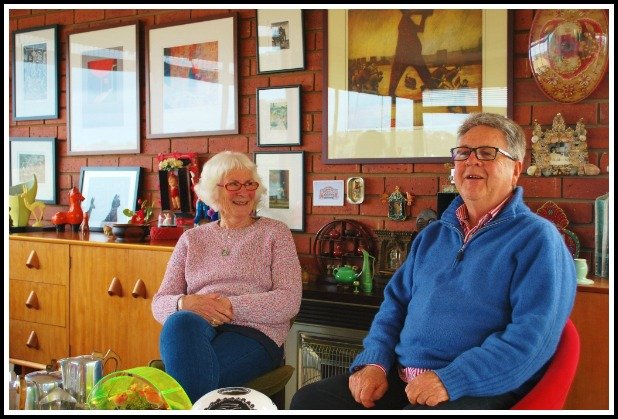
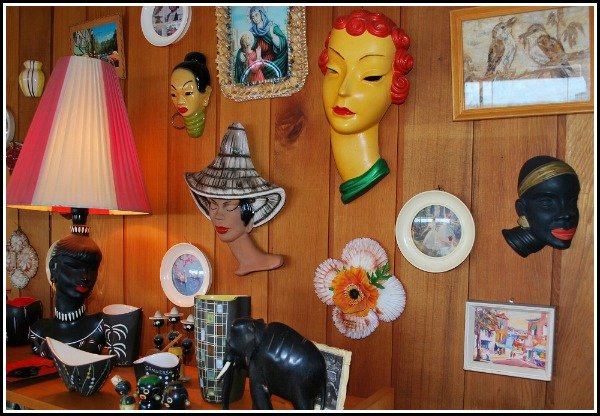
Where to look first? The Drylie home in Warrnambool is an eclectic museum of pieces from the 1950s and 60s and a smattering of whatever catches their eye.

ARCHIVED

Bluestone columnist and architect CLINTON KRAUSE previously worked in Daylesford before relocating his business to Warrnambool. Clinton explores the retro styles that gives our region so much character.

With family roots going back to the settlement of Port Fairy and a long association with retailing in the region, Claire and Tony Drylie are well known throughout the district.

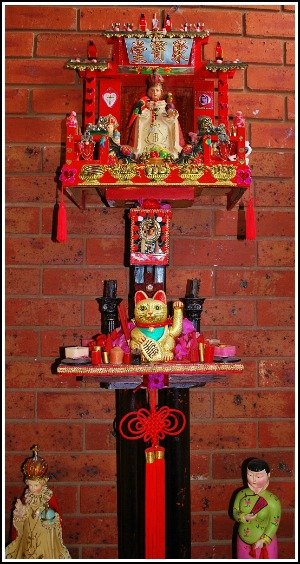
Claire’s emergence as an artist has also brought her work to the attention of our arts community and her intriguing dioramas assembled from religious iconography, retro kitsch and other plastic flotsam and jetsam also just happen to provide a hint of the private lives of this dynamic couple.

I recall my first visit to their home as a visual feast of colour, chaos and clutter that nearly threatened to overwhelm the senses.

It is as if Tony and Claire are actually residing within one of Claire’s complex art assemblages.

An extensive collection of pottery, retro furniture and art sits cheek-to-cheek with the ephemera of kitsch tourism souvenirs, plastic dolls and other miniatures.


Grouped collections of hats, pottery, clocks, genie bottles, cats, Madonnas, donkeys, lamps, ice buckets, and tea sets occupy every available nook and cranny.

The mayhem extends out into the garden where a mob of concrete kangaroos greet you at the entry, metal work sculptures adorn every wall, and pots of every size and colour contain curiously shaped cacti and other exotic plants.

claire and tony
Claire and Tony Drylie. The pair began their collecting with just one ceramic pot from Tasmania and ended up running their own store of collectibles.

To say that ‘Tony and Claire “like to collect” is an understatement and I set about uncovering the origins of this passion.

“It started with a pot in Tasmania,” reveals Claire.

Knowing nothing about Australian pottery at the time, she was captivated by the strong colours of the glaze and the unusual soft and rounded form.

Further research lead to an appreciation and interest in Australian pottery which sparked the pursuit of unusual, quirky and interesting pieces.

This lead to regular visits to local auctions and garage sales throughout the southwest, where the couple’s interest expanded to other areas such as retro furniture, wall art, ceramics and anything that had a certain style or quality of design.

shrine
One of Claire’s distinctive assemblages – made from pieces picked up at auctions, op-shops and by friends – which invite the viewer’s own interpretations.

Claire’s artistic eye for great design and a bargain was put to good use when she started selling pieces at a small stall in the Drill Hall at Port Fairy.

Whilst hugely popular with the buyers, Claires mix of retro, kitsch and shabby was at odds with the “serious and staid”  antique collections of the other stallholders and when a chance came to open her own shop back in Warrnambool, the couple jumped at it.

With Tony out the back restoring timber furniture and Claire filling the walls of the commodious space in Fairy Street, their business ‘Alternative Antiques’ became a must-visit destination amongst tourists and locals alike.

Fast forward to 2010 and with the couple having kept the supply and restoration of  inventory going for well over 10 years, it was time to move on.

The shop had become such an institution that Claire recalls loyal clientele actually getting a bit “bolshy” and emotional when told that the couple were winding down.

shell art
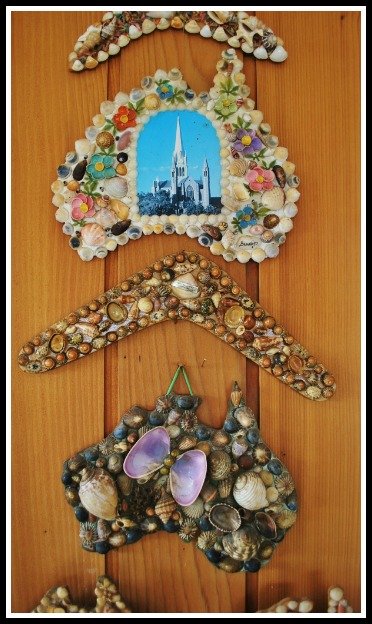
After being denied the opportunity to own a shell dolly as a child, Claire has more than made up for it with a huge collection of shell memorabilia with a twist of kitsch.

During the years of the business, a vast repository began to accumulate – a common practice at most auctions is to offer the best pieces thrown in together with ‘job lots’ of items that are impossible to sell.

Claire’s boundless creative energy found a use for all this detritus and she began to experiment with boxed dioramas of religious items, small scale figures and other items that, when assembled, create a narrative for the viewer to explore and interpret.

She is now establishing herself as an artist with the ongoing exploration and evolution of these unique installation pieces and was awarded the runner up prize at the inaugural Southwest International Women’s Day Art Prize in 2015.

This knack for arrangement has been given full flight in the styling of their home and the walls are adorned with montages and groupings of both themed and disparate objects which all seem to come together in a visually pleasing symphony of colour, form and wit.

Oh, and the story of the shell dolly?

Well, there was a girl down the road who had the most beautiful doll young Claire had seen and despite insistent pleas to her mother, it was dismissed as being far too kitsch and common to be bestowed as a gift.

All is good now though, because Claire has a whole shelf of shell dollies, and shell boomerangs, and souvenirs, and hats, figurines, seats, vases, masks, radios, lamps, pots , prints, cushions, caravans, clocks, tea sets, dinnerware, ice buckets, robots…………………………………………

Clinton-Krause


Tony’s collection is top drawer

Former second-hand dealer TONY DRYLIE is a natural collector of unique and interesting objects, but when it comes to choosing a particularly special collection, he couldn’t go past his set of small drawers:


tony drylie1
Tony Drylie, of Warrnambool, has been collecting small drawers for 30 years and loves the unique character of each piece.


[dropcap style=”font-size: 60px; color: #ABCCAB;”] T [/dropcap]hey say necessity is the mother of all invention and a collection of small drawers and cabinets demonstrates how “storage needs” were dealt with well before Bunnings or Mitre 10.

Former Warrnambool second-hand dealer Tony Drylie has been collecting unique miniature drawers and cabinets for about 30 years and has more than a dozen, one-off pieces that span more than a century.

“The first one I bought was a birthday present for my wife, Claire, and it went from there,” he said, pointing to the beautiful kauri pine miniature wardrobe that remains one of the most striking pieces in his collection.

The wardrobe is not a functional piece, but perhaps a practice item for an apprentice. Others in the collection, however, were built purely for utilitarian purposes.

A series of steel sardine cans (remember them?) have been recycled into a series of small drawers for nails and screws, another was built as a rustic first aid kit and medicine cabinet, while another, much more refined-looking cabinet was designed to contain smoking pipes and tobacco: it even comes with a lock and key.

tony drylie_14
A selection from Tony’s collection, including the recycled sardine can drawers and the more upmarket pipe and tobacco storage cabinet.


[dropcap style=”font-size: 60px; color: #ABCCAB;”] T [/dropcap]ony believes the oldest pieces date back to the late 1800s, while others reflect the Great Depression, when everything was re-used and recycled, including old industrial crates and boxes that were turned into furniture.

“I really like the fact that someone has sat down and gone to the effort of making it, usually out of second-hand timber, or whatever they had lying around, like the old steel sardine cans,” Tony said.

The collection unites Tony’s interest in the skill of fine woodcraft and his love of history.

“It would be really great to know the story behind each one: to know who built it and why,” he said.


tony drylie_20
Tony with the kauri pine miniature wardrobe that he bought for his wife, Claire, and which started his collection.

[dropcap style=”font-size: 60px; color: #ABCCAB;”] O [/dropcap]ne of his most precious pieces, however, is from his own family and is a wooden money box with moving parts that his grandfather made for Tony’s late father, Bill. While it is showing signs of age, Tony intends to make only minor repairs, as he does with all of the pieces.

“Most of them are in original condition, which is how I like to keep them, rather than lose their authenticity,” he said.

While Tony is no longer officially in the second-hand business, he hasn’t given up scouring clearing sales, auctions and garage sales for the occasional treasure.

When asked if his collection of miniature drawers was complete, he gave the reply that any true collector will give: “Oh no! Not by a long shot!”

[box] Do you have a treasure? It might be sentimental, it might be valuable, it might be part of a collection, or it might be something you just can’t live without. If you have a treasure that we can feature here, let us know! Email us at editor@bluestonemagazine.com.au[/box]

[button link=”http://the-terrier.com.au/subscribe-2/” type=”icon” icon=”heart” newwindow=”yes”] Did you enjoy this story? Please subscribe here to help Bluestone thrive.[/button]

newsletter Art Music Stones You might also enjoy…


Old Holden that just keeps rollin’ 

Nothing minor about this Mini

T-shirt captures the infamous ‘Cri

A coat of many memories: Di Clanchy

The smallest violin in Warrnambool