How David Jones saved “Metamorphosis”
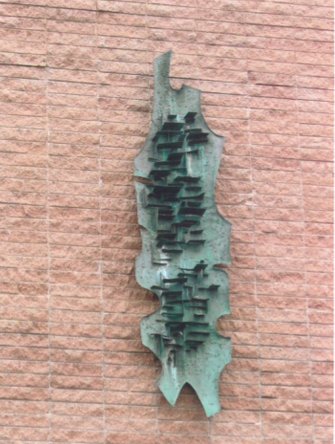
Metamorphosis by Derek Giles
Metamorphosis, by Derek Giles, as it was on the side of the Fletcher Jones factory in Warrnambool. Image courtesy of the Warrnambool Art Gallery.

By Carol Altmann

A simple question – “what ever happened to…” –  has uncovered a story about the retrieval of a well-known sculpture taken from Warrnambool, while also shining a light on the artist who made it.

The 3 metre tall copper sculpture, Metamorphosis, was installed on the eastern wall of the Fletcher Jones factory in Warrnambool on August 1, 1967 – the same year as the famous silver ball water tower was built just metres away.

The pair looked down on the factory workers, East Warrnambool school kids and passersby for more than 25 years until the collapse of Fletcher Jones saw the business taken over by Pelaco and the buildings sold to the Warrnambool City Council.

Bluestone recently posted a 1967 photo of the silver ball and sculpture to the Facebook page, Save the Silver Ball and Fletchers Gardens, which prompted a question from one follower: “whatever happened to that sculpture?”

Before long, the answer was provided by Lesena Selvage: it sits on an eastern wall of the South-West TAFE building, overlooking Gilles St, which is just one letter away from the name of the artist who created Metamorphosis, Derek Giles.

But what has never been revealed, until now, is that the sculpture was taken from Warrnambool to Melbourne and it was only through the dogged determination of the late David Jones, son of Sir Fletcher, that it was returned.
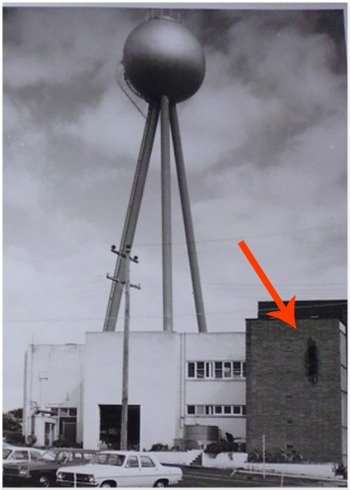
sculpture at fj
The Metamorphosis sculpture shortly after being installed on the site in August 1967 – the same year as the silver ball water tower was built. Image: Ralph Jones collection, courtesy of Melbourne University Archives.

Letters penned by David Jones reveal that he became aware by early 2007 that the sculpture had been removed by Pelaco and shipped to its factory in Maidstone, Melbourne.

While David didn’t name Pelaco, he urged the council to do all it could to ensure the sculpture was returned from “the company”.

“As chairman of (the City Art Advisory) committee and because of my past association with the Pleasant Hill establishment, I express my deep concern that this object has been taken from Warrnambool,” he wrote to then chief executive of council, Lindsay Merritt in February 2007.

“My understanding of the sale of the Pleasant Hill site to the WCC in the early 90s was that the infrastructure including the buildings and the gardens were transferred into the ownership of the city. I cannot imagine why the company could or should have formed the view that they had ownership of this sculpture.

“I request that you take whatever action is necessary to recover the sculpture and that the City Art Committee select a new site for the work.”

By December that same year, little progress had been made, despite the issue being raised by the City Art Committee at least four times.
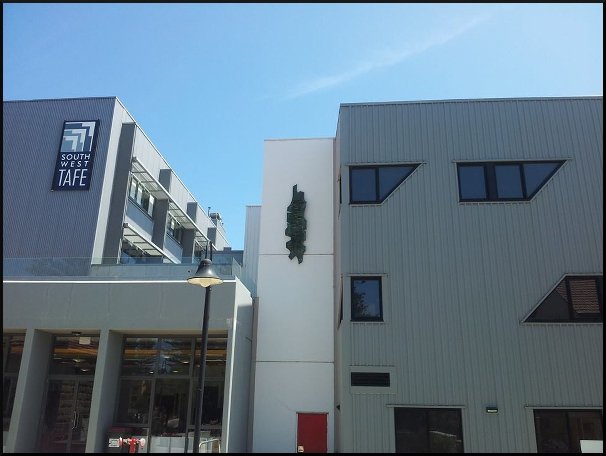
sculpture lesena selvage
Since 2009, the sculpture has been on permanent loan from the Warrnambool City Council to South-West TAFE and now overlooks Gilles St. Image: Lesena Selvage.

It appears a clearly frustrated David Jones did what any self-respecting supporter of local arts would do and approached the media to apply a little more heat to the flame.

A story ran in the local newspaper on 28 December 2007, asking people to help locate one of the city’s “most unusual artworks” that had “gone missing”.

“It’s 40 years old, a unique piece and worth several thousand dollars, but more importantly it’s owned by the citizens of Warrnambool and we should make every attempt to recover it,” David is quoted as saying.

The story ended with a request for “anyone with information” to contact the council or David, even though both knew exactly where the sculpture was.

David’s tactic clearly worked, because within 12 months the sculpture was back home – we are not sure how it was finally retrieved – and discussions were underway with the City Art Committee as to where it should be displayed.

South-West TAFE was chosen because of Derek Giles’ links to the art school.

It has long been thought that Derek Giles was an art teacher at the Warrnambool Technical College (now TAFE), but in fact he was a primary school teacher who lived with his wife and young family near the Fletcher Jones factory and who studied art as a mature-age student.
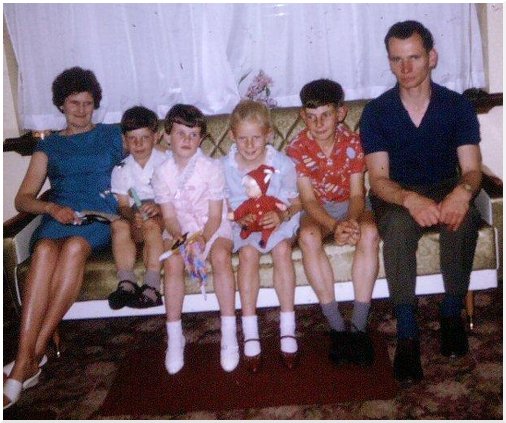
derek giles
The artist, primary school teacher Derek Giles, with his wife Meryl, who worked for David Jones, and his young family around the time of the commission. David Giles is next to his father. Image courtesy of David Giles.

I actually helped Dad build it,” said Derek’s oldest son, David Giles, by phone from Melbourne.

“It was put together in our garage (in Emma Ave) and I would hold bit this and that bit, while Dad kept saying ‘don’t look at the flame, don’t look at the flame,'” he laughed.

David, one of four children, was in Grade 6 at the time and, from what he understands, the commission came about through his mother, Meryl.

“My mother worked as a secretary to David Jones for about 12 months and I think one of Dad’s penultimate assignments for his art course was to produce a work, so Mum approached David to see if Dad could make him a sculpture,” he said.

Derek Giles, who was born in Melbourne, taught in primary schools around the south-west in the 1960s, including Port Fairy Consolidated and Warrnambool Primary School, but always had a penchant for art and worked across a range of mediums.

Metamorphosis is a wonderful connection to Warrnambool for the whole family: it is a real focal point,” David said.

“As kids, we always thought of it as Dad’s sculpture…(but) not really being art aficionados, we joked that he had made a high-rise for the birds, because they used to love to roost in the horizontal panels when it was mounted on the wall.”

Derek Giles died in 1993, at the age of 58.

There is little doubt that had David Jones not pushed for the return of Metamorphosis, it would have been gone for good, with the Pelaco factory at Maidstone since closed.

Later this year the Giles family will complete the final vision that both they, and David, had for the sculpture, which is to install a simple plaque naming him as the artist.

 I would like to acknowledge retired art academic Ross Gray and Warrnambool Art Gallery Curator Murray Bowes for their assistance with this story.


Granny rises from the grave for Women’s Day

1-parlour granny_13
Warrnambool textile artist Louise Parlour with her work inspired by the story of Agnes Ruttleton: the ‘Granny’ behind the famous Granny’s Grave.

By Carol Altmann

[dropcap style=”font-size: 60px; color: #8F9F59;”] A [/dropcap]lmost 170 years after she was laid to rest somewhere in the Warrnambool sand dunes, Agnes Ruttleton – the “Granny” behind Granny’s Grave – is to get her name back.

The Warrnambool City Council has followed through on its plan to have a plaque recognising pioneer Agnes Ruttleton added to the famous Granny’s Grave site at the east end of Lady Bay and has installed it in time for March 8: International Women’s Day.

Until now, Agnes has been incorrectly known only as Mrs James Raddleston, “the first white woman buried in Warrnambool” and thousands of locals and tourists have walked past her memorial in the dunes not knowing anything more about her.

Last year, however, Bluestone Magazine ran a story on the research of local historian Jenny Fawcett that revealed so much more about the life and times of Granny Ruttleton, who died in 1848 at the age of 60. It remains one of our most popular stories and you can read it here.

1-parlour granny_11
The headstone in detail, created using 10.5km of cotton and finished with real lichen picked from the roof of Louise’s home.

[dropcap style=”font-size: 60px; color: #8F9F59;”] A [/dropcap]mong those inspired by Agnes’ story was Warrnambool textile artist Louise Parlour, who used the imagery of the Granny’s Grave bluestone headstone for her entry in the inaugural South West International Women’s Day Art Prize.

“The theme for the art prize was ‘Women and Place’ and I think the Granny’s Grave story fits that so perfectly,” Louise said.

“So many people walk past that site and never really stop to look. Plus (Agnes) is not actually buried there and they have her name wrong, so it is like she is invisible, despite being one of the first pioneering women of Warrnambool.”

Louise photographed the headstone and used this to create a template from dissolvable plastic. Around this template she freehand embroidered the headstone using the closest colour she could find to bluestone.

The work took about 50 hours and 10.5 km – yes, 10.5 km – of cotton to complete.

“I think I bought about every batch of that cotton I could get my hands on in Warrnambool,” Louise laughed.

1-parlour granny_3
The completed work, including a poem about Agnes Raddleton’s life inside a piece of recycled marine ply.

[dropcap style=”font-size: 60px; color: #8F9F59;”] T [/dropcap]he gravestone’s green lettering was then stencilled on to the work, some real lichen added from Louise’s roof at home and the whole thing covered with a thin coat of PVC glue to hold it together once the dissolvable plastic was removed.

The headstone itself is surrounded by sand and pussy willows, boxed by recycled fence pickets from a friend.

“I wanted it to look like I imagine it did when it was first erected, not with the modern handrails and things around it,” Louise said.

As part of sharing Agnes’s story with the public, Louise wrote a poem encapsulating what is known of her life and included this in her piece, tucked inside a piece of weathered marine ply.

“I want people to pick it up, read it and go away knowing a bit more about Agnes,” she said.

[learn_more caption=”You can read Louise’s poem here:”]

Where is this woman?

Laid to rest

Windswept dunes

Leaving no remnants

No trace……………

No photos to be found

Only our imaginations

Giving Granny a face.

A pioneer woman of her day

A township of 100 people

So they say…..

Makeshift homes set up

Enduring the wind and rain

On Flagstaff Hill

Where the sheep today roam.

So who is this Granny?

Encapsulated in time

A bluestone grave

Neither reason nor rhyme

Standing all alone

Standing the test of time……

Not much is known about Granny

And her pioneer days

Agnes sailed by sea

From Tasmania

Aboard the Essington

Wife of James

No record of children

The colony of New South Wales

Town of Warrnambool……

Worked hard for a quid

Odd jobs and selling crays

Headstone depicts wrong name

Should read – Mrs Agnes Ruttleton

Second white woman

To be buried in Warrnambool

First believed to be buried on an island

Off the Hopkins River

Granny was admired by one Richard Osburne

Known as a publisher and local historian

Paid for her burial

In the sand dunes……

Returning some years later

To no avail

Could not find her marker

And all efforts failed

Richard Osburne fought

Council decided to erect a headstone

The one that stands today All alone……..

Louise Parlour 2015

(I would like to acknowledge Bluestone Magazine and their article “Who is the “Granny” behind Granny’s Grave?” published February 9, 2014, and local researcher Jenny Fawcett who uncovered the story of the “real Granny”.) [/learn_more]

[dropcap style=”font-size: 60px; color: #8F9F59;”] T [/dropcap]he marine ply was found at Levy’s Beach where she occasionally walks with her father, who visits the area regularly in search of that other Warrnambool legend: the Mahogany Ship.

It is the first time Louise has entered her work in an exhibition, but unfortunately, after our interview, she learned that she had missed out in the selection process (the prize attracted more than 70 entries, of which only 50 could be selected).

Despite missing out, Louise remained upbeat, saying she had thoroughly enjoyed creating the work. We think Agnes would be pretty chuffed too.

In the meantime, the council plaque – which has been added to the viewing platform next to the grave – provides details about Agnes and her challenging life as one of the first non-Indigenous people to settle in the area.

A council spokesman said the full text of the plaque, which can be found at the end of this story, was developed with the assistance of Elizabeth and (the late) Les O’Callaghan and the Warrnambool Historical Society, in conjunction with historian Dr Helen Doyle.

granny plaque
The plaque created by the Warrnambool City Council that has been added to the viewing platform at Granny’s Grave at Lady Bay. Image: Warrnambool City Council.

[learn_more caption=”Read the full text on the grave plaque here:”] Who was Granny? Granny’s Grave marks the burial site of Agnes Ruttleton, who died in December 1848. Agnes Ruttleton, known as “Granny”, was recorded as “the first white woman to be buried in Warrnambool”.

Agnes arrived in Warrnambool with her husband James Ruttleton in the late 1840s (probably both ex-convicts from Van Diemen’s Land) and lived in humble conditions, occupying a tent or hut at the base of Flagstaff Hill. It is believed they made a living catching crayfish. Exposed to unpredictable weather and with few physical comforts, they would have had a tough life.

In Warrnambool’s early days many settlers experienced similar hardship and made meagre incomes from fishing and beachcombing. In an 1850 census, eight men gave their place of residence as ‘at the jetty’, another five were described as ‘Fishermen at the Hummocks’.

Upon Agnes’ death in 1848, a group of leading Warrnambool citizens, including Richard Osburne, who would later publish The Examiner, Gilbert Nicol, Mark Nicholson, John Hollins Craig, John Moffat Chisholm and Thomas Denny, rallied to provide a decent burial ceremony for her.

Rev. Thomas Slattery, the Catholic priest from Belfast (Port Fairy), was brought across to officiate at a ceremony held at the sand hummocks and to consecrate the ground where she was buried. [/learn_more]

[box]The South West International Women’s Day Art Prize will be launched Thursday March 5 at 6pm at The Artery, 224 Timor St, Warrnambool. Live music. Judging by internationally recognised Portland artist Carmel Wallace.[/box]

subscribe

newsletter Art Music StonesYou might also enjoy…


A fence full of happy soles at Tyrendarra

Victoria’s oldest building right in our backyard

Deep into the cellars of KM Lynch

Turning into the Turn In Motel

Biblio Art Prize remains an open book


Remembering the art of Robert Ulmann

Robert_Ulmann__Tawny_Frogmouth
The late Robert Ulmann was one of Warrnambool’s best known artists – and one of the city’s great characters – after making the south-west his home in 1969. Image: Visit Warrnambool.

[dropcap style=”color: #abccab;”] O[/dropcap]ur campaign to restore the Robert Ulmann whale mural in Warrnambool has provided an opportunity to remember one of south-west Victoria’s most prolific artists, who died 15 years ago this November.

Despite Robert’s enormous contribution to the local art scene as a painter and sculptor during the 30 years that he lived in and around Warrnambool, it is quite difficult to find any formal, public recognition of his work, beyond that which he created himself.

This includes his studio and gallery overlooking the ocean on Hopkins Point Road, Warrnambool, which is still managed by his wife, Helen and daughter Justine, and was built after their Naringal property (and Robert’s studio) was completely destroyed in the devastating Ash Wednesday fires of 1983.

It also includes Robert’s contribution to Warrnambool’s public artworks, which is arguably greater than any other single artist.

There are four Ulmann sculptures dotted in high-profile locations around Warrnambool and two privately commissioned murals that are also in very public spaces, but a search of the Warrnambool Art Gallery website reveals very little about the man or his work.

As an aside, do you know where to find the Ulmann sculptures and murals in Warrnambool?

[learn_more caption=”Click here to find an Ulmann work:”] 1. Fletcher Jones Gardens, basalt sculpture, Memorial to Sir David Fletcher Jones.

2. Warrnambool breakwater, basalt sculpture, The Breakwater Centenary Sculpture.

3. Flagstaff Hill, lake side, The Lady in the Wind, Mt Gambier stone.

4. Warrnambool Art Gallery, exterior, The Australian Fur Seal, basalt sculpture

5. Bojangles Restaurant, Warrnambool, mural

6. Flaxman St milk bar, Warrnambool, mural [/learn_more]

ulmann stones
The Breakwater Centenary Sculpture, Warrnambool, created by Ulmann in 1990.


[dropcap style=”color: #abccab;”] R [/dropcap]obert, who was born in Switzerland, was a larger-than-life character who created an impression on all those he met, even if it was one of slight terror at the sight of what has been described as his “fierce” beard which would bob up and down during his highly animated way of talking.

His arrival in south-west Victoria in 1969 made the local news at the time and Warrnambool historian, Jenny Fawcett, has kept a copy of the clipping from The Warrnambool Standard in which it was reported that “an interesting personality” was visiting the district with his locally born wife, Helen (Goldstraw).

Robert, it said, “has had an adventurous life, painting and drawing his way through 21 countries,” that included Canada, where he first met Helen, who was working as a school teacher at Coppermine in the Canadian Arctic. It was here that Robert worked closely with the Canadian first peoples, the Inuit.

The Ulmann’s spent two years criss-crossing North and South America and then wended their way down through the Pacific Islands before finally reaching Australia. They settled in Naringal in 1972, having first spent a couple of years working in indigenous communities in the Northern Territory.

With all of that experience, and all of that adventure, no wonder Warrnambool – at times – would have struggled to contain a personality as large and dynamic as Robert’s, but he came to call the seaside town his home.

fletcher-gardens_29
The basalt “Memorial to Sir David Fletcher Jones”, created by Ulmann in 1978 and part of the Fletcher Jones Gardens in Warrnambool.


[dropcap style=”color: #abccab;”] A [/dropcap]uthor Penny Olsen dedicated her 2001 book, Feather and Brush: Three Centuries of Australia Bird Art (2001), to Robert Ulmann, who passed away during its production. In it, she describes how Robert worked “from nature, fast and with gusto”.

Robert loved to capture the energy of both animals and people as he saw them in the moment, not after the fact. It was not unusual to be talking to Robert and find that, halfway through a conversation, he would start sketching a portrait of you.

It was Robert’s passion for Australian wildlife, however, that won the hearts of so many of his followers.

He not only painted, sketched and photographed the beautiful creatures around him, he often invited them into his home which became a refuge for homeless and abandoned birds, mammals and marsupials.

In 1980, The Age newspaper ran a page 3 story about the Ulmann’s being the first people in Australia – and most likely the world – to hand-raise a baby echidna that developed a fondness for crawling up Robert’s trouser leg.

When asked why he loved to work on Australian animals, Robert told the reporter in typical style:

“You know why? They’re bloody hard to get hold of, specially the marsupials. They’re all nocturnal. That’s what makes the challenge…and people love furry things – specially the ladies.”

Robert died suddenly at the age of 71 on November 1, 1999.

bojangles_1
A portion of the colourful – and cheeky – Mr Bojangles murals in the Bojangles restaurant, Warrnambool, painted by Ulmann in the 1980s.

[box type=”bio”] The Robert Ulmann studio is at 440 Hopkins Point Rd, Warrnambool ph: 03 5565 1444 or email: eubalena@westvic.com.au. Free entry.[/box]

[button link=”http://the-terrier.com.au/subscribe-2/” type=”icon” icon=”heart” newwindow=”yes”] Did you enjoy this story? Please subscribe here to help Bluestone thrive.[/button]

newsletter Art Music StonesYou might also enjoy…


Glenn Morgan back in the saddle for retrospective

2014 Art Environment Award SCOPE Galleries

Questions and stories arising from clay

Recycled timber shapes a new life: Sarah Carrucun


A sculptor with the heart of a Lyon


lyons sculpture_57
Award-winning sculptor Jon Dixon has spent 20 years creating the Lyons Sculpture Park, near Heywood, in an organic and creative project that has no end.


[dropcap style=”font-size: 60px; color: #A02F2F;”] I [/dropcap]f sculptor Jon Dixon had his way, this story would contain only a single sentence: “art is important”.

“That’s all you need to write,” he says, as we start our tour of the 15-acre Lyons Sculpture Park that he and his wife, Chris, have created on their bush property 21km west of Heywood.

After walking just two or three minutes through what is a combination of sculpture, gardens, raw bush, and farmland it is patently clear, however, that one sentence is not going to cut it. Sorry Jon.

Indeed it is difficult to describe the park, because it refuses to slot into any simple category.

It is a “park”,  but not a manicured one. It is a gallery, but without an entry fee or labels on any of the works. And it is full of stone, wood and metal sculptures, some of which are obvious to the eye, but also others that are tucked in nooks and crannies: up a tree, behind a bush, attached to a fallen log.


lyons sculpture_49
The natural bush on the 15 acre property is studded with gorgeous sculptures, including this one from pink dolomite.


[dropcap style=”font-size: 60px; color: #A02F2F;”] T [/dropcap]he sculpture park – and the Dixon home – sits on what was once the township of Lyons and covers 30 individual titles: all half acre blocks that were once occupied by the small community built around the timber industry.

Jon and Chris bought the property 20 years ago, after Jon decided to quit his executive lifestyle and return to his first love of art.

“I was running my own industrial door company (in Melbourne) and I watched all of the company executives I knew climbing up the corporate ladder, stepping on heads along the way, burning people off along the way…and they were all miserable,” he said.

Once Jon and Chris, who is a secondary school English teacher, found the Lyons property, they knew it was the perfect place to stretch out and exercise their creativity.

Born in England, but raised in working-class New Zealand, Jon was immersed in the artistic and cultural symbols of the Maori people and this influence is clear in his style today.


lyons sculpture_33

[dropcap style=”font-size: 60px; color: #A02F2F;”] M [/dropcap]ost of Jon’s sculptures are worked from local limestone and bluestone, sometimes paired with “found” objects such as a recycled milk vat or a cemetery headstone, or the remnants of industrial farm machinery, equipment or tools. He also creates large metal sculptures, the most striking of which is a life-size silhouette of a rearing horse placed among the tall, yellowing grass of the property.

[box] Jon has generously donated a gorgeous sculpture valued at $600 to be given away to one lucky paid subscriber. Click here for details on how to win this wonderful piece.[/box]

One of the engaging things about the park is that there is no particular theme and it moves easily from the abstract – an overgrown field full of female torsos – to the spiritual, such as the “Stonehenge” style installation in a perfectly mown circle of a grass, to the political. The lack of labels or interpretive notes lets the viewer see what they want to see.

The raw bush, which Jon clearly loves and is slowly restoring to its native state, also contains a range of works, including a simple stone disc punctured with numerous holes.

Jon tells the story of a visiting Asian family who were captivated by this piece after he invited them to find “the most beautiful leaf” from the many gum leaves on the ground and place it into a hole.

“This was a family that, at home, had to drive two hours to find open space and here we have beautiful, natural bush. They stood here for a long time, just picking up leaves – dead ones, green ones – and placing them into the holes,” he said.

You are right, Jon. Art is (so) important.

lyons sculpture_64

[box type=”bio”] Jon Dixon has received numerous accolades for his work, including winning the prestigious Montalto Sculpture Prize in 2003. You can see more of Jon’s work at his website here and find him on Facebook here. The Lyons Sculpture Park is at 4143 Princes Highway, Lyons. Ph: 0437 000 433. Open daily 9am – 5pm. Free.[/box]

newsletter Eat And Drink Stones You might also enjoy…


No shying away from social commentary: Megan Cheyne

Meet the Rosewater woman behind Clare Claybody

Sue Ferrari and the power of every stitch

The creative pull of the ocean: Damian McDonald


Win a $600 Jon Dixon sculpture

win-sculp

CLOSED – Winner, Peta Caldwell


[dropcap style=”font-size: 60px; color: #A5CECD;”] A [/dropcap]ward-winning sculptor Jon Dixon has very generously donated one of his work’s valued at $600 for us to give away to one lucky paid subscriber to Bluestone Magazine.

At the end of our interview with Jon (you can read our story here), he disappeared into his studio and emerged with a lovely piece that he insisted we offer as a prize to our readers.

The female torso is carved from limestone and stands 42cm tall.

In donating this piece, Jon wanted us to receive the value of the prize in new paid subscriptions as his way of supporting what we do and to help us reach our goal of 200 paid subscribers.

So, the first seven people to take out a paid subscription – either monthly or yearly – will be automatically included in the draw.

You can subscribe here.

If you are already a paying subscriber – either monthly or yearly – you can enter the draw by simply dropping us an email to editor@bluestonemagazine.com.au

We will draw the winner* once we have reached the goal of seven new paid subscribers. What a perfect time to sign on to Bluestone!

Thankyou, Jon, for such a wonderful donation.

[box] * The winner will be announced here and also on our Facebook page, plus we will contact you personally. Please note the sculpture can be delivered to a Warrnambool address only, as we are unable to post such a heavy item! If you live more than 20km from Warrnambool, you will need to arrange collection. [/box]