WCC rate rise and a $450,000 roundabout makeover
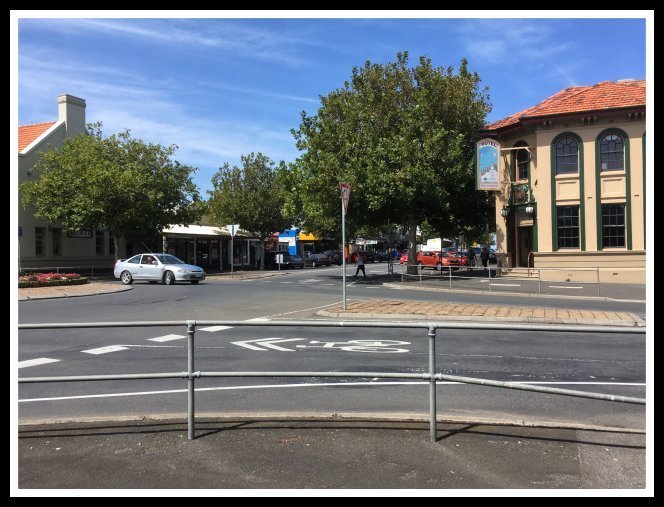
The Kepler St-Koroit St roundabout is in line for a $450,000 makeover later this year, in addition to new zebra crossings like those now operating in Liebig St.

Carol Altmann – The Terrier

How to save $700,000 in seven days, instalment #5:

On the same night Warrnambool City councillors decided to explore breaking the rate cap – on December 3 last year – they also agreed to spend $450,000 to spruce up a single city roundabout.

That’s almost half a million dollars to beautify just one roundabout – at the corner of Kepler and Koroit streets – and they did it without a hint of irony.


Not one of the five councillors who supported potentially raising rates above 2.5% (Cr Peter Hulin voted against and Cr David Owen was absent) seemed concerned that they expect ratepayers to choose between paying more for services, or having services cut, while they plunge money into non-essential projects.

Like dressing up a roundabout.
Mayor Tony Herbert was a strong supporter of the upgrade, saying Kepler St was the most important CBD street after Liebig St. Image: WCC

The council will draw $450,000 from the city parking fund – putting that fund into deficit – to upgrade the roundabout by the end of this year.

This is the busy roundabout outside the Warrnambool Hotel and Ishka etc, which is no doubt unfriendly to pedestrians in its current state.

But improving pedestrian safety (more about that in a moment) and a $450,000 makeover are two separate issues here.

Mayor Tony Herbert was particularly enthusiastic about the improvements because, he says, Kepler St is “the next most important” CBD street after Liebig St.


“It doesn’t matter who occupies businesses there, but I believe that is the next street to get the work done,” he told the meeting.

As it happens, Mr Herbert does occupy a business there, with his office smack bang in the middle of Kepler St, in the Wyton’s cafe precinct.
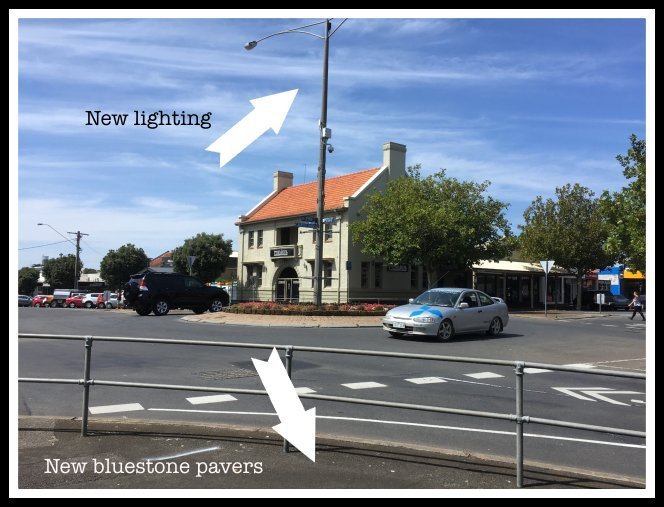
The $450,000 makeover at the Kepler St intersection will include bluestone pavers on each corner and new lighting in the centre of the roundabout.

Until last year, this intersection wasn’t even part of the city renewal plan, but it is now.

Now it will have bluestone paving wrapped around each corner foothpath and central lighting poles that allow for banners and decorations. (See the plan here).

The council calls this “high end aesthetic treatment” and there is no doubt it will be swish compared to boring old bitumen and basic lighting, but is it really necessary in a cost-cutting environment?

It’s a bit like fixing the electrical wiring in your house – for safety – and digging into your savings to replace all the light shades at the same time.


Because what started the momentum for this makeover was money from the Transport Accident Commission (TAC) to make the CBD safer for pedestrians.

The TAC will fund almost half of a $1.67 million upgrade to three CBD intersections, including the Kepler St/Koroit St roundabout.

The council will use that money to replicate those painful zebra crossings that are now in Liebig St and which make drivers give way to pedestrians as they enter and exit a roundabout.

(VicRoads, by the way, say this style of zebra crossing can work, but they also create a greater potential for rear-end accidents. But I digress…)
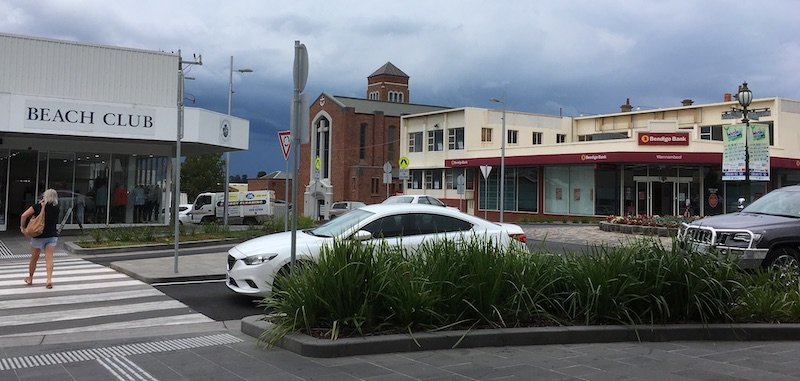
Love ’em or hate ’em, you’re getting more of them. The same style zebra crossings in Liebig St will be replicated at the Kepler/Koroit streets intersection and two others around the CBD.

Having secured money to build the crossings, the council decided to go one step further.

It rummaged around behind the couch and found a neat $450,000 to throw into beautifying the Kepler St/Koroit St roundabout.

Importantly, such a makeover would also create a distraction from the fact the council has run out of money for Stage 3 of the CBD renewal along Koroit St, which is not surprising given the other two stages blew out by more than $3 million.


So from not being part of the CBD renewal, the Kepler/Koroit intersection now has star billing.

In fact it will probably be all that happens along Koroit St between Kepler and Liebig St for some time.

Even so, can new pavers and lamps really be a priority when the council says it must save $700,000 a year from its budget?

It’s too late to ask that question because the beautification is going ahead.


Your input, via the council’s online consultation that opened last Friday, is to decide what else you might like to see added to the works and when you would prefer the 12-week project to start.

There is no option to say, um, we don’t want that style of fender-bender zebra crossing and, by the way, can we also save the $450,000 for something more important?

There is actually no mention of the $450,000 cost of the “high end aesthetic treatment”.

This figure remained buried inside the council agenda and minutes: until now.

More tomorrow.

If you would like to see The Terrier keep digging up, sniffing out and chewing on local issues, please make a small contribution below.

Donate


Is W’bool City Council a bloated boys’ club? The sums say yes.

Despite rate capping and a growing staff salary bill, life at the top of the Warrnambool City Council remains lucrative.

By Carol Altmann

Some time ago, a young Warrnambool lawyer who likes to crunch the numbers told me that our council was big, fat and bloated with an unsustainable salary bill for a city this size.

More recently, there has been a steady stream of people, all women, contacting me to say the council had turned into a dispiriting boys’ club, despite more women on the ground.

Having taken a closer look, I believe they are both right.

Let’s start with the bloat.

There are 731 people working at Warrnambool City Council (full time, part time and casual) and last financial year the cost to ratepayers was $31.5 million.

At the same time, the council collected $31.05 million in rates (not counting the $4.7 million waste management fee, which goes directly to providing a garbage service).

Look closely at those two figures again and you will see that every single dollar collected in rates  – $31.05 million – is equivalent to the amount needed to cover the cost of the staffing bill of $31.5 million. 


This financial year, the gap will widen.

WCC staff costs will jump by another couple of million to $33.2 million and rates, meanwhile, will bring in $31.97 million, which would actually not cover the bill.

With a cap on rates, something needs to give, and perhaps the first place to look is in the upper deck, where the salary packages are lucrative compared to those working at the grassroots.

According to figures given by the council to a parliamentary inquiry into rate capping, in 2016 the council had 21 senior officers each earning a total salary package of more than $120,000 a year – that equates to more than $2300 a week (before tax and including super, etc). 

This figure, by the way, doesn’t include the CEO, Bruce Anson, who has a package currently between $310,000 – $320,000.

When I asked the council if it still had 21 senior officers earning a total salary package of more than $120,000 a year, it was hard to get a straight answer.


Instead, it provided a convoluted response about the intricacies of the Local Government Act and a list that shows only seven senior council staff now earn a package of more than $130,000 a year, including the CEO and someone who does not report directly to the CEO, but who earns a sweet package of $145,000. (Who could that be?)

I am not sure where the other 15 staff have disappeared to, but I suspect they are still earning more than $120,000, and I suspect they are among the 22 senior people listed in the council’s “organisational structure” on its website, although I don’t know this for sure.

I can confidently say, however, that the vast majority of these big earners are not women, which brings us to the second point about the council becoming a boys’ club.

Leaving aside broader and worrying allegations that I have been receiving about how the boys’ club operates – I will save that for another day – I am going to focus simply on the numbers.


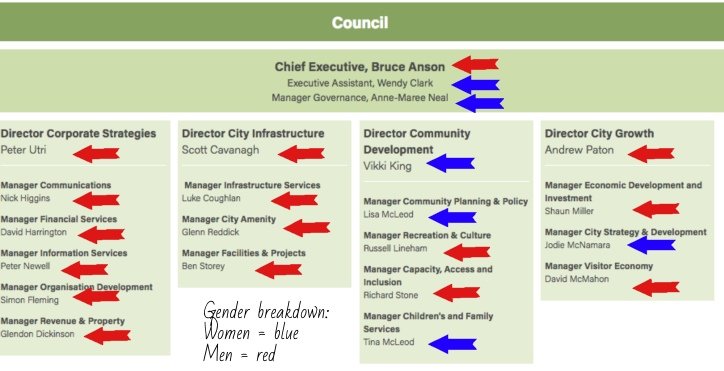
Check out the chart below:


As you can see, there are only six women in the council upper ranks, and only one, Community Development head Vikki King, holds a director position.

Two departments – Corporate Strategies and City Infrastructure – don’t have any senior women at all and City Growth has just one.


But wait, the council will say, we have more women than men on staff, which is absolutely true. There are 497 women, but only 227 full-time equivalent (45%), which means the majority are casual and part-time.

By contrast, there are 234 men, of which 163.8 are full-time equivalent – this is 70%.

As we all know by now, just having women around doesn’t make a place gender equal.

What really matters is what the women do, the positions they hold, and the influence they can wield (just ask the Federal Liberal Party) and, on this score, our council is seriously lacking.


If you are interested in transparency within government, visit The Guardian’s new The Transparency Project, which is exactly what journalism used to be about and can continue to be, thanks to donations, crowdfunding and partnerships rather than paywalls.

If you would like to support local, independent journalism, please consider making a contribution below. Thankyou to all of you who have already done so. 


Donate