Harbour plan needs cool heads and caution: Peter Ronald
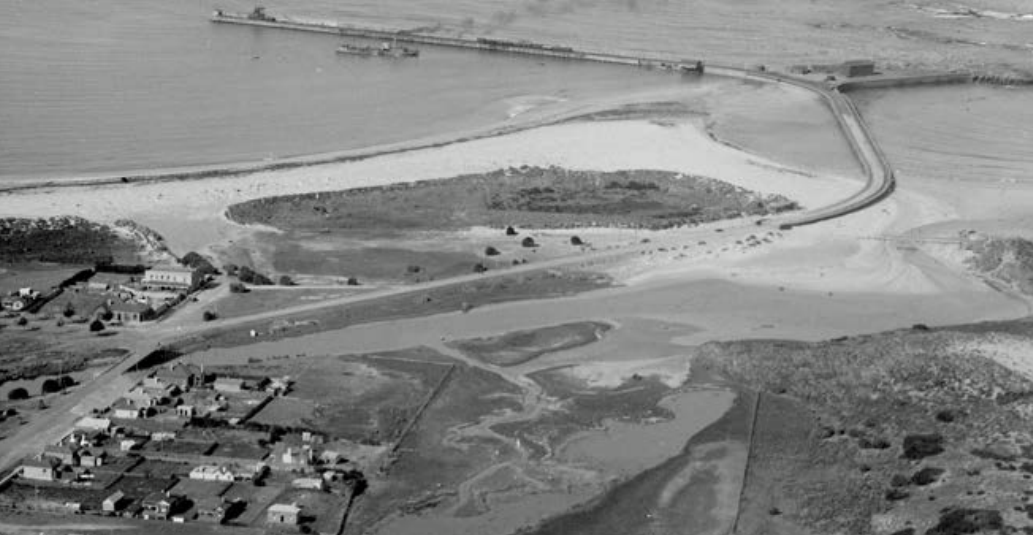
Lady Bay and the mouth of the Merri River, circa 1920s, when the viaduct was open between Stingray Bay and Lady Bay. Image: Lost Warrnambool/State Library.

Terrier guest writer – Peter Ronald*

The future of Warrnambool’s harbour has attracted growing interest recently and that is good to see, but it’s important that raw enthusiasm does not drown out sound judgement.

Good decision making on the harbours’s future will depend upon cool heads, questioning popular assumptions, and proceeding with great caution.

In the historical context, Lady Bay was never a great location for a port. The fact that European settlement occurred first in Portland, followed by Port Fairy then Warrnambool, is not accidental.

That chronology simply follows the relative suitability of each location as a serviceable port.

The lack of depth and associated siltation problems of Lady Bay were observed in the earliest days (well before the breakwater was constructed) and dredging was always going to be a necessary function. A greater limitation though, was/is Warrnambool’s exposure to the extremes of the Southern ocean.

Conditions beyond the breakwater can be, and frequently are, simply horrendous for boating.

In the days of coastal steamers, Warrnambool’s Harbour Master had the authority to close the port to all shipping movements, not because of conditions within the harbour, but because conditions across the open-ocean approach were too dangerous.

In spite of these things, it should be remembered that the breakwater has actually served its purpose.

The huge tonnage of cargo through the port was only possible through the construction of the breakwater and through the essential dredging within its lee. Nothing has changed. The depth and location of the entrance channel remain the same, sea conditions have the same degree of variability, the breakwater stands as it always has.

The key variable at play in the functionality of the port has been the extent and frequency of dredging.

The late Tom Wicking used to joke that when the old steam dredge would to go well out to sea to dump its spoil, the sand would make it back in before the dredge did!

A humorous exaggeration of course, but it served to emphasise the ongoing need for maintenance dredging. Maintenance is the operative word; the port continued to serve the needs of quite large ships for as long as the maintenance dredging was carried out.
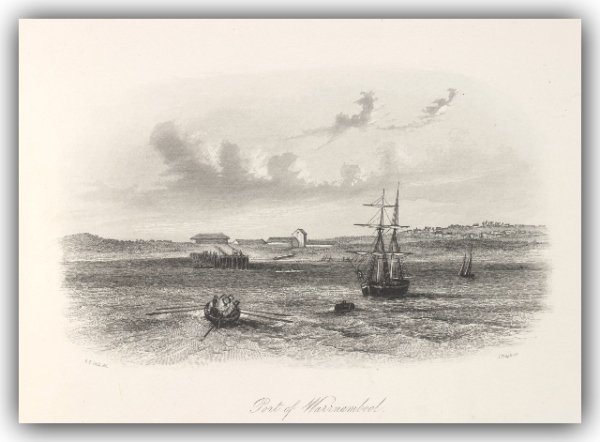
Port of Warrnambool, engraved picture by J. Tingle. Published by Sands & Kenny 1857. Image via State Library Victoria.

Just as we paint houses and mow lawns, we don’t shy away from these tasks just because they will need to be done again. The key point is this; no matter what level of port infrastructure we might like to add or subtract from Lady Bay, some level of maintenance dredging will still be needed.

As the late Edmund Gill explained; turbulent water carries sand and silt, but when that water is calmed the “cargo” is simply dropped. This truth is unalterable.

The primary interest in the port these days is for recreational boating via the boat ramp. I have about 50 years practical experience in boat launch and retrieval from Lady Bay and I refute the claim that the existing launch facility is unacceptably dangerous.

I have successfully launched a wide variety of craft over the years and never encountered a problem that was not of my own making. I have no doubt that the inexperienced, the bold and the stupid, will encounter difficulties!

This is particularly true when trying to launch in unsuitable conditions (as the inexperienced the bold and the stupid are prone to do). Given the frequently dangerous conditions beyond the breakwater, the key to safe seamanship around Lady Bay is simply knowing when to stay at home. It is not just a matter of inconvenience, the dangers are very real.

No other boat ramp facility in Victoria offers such immediate access to life threatening conditions. The total loss of life (drownings) within a 2km radius of the breakwater is probably unequalled anywhere in Australia.

In poor sea conditions it is true that the existing launch facilities are very difficult and risky. I would argue however, that this actually protects people from themselves.

The creation of an all-weather launch facility in Lady Bay would inevitably result in loss of life, simply by enabling people to put to sea when they shouldn’t.

This should not be interpreted as an argument to do nothing, but rather to illustrate the importance of fully exploring the consequences of any action.

There seems to be a popular view that, if only the launching and harbour facilities were improved, Warrnambool would become some sort of mecca for recreational (and even commercial) fishers. This is frankly a pipe dream.
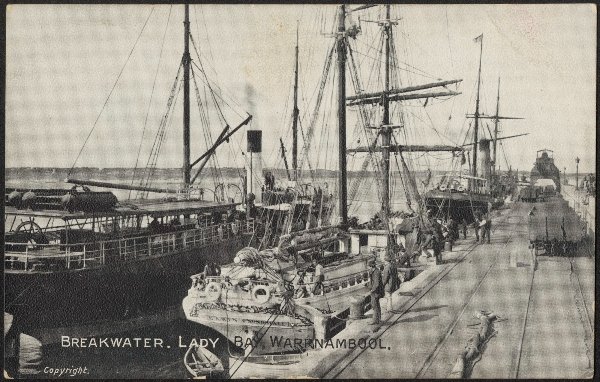
The Warrnambool breakwater in its heyday, circa 1907, when tall ships and steamers would frequent the port. Image: State Library Victoria.

Warrnambool’s true limitation in this regard remains the exposure to the elements beyond the breakwater, not inside it.

Given the comparatively tranquil waters in the lee at Portland and Port Fairy, Warrnambool will never be as attractive to recreational fishers as these other locations, no matter what launch facilities are on offer.

It is true that there is a large group of itinerant anglers eager to access blue fin tuna if and when that species comes within reach. It is also true, that a massive infrastructure overhaul of Lady Bay might just induce some of these anglers too choose to launch at Warrnambool. The question is at what cost?

Not just the budget necessary to completely overhaul our port, but also the cost to the people of Warrnambool through, for example, the aesthetic change that a fully enclosed harbour might bring, not to mention the potential of further traffic congestion and parking overflow.

Given the uncertain hope of attracting some short term visitors to spend a few days of the year in Warrnambool chasing tuna, the true cost/benefit of that endeavour requires some VERY close scrutiny.

Concerns have been expressed about the potential loss of our Lady Bay and its beaches through recent erosion and sand movement.

Certainly there are climate change considerations to be alert to, but it would be unwise to jump to conclusions just based on recent storm events. There are two things of note from the historical record.

Firstly, as previously mentioned, the navigational channel (found by aligning the two lighthouses at Flagstaff Hill) has remained unchanged in both depth and location since the 1840s. This confirms that whatever is occurring inside the breakwater and around the perimeter of the bay is having no impact on the vast bulk of Lady Bay.

Secondly, the beach shoreline has changed over the past 180 years through a cycle of erosion and deposition. Again however, from the historical record, we can see that the cumulative result has been a very substantial net gain.

The most recent erosion is exposing some interesting dating evidence; aluminium beer cans deep in the cut for example. This identifies very recent deposition of sand and dune formation.

No, we are not in imminent danger of losing our precious beach and no-one should panic, yet.

So, where to from here? Like everyone else, I have some ideas, but I don’t pretend to know the answers.

At a minimum, the ramps and associated boating facilities should be maintained, refined, and modernised where appropriate. The new fish cleaning station is a good example of what can and should be done.

In relation to dredging, surely there is room for some creative thought. A market for the dredged material, or even just a practical use for it, could help the cost benefit analysis considerably. Using the breakwater as the platform for dredging operations can significantly reduce costs and down time.

This was actually trialed once but the limitation was the reach of the equipment used. Perhaps some thinking outside the square might find some solutions to that.

If there is a problem of siltation in the immediate vicinity of the ramps, this could be easily dealt by prop blasting (using a boats propellor as an underwater “leaf blower”). It is a very simple technique  and has been successfully used in maritime archaeology and harbour maintenance for decades.

The technique is sometimes overlooked because of its simplicity but it works a treat; the bigger the boat(s) the more sand can be shifted, and very quickly.

In the final analysis, maybe some form of modest additional sea barrier will be appropriate.

In any case, however, the most important thing is to proceed with caution; unbridled enthusiasm can be a dangerous thing in relation to boating in general, and also in relation to harbour improvements in particular.

* Peter Ronald is a former director of Flagstaff Hill and a diver who specialised in shipwrecks.



After Budj Bim, how will we justify racehorses at Levy’s?

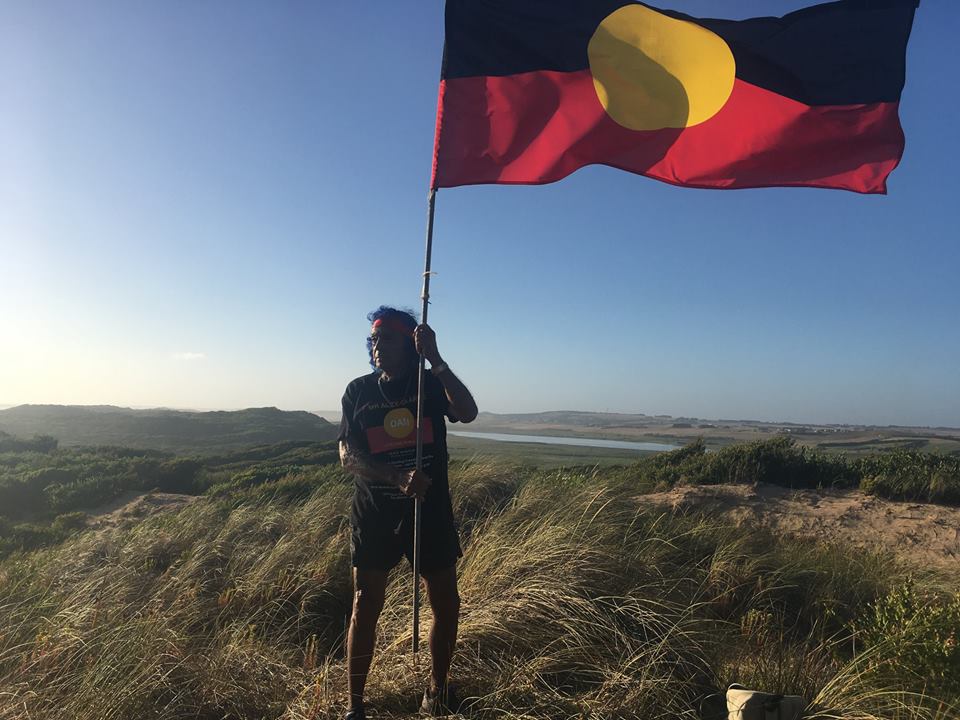
Uncle Alby Clarke, an 83-year-old marathon runner and well-known Warrnambool identity, is among the traditional owners fighting to protect Levy’s Point from racehorse training. Image: Belfast Coastal Reserve Action Group.

Carol Altmann – The Terrier

Once Budj Bim is declared a UNESCO World Heritage site, as is expected in July, how on earth will we justify large-scale racehorse training at Levy’s Beach?

What will we tell visitors from around the world who will travel – and believe me, they will come – to see our wild coastline and its incredible indigenous history, about racehorse training in a coastal reserve, as is due to happen from November?

“Oh,” they will ask quizzically, “so the traditional owners are okay with it?”

Actually, no, the traditional owners are not okay with it. They have never been okay with it, but we went ahead with it anyway.


Actually, we shall have to add, the Gunditjmara people said from day one that they did not want large-scale racehorse training at Levy’s Beach and Aboriginal elders are still fighting with all their might against it, but their voices were not enough.

In fact, we shall have to confess, the traditional owners were told they will just have to move their artefacts out of the way, as if they were a neat stack of objects lying on the surface like grandma’s best china.

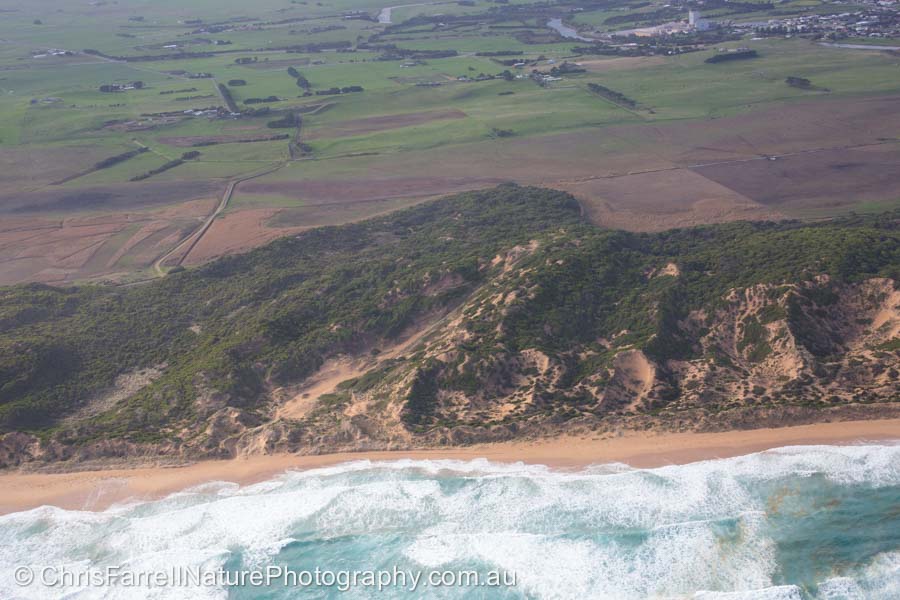
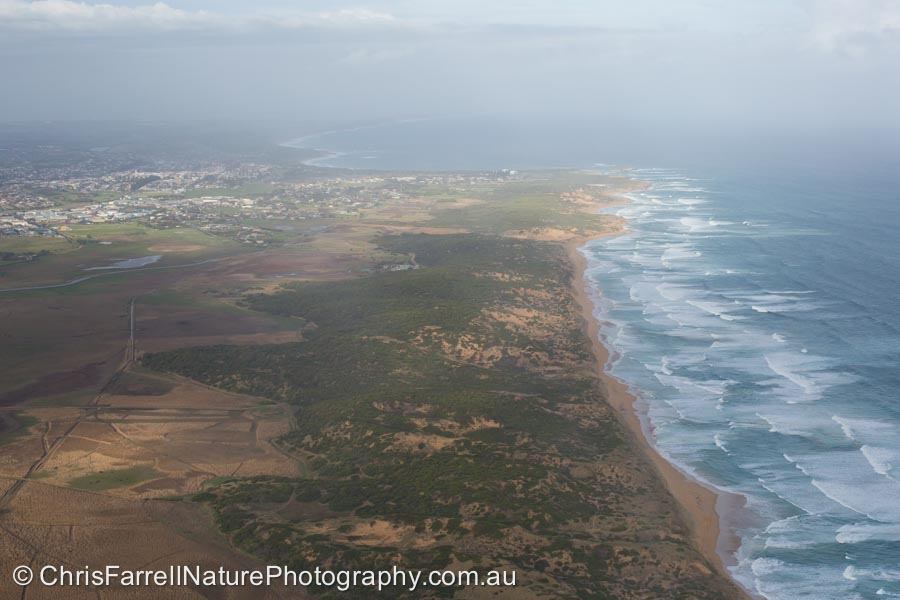
The stretch of Levy’s Beach on the Tarerer coast/Belfast Coastal Reserve, that will be open to large-scale racehorse training. This image was taken by Chris Farrell yesterday, May 25, 2019.

“Oh, but what about the spiritual and cultural connections that indigenous people have to this stretch of coast?” the curious will ask.

Well, we shall explain, they have been told to “share”, because the beach “belongs to everyone” and “sharing” has always worked so well for indigenous people in the past…

Honestly, how will we justify it? I can already feel the shame.

I am astonished that the resistance of the traditional owners to having up to 160 racehorses a day at Levy’s beach, five days a week, from this November was not enough to stop this plan dead in its tracks.


It is particularly astonishing given the Warrnambool City Council has embraced the significance of Moyjil/Point Richie, and is acutely aware of including indigenous stories in the future management of Lake Pertobe/Pirtup Killingk.

All fabulous stuff.

The WCC is also involved in developing a masterplan for the future of Tower Hill, which is yet another jewel in the rich indigenous history of our southern coastline that stretches from Moyjil, to Levy’s, to the Crags, to Deen Maar, around to Portland and the battlefields of the Eumerella wars, up to Budj Bim and Lake Condah.

We are sitting on a tourism mecca.

Make no mistake, indigenous and environmental tourism is the way of the future.

The stretch of wild Tarerer coastline that forms part of the Gunditjamra/ Eastern Maar story now receiving public recognition. Image taken yesterday, 25 May 2019, by Chris Farrell.

The UNESCO listing of Budj Bim/Mt Eccles will be a gamechanger and the State Government knows it, having allocated $5 million toward the next step before the listing is even final.

When it is confirmed, it will put Budj Bim up there with Kakadu, the Great Barrier Reef and Uluru.

And next month, coincidentally, globally celebrated indigenous opera singer and composer Deborah Cheetham will premiere a new work around the resistance wars that happened right here.

It will be Australia’s first indigenous requiem and it has been inspired by the terrible and tragic events during the colonial settlement of south-west Victoria that we are only now coming to understand.

All of this is unfolding around us in Warrnambool and yet, in Warrnambool, we are about to plonk large-scale racehorse training right in the middle, just a few miles from a beautifully kitted out racecourse and, of course, Lady Bay beach, where racehorses are already allowed.


Why?

Jobs? Really?

If that is the only justification (leaving aside the argument about the mental health benefits to the racehorses which, to me, must be the ultimate insult to traditional owners), then it is ridiculously short-sighted.

You can see racehorses and racetracks in dozens of countries around the world, but there is only one Tarerer coastline, one Levy’s, one Crags, one Deen Maar, one Moyjil.

These places are precious and irreplaceable and we are so fortunate to have them right here. They are a part of our future and what a wonderful future it could be.

The good news is that it is not too late to turn things around.

We can still ask our civic leaders to step back from making what will be a terrible mistake.


There is still time for our council, the State Government, and those in the racing industry who are pushing hard for access to Levy’s to respect the wishes of the traditional owners, to acknowledge that racehorse training can happen elsewhere, and to all work toward protecting this precious piece of coastline from further harm.

We can then hold our heads high as a part of the Budj Bim to Moyjil story – a story that goes back tens of thousands of years and is of global significance – rather than fumble for answers when we are asked to justify the unjustifiable.

So which path will we choose? Pride or shame? I know which path I want to be on.

Would you like to support The Terrier? Why not throw something into the tip jar? It all helps!

Terrier Tip Jar


To the lighthouse: a trip to Cape Nelson

cape nelson_shell
Nautilus: Looking up inside the 131-year-old Cape Nelson lighthouse which is still operational, but also open to the public.

By Carol Altmann

[dropcap style=”font-size: 60px; color: #A02F2F;”] I[/dropcap]t is with a hint of shame that I must admit that despite the Cape Nelson lighthouse being “just down the road” for 131 years, I have never got around to visiting it.

“You are not alone,” Rob Hunt says by phone, when I confess my failing.

Rob, who together with his wife, Margaret, leases and manages the Cape Nelson lighthouse precinct which includes unique accommodation, a cafe and the lighthouse itself, says most of their visitors come from well beyond south-west Victoria.

subscribe button10

“We get a lot of international guests, especially from Europe, China…who are looking for something different and something remote,” he says.

If people are prepared to travel tens of thousands of kilometres to see a place that is right on our doorstep, we thought it about time Bluestone drove a mere 90km from Warrnambool to just south of Portland and checked out the historic landmark in a spectacular landscape.

In the process, we uncovered the perfect day trip.

cape nelson_grant
Grant Wallace is one of several tour guides who provide an entertaining insight into the lighthouse, both past and present.

[dropcap style=”font-size: 60px; color: #A02F2F;”] P[/dropcap]ortland locals Grant and Carmel Wallace, together with son, James, have kindly agreed to act as our guides, which is extremely helpful because Grant is one of several tour guides at the lighthouse, so he really knows his stuff.

We start the day with what should have been an invigorating 3km, circular walk on the way to the lighthouse, the Sea Cliff Nature Walk, but there is so much to enjoy on the walk that it is impossible not to stop, look, smell and even taste, if the bush tucker berries happen to be out.

Best of all, the easy walk reaches its halfway point on a rocky outcrop that offers spectacular views across to Cape Bridgewater and makes you re-appreciate – all over again – the wild coastline that so defines where we live.

According to the Portland Tourism Association, this lovely walk was created in 1979 by Portland High School students, parents and teachers as the first bit of what is now the 250km Great South West Walk. It is well sign-posted off the Cape Nelson Road and you can download the Parks Victoria walking notes here.

Of course after a walk, comes lunch.

isabellas-cafe
The imposing lighthouse and refurbished frontage of Isabella’s cafe which overlooks the coastal heath. Image: Cape Nelson Lighthouse.

[dropcap style=”font-size: 60px; color: #A02F2F;”] T[/dropcap]he Wallaces whisk us off down the road to the lighthouse for lunch at Isabella’s, the beautifully refurbished bluestone cafe that was originally a stables and still has some bluestone flagstone flooring.

The cafe was the first thing to be revamped when Rob and Margaret took over the complex in 2008. They added a commercial kitchen, reglazed the front and employed former thespian, Steve Campbell, to run the place.

Steve, who still has the pliable face of an actor, adds a touch of style from the moment you step in the door, but this is not a stuffy, over-priced cafe. Instead it is cosy, affordable and offers great food including fish and chips (fresh flathead tails) to a gourmet, home-made chicken pie, to lamb kofta. (No wonder it averages almost five stars on trip advisor.)

Fed and walked, we make one final, quick detour before the lighthouse to look inside the cottage accommodation.

The side-by-side cottages were originally built for the assistant lighthouse keepers but, over the years, as Rob describes it, were “bastardised” into three units. As part of a painstaking restoration that finished in 2010, walls that had been pulled down were replaced. Fireplaces that had been closed off were reopened.

“We ended up doing a renovation in reverse: not fixing it, but taking it back to what it was,” Rob says.

The Hunts are now restoring the lighthouse keeper’s home for similar, boutique, unique accommodation.

cape nelson_view
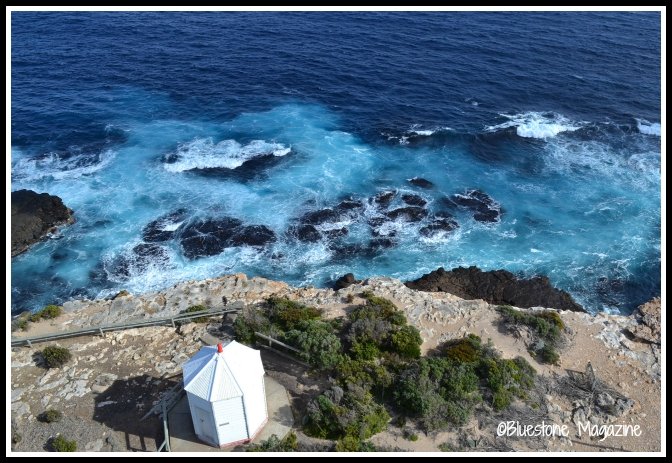
The view from the top – one section of the 360 degree panorama that awaits those who climb to the top of the lighthouse.

[dropcap style=”font-size: 60px; color: #A02F2F;”] A[/dropcap]nd so, to the lighthouse: the 32-metre tall, whitewashed wonder that has been safely guiding ships to the shore since 1884 and is still fully operational.

In this respect, it is a rare treat to be able to spiral your way into a working lighthouse, as most of those open to the public in Victoria have been decommissioned.

Whenever I am near a lighthouse, I always suffer from a mix of slight vertigo, awe and an inexplicable desire to quote passages from Moby Dick (if I knew any) and today is no different.

The lighthouse is in stunning condition, as solid as the day it was first built, with freshly painted railings and shining brass air vents and a visually arresting staircase that winds us up, up, up – like climbing the inside of a nautilus shell – until we pop into the light room.

Grant points out the globe that illuminates the world, well, at least our corner of it, and I won’t spoil that surprise…

He then heaves open an Alice-in-Wonderland-style door and we duck our heads, pass through, and step out.

Gasp.

Wow.

[box]The Cape Nelson Lighthouse precinct tours operate daily at 11am and 2pm, fees apply. Isabella’s is open seven days, from 10am-4pm, serving coffee, cake and lunch. Breakfast is also available from 10am on weekends. Licensed. For more information on the Cape Nelson Lighthouse precinct and bookings, visit the website here. [/box]

newsletter Eat And Drink StonesYou might also enjoy…

A trip to the top of Mt Elephant, Derrinalum

Climbing the cape at Cape Bridgewater

River camping is a shoe-in: Fitzroy River

More to Heywood than meets the eye


Take a seat in this Portland classic

clinton smaller jarrett
The feature fireplace in the Jarrett-van Roo’s Portland home incorporates a cornucopia of materials – crazy slate, marble, burnished copper, granite and timber!

Bluestone columnist and architect CLINTON KRAUSE previously worked in Daylesford before relocating his business to Warrnambool. Clinton explores the architectural styles that gives our region so much character. Visit his website here.

This month my search for great mid-century architecture takes me to Portland to the home of Jack van Roo and Megan Jarrett who not only live in a very stylish Tag Walter creation, but are also proprietors of ‘be seated’ a boutique business specialising in the sourcing, restoration and sale of retro furniture and décor.

The house was originally designed for Megan’s grandparents, Theo and Jean, in 1962 and demonstrates an elegant refinement and maturation of Tag’s signature style.

The entry to the home is a carefully orchestrated ‘theatrical’ experience – the large welcoming porch reveals a number of ‘tricks’ to delight the senses and create an atmosphere of intrigue: walls of glass frame tantalising glimpses of the interior, or draw the view out over the large elongated pond and towards the garden beyond.

Planter beds filled with ferns and exotic foliage flank the terrace and create a ‘tropical’ bridge to the front door.

Inside the front door numerous original features continue the theme. Seagrass-wallpaper feature walls, ceiling bulkheads with concealed pelmet lighting, the centrepiece fireplace with its bewildering fusion of copper, granite, marble stone and timber.

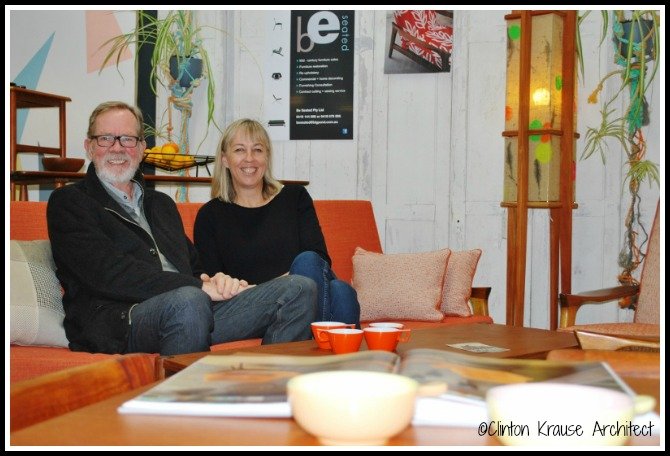
Jack and Megan Jarret reclining in the be seated showroom
Jack van Roo and Megan Jarrett have combined their individual talents with furniture and fabrics, not only in their business, but their home.

With an extensive background in interior design, textiles and furniture restoration, Jack and Megan are the ideal homeowners and the interior spaces are filled with funky armchairs, well-mannered Danish teak tables and sideboards and original era paintings and prints.

Megan recalls visiting her grandparents at early age and being spooked by the bedroom curtains with their large garish brown rose pattern – perhaps a precursor that has sparked her interest in textiles and fabrics!

One of my favourite areas of the home is the outdoor entertaining terrace. With its stone terrazzo tiles, breezeblock screen wall, innovative built-in outdoor bbq  and brightly colored ‘butterfly ’chairs, this composition pays homage to some of the great innovative concepts of the time by architectural heroes such as Richard Neutra and Quincy Jones.

The 5 dollar featherstone find of the century
The $5 dollar Featherstone find of the century. Such chairs are normally sold for thousands at auction houses.

During our interview Jack tells me of some very special items of furniture that they are currently working on, so we decide to pay the ‘be seated’ workshop a visit.

Entering through the tradesmens’ door, I am  completely unprepared for the sight before me – a vast cavern stacked high with row upon row of retro gems, some a little shabby, some very much worse off for wear.

We push into the melee towards the ‘holy grail ’ of the retro afficianado – and there they are!!!

A stunning pair of original Grant Featherstone armchairs complete with the original cut velvet upholstery. Rarely seen outside the auction house or museum, these chairs represent the pinnacle of design innovation by Australian designers of the modern period.

Jack takes an almost macabre delight in informing me that the owner paid just $5 each for these chairs at a recent garage sale………..

An Aladdins cave of retro wonders!
The ‘be seated’ workshop in Portland is an Aladdin’s cave of retro wonders.

We conclude our visit with a tour of the ‘be seated’ showroom to view the latest items lovingly restored and repurposed.

It is clear that the couple make a good team – with Jack’s considerable joinery and reupholstery skills and Megan’s eye for colour , texture and pattern in the selections of  rich fabrics used to give these pieces a new life.

Once again I leave my visit with the van Roo-Jarretts reassured in the knowledge that not only is another great retro style home in good hands, but there is also a thriving business in our region that is actively preserving the furniture and décor of this innovative era.


Clinton-Krause


A fence full of happy soles at Tyrendarra

shoe fence katrina maybury
Katrina Maybery with the ‘shoe fence’ that started by tying just four pairs of shoes to her front fence in Tyrendarra. Image: Bluestone Magazine.

Words and photos: Carol Altmann

[dropcap style=”font-size: 60px; color: #ABCCAB;”] T [/dropcap]he most famous “online” shoe display in south-west Victoria is strung out along a farm fence in Tyrendarra – but how did it start?

Bluestone decided to take a detour while returning from the gannet gawk-and-talk in Portland to find out and, despite turning up unannounced, was given a cheerful welcome and the full rundown by owner Katrina Maybery.

Katrina and her husband Heath live on the Princes Highway property with their two daughters Tahlia and Madeleine, and it is with Tahlia and Madeleine that the story begins.

“We were travelling in New Zealand and saw a fence like this, with shoes tied right along it, and I thought it would be a fun thing to do,” Katrina says.

“So we started it about four years ago, by tying four pairs of worn out shoes owned by our girls.”

The four pairs of shoes became a sort of Pied Piper for passers-by, silently urging them to follow suite and tie up one of their own pieces of footwear.

And they did: by the hundreds.

“I think we would have at least a couple of thousand,” Katrina says with a laugh as she surveys the layers of dangling shoes.

“I know that we have to keep mowing the lawn further and further along!”

shoe fence
Many of the shoes have been decorated or carry messages for those passing by. Image: Bluestone Magazine.

[dropcap style=”font-size: 60px; color: #ABCCAB;”] I [/dropcap]n only the way that shoes can, the fence captures a thousand stories behind the boots and heels, thongs and sneakers, slippers and gumboots. They are in all shapes and sizes – from steel capped work boots to a child’s slipper – and together form a piece of art that is always changing.

“Some people have decorated theirs before hanging it, others leave messages on them for someone they know will be passing by,” Katrina says.

Even as we talk, a man pulls over to take a snap of the fence before waving a cheerful “hello” and driving on.

From the hundreds of shoes that have been donated, there have been some standouts.

“We had a pair of cowboy boots once. They were beautiful, but somebody stole them off the fence,” Katrina says.

“And there was fellow who was closing his shoe store in Port Fairy and he bought out boxes of shoes and boots that he couldn’t sell because they were a bit dated, but he also didn’t want to throw them out – that’s some of them over there,” she says, pointing to a pair of women’s boots with pristine soles.

shoe fence_long
Soles and tongues and laces for as far as the eye can see. The fence now holds several thousand pieces of footwear. Image: Bluestone Magazine.

[dropcap style=”font-size: 60px; color: #ABCCAB;”] I [/dropcap]n a lovely twist, Katrina once ran a home-based, online shoe store specialising in children’s shoes but life became too busy to keep it operating. The sign for her business now hangs on the fence as quirky joke.

The shoe fence, which is directly opposite the turn-off to the road that leads to the Fitzroy River campground, is part of Katrina’s push to better promote Portland to tourists.

Just recently, a huge promotional road sign for Portland has been erected on the Maybury property, with their blessing.

“I think the Portland area has so much going for it and I am doing what I can to promote it to visitors,” Katrina says.

There is no doubt that the shoe fence is doing its bit to get tongues wagging.

subscribe

newsletter Art Music StonesYou might also enjoy…


What is holding Portland back?

A cafe that feels like coming home: Tea Tree Gallery

Pick a Pickled Pelican in Portland

River camping is a shoe-in

Secrets of an old shoe: unearthed from Timor St

Reviving classic Australian furniture by hand: Be Seated