Why is Lyndoch so paranoid about public scrutiny?
Lyndoch Living is owned by the community, but it appears that not all community members are welcome to join.

Carol Altmann – The Terrier

I have been asking this question for several months now, but what has Lyndoch Living got to hide?

The latest act of apparent paranoia is a blanket rejection of everyone who recently applied to become members of Lyndoch.

Not one person, it seems, made the cut.

Let’s be honest, my application was never going to be accepted, despite my own personal connection with Lyndoch as someone who had a parent in its care for 10 years, because I have made it clear through The Terrier that I intend to dig deep into its priorities, direction and its care for staff and residents.

But others have been rejected too.

In fact, from what I am hearing, those who had their applications rejected include a local GP, a retired business journalist, a former high school maths teacher, a former international school librarian, a former small business owner…

According to the Lyndoch board, not one of these people was considered up to scratch.
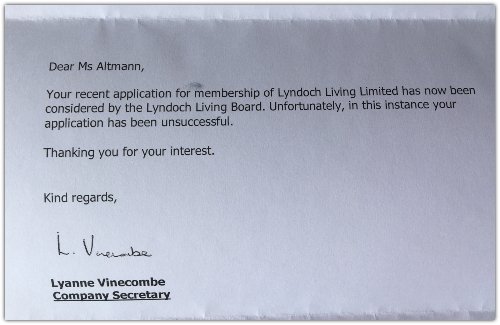
The Lyndoch rejection slip: expected in my case, but others have also failed to make the cut.

I am not sure what selection process was used, as the board is under no obligation to give its reasons for saying ‘no’, but the fact every single application was rejected suggests that there was no process.

Instead, it was most likely based on whether the applicant knew me, or liked The Terrier on Facebook, or commented on a story, because Lyndoch doesn’t want anyone creeping into the tent who may make life uncomfortable by asking tricky questions, or, heaven forbid, stand for the board.

That would mean a loss of control, and control, in the current climate at Lyndoch, is everything.

What we should have is a fully transparent organisation with a broad cross section of members – the more, the merrier – because Lyndoch is owned by the local community.

I will say it again: the community owns Lyndoch, not the small group of people who are now refusing to let anybody else in the door unless, it seems, they are hand-picked.

Among the existing 16 members of Lyndoch are company secretary Lyanne Vinecombe, chair Kerry Nelson, CEO Doreen Power and Director of Nursing Julie Baillie. Image: Lyndoch Living.

As it stands, there are just 16 members of Lyndoch, including the nine-member board, the CEO, some senior executive staff and a couple of life members.

This might be perfectly acceptable if other platforms of scrutiny had not been removed as part of recent changes to how Lyndoch operates.

These changes, of course, were approved by the existing members. Most of us didn’t even know it was happening, yet the way Lyndoch had operated for decades would be no more:

As of last year, the Lyndoch annual reports are no longer available online.

As of last year, the Lyndoch annual meetings are no longer advertised to the general public.

As of last year, vacancies on the Lyndoch board no longer have to be advertised.

We don’t even know, until Lyndoch is compelled to report to the Australian Charities and Not-for-Profits Commission later this month, whether it made a surplus or another deficit in 2019.


So much for being open and accountable to the community.

Inside the Lyndoch tent, the clamps are also coming down.

A new policy from the CEO Doreen Power prevents Lyndoch staff from approaching the board directly and declares all communication to the board must be made via the CEO.

Even then, staff can only talk to the board about policy matters.

Again, this might be fine except for when, hypothetically speaking, the problem is with the CEO.

What does a troubled staff member do then?

Well, they might come to The Terrier, where there is at least a place to be heard outside of the Lyndoch cabal.
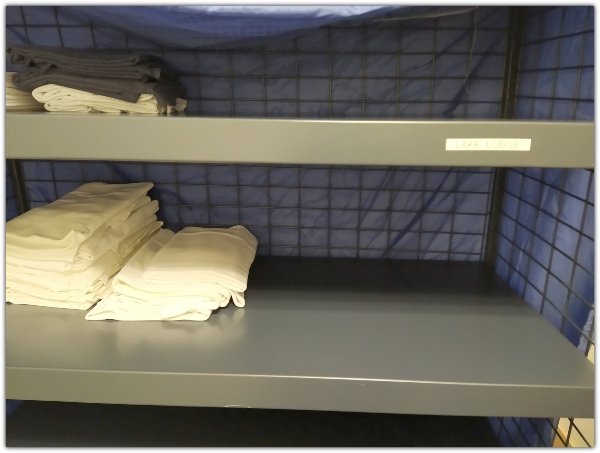
A shot of one of the depleted linen shelves inside Lyndoch last year. Some staff took to tearing up old towels to use for face washers.

As readers know, a lot of people concerned about Lyndoch have come to The Terrier to talk about all manner of things.

This includes the on-going shortage of staff – with one RN on night duty across the whole of Lyndoch – or the shortage of linen that saw staff cutting up old towels to use as face washers.

Or they have come with concerns around the huge number of staff that had left the organisation in the past four years – up to 80 people from right across Lyndoch, with many leaving distressed and disheartened.

Or they are worried about how Lyndoch could afford to buy two existing medical centres and have the funds to build and operate a brand new medical centre when, at the end of the day, it is supposed to be focussed solely on looking after the frail.

These are all good questions that deserve to be fully scrutinised and, with your help, that is exactly what I will continue to do in 2020.

Did you apply to become a member of Lyndoch? Send me a message to tell me how you fared. If you would like to apply, here is the form.

If you would like to help keep the Terrier typing, please throw something in the tip jar below. 
The Tip Jar


Doubles: WCC allows senior managers to hold private jobs

A senior Warrnambool City Council manager is also working for a private company that is going global with a camera to stop mobile phone use while driving. Image: tehran-today.

Carol Altmann – The Terrier

When you dig into the Warrnambool City Council, it’s amazing what tumbles out, like a full-time, senior manager having a second job outside of the council.

The manager is earning more than $100,000 as a senior public servant, but also, at the same time, is working for a private company – all with the approval of the council.

As such, the manager in question, WCC Economic Development and Investment head Shaun Miller*, makes no secret of his second job, which he started in March and which is listed on his Linkedin profile.

It’s with an Australian-based group called Acusensus, which has developed a world-first camera system to detect people using their mobile phones while driving and, it is hoped, reduce road accidents as a result.

It is a great idea and Acusenus, it is fair to say, is on the cusp of something very big.

It recently hooked up with the NSW Government to supply these cameras, and is rapidly building a network of global contacts.

No wonder it has been on a hiring spree, and Mr Miller has jumped on board as its International Business Development Manager.

Mr Miller also knows some of the guys at Acusensus, including its chair Ravin Mirchandani, who he worked with before his days with the WCC.

As I say, Acusensus and Mr Miller make no secret of any of this, with the company making a public announcement when Mr Miller was hired.

Acusensus announced in March its appointment of WCC Economic Development and Investment manager Shaun Miller. Image: Acusensus.

Having said that, the announcement makes no mention of Mr Miller working for the Warrnambool City Council – it skips over that bit.

Mr Miller was refreshingly frank – if brief – when I asked him about this second job.

“In response to your email, I work 7.6 hours a week for Acusensus.

“This does not impact on my council role.”

So, as is often the way with the goings on inside the WCC, Mr Miller is not doing anything the council has not allowed him to do.

He is not breaking any council rules: we just don’t know what those rules are.


I have no doubt Mr Miller is able to separate his roles entirely, but boy, it raises some questions as to why the council would think this was okay.

The most obvious is: how does the council keep an eye on such second jobs?

How does it keep an eye on whether a manager is spending council time working on council business, or on private business?

What about all of the contacts and insider knowledge the manager builds through council work – and for which he/she is paid handsomely by ratepayers – which could be of use in the private business?


And what if, in six or 12 months time, the manager jumps ship for the now well-and-truly-established private job that is far more appealing than the council job?

In some circles this is called hedging your bets.

Again, I am not suggesting  Mr Miller is anything but stringent in separating off his 7.5 hours with Acusensus, but these broader questions still need to be asked.

And so I asked them.

I asked the WCC spokesman Nick Higgins on Tuesday if it was normal for senior managers – or any full-time council staff for that matter – to be given approval to have another job?

The answer?

Silence.

Crickets.

Bat + Ball + Home.

It appears The Terrier is not allowed to ask questions – or expect answers –  about anything connected to the $34 million of ratepayers’ money spent on staff.

(Actually, it appears since the credit card scandal – which I will return to in coming days – I am not allowed to ask about anything at all, sorry readers.)

In the absence of any official explanation, we will have to assume the council has a firm policy to cover second jobs, which is what government authorities suggest councils do if they intend to go down this complicated path.

And if it doesn’t have a policy, it might be writing or reviewing one right now. I wonder if it will be made public?

*Mr Miller was mentioned in dispatches as part of the WCC group that visited Flemington for four days for, we assume, a Victorian tourism conference and, for one WCC staffer at least, most likely a day at the races. This story sent Terrier readers off down the rabbit holes to find out more, which is where the Acusenus job came to light. Good digging.


The people say “no” to plan for $600 market trader levy

The Terrier – Carol Altmann

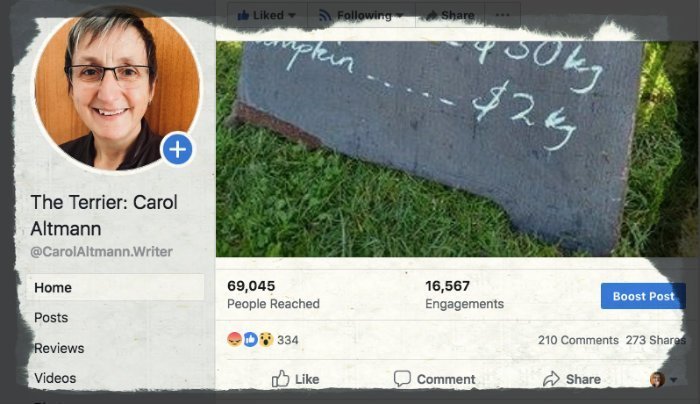
Last week, The Terrier Facebook page did an unintended, free poll for the W’bool City Council on its plan to whack market stallholders with a new $600 a year fee to set up their trestle tables and tents.

The post exploded.

The Terrier is a one-person operation, so this sort of response to a single post is incredible.

It sends a very clear message and it is one we all hope the WCC hears with ears wide open: we have had enough of the constant asking for more of our hard-earned dollars without one shred of solid evidence or justification.

Despite promises, Mayor Tony Herbert is yet to provide any examples of a permanent city trader who pushed for this levy.

Mr Herbert has also not explained why, after operating successfully for years, the fresh markets are now considered a public health risk that this new fee would help “monitor”.

(Btw, stallholders have to meet food standards, pay insurance and, usually, pay a fee to the market organiser.)

The council has also not explained why local market stall holders should pay $600 a year, yet big outfits like Jurassic Creatures plonked themselves at Lake Pertobe for a month over summer without – I have learned – paying one dollar in permit fees.

It is unfair. It will kill the local market scene and it will not make one iota of difference to the CBD traders struggling to come back from a street upgrade that ran a cool $3 million over budget and still relies on paid parking.

So here you go WCC, the feedback is in and the people have spoken. Let’s see what happens next.


Giant trees saved for now, but what happens next?

By Carol Altmann

Phew, that was close. Two of Warrnambool’s oldest street trees have been temporarily spared from being chopped down by the Warrnambool City Council this weekend, but the fight is far from over.

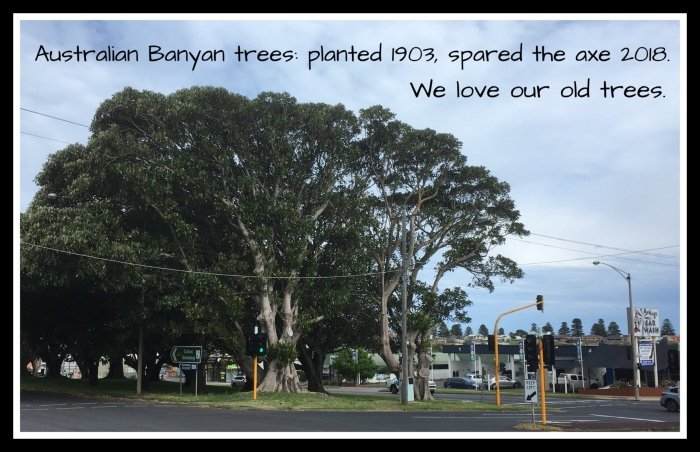
The two, 115-year-old Australian banyan trees on the corner of, yes, Banyan St and Raglan Parade are not yet saved, but thanks to people power, the pause button has been pressed.

Let’s look at what just happened and what happens next.

What happened was the council falsely and arrogantly believed that it could destroy these two magnificent trees that have been alive longer than any person on the planet and nobody would really care.


It also believed that consulting the public meant putting a media release on its website, sending this to the local paper, and contacting a few nearby property owners – all just 10 days before the chainsaws moved in.

Lastly, it hoped that we would blindly accept that these trees had to be chopped down because they were causing car accidents, that they were bubbling up the footpath and that the whole avenue of trees would actually look better if these two trees were gone.

To say the council was wrong on every single count is an understatement.

More than 2000 people signed an online petition within four days to stop this massacre. The petition, started by local Scarlett Patrick, is still going strong.

People were furious. They were furious because their heritage was about to be ripped out (again), that our precious old trees were being treated with contempt, that nobody had a chance to offer an opinion or an alternative, that not one single elected councillor was jumping up and down in outrage, and that the justifications being rolled out just didn’t make sense.

The trees, as we all know, are not causing car accidents at a big intersection that has traffic lights. They are not causing drivers to rear-end each other, or to turn too soon, or too late.

VicRoads knows this and I asked them, just to be sure, if they had expressed concerns to the council about the old trees.

They hadn’t.


What VicRoads did do, however, was offer to pay for a new footpath if the council decided to pull out the trees:

“VicRoads (Regional Roads Victoria) is responsible for the maintenance of the footpath in the Princes Highway median, and has, as a result of the Council’s plans to remove the trees, agreed to fix any damage to the footpath,” a spokeswoman said via email.

The footpath under the big trees is getting rough, just like those at the Warrnambool Botanic Gardens, but there are many ways to improve this and, just to be on the safe side, there is another, perfectly flat footpath just 2o metres away on the other side of the road.

Locals know this, they can see it for themselves.

(They can also see the broken stump of a traffic and pedestrian light that has been sitting there for weeks, wrapped in orange safety tape, waiting to be replaced.)

Picking up on the angry mood, the council has now switched tack.

You’ve got it all wrong folks! The priority was not about traffic accidents and footpaths, but actually improving the full avenue of Australian banyans/Moreton Bay figs along Raglan Parade.

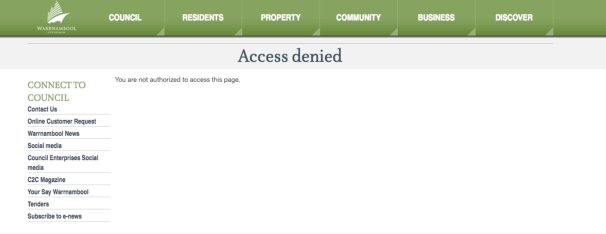
The original media release has been taken down from the council website (see above), but this is the opening line of a statement sent to me this week:

“Council’s intention in proposing to remove these trees was to address issues associated with aesthetics of the boulevard which had been impacted by heavy pruning of the two trees as part of power line and signal clearance works, other considerations included pedestrian access and visibility at the intersection.”

So you prune the trees so harshly that they look ugly, then you get rid of them because, hey, they look ugly.

Oh boy, we are back in George Orwell territory again.

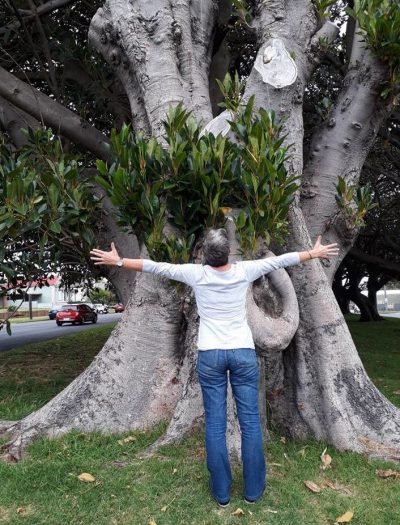
Self-confessed tree hugger with the 115-year-old banyan tree.

The good news is that the council says it will now consult more broadly. When and how, we still don’t know, but it has decided to bundle the issue into its response to another petition, received in April this year.

That petition, signed by 19 residents, asked to have some native trees planted on the median strip in the southern end of Banyan St, between Timor and Merri streets.

Thanks to Scarlett Patrick, you, and more than 2000 other people, these 19 residents now have a whole lot more clout and the two Australian Banyan trees have a second chance.


More broadly, the council has been given a wake up notice that people are watching, that they do care, and that we need a better policy on how we manage our precious urban forest.

The Lorax would be proud.

[You can sign the petition here.]

 If you would like to keep seeing more pieces like this about local issues, please make a small contribution below.

Donate


Could we play our own Trump card?

US President Donald Trump rose to power largely on the back of shallow slogans and thin policies: could we see a similar ascension here? Image: Business Insider.

By Tom Waterwheel*

Australians seem to view the rise of Trumpist populism with bemusement and alarm.

The daily trainwreck of Donald Trump and his advisors keeps the political junky on high alert.  As if the Trump Bull-in-a-China Shop was not entertaining enough, we now have puppet master Steve Bannon, the anti-intellectualist Sean Spicer and Dial-a-fact Kellyanne Conway sharing the burden of spreading hate, pseudo facts and fear around the globe.

Trump is no lone ranger.  For the price of one, the US, and by extension the world, got Trump and his posse of war-mongering deadbeats, who now occupy the White House because of the collective brain-out of 63 million Americans.  Most may by now regret this, but the race was run and won on November 8, 2016 and on that day, too many Americans put number one next to the man who unashamedly campaigned on lies, sexism, racism, war-mongering and plain dumb economics.

The question is: could it happen here?

Trump tapped into a nationwide attention deficit disorder.  For whatever reason the punters en masse didn’t take the effort to read politics beyond a 140 character tweet.  Those of us left bewildered by what we have seen blame Facebook, Twitter, I’m a Celebrity get me out of here, the media etc..

None of that matters.  Trump and Clinton faced an increasing number of voters who do not do policies.  Instead, they want solutions, quick, easy and on a plate; and on that front Trump was their man.

Where Clinton had thoughtful and considered responses to the challenges facing the USA, Trump had solutions and a little abuse thrown in, 140-characters-or-less.  Few of which made sense.  But at least Joe Punter heard the solution with little effort. (And he is still at it).

In Australia, we have seen politicians tread down this same path.  The 2013 election where Tony Abbott prevailed, was characterised by fear politics.

On the specific policy issues of asylum seekers and climate change, Abbott blazed a trail that Trump made a highway.  Whenever a microphone is close, these ‘leaders’ simply repeated the mantra that progressive policies on asylum seekers and climate change will take jobs away from middle Australia/America.

Trump and Abbott on asylum seekers: “stop the boats”, “build a wall”, “stop the boats”, “build a wall”.

Trump and Abbott on climate change: “great big tax”, “Chinese conspiracy”,  “great big tax”, “Chinese conspiracy”.

Abbott handed the baton to his neo-conservative colleagues across the Pacific, and run with it they did.

But as we witnessed, Abbott’s ill-considered neo-con policies did not wash with everyone in his party and his stay at the Lodge was cut short.  Perhaps Trump’s stay will be short too, however the US political system does not work as does ours, with leaders not so disposable.

Like a phoenix rising from the ashes, Pauline Hanson’s political career has been resurrected. Image: Alchetron.

Our own redhead, Pauline Hanson, is our closest version of Trump and it is when we look to her appeal and increasing popularity that we see Trumpism alive and well in Australia.

What is telling about the Hanson effect, is that she, like Trump, appeals to a scattering of the disaffected across the political spectrum from the far right to the traditional working class left.  She, like Trump, speaks to their frustrations, often to their yearning of the old days, when unskilled jobs were seemingly abundant and Australia was by and large a white, Christian society.

Fear is one of our greatest motivators and Pauline does fear well.  Furthermore, times are tough for many, and as the USA has experienced over the last decade, the winds of global competition can be unforgiving, and we in Australia are now starting to feel its effects.

In a connected world where capital moves freely across the globe, old stable economies such as Australia, have much to lose.  To deal with the acceleration of change, be it capital inflows and outflows, refugees, climate change and so on, requires intelligent, considered responses.

We have seen little of such, indeed the short-term opinion poll obsession of our major political parties suggests the established political class are more focused on short-term survival over long-term intellectual policy, leaving the door ajar for the Prophets of Doom.

So here we are, mid 2017.  The UK has lurched towards nationalism in an increasingly global world; the USA has fallen for anti-intellectualism in an ever more complex and sophisticated world; and the French, as did the Dutch, looked closely at following the far-right option.

This at a time when more than ever refugees are escaping poverty, war and political and religious persecution.

When unemployment goes up, so does the appeal of neo-conservative approaches to climate change and asylum seekers. Image: FrumForum.

As it stands, one important ingredient is missing in Australia to cook up a Trump Stew: high and long-term unemployment.

Australia’s unemployment rate is 5.9%.  Australia is yet to swallow the bitter medicine of a changing world economy where jobs are replaced by robots, computers and machines and unskilled labour exported off shore.

Rest assured, however, it is coming and recent history demonstrates that Australian politicians offer little in the way of long term policies to enable Australia to adapt to an ever changing world.   If Australia’s economic fortunes nose dive and unemployment tilts up, a reactionary politician may be the sole beneficiary.

Our seat of Wannon doesn’t follow national trends: its voters are unquestionably loyal to the conservatives.  Wannon will go where the Liberals take them.  If Canberra judges a hard right Trumpist is needed to lead the Coalition, then of course they could expect to count on the vote of the Wannon constituents to support them.

Having witnessed Trump in full flight, would we be wise enough to stand up and say no?

* Tom Waterwheel is the pseudonym of a local political observer and agitator who, because of the constraints of his day job, cannot write publicly under his own name.