Harbour plan needs cool heads and caution: Peter Ronald
Terrier guest writer – Peter Ronald*
The future of Warrnambool’s harbour has attracted growing interest recently and that is good to see, but it’s important that raw enthusiasm does not drown out sound judgement.
Good decision making on the harbours’s future will depend upon cool heads, questioning popular assumptions, and proceeding with great caution.
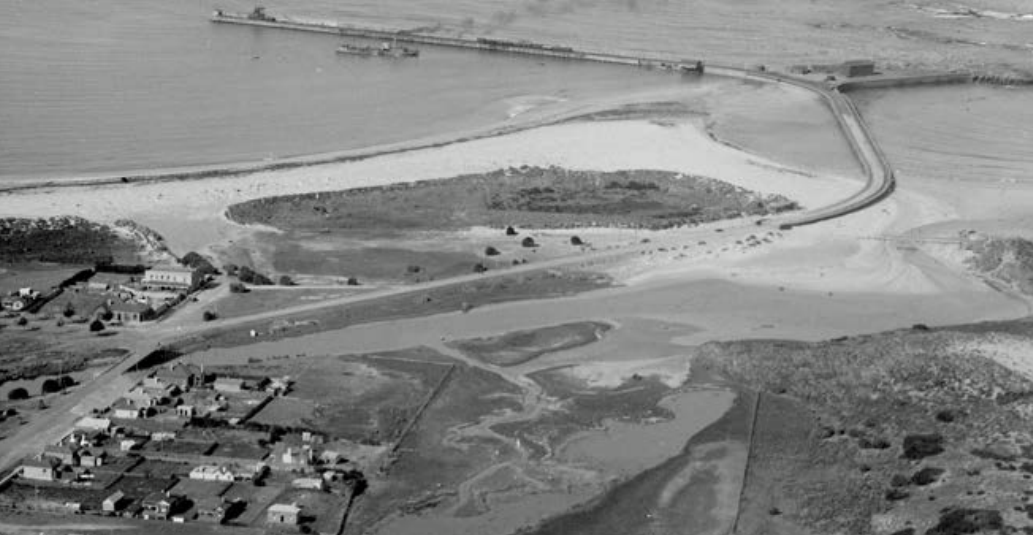
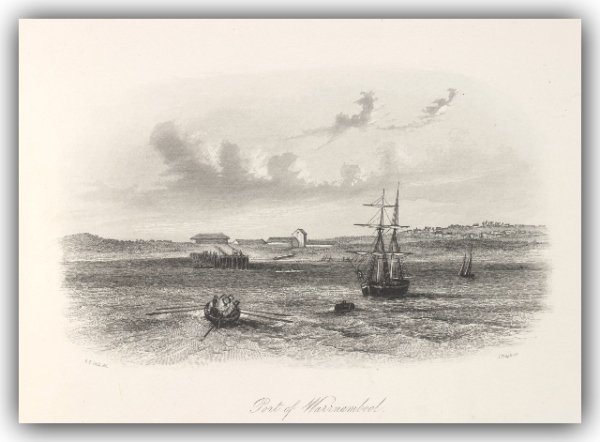
In the historical context, Lady Bay was never a great location for a port. The fact that European settlement occurred first in Portland, followed by Port Fairy then Warrnambool, is not accidental.
That chronology simply follows the relative suitability of each location as a serviceable port.
The lack of depth and associated siltation problems of Lady Bay were observed in the earliest days (well before the breakwater was constructed) and dredging was always going to be a necessary function. A greater limitation though, was/is Warrnambool’s exposure to the extremes of the Southern ocean.
Conditions beyond the breakwater can be, and frequently are, simply horrendous for boating.
In the days of coastal steamers, Warrnambool’s Harbour Master had the authority to close the port to all shipping movements, not because of conditions within the harbour, but because conditions across the open-ocean approach were too dangerous.
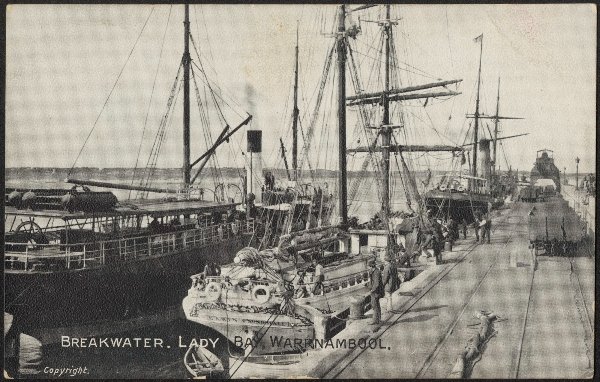
In spite of these things, it should be remembered that the breakwater has actually served its purpose.
The huge tonnage of cargo through the port was only possible through the construction of the breakwater and through the essential dredging within its lee. Nothing has changed. The depth and location of the entrance channel remain the same, sea conditions have the same degree of variability, the breakwater stands as it always has.
The key variable at play in the functionality of the port has been the extent and frequency of dredging.
The late Tom Wicking used to joke that when the old steam dredge would to go well out to sea to dump its spoil, the sand would make it back in before the dredge did!
A humorous exaggeration of course, but it served to emphasise the ongoing need for maintenance dredging. Maintenance is the operative word; the port continued to serve the needs of quite large ships for as long as the maintenance dredging was carried out.
Just as we paint houses and mow lawns, we don’t shy away from these tasks just because they will need to be done again. The key point is this; no matter what level of port infrastructure we might like to add or subtract from Lady Bay, some level of maintenance dredging will still be needed.
As the late Edmund Gill explained; turbulent water carries sand and silt, but when that water is calmed the “cargo” is simply dropped. This truth is unalterable.
The primary interest in the port these days is for recreational boating via the boat ramp. I have about 50 years practical experience in boat launch and retrieval from Lady Bay and I refute the claim that the existing launch facility is unacceptably dangerous.
I have successfully launched a wide variety of craft over the years and never encountered a problem that was not of my own making. I have no doubt that the inexperienced, the bold and the stupid, will encounter difficulties!
This is particularly true when trying to launch in unsuitable conditions (as the inexperienced the bold and the stupid are prone to do). Given the frequently dangerous conditions beyond the breakwater, the key to safe seamanship around Lady Bay is simply knowing when to stay at home. It is not just a matter of inconvenience, the dangers are very real.
No other boat ramp facility in Victoria offers such immediate access to life threatening conditions. The total loss of life (drownings) within a 2km radius of the breakwater is probably unequalled anywhere in Australia.
In poor sea conditions it is true that the existing launch facilities are very difficult and risky. I would argue however, that this actually protects people from themselves.
The creation of an all-weather launch facility in Lady Bay would inevitably result in loss of life, simply by enabling people to put to sea when they shouldn’t.
This should not be interpreted as an argument to do nothing, but rather to illustrate the importance of fully exploring the consequences of any action.
There seems to be a popular view that, if only the launching and harbour facilities were improved, Warrnambool would become some sort of mecca for recreational (and even commercial) fishers. This is frankly a pipe dream.
Warrnambool’s true limitation in this regard remains the exposure to the elements beyond the breakwater, not inside it.
Given the comparatively tranquil waters in the lee at Portland and Port Fairy, Warrnambool will never be as attractive to recreational fishers as these other locations, no matter what launch facilities are on offer.
It is true that there is a large group of itinerant anglers eager to access blue fin tuna if and when that species comes within reach. It is also true, that a massive infrastructure overhaul of Lady Bay might just induce some of these anglers too choose to launch at Warrnambool. The question is at what cost?
Not just the budget necessary to completely overhaul our port, but also the cost to the people of Warrnambool through, for example, the aesthetic change that a fully enclosed harbour might bring, not to mention the potential of further traffic congestion and parking overflow.
Given the uncertain hope of attracting some short term visitors to spend a few days of the year in Warrnambool chasing tuna, the true cost/benefit of that endeavour requires some VERY close scrutiny.
Concerns have been expressed about the potential loss of our Lady Bay and its beaches through recent erosion and sand movement.
Certainly there are climate change considerations to be alert to, but it would be unwise to jump to conclusions just based on recent storm events. There are two things of note from the historical record.
Firstly, as previously mentioned, the navigational channel (found by aligning the two lighthouses at Flagstaff Hill) has remained unchanged in both depth and location since the 1840s. This confirms that whatever is occurring inside the breakwater and around the perimeter of the bay is having no impact on the vast bulk of Lady Bay.
Secondly, the beach shoreline has changed over the past 180 years through a cycle of erosion and deposition. Again however, from the historical record, we can see that the cumulative result has been a very substantial net gain.
The most recent erosion is exposing some interesting dating evidence; aluminium beer cans deep in the cut for example. This identifies very recent deposition of sand and dune formation.
No, we are not in imminent danger of losing our precious beach and no-one should panic, yet.
So, where to from here? Like everyone else, I have some ideas, but I don’t pretend to know the answers.
At a minimum, the ramps and associated boating facilities should be maintained, refined, and modernised where appropriate. The new fish cleaning station is a good example of what can and should be done.
In relation to dredging, surely there is room for some creative thought. A market for the dredged material, or even just a practical use for it, could help the cost benefit analysis considerably. Using the breakwater as the platform for dredging operations can significantly reduce costs and down time.
This was actually trialed once but the limitation was the reach of the equipment used. Perhaps some thinking outside the square might find some solutions to that.
If there is a problem of siltation in the immediate vicinity of the ramps, this could be easily dealt by prop blasting (using a boats propellor as an underwater “leaf blower”). It is a very simple technique and has been successfully used in maritime archaeology and harbour maintenance for decades.
The technique is sometimes overlooked because of its simplicity but it works a treat; the bigger the boat(s) the more sand can be shifted, and very quickly.
In the final analysis, maybe some form of modest additional sea barrier will be appropriate.
In any case, however, the most important thing is to proceed with caution; unbridled enthusiasm can be a dangerous thing in relation to boating in general, and also in relation to harbour improvements in particular.
* Peter Ronald is a former director of Flagstaff Hill and a diver who specialised in shipwrecks.