After eleven months, illegal sign is deemed illegal by WCC
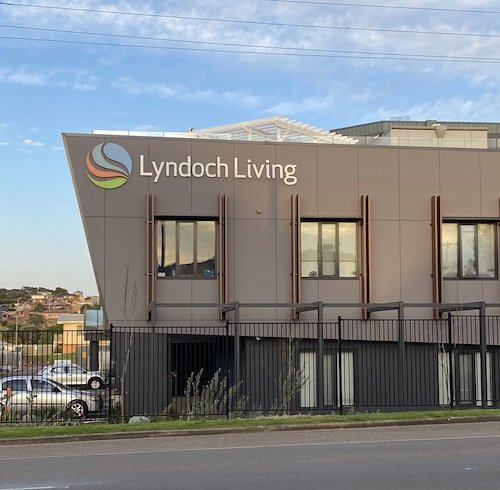
A $30,000 sign installed at Lyndoch Living last year has been denied its permit application by the WCC planning unit.
Carol Altmann – The Terrier
Update: A $30,000 corporate sign installed at Lyndoch Living last year has been denied a permit by the Warrnambool City Council planning unit.
The 5m-long sign was installed on the side of the new Swinton Wing last November without a permit.
A permit was lodged retrospectively in December by consultants, Fastnet, on behalf of Lyndoch Living.
Several objections* were lodged in January on a number of grounds, including that the sign was double the 3sq/m area size permitted under planning laws for what is classified as a “sensitive” residential zone.
After nine months of back and forth with Fastnet, the WCC planning team has now rejected the sign on the grounds of its size.
The sign was also originally illuminated at night, until that was found to be flat out illegal under planning laws.
Lyndoch Living now has 60 days to appeal the decision to VCAT.
If there is no appeal, the sign must be removed.
*As an East Warrnambool resident, I was among the objectors.
Illegal sign, unfinished tavern, expose set of double standards
A 5m corporate sign on the side of Lyndoch Swinton Wing was installed without a permit and is still awaiting approval.
Carol Altmann – The Terrier
What does an illegal sign, a half-built tavern and being woken by trucks at 6.30am on a weekend all have in common?
They are shining examples of the failings of planning laws that are supposed to help protect the rights of Warrnambool residents.
I am sure you have examples of your own, but let me pick out three, including two I know well, because they stem from my own neighbourhood.
The first is a textbook case of “just do it, and ask later”.
It’s the 5m-long, illuminated sign that was installed on the side of Lyndoch Living last November without a permit.
You know the one – Lyndoch didn’t bother to apply for a permit, perhaps thinking nobody would notice, even when it was switched on at night.
Such an illuminated sign is illegal in a residential area, so after complaints to the Warrnambool City Council, it was switched off.
The sign, however, is still there.
It’s still awaiting a decision on a permit lodged belatedly in December.
That was nine months ago*.
“The non-compliant sign remains an open enforcement matter which Council continues to work on,” is how the WCC spokesman put it.
Why hasn’t it been taken down in the meantime? Nobody from the council staff can tell me.
And what have been the consequences for Lyndoch acting without a permit in the first place? Zero.
Just as the penalty for Lyndoch digging a road through a public reserve was zero.
And just as the penalty for Lyndoch failing to apply the parking and traffic plan for its medical hub was zero.
Laws, schmaws. Who cares? Move aside.
All of this has unfolded at Lyndoch while WCC director Andrew Paton sits on its board and former councillor Sue Cassidy is chair. Have they not noticed?
The latest battle for residents around Lyndoch is construction noise from the new medical clinic.
At least five times in the past seven weeks, nearby residents – including a 90 year old widow and a frontline shift worker – have been woken by noise before 7am weekdays and 9am on Saturday.
This is against the noise laws.
The council, which enforces these laws, has been alerted and has in turn alerted the construction company, Nicholson, but still the breaches go on, including this morning.
Consequences so far? Nothing.
A spokesman for Nicholson said this afternoon that it “places the utmost importance in complying with all regulations including EPA and local Government.”
“We would like to re-assure all residents on Hopkins Road that (we) take any and all complaints very seriously and would encourage any residents with concerns to engage in direct dialogue with us.
“Nicholson Construction will be contacting neighbouring residents in the coming days….”.
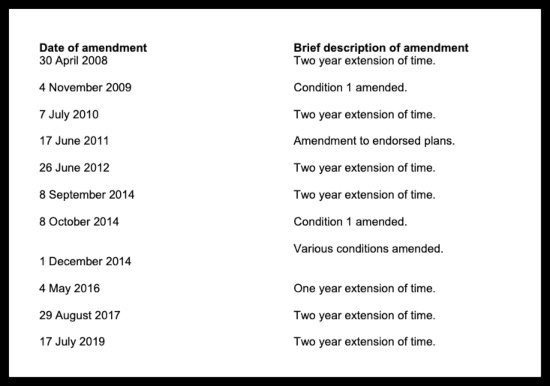
The timeline for the Northpoint tavern and its string of extensions and amendments.
Let’s shimmy across to north Warrnambool and the running sore of the Northpoint tavern/hotel on Hayley Drive which has been unfinished for 15 years.
Fifteen years – is this a record?
This half-built project has been through four councils and is about to ask for yet another extension from a fifth.
Any consequences or penalties after 15 years?
Zero.
What a complete failure of planning laws and what a complete failure to protect residents from a half-built eyesore.
Meanwhile, the average Warrnamboolian is cut no such slack for breaking the rules.
Imagine any of us trying the same arguments as above to avoid, say, an $80 parking fine:
You: “Sorry, I forgot I need to pay for parking.”
Local laws: “Okay. No problem.”
You: “Oops! I need a bit more time. Just another hour and I am on to it, promise”.
Local laws: “No stress. Chill!”
You: “Actually, something has come up, do you mind if I park my car here all day and sort it out tomorrow?”
Local laws: “Great idea. See you then!”
In your dreams.
* I was co-signatory to an objection to this sign in January. In the interests of full disclosure, you can read the objection here.
Historic trainers to pay $341.25 per horse for beach access
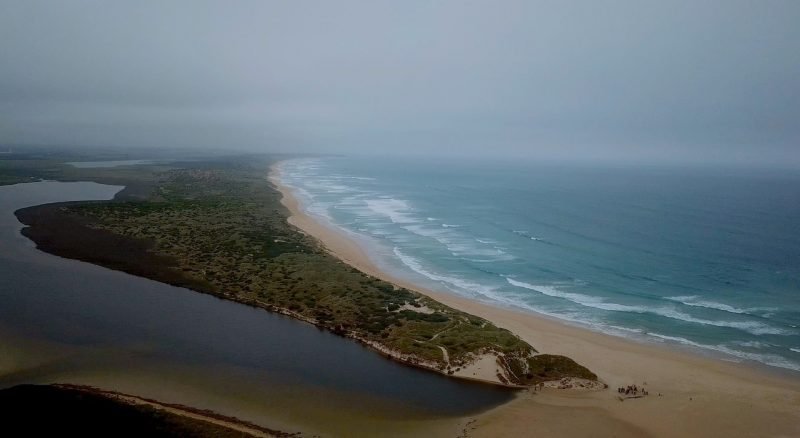
A stunning aerial shot of Rutledge’s Cutting looking back to Levy’s Beach by Justin Williams iXplainIT Technology Training.
Carol Altmann – The Terrier
While the battle over large-scale racehorse training at Levy’ Beach rages on, details are emerging on how historic training will be managed at Killarney and the super-sensitive Rutledge’s Cutting.
One of those details is that Parks Victoria will charge a licence fee of $341.25 per racehorse, per year.
In the past, the only fee that applied was the Moyne Shire Council annual permit fee of $100 per trainer, regardless of how many horses were trained.
This helped open the floodgates for dozens of racehorses to be piled onto the beach, including those trained by some of the wealthiest in the business.
Unlike Levy’s Beach, Killarney and Rutledge’s Cutting will not be made available for racehorse training all year round, but limited to 1 Feb to 15 December at Killarney and from 1 April to 31 July at Rutledge’s.
Permit applications for “historic” trainers to access Killarney and Rutledge’s Cutting closed on February 4 and are now being processed by Parks Victoria and while it won’t reveal how many applications were received, they are understood to be a relatively small number.
The reasons for this, no doubt, are the now strict conditions around getting a historic licence and the limitations of that licence, both of which reflect the environmental sensitivity of the area.
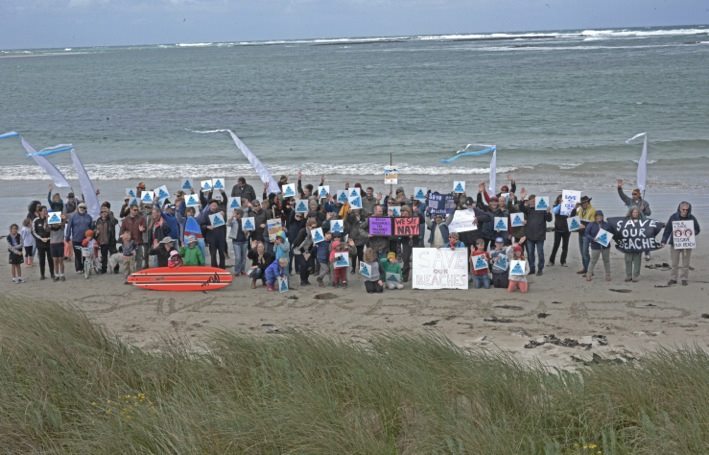
Killarney Beach was at the centre of protests like this one in 2016 to stop large-scale racehorse training after big trainers moved in and dominated the beach. Image: Belfast Coastal Reserve Action Group.
Rutledge’s Cutting, in particular, is a habitat for the critically endangered Orange-bellied parrot and a significant breeding site of the Hooded Plover, plus it attracts large flocks of migratory shorebirds.
Here are some other key points of the new licence arrangement:
trainers must live in either Moyne Shire or the City of Warrnambool;
they must prove they have continuously used the Belfast Coastal Reserve for training since 2008;
they must have a stable of no more than 10 racehorses;
if a trainer doesn’t apply for a licence now, they cannot apply in the future;
the licence must be renewed every two years;
the licence is not transferrable;
only trainers who do not wish to use Levy’s Beach/Hoon Hill can apply;
Killarney: a maximum of six horses on the beach and four in the water at any one time;
Rutledge’s Cutting: a maximum of 15 horses per day, with up to four on the beach at any one time.
This list sits in sharp contrast to Levy’s Beach which, as it stands, is set to become the sacrificial lamb within the coastal reserve with plans for up to 800 racehorses a week, including 200 a week on the long “Hoon Hill” dune.
The licence fee for Levy’s Beach has not yet been revealed, but it is expected to be around $400 per horse, per year.
In the past, racehorse trainers used the beach illegally, and for free, with authorities turning a blind eye until – like Helen Reddy’s classic “I am Woman” lyric – the numbers became too big to ignore.
By contrast, Rundell’s Riding School has accessed the beach for more than 20 years by paying an annual permit with conditions, and recreational riders were allowed as part of low-impact use.
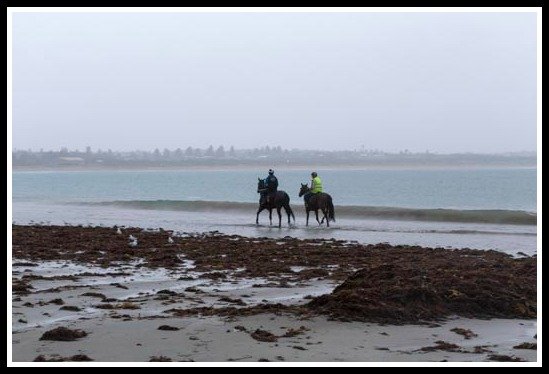
Questions are now being asked by some city councillors as to whether Lady Bay is enough to meet the demands of racehorse trainers. Image: Enjoy Racing website.
Racehorse training is also set to resume at Warrnambool’s Lady Bay on March 31, after the summer break, with up to 96 horses on the sand each day. This number may drop to 50 per day if Levy’s goes ahead and the Warrnambool Racing Club pays $400,000 toward a new horse wash-down/bespoke carpark at Lady Bay.
Trainers pay the council an annual flat fee of $225 to access Lady Bay, regardless of the size of their stable. There is also a daily beach access fee per horse of $6 and $2.50 for swimming.
All eyes are now on whether, following the removal of former big-gun trainer Darren Weir, the Warrnambool City Council will decide that Lady Bay is enough to accommodate the demands of trainers, without the need for Levy’s.
Cr Michael Neoh certainly opened this door as a possibility at the last council meeting, when he asked for the numbers to be crunched.
We shall wait and see.
If you would like to see The Terrier keep digging up, sniffing out and chewing on local issues, please make a small contribution below.