Why did the Lyndoch board act? And why they must go
All in this together: the toxic world of Lyndoch Living can only be cleansed with a clean sweep.
Carol Altmann – The Terrier
Lyndoch staff were today sent a message from board chair Sue Cassidy announcing that CEO Doreen Power is on ”annual leave”.
The chair may be hamstrung, legally, by what she can say at this point, but “annual leave” only creates confusion and uncertainty for staff.
The same statement was made to the local paper and explains nothing.
This is how Lyndoch has rolled for the past four years: full of uncertainty, mistrust, confusion and “who do we believe?”.
So, in the face of this “who do we believe?”, I again defer to my rock solid sources who have never let me down these past four years while we have navigated a lonely and torrid river toward the truth.
I can tell you this: Ms Power went to work yesterday and was gone from her office by 4pm, apparently lugging two large bags. They were not suitcases packed for a trip to Port Douglas.
Also in the building yesterday afternoon were board Chair Ms Cassidy and Treasurer Kane Grant who met with the CEO.
They were not checking on her holiday plans.
What I understand is at that meeting, the CEO was given the option to resign, or an independent investigation would be launched into the many allegations surrounding her “management style”.
The board would then use the results of this investigation to make a decision on her future.
Such an investigation would protect the board from any claims by Ms Power of unfair dismissal, because – as we know – the board has fully supported the CEO and everything she has done.
Ms Power now has a choice while on “annual leave”: resign and, most likely, be paid out for the remainder of her contract OR remain on leave and be mired in a full-blown investigation.
But why did the board act NOW? Why not last week? Or last month? Or last year?
My sources tell me there was movement from health worker unions and WorkSafe that was about to hit the board with a sledgehammer.
Worksafe and the State Health Minister have been watching Lyndoch closely, and my sources tell me that Wednesday, the day before Ms Power was confronted by the board members, another long list of complaints had been formally lodged with Worksafe by a lawyer.
There can only be so many complaints and allegations about over-work, intimidation, bullying, toxicity and pressure to “do certain things”, before the hammer swings.
The board has legal obligations around staff safety which it must uphold or it may face serious penalties as individuals, including fines and jail.
The State Minister also has a duty of care, as Lyndoch Living is contracted by the State Government to run its state-funded beds at Lyndoch.
This explains a lot.
We all know the seven board members didn’t wake up yesterday morning and suddenly decide the CEO was not the same person they had backed all the way for seven years.
Just three weeks ago, the board refused to let our local MP speak confidentially at its board meeting about the CEO.
But yesterday, after our local MP spoke about the CEO in Parliament on Tuesday, they were all action stations.
Turn out they could be all running for the life boats because with WorkSafe now heavily on the case, it’s either the CEO, or it could be them.
Trouble is, the board has lost community trust and credibility.
We lost faith in them a year ago, not only because they have continually backed the source of all the toxicity and troubles, but they have treated the community with contempt.
They must go.
All of those responsible for enabling the culture that has almost killed Lyndoch cannot be a part of its healing and its renewal.
The next Lyndoch AGM is in October: all board positions should be advertised now, for a complete spill and a new start.
We, as a community, deserve nothing less than a clean sweep.
Parliamentary petition launched to remove Lyndoch board
Carol Altmann – The Terrier
The Keep Lyndoch Living community group has today launched a petition via the State Parliament, asking for the removal of the Lyndoch board.
Sign it. Share it. Any Victorian resident can sign.
The petition to the Legislative Council asks for the State Government to work with the Federal Government to “take all possible steps” to replace the board with an administrator.
The administrator would remain until a new Lyndoch board can be elected via public nominations.
It has come to this.
Six weeks after more than 400 people gathered in the cold to call for greater transparency from the Lyndoch Living board, there has been nothing of the sort.
And judging by the non-sensical and insulting comments of the board Chair Sue Cassidy on ABC radio last week, the community will remain cut off, despite our many concerns around the care of our elderly and vulnerable.
The board has no interest or intention in engaging with the general community.
Trust in this board is now completely broken.
I hope this petition draws thousands of signatures between now and when it closes on 31 August.
It will then be tabled in Parliament by our local Member of the Legislative Council Bev McArthur, who delivered a statement to the rally on 5 June and who has continued to offer her full support to this cause.
A paper version of the petition will also be available at a public sign-up on the Warrnambool Civic Green next Sunday, 24 July, from 11am to 1pm. I plan to be there to help out.
Copies will also be available for you to take away to gather physical signatures from those unable to sign online.
All of the signatures – online and on paper – will be collated into one total.
Sign it. Share it. The message is clear: this board has to go.
[Disclosure: I assisted Keep Lyndoch Living to lodge this petition with the Legislative Council to ensure it met all the requirements.]
Roma Britnell: law reform needed to better protect women
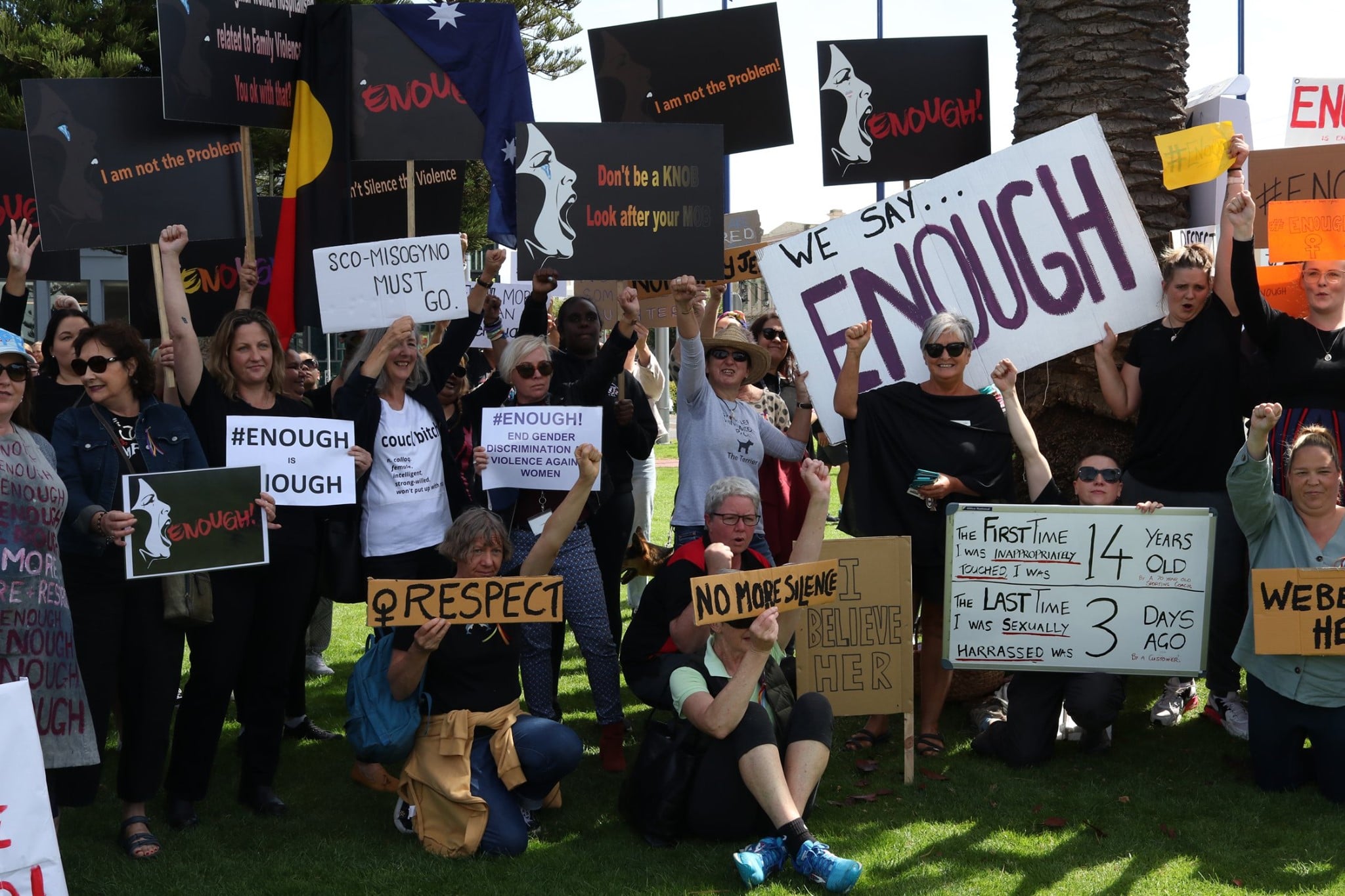
Hundreds of people turned out for the March4Justice gathering on the Warrnambool Civic Green. Image: Emily Bissland/ABC South-West Victoria.
This is a slightly edited version (for brevity) of South West Victoria MP Roma Britnell’s speech to State Parliament on 18 March 2021, following the March4Justice rally:
Ms BRITNELL (South-West Coast) (14:44): I rise to speak on the Cemeteries and Crematoria Amendment Bill 2021. The purpose of this bill is to protect affected persons against further significant harm, pain or suffering that may be caused as a result of the exercise of a right of interment…
This bill effectively has come about as a result of a shocking case of the murder of a woman by her husband. A headstone was placed on her grave which had ‘In loving memory’ or words to the effect that her husband was respectful, and there was nothing further from the truth. It was upsetting for her children, her family, her brothers, her sisters. Obviously it was completely inappropriate.
Not only that, but the man who murdered her, her husband, had the right to in time, when he died, lie beside her. So it makes complete and utter sense to change that for those who have been, like in this case, murdered, harmed, and in some cases it even applies to a victim of sexual assault, where a family member may be able to lie beside them. That is completely wrong, and this bill goes exactly to where that needs to be changed. This discussion actually happened before Karen’s death. In 2016 the Victorian Law Reform Commission made a recommendation. That was five years ago, so it is a real shame that it has taken the government this long to fully adopt—which is what we are doing here—those recommendations. It is simple, and it has been far too long coming.
This makes me think about what we are really doing to support women. Are we doing enough? Clearly we are not.
Not when you see the figures that my colleague the member for Lowan just raised in her speech around the people who are victims of family violence. They are on the increase. Violent crime stats just out today demonstrate the increase in family violence, not decrease, of those cases that are being reported to police. It is just not okay. Women have the right to feel safe. They have the right to feel safe wherever they are, be it at work, be it on the street or be it at home. Are we doing enough? Clearly we are not.
I was at the March 4 Justice just this week with my colleagues, and I back the fact that we as a group of community members, as females together—both sides of this house—must work together. Colleagues—be it my male colleagues, my female colleagues—we can all do so much more…
There was a real white-hot anger at that rally, and I could feel the women just so intent on making a change. You can understand the anger, particularly from women who were present who have been abused. Sexual assault is a really serious crime, and we are not seeing the results in convictions that we see in other serious crimes like murder. Why is that?
I am reminded of when I was at school in year 11 studying legal studies, and I remember learning about momentous change that was happening in the legal system where, for the first time—and I learned this I reckon in 1983—women, instead of being in the box facing their perpetrator, could actually do what was called a hand-up brief. The very fact that it was called a hand-up brief or is still called a hand-up brief—I know it is a fairly common legal term still; I am not sure if it is the right one anymore—is kind of bizarre in itself.
What it means is that women, instead of facing their perpetrator, could write their report and hand it in as a written format rather than as a verbal format in front of the perpetrator—a great and momentous change. But it made me think: have we done enough? I know we have got the Royal Commission into Family Violence results and we have had 227 recommendations, 64 of which are still to be implemented, but have we really actually looked at what we can do?
I suggest we get the legal minds of this state and perhaps this country together—the brightest and best—and look at the meaningful reform we really need to have so that we get the convictions just like we get in other serious crimes. Because it makes no sense that we are not getting the same level of convictions. It is not that the women are making it up, it is not that it is not true; it is that we need to find ways to support them.
There must be an opportunity for us to look around the Western world and see how other nations are perhaps doing it better. I am not saying we should undo the very important rules of law that we have in place, the foundation of our very democracy, but I am wondering: have we really put those minds together and formed a panel that can actually do that review?
I think it is time we made a difference, and I believe that meaningful reform is absolutely possible. I had in my office just a few weeks ago a woman who was terrified for her safety. The intervention order that she had out on her husband was coming to an end. I do not want to give any more details than that, but it struck me as strange that she was relying on that IVO. She was terrified for her life and she gave me lots of reasons and stories that made me also very concerned about her life. The very fact that she was being put into such a fearful place really sent a chill down my spine. I wrote to the minister that day with a sense of urgency, via email, which obviously is instant. I am actually still waiting to hear back, and I think it was three weeks ago. So we must be able to do better.
I know we have got to support our women, and sexual abuse, murder and being treated like this woman was—with absolute fear—is no way for any human being to live.
I think the bill does do one thing that will help change what has happened to Karen, and I pay my respects to the family for the pain and suffering that they have gone through, which no family should have to go through. But it is time, well and truly past time in fact, to make these changes. I hope that we do more than make these changes in this legislation, but we look at the figures today of 1800-plus people being treated by ambulance call-outs in the 2019–20 year that are victims of family violence where 30 per cent of children are actually witnessing these events.
We need to support women so they can call these situations out early, know that they will get help and not be like another woman who came to my office having left a marriage situation where there was a lot of emotional violence and withdrawing of ability to see friends and withdrawing of finances. Four years later she said to me, ‘I’m couch surfing and I really did think, given all the support they talk about for women, that I would at least be supported with a home’. After 3½ years of couch surfing, for the last six months she has joined up with her friend, pooling their funds and living in motels. But she is on a national disability insurance scheme package. She cannot drive. She has to walk to services that do a great job, she said, supporting her. She cannot move out of the area because those support services are critical for her disability. But come May when we have the May races in Warrnambool, when the motels are full, she is out on the street.
And that is just last week’s story.
How many stories do we get in our offices where we are just not doing enough? She left her husband in that abusive situation—it was not physical abuse, it was emotional abuse but fairly significant—believing that she would be supported, because that is what we say to women these days. But it is not; it is just not happening enough and that was why the rally occurred.
We can do more, and my suggestion is we get the best legal minds in our nation together, particularly in the state of Victoria, and lead the way of finding better ways to support women. That hand-up brief, the example that I spoke about, was 35 years ago at least. So I think it is time for change, and there are ways to do that.
[Note, this is an uncorrected proof from Hansard, so may have minor changes in the final published version.]