Power shutdowns allow long-overdue work on shop tops
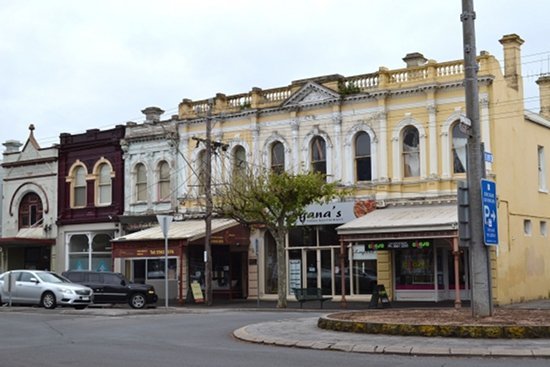
File photo: some of the dilapidated shop tops along central Timor St, Warrnambool.
Carol Altmann – The Terrier
JUST IN: A couple of weeks ago I called Powercor to see whether plans were still going ahead to briefly turn off power lines along central Timor St which would allow long overdue painting works on some of the most magnificent shop tops in Warrnambool.
The good news is that – YES! – it is still going ahead and a series of brief power shut downs will start as of tomorrow, 31 March, and extend on and off over the next 90 days.
This means property owners along the stretch between Kepler and Liebig St can finally get painters up there safely, without them risking a tight perm or far worse, and paint around the power connection points to each building.
With the help of the Warrnambool City Council, property owners can apply for $ for $ funding up to $3000 to help cover the cost of the works which – in my humble view – will transform the street.
It’s been a feat of logistics to get this all organised since it was announced by former Mayor Tony Herbert mid last year, but Powercor, the WCC and property owners have now come up with a workable solution.
Let’s hope all of the property owners grab this golden opportunity.
In a statement today, Powercor Major Client Manager Richard Scholten said Powercor knew “how important this restoration work is for shop owners in Timor Street, so we are pleased that we have been able to support this facelift to be completed safely.
“The final solution is one that not only achieves the desired restoration of each building, but does so in a way that keeps power on for these businesses and the surrounding community.”
Mayor Vicki Jellie said the plan resolved what was a major obstacle for shop owners:
“We know that many have been wanting to carry out maintenance on their buildings and this collaboration with Powercor removes the obstacle that prevented this from happening,” Cr Jellie said.
“Importantly, pedestrian access to businesses will be maintained while the work is carried out.”
You can read the full Powercor media statement here: https://www.powercor.com.au/news/media-release-power-works-help-restore-warrnambool-shop-facades/
After Don and Harvey, can we stick with Rolf Harris?
Mixed messages: rather than get rid of a mural painted by sexual abuser Rolf Harris, the W’bool City Council opted to cover it up. Image: ABC South-West.
What message does this black perspex send to women and girls in Warrnambool?
To me, it screams hypocrisy.
At a time when sexual predators – who also happen to be famous – are finally being outed for the scum that they are, surely Warrnambool can no longer hold on to this.
For those not familiar with this piece of black perspex, it is covering a kitschy mural painted spontaneously by Rolf Harris on a wall behind the scenes at the Lighthouse Theatre, way back in 1986.
A lot has changed since 1986.
We now know that Rolf Harris is a sexual abuser, down there with the likes of Harvey Weinstein, Don Burke, Lewis CK, Kevin Spacey, Bill Cosby and others who have finally been outed as the grubs so many people knew them to be.
In Harris’s case, his disgusting crimes – for which he has been jailed – were against young girls. Kids.
And yet Warrnambool is sticking with Rolf.
We are still making excuses.
We have not yet had the courage, it seems, to actually paint over this work but to let it remain covered up, like a dirty little secret for somebody else to deal with down the track.
In the light of what is coming out now about Weinstein and Burke, does that “nothing to see here” approach sound familiar?
That decision was made on our behalf by a majority of the Warrnambool City councillors in 2015 who, using logic I still can’t understand, saw the covering up – rather than complete removal – as a sign of support for victims of sexual violence.
The main argument was that this mural was ART! and all ART! – even a slap-dash mural by a convicted child molester – is worth preserving at all costs.
Really?
Would we seriously consider hosting a gardening talk by Don Burke at the Lighthouse Theatre? Or a film night in honour of Harvey Weinstein, because, hey, their talents are quite separate to their being sexual abusers?
Fortunately a lot has changed since 2015.
We now have a new council. And we have now entered a time – AT LAST – when the powerful and the famous are no longer being given social immunity because of their particular talents, personality, wealth or likeability.
And right this minute, the council itself has the perfect opportunity to correct its mistake of hiding this mural and instead make a strong, symbolic gesture that we, as a city, do not tolerate sexual abusers – no matter who they are.
How?
Well, I saw on Facebook this morning that Connect Warrnambool (which is run by the WCC) is proudly supporting 16 Days of Action to support Gender Equality (#16days) and it talks about things like promoting respect for women and increasing women’s safety and well-being.
All very stirring stuff, but such words, without action, are as hollow as Peter Dutton’s heart.
So here is my idea for Connect Warrnambool, and it is one that I have been pushing since 2015:
borrow a Makita drill and remove the screws that are holding up the perspex on the Harris mural;
ask for willing volunteers to come and run a paint roller right over the space (you will be inundated, Connect Warrnambool, I promise);
invite a young woman artist to paint a fresh mural and;
lastly, install the black perspex on the stage at the W’bool Civic Green and let little kids draw their art all over it.
What a message to say that we are absolutely serious about respect for women and girls.
I have my painting overalls ready…
Jackie Carruthers and I are ready to roll!
The artistic face of Christopher Grace
[printfriendly]
Having walked away from a potential career as a photographic artist in his teens, Christopher Grace is returning to his love of shooting with film.
Words and images by Carol Altmann
[dropcap style=”font-size: 60px; color: #A02F2F;”] N[/dropcap]ot long into our conversation across a table outside Proudfoots Boathouse, Christopher Grace lights a second cigarette and leans in: “I realise I fucked up”.
The celebrated south-west chef, who has worked at just about every top restaurant in the region, is not talking about stuffing it up with food, but his first love – art.
He is also speaking of a time when he was not Christopher Grace – which is virtually a brand name – but Chris Grace, a gifted art and music student fresh out of Box Hill Tech, who was accepted into the highly competitive photography degree at RMIT university.
He dropped out after two years. Not because the work was beyond him, but because, like for so many uni students, the temptations beyond the tute room proved too great.
“There is a level of self motivation required to succeed at university and I, unfortunately, didn’t have it at that time,” he says with a crooked smile.
What should have been a beginning, became an abrupt ending.
Reaching out – or back – to a love of photography has reignited a creative heart in well-known chef, Christopher Grace, who works with a trusty Nikon F4 film camera.
[dropcap style=”font-size: 60px; color: #A02F2F;”] C[/dropcap]hristopher left art behind and, like local counterpart Ryan Sessions, fell into cooking (by taking a job at a takeaway joint near the call centre where he was working) and realised he had a knack for the chemistry of food.
His career as a chef has been stellar, including 14 years in the south-west working at celebrated restaurants including the Royal Mail, Merrijig Inn, Portofinos, Basalt and in his current role as manager of Proudfoots but now, at the age of 36, there is a stirring.
“I quit the booze for a while about 18 months ago and had a realisation that I was never going to be content unless I had another crack at photography,” he says.
The only problem was, the world had moved on and digital images and Photoshop had all but replaced film and darkrooms.
“I didn’t own or know how to use a digital camera, and I didn’t want to,” Christopher says.
“For me, it is still about film. Film is really important to me because you make decisions, you control the process, you have an intent and it is so much more rewarding than holding up a computer and letting it take the photo for you.”
A face in the crowd: one of the 30 best images Christopher shot on film during a recent trip to Bali using the Nikon F4 which, he says, made people feel more relaxed than pointing at them with a smartphone.
[dropcap style=”font-size: 60px; color: #A02F2F;”] A[/dropcap] friend sold Christopher his Nikon F4 film camera, a heavy, full-metal-jacket unit built to withstand a war zone.
Christopher carted the beast across Bali and shot four rolls of precious film with 36 shots per roll. The results are framed and waiting for a wall in his home, where we pick up the conversation.
” I got about 30 images that I really like,” he says, pulling a selection from the pile.
They remind me of photos from the 70s: pre-Photoshop, natural, muted tones, and strangely captivating for this very reason.
“The images have scratches, burn marks, finger prints and some have been developed in old developing fluid, which has created its own effect. They are imperfect and that is the whole point,” Christopher says, his voice animated.
A photograph or a drawing? Christopher’s hand-coloured photograph of yellow-tailed black cockatoo blurs the boundaries – and that’s just how he likes it.
[dropcap style=”font-size: 60px; color: #A02F2F;”] P[/dropcap]art of the appeal of both cooking and photography to Christopher is that they both rely on rules: what works, what doesn’t.
But while he says he “likes rules”, he also likes to bend if not break them.
As Christopher shows me his portfolio of work, which includes photography, collage and spray painted art works, it is hard to tell what is a photo, what is a drawing, and what is a painting. And that, again, is the whole point.
“I will take a photo and hand colour it with pencils or Textas, so it is no longer looks like a photo, but a drawing – but it is still a photograph,” he explains, smiling at the deliberate confusion he creates.
Christopher with a section a large work, a photograph of gravel on the roadside that is being transformed into something quite different through hand colouring.
[dropcap style=”font-size: 60px; color: #A02F2F;”] I[/dropcap]t is all about the freedom to experiment, explore and maybe even occasionally fuck up, and in this I get a sense Christopher is rediscovering a freedom that no longer exists for him in cooking where, in a smartphone world, food has become an obsession and everyone is a critic.
So while Christopher has set a goal to create 52 art works in 52 weeks – and is on track – he is ambivalent about an exhibition.
“I would love to have a small exhibition, but I am not sure if anybody would come and that doesn’t bother me, because I don’t need other people judging my work when I already judge myself so harshly,” he says.
If any proof was needed of that fact, look no further than the letters on Christopher’s spare bedroom, where much of his art is stored: MONASA.
“The Museum of New and Shit Art,” he laughs.
A detail from a series of images experimenting with objects laid on mirrors and photographed from above.
The Warrnambool man who taught Namatjira watercolours
Rex Battarbee and Albert Namatjira circa 1950s, when Albert was at the height of his fame. Image courtesy Gayle Quarmby.
[box]WIN! Subscribers can go in the draw to win a copy of Battarbee and Namatjira, by Martin Edmond (Giramondo, 2014) by simply emailing us at editor@bluestonemagazine.com.au by Friday May 1. Prize supplied courtesy of Giramondo publishing. [/box]
By Carol Altmann
Just about everyone who grew up in the south-west in the 60s had at least one print by Albert Namatjira in their family home, but far less people are aware that the man who taught Albert watercolours was from Warrnambool.
Reginald Battarbee, known as Rex, is today far less famous than his pupil, but was an artist in his own right whose life journey would see him play a pivotal role in the emergence of Albert as an acclaimed artist.
While Albert Namatjira’s story has been well documented, Rex Battarbee has remained relatively in the background – until recently.
New Zealand author Martin Edmond has combined the stories of both men in his biography, Battarbee and Namatjira, (Giramondo)released late last year to what have been strong reviews and an appreciation that their shared history has, at last, been recorded in detail.
Martin has drawn extensively upon Rex’s personal diaries and other documents, many provided by Rex’s daughter, Gayle Quarmby, to tell the story of a man who grew up as one of five children in Warrnambool – the son of a pig farmer – who would later spend years of his life in the outback.
Older Warrnamboolians will remember “Battarbee’s corner” along the old highway in east Warrnambool, named for the nearby Battarbee farm, Skiddaw: there is now a Skiddaw Cr in this same area.
An earlier shot of Albert Namatjira with his paintings, circa 1940. Image courtesy Gayle Quarmby.
Rex began his working life there, helping his father with his ham and bacon curing business, until the outbreak of World War 1.
Rex joined the many thousands of young men from south-west Victoria who enlisted and, in so doing, stepped onto a path that would lead to a very different future.
Martin recounts the extraordinary series of events that began on 12 May 1917 when Rex was peppered with machine gun fire at Bullecourt and was so badly injured that he was left for dead.
It was only two days later that he was found under a pile of bodies, still breathing, and rescued by two stretcher bearers.
Unbelievably, the stretcher bearers also came under fire and were killed while transporting Rex to safety, requiring him to be rescued a second time.
Wounded: Rex Battarbee circa 1920s after he returned from the battlefields of World War 1 with his life-changing injuries. Image courtesy Gayle Quarmby.
It is an horrific, Sliding Doors moment that accompanies any near death experience and raises the question that if Rex had not survived, would Albert Namitjira have ever come to prominence many years later?
Martin describes the injuries that would change Rex’s life irrevocably: “His left hand was smashed; his right elbow and shoulder too; he took bullets in the chest as well. One of those pieces of shot, a round ball of lead, emerged years later from his armpit on the opposite side of the body upon which it entered; another token was a 1914 Australian penny with a dent in it where a bullet had glanced off.”
While maimed for life, Rex’s injuries shaped what appeared to be his destiny: he could no longer farm so, inspired by his artistic sister, he enrolled to study commercial art in Melbourne.
Rex Battarbee discusses a work with Albert Namatjira, circa 1950s. Image courtesy Gayle Quarmby.
How Rex and Albert’s lives came to intersect was another product of Rex’s adventurous spirit and bold, never-look-back approach to life.
By the late 1920s, he and fellow art school student John Gardner had taken to making long journeys into remote areas to spend time painting.
The ultimate remote area was central Australia which, at that time, was as foreign to most white Australians as Mars, having never seen even colour photos of the outback, let alone visited there.
Rex and John began to visit Alice Springs in the 1930s and, in 1934, held an exhibition at the Hermmansburg Mission. Unlike other exhibitions at the mission this one, for the first time, was open to both white and indigenous people to see.
Rex Battarbee and Albert Namatjira with Albert’s early works circa 1938. Image courtesy Gayle Quarmby.
Martin writes that the indigenous people were captivated by the watercolour paintings of their country, having never before seen it captured as if looking at a screen, compared to the top-down view of Aboriginal paintings.
One viewer, Albert Namatjira, was particularly entranced and, having looked at the paintings a long time, remarked to the pastor in charge, “I can do the same”.
At about the same time, Rex recorded in his diary: “Albert who does the poker work would like to paint and Mr Albrecht (Pastor Albrecht) is prepared to buy him paints and wants me to tell him what to get”.
And so a relationship began that, within five years, would see Albert Namatjira hold his first shows in Melbourne and Adelaide: both sold out.
[dropcap style=”font-size: 60px; color: #8F9F59;”] O [/dropcap]ne of the many beautiful things to come out of the inaugural South-West International Women’s Day Art Prize was the opportunity for people to see works by artists who don’t receive – or necessarily seek – a lot of exposure.
One such artist is the softly spoken, warm-smiled Anne Fleming, a painter and ceramicist who works from her home studio in the main street of Dunkeld and who operates a small gallery in the same location called The Waiting Room.
Like many artists, Anne is not particularly keen on spending precious creative time learning how to master Facebook, or worrying about how to run a website, so apart from a presence on the South West ArtsAtlas , most people find Anne’s studio by happy accident.
It is a delightful discovery.
The beautifully glazed work, “Catching up”, which not only reflects Anne’s talent, but her wry sense of humour.
[dropcap style=”font-size: 60px; color: #8F9F59;”] D [/dropcap]elicate, finely glazed ceramics are displayed alongside Anne’s often-dramatic oil paintings inspired by the landscape: not just that of her immediate surroundings, but those of her extensive travels in remote Australia. She and her husband Doug, a GP, love to head out in their Toyota troop carrier to “camp rough” – there is no caravan attached.
“I have never been interested in painting pretty, chocolate-box type images. I love exploring the contrasts and the drama and to say something about what this landscape means to me,” Anne explains.
There is a similar drama and movement in Anne’s sculptural work but these, unlike most of her paintings, are influenced by observing people rather than places.
Anne picks up one such work, “Catching up”, a beautifully white-glazed piece which at first appears to be two young women sitting having coffee, until you look more closely.
“One is talking on her mobile and the other is checking her mobile, which is how many young people catch up these days,” Anne says, laughing.
Anne’s entry in the inaugural South-West International Women’s Day Art Prize, “Dancer”. The work now belongs to a lucky Warrnambool owner.
[dropcap style=”font-size: 60px; color: #8F9F59;”] A [/dropcap]nne chose one of her sculptural works to enter in the South-West IWD Art prize – ‘Dancer’, inspired by the Bangarra Dance Theatre – and it is this piece, and others like it, that hint at her first career as a physiotherapist.
This is a work by someone that clearly knows how bodies move and what they look like when they do.
It is the same with another piece, a bent-backed shearer, who again reflects another stage in Anne’s life when she and Doug decided to move from the Mornington Peninsula to the south-west.
“We decided we wanted to live on a few acres, so Doug started looking around for a practice in the country and there was one at Penshurst,” Anne explains.
“The only problem is that it is very hard to just buy a few acres in this part of the world, so we ended up with 500!”
The pair had never farmed in their life, but were thrown in the deep end when about 1000 sheep were delivered “to the front door” of their property and needed to be mustered into a back paddock.
“They had to go through this tiny gate. We had no sheep dogs, but we had kids on bikes, and it took forever,” Anne laughs at the memory.
‘Wangi Falls”, oil on board, is one of Anne’s many dramatic landscapes inspired by her “rough camping” trips to remote Australia.
[dropcap style=”font-size: 60px; color: #8F9F59;”] W [/dropcap]hile still working as a physiotherapist – and a farmer – Anne returned to study art at Deakin University in Warrnambool in the 1990s and picked up a thread that had lain dormant while she raised her family.
Growing up in Adelaide, Anne would watch the work of her mother, Dorothy Potter, who was part of Val Morgan Advertising and responsible for designing ads shown at cinemas and drive-ins.
“My mother was very artistic…and I had always loved art, but I hated art at school because that was all very formal, about colour wheels and that sort of thing,” Anne says.
Anne took a series of small classes and workshops, but it was only once she enrolled at Deakin and studied under the guidance of lecturers like Graeme Birt and Ross Gray that she began to find her “voice”.
“You are always learning,” she says, “and it’s never what you might call easy.
“A lot of people say, ‘oh, it must be so relaxing to just paint’, but it is often agony and very frustrating but then, at some point, the painting takes over and it works…and you realise you have created something that nobody has done before.”
Anne Fleming in her Dunkeld studio: “You are always learning and it is never what you might call easy.”
[box]The Waiting Room gallery can be found at 107B Parker St, Dunkeld. Open “haphazard” hours, but mostly weekends. Contact Anne on 0438 361 761. See more of her work on South West ArtsAtlas here.[/box]
[button link=”http://the-terrier.com.au/subscribe-2/” type=”icon” icon=”heart” newwindow=”yes”]Bluestone is aiming for at least 500 subscribers in 2015. If you enjoyed this story, please click here to become one.[/button]




 Complement this story with…


 You might also enjoy…