We still have jumps racing? Can’t get over it
the age
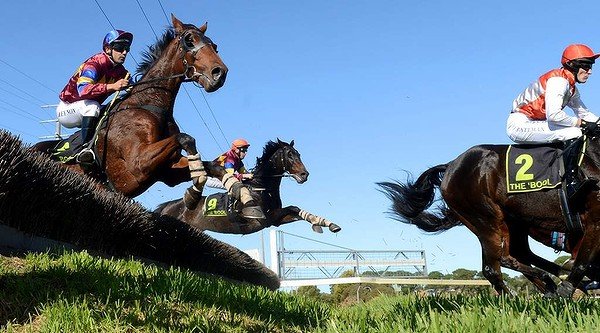
Regardless of the spectacle, the harsh reality is racehorses are continuing to die as a result of jumps racing in Victoria.  Image courtesy of The Age.

As Victoria continues to buck the trend on placing a ban on jumps racing, we ask if steeplechasing really is integral to the success of the Warrnambool May Racing Carnival.

OPINION – Carol Altmann

Here we are at that awkward time of year again in Warrnambool when the city’s biggest local sporting event – the May Racing Carnival featuring the Grand Annual Steeplechase – is also the most difficult to embrace.

For no matter how we dress it up, the reality is that jumps racing is on the nose and has been for many years.

Despite this, the powerful figures that surround the “sport” continue to tell us that horses love jumping, that the local economy would wilt without the jumps races, and that those campaigning to have jumps racing stopped are just a bunch of lefty loopies without a sense of fun.

One of the most vocal “lefty loopies” is, of course, that highly radical and subversive organisation, the RSPCA, which has an ongoing campaign against the practice on the grounds of animal cruelty.

It appears that the RSPCA is welcome to tackle battery hens, sow stalls, duck shooting, puppy farms and run the cheerful Million Paws Walk, but if it dares to go near the sanctity of the steeplechase, it is accused of being “grandstanding hypocrites,” guilty of euthanasing thousands of unwanted cats and dogs each year.

That is how the former head of the Australian Jumps Racing Association, Rodney Rae, described the RSPCA president Dr Hugh Wirth in 2011, disregarding the fact that the RSPCA is the group that mops up the sad mess left behind by irresponsible pet owners around Australia.
 

grand national
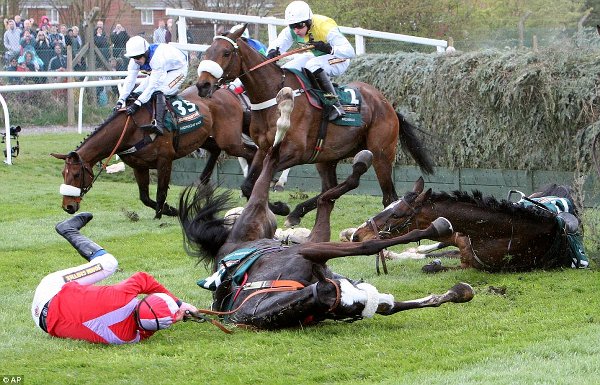
The Grand National Steeplechase in the United Kingdom remains one of the most controversial races in the world due to a high number of horse fatalities. Image courtesy of The Huffington Post.


But let’s return to jumps racing.

As most people know, this is a sport that no longer exists in any other states except for Victoria and South Australia. Jumps racing finished in Queensland more than 100 years ago. It stopped in WA in 1941 and in NSW in 1997. Tasmania joined their ranks in 2007.

A Senate committee in 1991 suggested it be phased out across Australia over a three-year period and, in 2010, this is exactly where things were headed for Victoria – until the state election prompted local MP Dr Denis Napthine to pledge $2 million to assist the racing industry if the Coalition won office.

The Coalition won and Dr Napthine, who part-owns a racehorse with local Federal MP Dan Tehan*, would be not only the Minister for Racing but also, eventually, Premier. Talk about friends in high places.

Despite the $2 million having surely being spent by now, horses still die in jumps racing.

It is a nasty, unavoidable truth of the “sport”, even if we try and disguise it behind the green curtain that is hastily erected around the broken horses before they are euthanased on the track.

According to the RSPCA, four horses died in jumps racing last year and there is no doubt that this week, many punters will be watching the three main jumps events at Warrnambool with their hearts in their mouths, hoping all the horses (and riders) make it home, while feeling a deep sense of unease that the horses are being made to perform this way in the first place.
 

spinthebottle
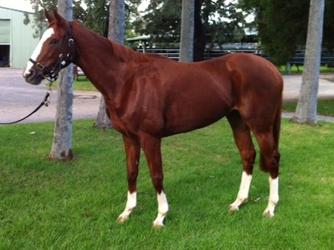
Spin the Bottle, part-owned by Premier Dr Denis Napthine and local Federal MP Dan Tehan. He is not a jumps racer.


The Warrnambool Grand Annual Steeplechase is 5.5 kilometres long – the Melbourne Cup is 2km shorter – and includes 33 jumps: the most of any steeplechase event anywhere in the world. That is a lot of running and a heck of a lot of jumping, even for a horse that “enjoys” it.

And for all of their Herculean efforts, hardly anyone remembers who wins. Can you name one winner of the Grand Annual Steeplechase? Or the Brierly Steeplechase? Or the Galleywood Hurdle?

At the end of the day, it all seems so cruel and so unnecessary, especially when such a small group of people has any significant investment in jumps racing and its immediate spoils.

The average punter, I believe, would be just as happy to go along to a three-day racing carnival at the beautiful Warrnambool racecourse and not see horses jump.

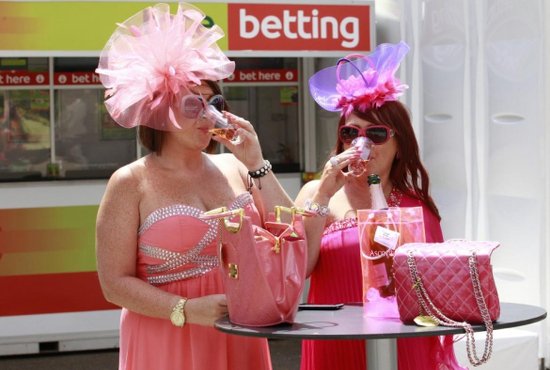
Some of the most popular – and charming – race carnivals in Victoria (think Dunkeld, Hanging Rock) attract thousands of people not because of the actual racing, but because of the atmosphere, and the chance to dress up and drink champagne for brunch.

Given the increasing awareness and activism around animal rights, especially among young people, it is only a matter of time until jumps racing is banned across Australia.

So why not cancel the jumps at Warrnambool, just for a year? Or maybe for three years, as happened during World War II when the Grand Annual Steeplechase was suspended because of more pressing matters than horse racing.

Then will we know whether the May Racing Carnival can truly stand on its own two legs, rather than relying on horses to stand on all four: despite all that is thrown at them.

*Since writing this piece, The Age has questioned the connections between Dr Napthine and Midfield Meats managing director Colin McKenna, another part-owner of Spin the Bottle.
 

royal ascot
Wouldn’t punters be just as happy wearing fancy clothes and sipping champagne trackside without the need for jumps racing?


Don’t drop the ball on FJ’s silver icon

julie eagles
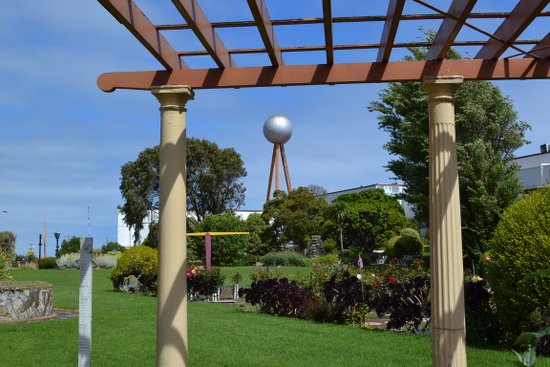
And up it goes…the Fletcher Jones silver ball (which is not looking quite so silver) is carefully placed onto its tripod. The ball has watched over Warrnambool for more than 45 years. Image supplied by: Julie Eagles.


OPINION – Carol Altmann

[box] The campaign to restore the Fletcher Jones silver ball is gathering pace, amid questions of whether it is still structurally safe. The group working to save the ball held its first think-tank last week to map out a strategy.[/box]


[dropcap style=”font-size: 60px; color: #A02F2F;”] I [/dropcap] want to offer some words of reassurance about Warrnambool’s iconic Fletcher Jones silver ball: it will not suddenly topple off its perch and roll down Lava St.

Ralph Jones, an engineer and the son of Sir Fletcher, was much smarter than that. He made sure that the water tower not only looked fabulous, but was engineered to withstand Warrnambool’s excoriating weather.

According to those who worked on the ball, it sways a few centimetres in the wind and this is not a bad thing, as it means it bends to weather, rather than chests it like a brick wall.

The ball also has legs that extend into the silver ball itself (see photo above), and this means it can’t roll away unless all three pylons were rusted through and, as of its last thorough inspection in 2010, there was no suggestion of this being even remotely close.

Now that we have cleared that up, the question remains as to why this magnificent, retro, visionary and unique piece of industrial art that has watched over Warrnambool and welcomed its visitors since 1967, is being left to rust.


fj ball kate maree
The campaign to preserve the silver ball has prompted some wonderful images of the structure, including this one by Kate-Maree Jackway.


[dropcap style=”font-size: 60px; color: #A02F2F;”] D [/dropcap]espite being heritage listed for its local and state significance, the job of caring for the silver ball has fallen into the too-hard basket all because its most recent owner, Ian Ballis, went into receivership in 2012.

The financial misfortune of just one man has been enough to throw the future of an iconic Warrnambool landmark into jeopardy.

There was no plan B.

The ball is not about to topple over, but it does need annual inspections and on-going repairs, as required, to keep it from rusting in Warrnambool’s sea air. It has also not been painted for many, many years.

Given how shabby it looks these days, no wonder some people consider it an eyesore and question whether it is worth saving.

But the Save the Silver Ball and Fletcher Jones Gardens group thinks differently.


gordon baldwin
Another perspective, this time by Gordon Baldwin, shot through the Robert Ulmann sculpture that pays tribute to Sir Fletcher Jones.


[dropcap style=”font-size: 60px; color: #A02F2F;”] T [/dropcap]his motivated bunch of people know that if the silver ball is removed, Warrnambool will lose an irreplaceable part of its skyline and its social heart.

The group held a think-tank last Thursday to brainstorm ideas to save the ball and a lot of the discussion was around how much it would cost to maintain each year, where to find a crane for the work, and how to raise funds for all of these things.

In trying to answer these questions, it is worth looking back at recent history.

The Warrnambool City Council owned the Fletcher Jones site from 1992 to 2007 and, I presume, had a maintenance plan in place for the ball during those 15 years. How much did this cost and what work was involved? Could it continue this work if the community helped to off-set some of the expense, as is happening with the $4 million redevelopment of the Reid Oval football park?

There is a precedent with the Fletcher Jones silver ball for such an arrangement.


amy fitzgibbon
This image, supplied by Amy Fitzgibbon, shows workers pulling up the illuminated cross for the festive season. Vertigo? What vertigo?


[dropcap style=”font-size: 60px; color: #A02F2F;”] A [/dropcap]fter the site was sold to Ian Ballis in 2007, the council continued to pay for the illuminated cross to be hoisted onto the silver ball each Christmas up until 2010, when the cross was removed completely.

For those three years, Keppel Prince Engineering donated the use of a crane, so perhaps Keppel Prince would consider donating a crane again for annual inspections and maintenance work?

And maybe Hammonds Paints, Ponting Bros or even Bunnings might consider subsidising the cost of the paint and other materials?

If one thing is certain, it is the ball will only be saved through creative – not mainstream – solutions.

The Save the Silver Ball group is already working on ideas for a public fundraising campaign and a spring picnic. I really like the idea of a reviving an annual Christmas picnic in the fabulous Pleasant Hill gardens, with food, musicians, market stalls and a treasure hunt for the kids, with a portion of the proceeds to go toward annual maintenance of the ball.


butter nutz
The silver ball can be seen for miles around Warrnambool, including from above Lyndoch. Image by Butter Nutz.


[dropcap style=”font-size: 60px; color: #A02F2F;”] A [/dropcap]nd then there is crowd-sourcing through online fundraising sites like Pozible, where author Regina Lane recently raised $15,000 in a matter of months to write the story of Saving St Brigid’s at Crossley.

If we can find $4 million for an upgrade of a football oval, and $2 million for steeplechase horse racing in Warrnambool, surely we can’t give up on the silver ball because it might cost 10, 20 or even 30 thousand dollars a year to maintain?

The greatest travesty would be to see the ball pulled down because of a perceived lack of money: what is lacking is not money, but positive, creative thinking and a large dose of motivation.

And the Save the Silver Ball group has this in spades.

Far from giving up, as our local newspaper appears to suggest we do, the fight has only just begun because the silver ball does not belong to Ian Ballis, or the council, or the State Government or Heritage Victoria – it belongs to all of us and we each need to do what we can, however small, to help keep the ball in the air.


fletcher-gardens_30
The iconic silver ball is far from a write off, but needs an ongoing commitment by the community to keep it in the air.

[box] Bluestone Magazine is committed to the campaign to save the best of the Fletcher Jones site. Please join the 500-plus people at the Save the Silver Ball and Fletcher’s Gardens Facebook page to be part of this effort. [/box]


 newsletter Eat And Drink Stones You might also enjoy ….

Mini FJ’s silver ball to shine again for festival

Fletcher Jones site taken off the market 

The Save Fletcher Jones campaign

Close Flagstaff Hill; save Fletcher Jones

Fabrication: Flaunting Fletcher


Be all things or stick to the basics?

council plan
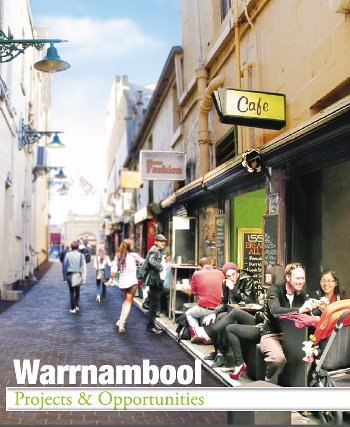
The dream: an image of bustling cafes built into the sides of Warrnambool’s laneways graces the cover of the council’s recently released priority ‘wish list’.


[dropcap style=”font-size: 60px; color: #A5CECD;”] C [/dropcap]ouncils were once primarily responsible for rates, roads and rubbish: my, how times have changed.

The 16-point list of advocacy priorities released by the Warrnambool City Council suggests that the council must now be all things to all people, fixing everything from school retention rates, to unemployment, to developing the region’s food export industry…right down to upgrading the stormwater drains. But is this what ratepayers really want or expect?

Sixteen points is a lot of priorities for a council covering only 32,000 people and they can’t possibly all be met, especially when we struggle to get the public toilets right.

I say this because as I was walking back from a media briefing on the plan last week, I wandered past the vandalised portable toilet box on Gilles St, across the road from the heritage precinct of the former police station and court house.

Having only been back in Warrnambool a relatively short time, I thought these toilets must have been installed for the comfort of the workmen repairing the former post office nearby.

A google search, however, revealed the eyesore is considered a public toilet and has been sitting there since 2011 while the council finalises its public toilet strategy.

My heart sank. If it takes more than three years to sort out the public lavatories, what hope is there of achieving the bulk of the 16 priorities that had just been outlined to the media by Mayor Michael Neoh and CEO Bruce Anson?

Moreover, do we need to have 16 priorities? What about focussing on five, securing the funding for these, and doing them really, really well? (We will list our top five later).

toilet_19
The reality: the ‘temporary’ toilet block on Gilles St indicates that making progress on some projects can take years.


[dropcap style=”font-size: 60px; color: #A5CECD;”] W [/dropcap]hile there is nothing wrong with thinking big and aiming high, we have three levels of government for the simple reason that each one looks after different levels of responsibility.

Ratepayers, I suspect, want a local council to focus on maintaining and improving their local amenities, to ensure that their city is a good looking and vibrant place where people want to live, work or visit for an unforgettable holiday.

Given this, it was heartening to hear Mr Anson list the revitalisation of the CBD as the number one priority, but there was scant detail on how this would be done, and by when. (*Since this piece was written, WCC has announced it is seeking an architect to redesign the portion of Liebig St between Koroit St and Raglan Parade).

The gradual rejuvenation of some of the city’s laneways – a wonderful council project –  is an example of what can happen, yet the F Project artists behind all of this hard work are scrimping and scraping to develop their art space down at The Artery, in Timor St.

The Artery has the potential to utterly transform what was a bland part of the CBD and to draw tourists in droves, but unfortunately this simple project has received very little council money.

At the same time, the council says in its latest document that it hopes to secure $100,000 for a “comprehensive study” into food production in south-west Victoria and potential export markets. Why? Isn’t this the domain of the State Government and, more particularly the local member, Denis Napthine? Or perhaps it is even better suited to the Federal Government, and our local member, Dan Tehan?

bluestone2_29
The Artery artists’ hub in Timor St has the potential to be a magnet for tourists and locals alike.


[dropcap style=”font-size: 60px; color: #A5CECD;”] L[/dropcap]obbying the other two tiers of government is part of what local councils do, but do we really want to secure and spend $100,000 on another study in the process?

Even a portion of this money would go a long way toward, for example, The Artery being able to open its retail space, gallery and studios – heck, they might even be able to get their signwriting done.

To be fair, the council’s priority list does contain some good, grassroots project such as upgrading the dated public swimming pool and working on a plan to improve the equally dated and tiny library, but it also contains a chunk of ‘priorities’ that have been around for so long now, most of us have forgotten when they were first announced, such as sorting out the future of the Fletcher Jones site, Flagstaff Hill and the railway station precinct.


bluestone2_25
Warrnambool will receive a longer airport runway, but the trains will still be slow, unreliable and crowded.

[dropcap style=”font-size: 60px; color: #A5CECD;”] S[/dropcap]peaking of the railway, improving the inadequate train service to Melbourne has been another, long-standing priority that has again been wish-listed by the council, yet it is the extension of the Warrnambool airport runway that is taking precedence for $4.5 million in state and federal funding.

The number of people who use this runway will be minuscule compared to the number of train commuters who already struggle to find a seat on a service that operates only three times a day and lumbers along at a Cobb-and-Co-like speed of 74 kph.

We should be outraged, especially as our compatriots in Bendigo, Ballarat and even Traralgon each have more than a dozen services a day, including a number of express trains.

A fast, reliable commuter service between Warrnambool and Melbourne is also critical to tourism, yet there is no indication that the service will receive another cent from either the state or federal governments.

The council has developed an enormous amount of strategic plans and strategies – the latest one brings the total to 32 in the past 10 years – but my fear is that it is spreading itself too thin, that it expends too much time and money reaching for the stars rather than dealing with the basics, and that, like the toilet box in Gilles St, it will ultimately struggle to be flush with success.

[box] Below are Bluestone’s five funding priorities (what are yours?):[/box]

  • Secure and save the best of the Fletcher Jones site and gardens and lobby for state funds to make it happen. This site is critical to creating a sense of ‘arrival’ to Warrnambool and has the potential to be something very special.
  • Fix the train service with more frequent, faster and reliable trains that include express services.
  • Revitalise the CBD by, for example, offering incentives to restore and repair the heritage buildings, remove the parking meters and create a true restaurant precinct.
  • Finish the sensational foreshore bike path by, as previously suggested by the council, linking it back through Lake Pertobe to the railway station. People would travel to Warrnambool (on a fast train) just to ride this path – I have already met some.
  • Upgrade the whale watching precinct into the world-class attraction that it should be.

Logo Smile newsletter More opinion pieces…


Who will step up for Fletcher Jones?

Time for a fresh start with Australia Day

Broken link for Artlink

Losing sleep over a lot of rubbish

Close Flagstaff Hill; save Fletcher Jones

When scrutiny is sub-standard, democracy suffers


The Save Fletcher Jones campaign


[dropcap style=”font-size: 60px; color: #A5CECD;”] B [/dropcap]luestone Magazine is part of a growing grassroots campaign to save the best of the iconic Fletcher Jones site in Warrnambool from being lost through neglect.

The site is rapidly deteriorating and yet there is still no firm plan in place to preserve what has been deemed a place of state significance. It is also an important part of Warrnambool’s social history and holds a special place in our hearts.

Shortly after we wrote two opinion pieces on this issue, two people – Julie Eagles and Tonia Wilcox – started a Facebook page for those who wish to see the gardens, the silver ball and other important parts of the site saved. An enormous number of people are sharing their memories and images on this page, some of which we have collated for our youtube clip.

[box] You can join the Save the Silver Ball and Fletcher Jones Gardens group by clicking here.[/box]

You can also read our latest opinion pieces about the Fletcher Jones site below:

Close Flagstaff Hill; save Fletcher Jones

Who will step up for Fletcher Jones?


fletcher-gardens_40


The Warrnambool Planning and Heritage Group wrote a report 18 months ago that warned Fletcher Jones faced the same fate as the demolished 94 Merri St, which dated back to the earliest days of Warrnambool in the mid 1800s, unless action was taken now. The Warrnambool City Council’s response to the group’s 15 recommendations was tabled at its 9 December 2013 meeting (see a summary here).

For more information you can also read the Heritage Victoria statement of significance on why the site is important and which parts have been listed for protection.

[box] If you are passionate about the future of the Fletcher Jones site, as we are, please take a moment to read the latest and to get involved. Bluestone Magazine will have regular updates as the campaign unfolds.[/box]


Losing sleep over a load of rubbish

cannotsleep

We are not sure what sins Warrnambool has committed to deserve being woken in the middle of the night each week, but its poor residents endure what are possibly the worst rubbish collection times in Australia.

Yes, it’s a first-world problem to be worrying about garbage collection times, but what a blessing it was over Christmas – due to a change in routine – to have a brief respite from the normal 3am kerbside collection.

I remember when I first moved to Warrnambool last year and being woken by what I thought was a car accident outside my bedroom window in the dead of night, only to leap out of bed and find the garbage truck squealing and flashing its way along the street.

It later returned to pick up rubbish from the other side of the street. Then the recycling truck turned up … Four passes in two hours does not make for a good night’s rest! (We also know of at least one courtyard in Warrnambool where the rubbish truck reverses the whole way in, despite their being a wide turning circle at the end. Can you imagine the racket?)

flashing lights
An accident in the dead of night? No…just the garbage man doing his job at some ungodly hour of the morning.

Bluestone Magazine decided to do a spot survey to find out if Warrnambool residents are the only Victorians who endure garbage pick-ups anywhere from 10pm to 3am: the 10pm folk are the lucky ones!

Our spot survey included councils and shires in Victoria, Tasmania, New South Wales, South Australia and Queensland and we found that all residential kerbside rubbish collections took place between 6am and midday – except in Warrnambool.

Even in the largest city in Australia, Sydney, the rubbish for Sydney City Council is collected at around 9am.

There is no doubt rubbish collection is a vital weekly ritual and we are grateful for an efficient service, but why has Warrnambool gone for a nocturnal pick-up?

We went in search of an answer.

telopea-garbage-bin-row-side-ur
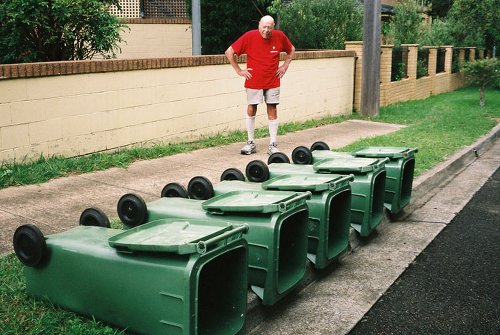
The only things exhausted after rubbish night in Sydney are the rubbish bins. (Pic: http://www.walksydneystreets.net)

Warrnambool City Council contracts Wheelie Waste to provide a weekly garbage and fortnightly recycling collection. Wheelie Waste  also provides rubbish collection services for 12 other council areas in Victoria, including the Moyne Shire and Colac Otway Shire – both of which have rubbish collection starting from 6am.

I called Wheelie Waste to find out why Warrnambool wasn’t also on the 6am schedule, but they didn’t want to comment to Bluestone Magazine and directed me to the council.

The council’s Manager of Communications, Nick Higgins, was more forthcoming:

“The night time collection of waste occurs for two main reasons: safety and efficiency,” he said in an email.

“Collecting during daylight hours would mean the trucks would be on the streets when there is more pedestrian traffic and potentially during school drop-off times.”

(But what about Sydney, surely it has more pedestrian traffic?)

Nick then went on to say:

“Collection of waste during the day is more costly due to the collection being less efficient as a result of factors including traffic, parked cars and school zones, all of which slow down the service.”

house

So in effect, the council’s main reason for collecting rubbish overnight is about cutting costs – although we are not sure how much is saved – because if it was all about safety, every other council would run overnight collections to avoid running over any school children.

We already know that Wheelie Waste has no problem with collecting waste during the day, because its general manager of contract garbage, Chris Philp, said late last year that manoeuvring around traffic and parked cars was not a problem.

“We pick up waste all around Victoria and don’t have problems with cars parked on the road,” he said.

I wonder, if asked, would Warrnambool residents prefer an end to their weekly garbage wake-up calls, or saving a dollar or two from their rates? After all, the biggest savings in the cost of garbage collection have come from recycling. Maybe it’s time for a re-think.

Let’s sleep on it.

How we compare: Warrnambool 10pm to 4am; Port Fairy (Vic) from 6am; Portland (Vic) mid-morning; Cheltenham (Vic) from 6.30am; Mirboo North (Vic) around 8.30-9am; Ballarat (Vic) from 7am; Traralgon (Vic) between 6am-9am; Colac (Vic) 6am- midday; Albury (Vic) from 6am; Richmond (Vic) 9am-noon; Gawler (SA) from 7am; Port Adelaide (SA) from 7am; Huonville (Tas) 8am; Kingston (Tas) around 7am; Sydney City (NSW) 9am; Northern Rivers (NSW) 10am; Manly (Qld) from 7am.