Air issues expose deteriorating state of W’bool Art Gallery
Carol Altmann – The Terrier
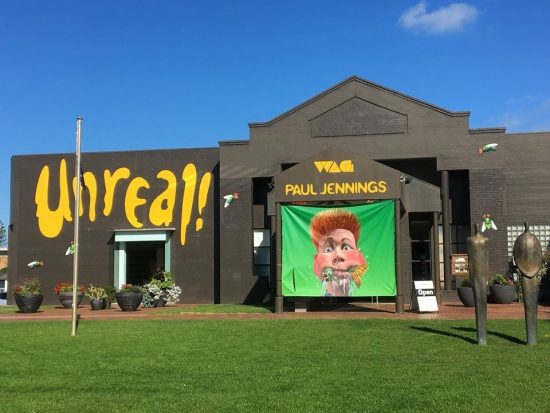
Interesting to see the W’bool City Council must now spend $530,000 to replace the air-con system at the art gallery, which has been limping along on one leg for some time.
Like the poor old library across the road, the poor old art gallery has been neglected to the point where it no longer meets modern standards.
We have missed out on major national and international touring shows because the air quality system has not been up to scratch, which might explain why the Paul Jennings and Damon Kowarsky exhibitions each stayed open for more than six months.
Just like the library, this sad state of affairs is not the fault of the gallery director and staff, who have had to make do with what they have been given.
Take, for example, the fact that the art gallery – in 2019 – still doesn’t have a decent online database.
As a result, most of us have no idea what is even in the collection and, despite the most recent shows “Rich Pickings” and “Wanderlust”, most of it remains hidden.
The council agenda for tomorrow night’s meeting reveals that in just the last 12 months, since the council agreed to fix the gallery’s air-con system, it has failed numerous times and $20,000 has been spent patching it up.
Why have our two main cultural institutions been allowed to run down into this state?
Is the hosting of AFL practice matches at Reid Oval, or spending millions propping up Flagstaff Hill, or spending countless dollars on endless studies of the harbour considered a greater priority? Sadly, yes.
At least the poor old library will soon be replaced with a shared complex with TAFE, although I am not convinced that this is the best long-term solution.
Maybe we could follow the lead of other cities and instead of maintaining separate institutions like in the past, we combine the art gallery, library and a museum into a new state-of-the-art building to replace the existing art gallery.
The Civic Green remains the perfect location for such a contemporary cultural centre (and there is plenty of room for parking right next door).
Such a landmark building would also restore Warrnambool’s reputation as a leader in exhibiting and promoting arts and culture, which it was when the gallery opened in 1986.
Personally, I would much rather see this than AFL practice matches at Reid Oval, and I am Port Power fan.
Peter Ronald on the destruction of 100-year-old ‘Rowitta’
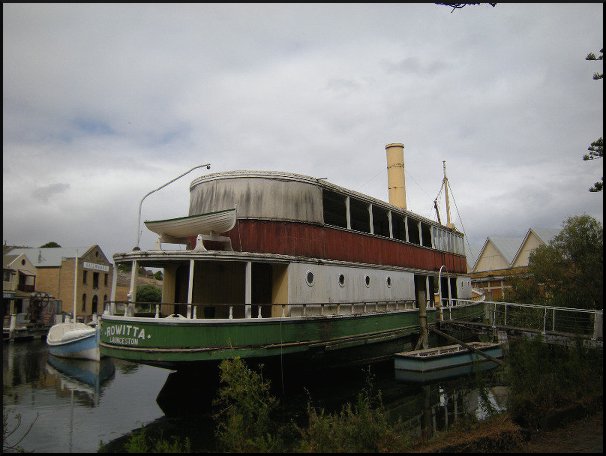
Fading away: the 100-year-old wooden steamer, Rowitta, is being pulled apart after it was decided by Flagstaff Hill to discontinue all maintenance. Image: Amanda Turnidge-Jones.
Bluestone invited the former director of Flagstaff Hill, PETER RONALD, to write on the imminent destruction of the Rowitta, one of the oldest vessels at the Flagstaff Hill Maritime Village:
ANALYSIS – Peter Ronald
The Rowitta has involved some difficult decisions for Flagstaff Hill over the years, but it seems the vessel will soon no longer exist. (*The WCC has since announced the removal of the Rowitta began on April 20, 2015.)
The destruction of historic ships is an unusual pursuit for maritime museums and accordingly, I have been asked by Bluestone Magazine to contribute my opinion on the issue.
I do so with some reluctance, but perhaps it is timely to put some matters on the record. I have always sought to grace an honest question with an honest answer; that is simply my aim here. Anybody seeking my views on this issue would have received precisely this same answer.
The vessel’s hull was originally purchased and moved onto the site with the idea of creating the impression of a sailing ship as the centrepiece of the village. This initial concept was – without any disrespect to those responsible – primarily about creating atmosphere rather than the noble goals of maritime heritage conservation.
As I attempted to steer Flagstaff Hill from “maritime village” to “Maritime Museum”, it became essential to reassess the role and significance of this primary centrepiece: the Rowitta hull. Options for the hull were clear; to pursue the “atmospheric” notion, restore the vessel to its original configuration, return it to the ocean (for sale/use elsewhere), or just let it rot (a “caged” shipwreck on the Shipwreck Coast).
I suspect that these may have been the sorts of options reconsidered by current Flagstaff Hill management. The underlying question however is, why?
Why, some 20 years after the decision to restore and preserve the vessel, was the matter revisited? Why does total destruction of the Rowitta now seem like a good idea? The answers are clear, but it is not a pretty story.
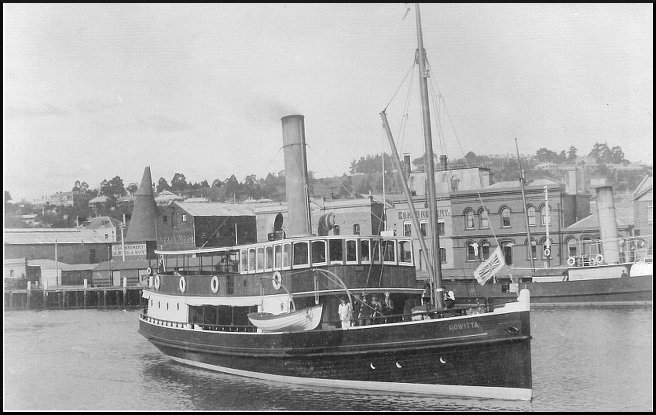
The Rowitta in her prime as a steamer on the Tamar River, Launceston, shortly after her launch in 1909. Image: On the Tide (Vol 1), reproduced courtesy of Launceston Reference Library.
Historic ship preservation is a well practised activity around the world and typically involves a period of extensive restoration, followed by meticulous maintenance. Through the research, hard work, and amazing skills of the late Ron Stewart, the hull was ultimately restored to its former glory as the historic steamer, Rowitta.
When I left Flagstaff Hill, the restoration was largely complete (the reconstructed aft cabin being used as an education centre/classroom) and maintenance was ongoing.
What happened next, in my view, is that Flagstaff Hill entered a “dark age” from which it is yet to recover.
Let’s be clear, under the planned and precise direction of the City’s then Administrators (and followed by subsequent Councils), the ethical constraints of the museum philosophy which had guided development for a decade, were abandoned in favour of a “tourist” focus.
The logic was that a change in emphasis from museum to tourist facility would herald even higher levels of economic success. Well, the scores are now on the board in relation to that failed experiment, and the Rowitta is symbolic of the collateral damage.
No longer an historic object in the care of a Maritime Museum, maintenance lapsed under the new direction. The high standard of restoration that had been achieved was simply eroded through neglect. That splendid work, so diligently accomplished by Ron Stewart, apparently deteriorated to the point that it was no longer even safe to enter the vessel.
The rotting Rowitta: the boat has been off-limits to Flagstaff Hill visitors for some time after it was considered unsafe to board. Image: Bluestone Magazine
The debate around “historic” ship or mere replica, raises a relevant and well studied aspect of historic ship preservation. It is true that any historic vessel preserved in an open-air environment will, as the result of basic maintenance, require the replacement of original fabric.
Over time, the percentage of original fabric present in any such vessel will therefore, effectively diminish: this is particularly true of timber vessels. In the Rowitta’s case, the hull is of completely original configuration and, I would argue, of primarily original fabric.
The deck has been renewed and the upper-works have been replicated. The end result of this equation, however, and by the standards of international maritime museum practise, is that the Rowitta was – and remains – an historic vessel.
To suggest otherwise is simply an argument of convenience used to justify a predetermined outcome.
Curiously, if the vessel was positioned just 350 metres to the south (ie. on the beach) it would now automatically be afforded the full protection of Historic Shipwreck legislation.
With the above background, I can only sympathise with present management. I believe the current manager is again pursuing museum goals for Flagstaff Hill, and for this I commend him, but the policy decisions of the past make the task a truly formidable one.
It should never have come to this: Flagstaff Hill’s “dark age” was unnecessary and, in any case, lasted far too long.
In the Rowitta example, the cost of the failed experiment will now be born by future generations through the loss of a piece of Australia’s maritime heritage: a 100-year-old historic ship.
I observe with sadness that Warrnambool’s maritime museum has been taken to the point of “burning the furniture”; one of it’s oldest and largest historic artefacts. Flagstaff Hill may never recover from the “dark age”, but there are foundational lessons to be learned from this current humiliating predicament.
Flagstaff Hill: a museum in transition or a mess?
The cracks in Flagstaff Hill’s museum collection are being revealed as a result of persistent questioning by those concerned about missing items. Image: Bluestone Magazine.
OPINION – Carol Altmann
[dropcap style=”font-size: 60px; color: #A5CECD;”] W [/dropcap]arrnambool’s Flagstaff Hill Maritime Village has finally admitted that it has lost more than 100 items from its collection in what is a clear indication that all is not well down on the hill.
Privately, people who have had a long association with the village either as former staff members, volunteers, or long-term supporters are questioning how has it all gone so wrong and, more importantly, can it be fixed?
In response to my piece last weekend in which I asked if the missing Loch Ard ingots were the tip of the iceberg (they were), FHMV manager Peter Abbott wrote a letter to the local newspaper in which he confirmed that at least 129 items donated to the museum could no longer be accounted for.
This is not about a clerical error on a database, this is about losing irreplaceable items that were given to Flagstaff Hill for protection. Put simply, despite being an accredited museum, Flagstaff Hill has no idea where these objects are because of years of poor record keeping and poor storage.
As to be expected, Mr Abbott used his letter to downplay the issue, referring to a missing bar of soap and a “small tin”, but even a single button can be valuable depending on who wore it: that’s what museums are about.
Bluestone has since learned, for example, that the very first items donated to Flagstaff Hill back in 1973 are also missing. They are a lamp that is believed to have come from the Loch Ard, and a police lamp, believed to have been used in the search for survivors from the Loch Ard.
These are not insignificant items.
Copper sheets salvaged from the wreck of the Loch Ard have been damaged since coming into the possession of Flagstaff Hill, including a large cut to one sheet in the Bond Store.
[dropcap style=”font-size: 60px; color: #A5CECD;”] I [/dropcap]t should also come as a shock to learn that while the copper sheets from the Loch Ard (1878) are not missing, some have been cut up.
As I wrote last week, these 10 sheets were given to the village by the Federal Government in 1984 and were supposed to be housed under a loan agreement that, until recently, had been forgotten about.
The online listing for the copper sheets confirms: “One sheet appears cut or severed in a diagonal line downwards from its top left hand corner. One sheet has a 10cm X 10cm square cut out of its top right hand corner.”
The sheet that has been virtually sliced in half can be found inside the Bond Store.
When asked about these two sheets, Mr Abbott referred me to a third sheet, now housed at the Port Campbell Tourist Information Centre, that had a small drill hole added so that it could be secured to the wall (the people responsible apologised to Flagstaff Hill in 1993 for their mistake.)
Mr Abbott didn’t explain why these more recent and much larger cuts were made, but it has been suggested that at least one piece was used to create a copper sculpture.
FHMV also considers it acceptable to store some of the remaining sheets – those twisted by the blast during their salvage – outside in the weeds near the Barracks, as if they were storing bits from Bunnings, rather than relics from the Loch Ard.
Buckled copper sheets (centre) from the wreck of the Loch Ard are “stored” among the weeds and an assortment of other items outside the Barracks. Image: Bluestone Magazine
[dropcap style=”font-size: 60px; color: #A5CECD;”] M [/dropcap]r Abbott also used his letter to confirm that the brass bell from the wreck of the Newfield (1892) has disappeared after being removed during renovations in 2002 – 13 years ago.
Bluestone has been told that Flagstaff Hill was alerted to the missing bell back in 2009, but did nothing: there was certainly no public call for its return.
In fact the whistleblower who first raised concerns about the security and integrity of the collection management process has since left Flagstaff Hill in frustration.
None of this, it must be said, is the fault of the volunteers who provide countless hours of unpaid labour to try and fix problems that have been years in the making. They are doing their best and I saw that first-hand during a visit last Friday.
The volunteers, however, are history enthusiasts, not experts. Mr Abbott, similarly, comes from a tourism management background rather than a curatorial one.
Indeed one of the few people on staff who had a qualification in cultural heritage management, Helen Sheedy, has this year left Flagstaff Hill to work elsewhere in the council.
It is hard to imagine the Warrnambool Art Gallery being managed with so few expert hands and I can just imagine the outcry if it lost more than 100 artworks along the way.
In the meantime, Flagstaff Hill has gone from being a profitable venture – where it made money for the council – to one that now loses about half a million dollars a year.
Whether Flagstaff Hill is given the resources it needs to operate a well-oiled museum like it did in the 70s, 80s and 90s remains to be seen, but the cracks are starting to show and, for those who donated their items in good faith, the revelations of the past few days will be shocking.
[box]If you would like to do a Flagstaff Hill back-of-house tour of your own, you can join the free tour this Wednesday Jan 14 at 11.30am and 6pm. [/box]
[button link=”http://the-terrier.com.au/subscribe-2/” type=”icon” icon=”heart” newwindow=”yes”]To help Bluestone continue its work with Opinion, please subscribe here for just $85 a year.[/button]


 You can find more Opinion here…