Sign of the times for Mortlake icon
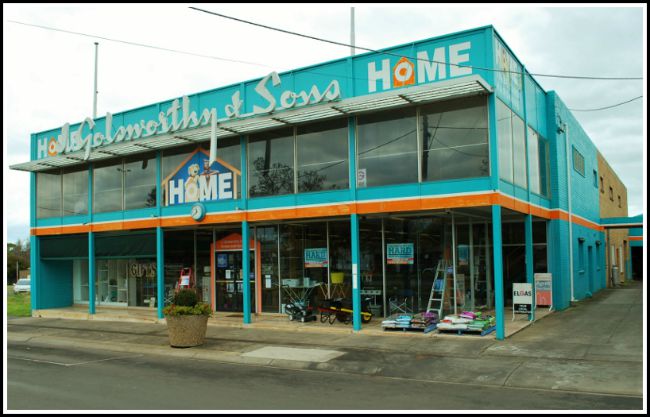
Glass curtain walling to the facade is shaded by a timber sunscreen and deep overhangs (800x507)
The Golsworthy and Sons hardware store in Mortlake is a classic example of 1960s architecture that has remained largely in tact since it was first built. Image: Clinton Krause.

Bluestone columnist and architect CLINTON KRAUSE previously worked in Daylesford before relocating his business to Warrnambool. Clinton explores the architectural styles that gives our region so much character.

Anyone passing through Mortlake would be familiar with the eye-catching facade of ‘Golsworthy and Sons’ Hardware Store at the eastern end of the main street.

Built in 1962, the building is testament to the optimism and buoyancy that arose from the regions prosperity during the post war boom in settlement and farming in the region.

The family dynasty of four generations took over the local hardware shop in 1930 and embarked on successive expansion of both the business and the premises, culminating in the appointment of Melbourne architects Montgomery, King and Trengove to create the cutting-edge, modernist mecca that endures to this day.
tools sign
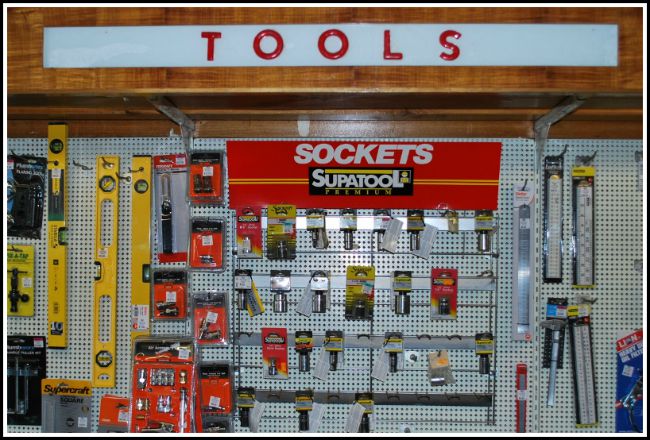
Neat as a pin: Custom designed pelmets designate the allocation of goods. Image: Clinton Krause.

More than a thousand people attended the opening ceremony in November 1962, partaking in afternoon tea on the upper floor.

The ‘Mortlake Gazette‘ of that month proudly boasts: “It is doubtful if there is any store in the country the would be the equal of the new building and it compares more than favourably with any Melbourne store”.

Locals, however, were less enamoured, and Eric Golsworthy, third heir of the hardware empire, repeatedly refuted naysayers who claimed that the shop was too big and too expensive for the likes of Mortlake.

It turns out that Eric’s timing was just right and the new business flourished during the good times brought on by the post-war building boom , the influx of residents to the district during the Government’s Soldier resettlement program and the healthy market price for wool.

At one stage the company employed 25 people and the building arm of the business was engaged to build many of Mortlake’s notable public buildings including the Police Station, Ambulance Station, Shire Offices, preschool and infant welfare centres to name just a few.
atrium
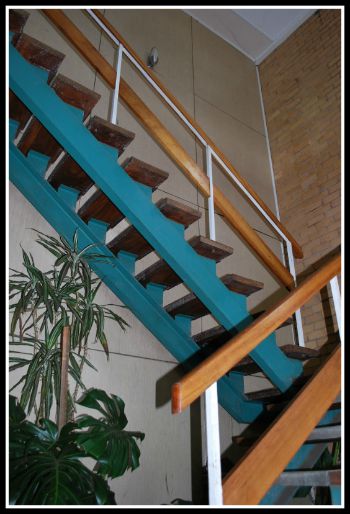
A plant-filled atrium and stair leads to the upper display floor.

Chatting with the current owners, Rod and Betty Golsworthy, it is clear that the halcyon days are over and that the end of a long and successful family enterprise may be drawing to a close.

I am sitting in Rod’s office and I can’t help but feel that I may be on set for an episode of the classic series, ‘Madmen’.

We are seated in 60’s armchairs surrounded by rich blackwood timber wall panelling at a custom designed timber desk with curvaceous lines and stick legs.

On the floor is grey and blue checked linoleum and out through the glass partitioning, the banks of fluorescent pelmet lights still do their job of visual ‘ razzle dazzle’ across the shop floor.
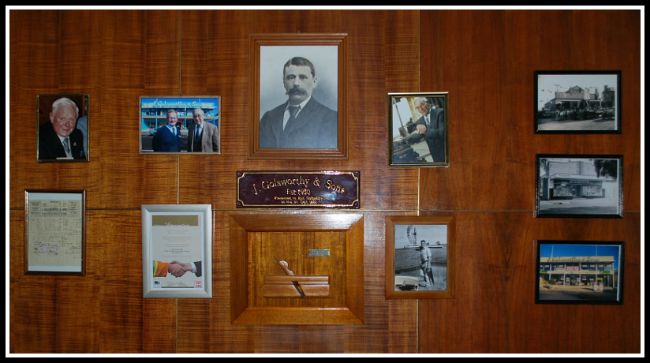
Three generations of the Golsworthy family along with a loyal longserving employee are proudly displayed. (800x436)
Three generations of the Golsworthy family along with a tribute to a loyal, long-serving employee are proudly displayed. Image: Clinton Krause.

Rod proudly shows me the “wall of fame” – a commemoration of the Golsworthy business reign, from James who founded the business in 1930, to Ernest , then Eric and through to Rod.

A photo of employee Arch Grant celebrates 60 years of loyal service. There is a lot of history here to take in.

An exploration of the shop reveals original cabinetry and display stands, building details and even the original architects’ coloured perspective rendering for the proposal.

The stairwell leading to the upper floor is a stylistic statement of floating steps, indoor planter bed and wall panelling all within a glass atrium – very groovy.

The shopfloor is still packed with tools , equipment, hardware and home decor and it is not hard to imagine the days when tradies lined the long counter with their scribbled lists for wire, screws and “2-b-4’s”.

It becomes clear to me while reminiscing with Rod and Betty how both this shop and the Golsworthy family are such a pivotal part of the community fabric and the cultural history of Mortlake.

It is a real delight to discover such an intact “time capsule” of 60’s architecture and design.

In the building itself – the shopfittings, photos , news articles and even the original architectural plans – there is a rich record of an entrepreneurial spirit that has left an indelible imprint on this small rural town.

Clinton-Krause


Lack of schooling a ticking bomb

bored hoods

OPINION – Carol Altmann

[dropcap style=”color: #a02f2f;”] T [/dropcap]here is a ticking bomb under south-west Victoria called a lack of education and it is set to blow up in our faces unless we start to do something about it.

For a variety of reasons that are still being nailed down, hundreds of teenagers in the south-west are dropping out of school and either doing nothing, having babies, drifting, or falling into a nasty, destructive spiral that – once they have tumbled in – is extremely hard to climb out of.

The numbers are chilling.

The six councils that make up the Great South Coast Group (stretching from Corangamite to the South Australian border and up to Hamilton) have reported that only 57 per cent of all school kids in our area are finishing Year 12 or its equivalent.

In some areas, such as in and around Portland and Heywood, is it a lowly 51 per cent.

For boys, the figures are like those from a bygone era: 44 per cent in Glenelg, 46 per cent in Corangamite and 48 per cent in Moyne.

As one member of the Great South Coast Group put it, we are teetering “on third world standards”.

Pregnant boy milwaukee
Teenage pregnancy is among the issues facing the south-west community that are connected to school drop out rates. Image: onemilwaukee.org

[dropcap style=”color: #a02f2f;”] T [/dropcap]hese dreadful figures come amid news that youth unemployment among 15-19 years olds is at its highest level in Victoria since 1997, with 20 per cent of kids in this age bracket having absolutely nothing to do when they get up every day.

In short, we are failing the next generation by selling them the great lie that if they don’t finish secondary school, they can still have a good future.

They won’t, because the sort of jobs that we might have picked up with a Year 9 or Year 10 education are going or gone.

Thousands will be left out and condemned to an under-class that struggles financially, emotionally and socially for their entire lives.

And if they fall behind, south-west Victoria will fall behind and become a welfare-basket backwater that can no longer cut it on a national, let alone international scale.

If this all sounds grim, it is because it is and it is happening right before our eyes and we, as a community, are contributing to the problem unless we help to fix it.

fj factory floor
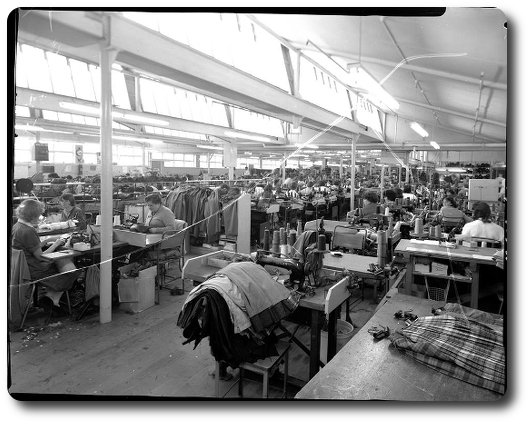
Jobs that once filled the gaps are now going or gone. (Fletcher Jones factory floor, Warrnambool. Image: Ralph Illidge, via David Owen, Save the Silver Ball and Fletchers Gardens.)


[dropcap style=”color: #a02f2f;”] T [/dropcap]he Great South Coast Group set up a working party which has spent almost three years trying to get their heads around the enormity of the problem and what to do about it.

At times, one member said, it felt like an almost overwhelming task and no wonder, because in order to really make a change, everything has to change.

After months of research, thinking and talking, the working group has come up with a broad-scale plan that challenges us to do things differently and to step away from our old ways of thinking.

Take, for example, the thinking that “the government” will step in and fix it. We have tried that, and it is not working.

What has happened, instead, is that multiple government departments are all tackling the same problem, in their own ways, without talking to each other, without being allowed to talk to each other and some kids end up with 12 separate case workers and no long-term solution.

(There is a great anecdote from a homelessness program in Woollomooloo, Sydney, where 52 “service providers” were all helping the homeless without knowing how many homeless they were helping. It turns out there were 90 people sleeping rough and this turned the issue on its head to become the “90 homes for 90 lives” project.)

kids playing footy
While sporting prowess is highly valued in our community, academic ability attracts far less comment.

[dropcap style=”color: #a02f2f;”] T [/dropcap]ake, as another example, our thinking that the problem starts in early primary school, when kids learn to read and write and do sums.

Wrong. The working party argues that it begins at conception.

The minute that little sperm penetrates that egg, a whole suitcase of potential – or lack of – flips open for that child: is the mother an addict? Is the father? Are they comfortably well-off or poor? Literate or illiterate? Supported or isolated?

And what about the community mindset that worships all forms of sporting prowess, especially football, above academic ability?

This needs to change too.

The working party has based its approach on what is called a Collective Impact model – snappy title, right? – but it is exciting and has worked very successfully in places like Sweden, Canada and the US, but is only now catching on in Australia.

In a nutshell, it involves motivating the community as a whole – politicians, parents, teachers, employers, philanthropists, business owners, the elderly, service clubs, sporting clubs, you and me – to work for real change.

Instead of operating in our own little corners, or doing nothing at all, we are urged to work collaboratively and collectively. “That is not my area,”  or “that is not my problem,” won’t be part of the language.

centrelink

[dropcap style=”color: #a02f2f;”] T [/dropcap]he first step, and it is happening as we speak, is the Great South Coast Group setting out a community action plan for each council area, because each has its own challenges.

Beautiful little Mortlake, for example, is doing its best not to become a welfare ghetto in the face of low-cost housing, poor services, poor public transport and the sheer boredom of those who have been located there by “the system”.

The action groups aim to get people talking about the problem – like we are now – and set down steps for change that we can all be involved in, even if it is something as simple as listening to a child read.

It will take years to turn around a mind-set that has been years in the making, but I think this is the best approach I have seen in a long time and I can’t wait to see it unfold.

Are we all prepared to help?

[box] The Great South Coast working party members include: Helen Bayne (South West PCP), Helen Durant (Great South Coast Early Years Network), Karen Foster (Great South Coast), Toni Jenkins (South-West LLEN), Marcus McCormick (South-West LLEN), Vicky Mason (W’bool City Council), Anne Murphy (Glenelg & Southern Grampians LLEN), Mary Pendergast (Dept of Education and Early Childhood Development) and Kaye Schofield (RMIT Hamilton). You can read more about the project here.[/box]

[button link=”http://the-terrier.com.au/subscribe-2/” type=”icon” icon=”heart” newwindow=”yes”] Would you like to have early access to our Opinion pieces? Please subscribe here.[/button]

newsletter Eat And Drink Stones Read more Opinion pieces here…


Trader levy deal…and the Jennifer Lowe factor

Council’s racing hospitality bill hard to swallow

Reekie to challenge Napthine at state election

Forget cover ups, roll right over Rolf

Community vision should extend city wide: Julie Eagles

Flagstaff Hill at $15 million crossroad

Scrap trader levy and start over

What is holding Portland back?