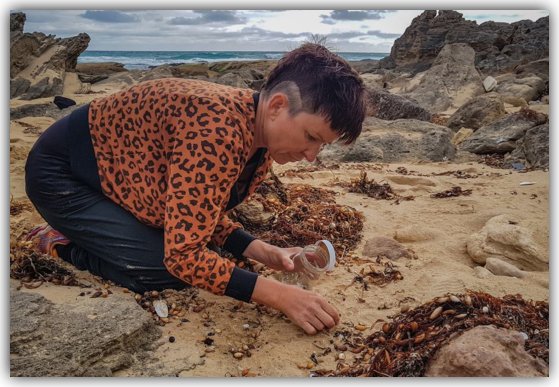
Warrnambool film maker and environmental activist Colleen Hughson, meticulously collecting tiny plastic ‘nurdles’ that were illegally dumped through the Wannon Water system last November. Photo: Rosana Sialong.
By Carol Altmann
Every time I look at the above photo of Warrnambool woman Colleen Hughson, I am struck by the humility of it.
There is Colleen, at Shelly Beach, on her knees, deeply focussed, picking up tiny plastic beads – aka an environmental nightmare called “nurdles” – between her fingertips, one by one by one by one….the number appears to be endless.
That shaved spot you can see above her right ear was where she had surgery to remove a brain tumour not long before this photo was taken by fellow ‘nurdler’ Rosana Sialong*.
I am sure surviving a brain tumour must change you. It would make some of us, I suspect, become more selfish. In Colleen’s case, however, it has made her generous spirit even more generous.
When Colleen, a film maker, discovered that tens of thousands of nurdles had been illegally dumped through the local Wannon Water sewerage system last November, she started a community action and clean-up group, Good Will Nurdle Hunting, that is still going gangbusters today.
Colleen and Rosana and dozens of others have now been cleaning up this plastic pollution for months, including days of blazing heat and finger-freezing cold.
So far, they have picked up more than 650,000 nurdles from our local beaches and it ain’t over yet. They just keep coming.
Wannon Water has also been cleaning up this mess for months.
It recently announced it had so far spent $334,000 on collecting nurdles: imagine the cost if Good Will Nurdle Hunting was not helping out for free? It would probably be at least $500,000.
What happened here was a major environmental crime.
A crime that is equivalent to someone stealing half a million bucks from a bank, except unfortunately crimes against the environment are not measured that way.
And yet nobody has been held responsible and nobody will because Wannon Water, despite its best efforts, has run out of leads.
I asked Wannon Water’s general manager (service delivery) Ian Bail a bunch of questions about where the investigation was up to and, in a nutshell, this is what he said:
20 sites have been visited. There are no more visits to come;
the nurdles have been inspected by two independent labs and they still don’t know what specific type of plastic it is or what it might be used for;
investigator and retired police officer Mick Fennessy, who was hired by Wannon Water, has finished his immediate task;
the multi-million dollar upgrade to the Warrnambool Sewage Treatment Plant will include a new system for accepting sludge which, hopefully, means this won’t happen again.
Wannon Water is keeping the investigation open. It still hopes for a breakthrough, but that won’t happen unless someone who knows what happened speaks up.
And somebody knows.
The person who poured the zillions of the nurdles into the system knows.
The person who delivered the sludge to Wannon Water’s treatment plant containing all of these zillions of nurdles also knows, or should know.
Was somebody paid to look the other way?
Somebody knows.
And while we wait for somebody to grow a conscience, people like Colleen and Rosana and Keith and Brenda and Donna and Luke and Megan (the list of names goes on), will keep picking up the pieces.
*Rosana’s photo provided the inspiration for this year’s Warrnibald portrait prize winner, Megan Nicolson, who reproduced it in needlepoint.
If you would like to see more stories like this, please consider making a small contribution below.
How can you dump piles of deadly plastic without detection?
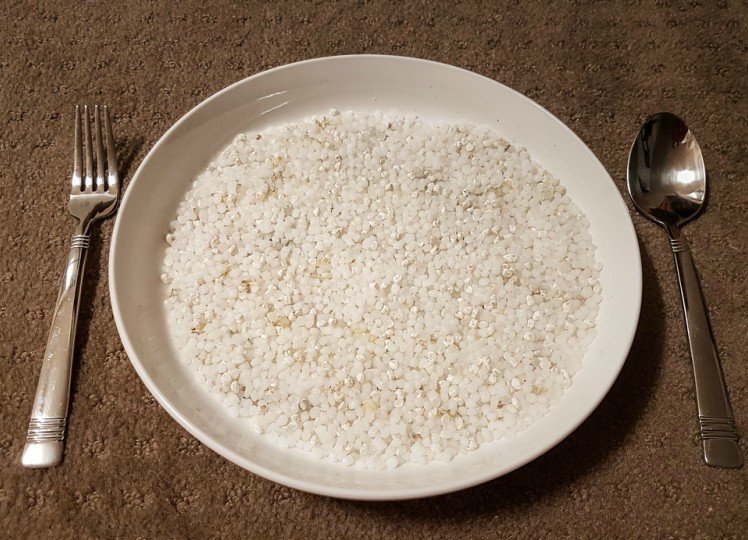
Pollution in disguise: Millions of micro plastic ‘nurdles’ were illegally dumped into the Warrnambool sewerage treatment plant last November. This image by Rosana Sialong shows how easily they can be mistaken by coastal wildlife for food. Image: Good Will Nurdle Hunting.
By Carol Altmann
LAST November, millions of tiny plastic pellets (nurdles) were dumped illegally into Warrnambool’s sewerage treatment system – polluting our beaches all the way from Thunder Point to Yambuk – and still nobody has been found responsible.
How can this be?
This was a criminal act, but as Bob Brown said recently, crimes against the environment don’t attract police cars with their lights flashing and sirens roaring.
It was also, I suspect, one of the largest pollution spills ever recorded in Warrnambool and one from which it will take months if not years to recover.
Even as I write this, the Good Will Nurdle Hunting action group – set up by film maker Colleen Hughson – and others, are still laboriously picking up thousands of nurdles to avoid them getting stuck in a seabird’s gut and killing them.
And yet five months on, Wannon Water, who is responsible for accepting and treating the waste that comes into the Warrnambool plant, appears no closer to finding a culprit.
In these days of swipe cards, security codes, security cameras, trade waste controls, random testing, checklists, computerised logistics and god knows what else, this seems inconceivable, but it is the current reality.
It is also astonishing that Wannon Water didn’t know exactly what was being poured into its treatment plant on or around November 16.
This might be a harsh assessment if we were talking about the general sewerage system that caters for tens of thousands of customers from across the south-west, including those stupid enough to flush all manner of junk down the loo.
But in this case, the search is not a needle-in-a-haystack scenario, but actually quite narrow.
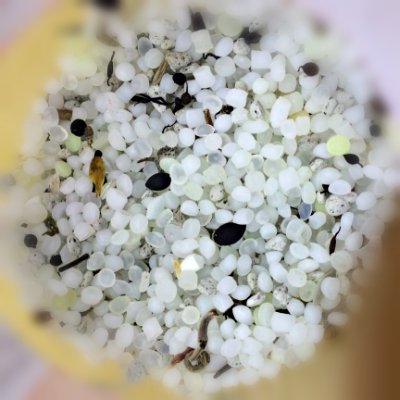
Local artist Megan Nicolson collected almost 2000 nurdles in one sweep around Shelly Beach on April 17, and they just keep coming. Image: Good Will Nurdle Hunting
BEAR with me for a second while I lay this out, because it is critical as to why this spill is considered by many to have been avoidable and why so many people are still angry and demanding answers.
Wannon Water has confirmed that the plastics came into its plant through what is called a Sludge Acceptance Point (SAP). This is where authorised tankers deliver gunk collected from authorised customers. You need a key and a swipe card to get in. In other words, it is not open to just anybody.
As Wannon Water managing director Andrew Jeffers said by email, “WannonWater’s system is secure and only able to be accessed by approved customers. Volumes received at this point are only a very minor proportion of the total volume of sewage treated at the Warrnambool plant.”
Of these SAP customers, Wannon Water has identified 20 sites that were inspected as part of its investigation, including some sites that might use nurdles or raw plastic.
Yet despite nailing it down to just 20 likely sources, none of these inspections, it seems, has come to anything.
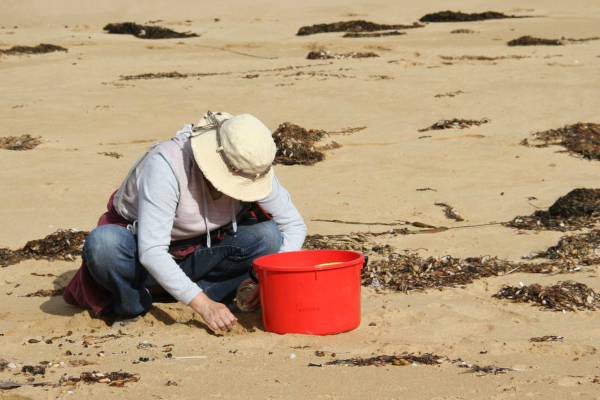
Knees down, back bent, nurdle collector Rosana Sialong is one of the many locals still trying to remove the nurdles from the Shelly Beach area. Image: Good Will Nurdle Hunting.
WANNON Water declined to list the 20 sites inspected, or to reveal much of anything about its ongoing investigation, so I asked five local, large industries directly if they had any knowledge of the spill.
Here is what they said:
Midfield Meats: “Midfield doesn’t use nurdles in any processes.”
Murray Goulburn: ‘MG does not use Wannon Water for its effluent disposal. We have our own wastewater treatment system and spray irrigate on to our farmland. In addition, MG does not use a product of this nature in any aspect of its manufacturing.’
Beach Energy: (owners and operators of the Port Campbell gas field, formerly operated by Origin Energy): “No nurdles are used in production on site.”
Fonterra: “I’ve spoken to our site environment manager and can advise that we don’t use nurdles in our production processes”.
Saputo/Warrnambool Cheese and Butter: The questions have been sent to Saputo communications in Canada – still waiting a response.
And what about two of Warrnambool’s septic and trade waste collection services, Berminghams and Sergeants? What do they know?
Sergeants: “As the records would state (we) didn’t dispose of any liquid waste at the Warrnambool facility during the months of October, November or December”.
Berminghams: “We have nothing to tell you about that.” The person said on the end of the phone before ending the call.
Lastly, I called Bartlett’s Environmental in Geelong.
Bartlett’s are contracted to clean the Wannon Water sewer pump stations and truck the sludge to the SAP, so maybe they unknowingly sucked up a load of nurdles around November 16 last year?
At first Barlett’s offered to look into it, and then, a day later, its general manager John McCoy emailed: “For all matters regarding contract work undertaken by Bartlett’s Environmental for Wannon Water, please refer all questions directly to Wannon Water.”
Mr Jeffers, who declined to be interviewed directly for this piece, said via email that Wannon Water had since ruled out the plastics coming in via sludge from a sewer pump station.
So around and around and around we go.
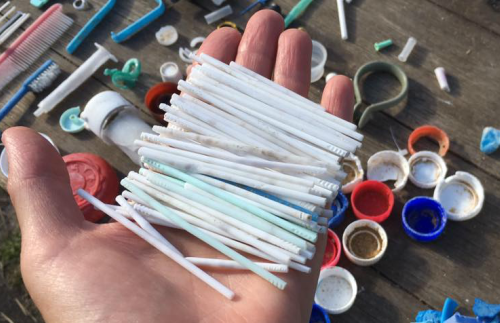
Thousands of cotton ear bud sticks, like these collected on April 20, were considered by many to be the canary in the coal mine on the pollution problem. Image: Pick Up Sticks Facebook Group.
WANNON Water appears keen to find out who has caused it such grief.
It is even using the skills of a private investigator, retired police officer Mick Fennessy, who is a big, no-bullshit kind of guy, to try and flush out the truth.
But what this spill has exposed is not only an environmental vandal in action, but a gaping hole in how the Warrnambool treatment plant has operated – quite legally – to date.
Wannon Water has now realised that its screening systems were not good enough, both before sludge was poured into its plant, and once it passed through.
What has happened since this spill is that two, finer screens have been installed at the treatment plant to catch anything larger than 1.5mm before it reaches the ocean.
Wannon Water is also “now supervising all loads coming in” to the SAP, according to Mr Jeffers.
Both of these are important changes but, some argue, they should have been made immediately when thousands of cotton bud sticks appeared at Shelly Beach en masse in 2015 and turned up in vast numbers again last August.
The slim white sticks were considered to be the canary in the coal mine, sending a highly visual warning that thousands of litres of small plastic could be passing through the Warrnambool treatment plant to the ocean.
Nothing, however, was done, despite Wannon Water being told about the pollution.
“Both the Environmental Protection Authority and Wannon Water were informed by myself and others of the sticks, but they either didn’t believe me or were unwilling to do anything about it,” said Luke Foster, a local plumber and member of Good Will Nurdle Hunting.
If the new 1.5mm screen had been installed before November 16 last year, the argument goes, very few of the millions of dumped nurdles would have made it to the ocean.
“I am happy there is now a 1.5mm screen at the end of the waste water treatment plant to capture these plastics. However, it may be a long time before we are able to remove the majority of plastics that remain in the marine environment from past pollution,” Mr Foster said.
Mr Jeffers, however, has distanced Wannon Water from any responsibility for the cotton bud sticks.
“WannonWater does not believe the cotton buds were related to the current sewage treatment plant nor the nurdle incident,” he wrote.
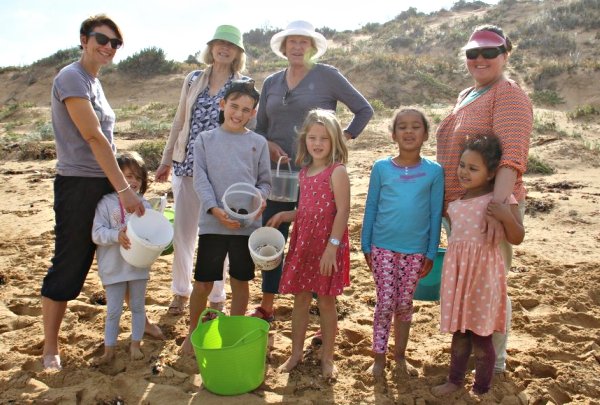
Some of the many Warrnambool locals who have joined he clean up effort at local beaches. Image: Good Will Nurdle Hunting.
THERE is a lot at stake for Wannon Water from this pollution problem, with the EPA continuing its own investigation into potential breaches of the Environment Protection Act by the treatment plant.
As EPA South West manager Carolyn Francis outlined, the maximum penalty through the courts for a breach of an EPA licence is $380,568. The EPA can also directly issue Infringement Notices of $7729.
There is also, of course, the need to reassure the public that Wannon Water is top of its game when it comes to handling pollutants: preventing them from entering the system in the first place and catching them – and the polluters – when they do.
Catching the nurdle culprit so long after the event, however, appears increasingly unlikely and yet time alone, surely, cannot be an excuse to give up the search. We deserve answers.
In the meantime, Colleen Hughson, who really got the ball rolling on the public clean-up, says she has been amazed by the community response.
“The most heartening thing about the nurdles spill is the amount of ‘good will’ the community has shown in coming together to clean the mess up.
“(It) has also highlighted the bigger issue of marine plastic pollution and many people in my community have been inspired to look into ways of curbing their own consumer habits to stop the flow of plastic waste. It’s brought about conversations, generosity and a willingness to take positive action.”
Do you know anything about the illegal dumping of the nurdles? If you do, contact me at altmanncarol@gmail.com
For information on Wannon Water’s response to the nurdle spill, including media releases, clean-up activities and ongoing updates, visit its dedicated webpage here.
Finding harmony on the hill
It has been an 11-year journey, but Mick and Amanda Fennessy are living their dream on their Tower Hill property that they have partly converted into self-hosted accommodation.
[dropcap style=”color: #a5cecd;”] H [/dropcap]ow do two former police officers from Melbourne wind up running holiday accommodation near an ancient volcano in South-West Victoria? The same way as so many other seachangers who move to the area – via a holiday to Port Fairy.
It is 11 years since Mick and Amanda Fennessy made the decision to relocate from inner-suburban Richmond to a five-acre property at Tower Hill after visiting relatives in Port Fairy and – you guessed it – seeing a property for sale on their way home.
“We did a bit of a drive-by, had a look, and dismissed it, but then shortly after we returned home, we opened The Age newspaper and there it was, rural property of the week. It was like it was telling us something,” says Mick.
The timing was right, Mick explains, for the couple to try something different with their lives, having worked for many years in the police force (which is where they met) and financial investigative work. They bought what he affectionately describes as “five-and-a-half nuisance acres”: too small to generate an income, but too large not to require significant maintenance and mowing.
Drinks anyone? Quirky, locally made garden art like this piece by Casterton artist Barbara Dobson is sprinkled around the Fennessy property.
[dropcap style=”color: #a5cecd;”] P [/dropcap]art of the property is taken up by rolling lawns and native gardens, while another portion is devoted to a couple of hundred fruit trees, including a splendid fig, that provide ample produce for Amanda’s home-made preserves that she sells through local markets under the Tower Hill Farm Produce label.
That left about two acres overlooking Lakeview Road, with southern views to the ocean and eastern views across to the night lights of Warrnambool.
“Right from the get-go we thought about how we could use the two acres for accommodation, but we weren’t entirely sure exactly which path to take,” Mick says.
The pair knew they wanted something unusual, so initially explored using up-styled shipping containers – “self-contained, containers” – before settling on recycled school classrooms.
The six school portables come from mostly tiny hamlets – Coolaroo South, Nilmah, Merrijig, Bendigo South East, Syndal South, Manchester, Newtown and Goornong – and were bought through a supplier who trades in such things.
“They are quite incredible structures with solid hardwood floors and everything hand-nailed. Even though they are called portables, they aren’t going anywhere,” Mick says with a laugh.
The interiors of the former school classrooms have been completely refurbished to give them a second life as accommodation. Image: Harmony at Tower Hill.
[dropcap style=”color: #a5cecd;”] A [/dropcap]manda, who during this interview is busy cooking figs on the stove, overseeing wood chopping by two visiting friends, and checking on the progress of a builder, dips in and out of the conversation, but has a moment to show off one of the five portables that have so far been converted.
As Amanda hauls back the sliding door (remember those?), I feel for a split second as if I am about to revisit Grade Two with Miss Fitzgerald at Warrnambool East Primary School circa 1972, but these portables are nothing like a classroom. The transformation from a utilitarian space into sleek, modern accommodation is remarkable.
“We always had a mental picture in our head of what it would look like, and we have not only reached that, but I think we have exceeded it,” Mick says.
Harmony at Tower Hill, as it is known, has been open since last December and, because of its dog-friendly status, recently accommodated some of the Maremma dogs (and their handlers!) during the filming of the Oddball movie in Warrnambool.
Another life: Former Detective Sergeant Mick Fennessy and Senior Constable Amanda Fennessy during their days in the force.
[dropcap style=”color: #a5cecd;”] T [/dropcap]he Fennessy’s complete change in lifestyle has coincided with Mick having the ultimate wake-up call that life can, quite literally, shift in a heart beat.
When we meet, he is three weeks into his recovery from a quadruple bypass on a damaged heart that, if left untreated, would have failed him.
“It was like the warning light coming on, on your dashboard and you know that the rollercoaster is taking a dip downhill. You don’t want to see that too many times in your life before you start making changes,” he says.
Fortunately the only lights coming on for Mick now are those twinkling in the distance from Warrnambool.
Did you hear the one about…? Garden art by Timboon sculptor Jon Hayes (Tomrtoe) is among the Fennessy’s collection.
[box type=”bio”] You can find out more about Harmony at Tower Hill on the web here. [/box]
[button link=”http://the-terrier.com.au/subscribe-2/” type=”icon” icon=”heart” newwindow=”yes”] Did you enjoy this story? Please subscribe here to help Bluestone thrive.[/button]


 You might also enjoy…