Sink or swim? Lyndoch’s $22m clinic months from completion
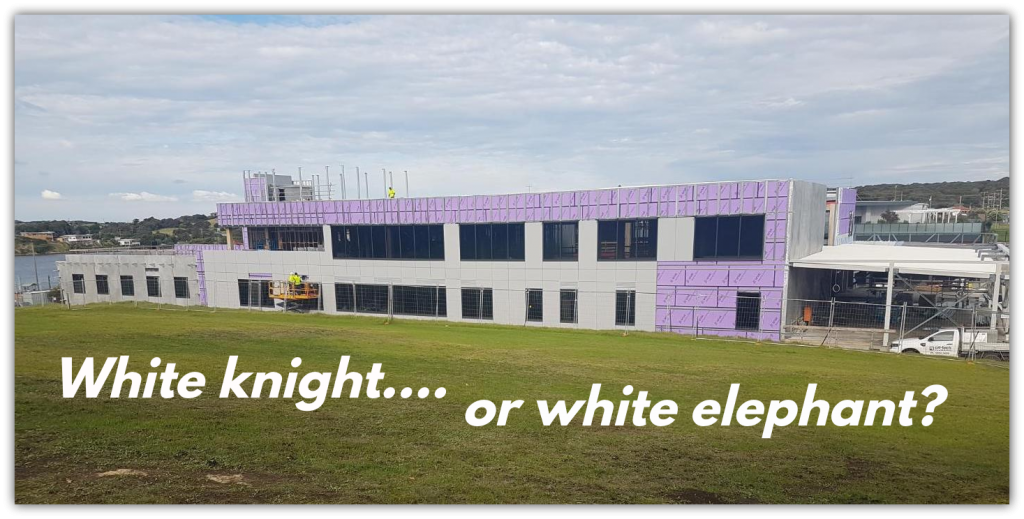
The $22 million health care centre under construction at Lyndoch Living. It was due to open next month, but is far from completion.

Carol Altmann – The Terrier

Lyndoch Living’s multi-million-dollar health clinic was due to open next month: it’s still an empty shell.

This is the three-level, 6761sq/m, $22 million (at least) health centre being built right next door to Lyndoch on Hopkins Rd.

This project will either be a white knight, or a white elephant. It could kill Lyndoch.

The whole project is a huge gamble and it’s one the board decided to take about five years ago, without any public consultation, when for the first time in Lyndoch’s history, it borrowed a bucketload of money – about $12 million – to fund this grand plan.

On top of the $12 million, Lyndoch has redirected another $10 million from its own funds (not including residential bonds, which is illegal) that would otherwise have gone toward aged care.

So that’s at least $22 million which has to be recouped by Lyndoch, plus any cost blow outs, plus interest, plus taxes, plus maintenance and repairs, before this building turns a profit.

The building was supposed to be finished by next month, or August at the latest.

As we could see during the 5 June rally, it’s nowhere near it.

And so the huge floor space – equal to about four Olympic swimming pools – is nowhere near being ready to start taking tenants.

Which brings us to the first of many questions:

What is the new finish date?

What are the inevitable extra costs due to delays and the rising cost of materials?

And – most importantly – how many tenants has Lyndoch secured for the space?

The board was hoping for a full royal flush of up to 20 GPs, a dentist, a radiologist, acute care staff, pathology, allied health services, a café, a chemist and education/training facilities.

God knows where they’re all coming from.

Perhaps Lyndoch has a secret stash of healthcare professionals tucked away that the rest of regional Victoria can’t access.

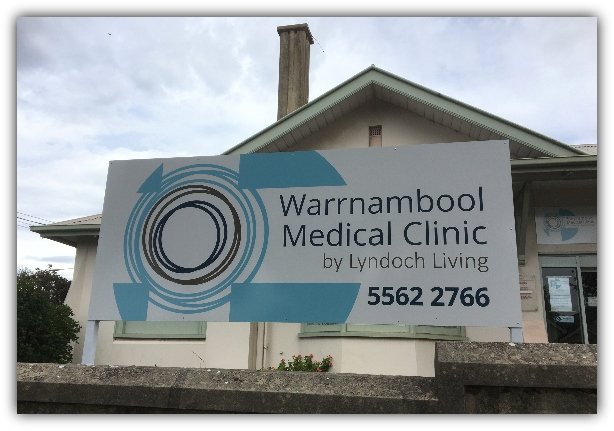
The Warrnambool Medical Clinic, which Lyndoch bought three years ago, has 14 (full and part time) GPs but those contracts recently expired, and it’s not known how many have signed up for another three years.

I’ve asked Lyndoch CEO Doreen Power and chair Sue Cassidy for comment on all of these questions, but, once again, have had no reply.

I have also not had a reply about the directorships of the medical clinic company (Lyndoch Healthcare Pty Ltd).

The company has four directors: Ms Power; Unisex Cuts hairdresser Ms Cassidy; board member and Warrnambool City Council manager Andrew Paton; and, more recently, Sue Fleming who was previously with South West Healthcare.

How were these directors chosen? Were these positions advertised? How long are they directors for?

And the big question that nobody seems to be able to answer: will they be paid?

Given the clinic is a commercial venture, (not a charity or not-for-profit), you would assume the answer is YES!

The best I could get from Mr Paton, some months ago, was that he was not being paid “for now” and that any other suggestion was “hypothetical”.

So Lyndoch continues to pretend it can do what it likes, even when the future of Lyndoch is at stake, but we are getting mighty sick of the game, and so is the new Federal Government.

As MP Anika Wells tweeted last night: “Accountability and transparency will be at the centre of all aged care reform under the Albanese Government”.

It can’t happen soon enough.



Lyndoch posts record loss as it ploughs on with masterplan

Lyndoch Living aged care is sailing into un-charted waters with big borrowing, big spending and a sharp decline in its overall equity.

Carol Altmann – The Terrier

Lyndoch Living’s full financial figures dropped late today and here is a quick snapshot:

Lyndoch last year posted a record loss of $4.029 million – almost $2 million up on the loss of the previous year.

In 2020, it posted a loss of $2.4 million.

In 2019, it posted a loss of  $1.88 million.

In 2018, it posted a loss of $1.77 million.

In 2017, it posted a $846,000 surplus.

Er, is this supposed to be how a not-for-profit operates? Not breaking even, but running at continual losses?

More importantly, Lyndoch’s net worth has dropped to $40 million in 2021, down from $48 million in 2020 and $69 million in 2015.

This net worth/equity figure  comes from adding up all of Lyndoch’s assets (around $100m), and subtracting all of its liabilities.

Lyndoch’s assets have hovered around the $100 million mark for several years now.

What has changed are the liabilities – they keep going up, up and up.

In 2018, Lyndoch’s liabilities were $37 million

In 2020, Lyndoch’s liabilities were $47 million.

In 2021, they were up to $60 million.

All of this cuts deep into Lyndoch’s overall financial position.

Lyndoch is borrowing big, it is taking risks, it is investing in a $22 million medical centre that is due to be finished mid-year, ploughing ahead with its $100m masterplan and somewhere in all of that is a whole lot of hope – by us – that it will all work out.

Hold on to your hats, me hearties.

[The full figures are available through the Australian Charities and Not for Profits Commission. I will pull apart the figures in detail in coming days.]


Covid doesn’t stop digging into Lyndoch’s finances and future

As another year begins, the questions over the direction and culture of Lyndoch Living aged care still linger.

Carol Altmann – The Terrier

Righto, off we go. Let’s pick up right where we left off, because after all I am like a dog with a bone, and so tonight I am gnawing on the many things that we still need to know about Lyndoch Living – our community owned aged care home.

If any readers hoped that I might be moving on to another issue, look away now, because I am not finished with what has been a three-year investigation into how Lyndoch has changed, who has been involved, why and whether we can soon rest easy.

I am seeing this through – it will remain the focus of The Terrier for now – and I hope you will too.

Ah but hang on, there is one issue we need to address first and that is Covid.

Covidcovidcovidcovid.

Covid, as we know, is still disrupting aged care homes right across Australia with lockdowns, Covid outbreaks, visitation restrictions, and worsening staff shortages, and all of this is having a terrible impact on those who are isolated from their loved ones.

I am sure we all understand this, but Covid is not and cannot be a reason to stop asking the hard questions of Lyndoch that still remain unanswered.

In my view, it is even more of a reason to probe deeply into our publicly owned aged care home, because the local community are the custodians and caretakers of Lyndoch and we want to know that it is operating at the very highest standards of care, trust, accountability and transparency.

This has been the battle for the past three years – longer for those who work there – and it is not over yet.

Let’s begin with the AGM that was held just over a month ago.

At that time, Chair Susan Cassidy said during the livestream that any questions from members would be taken on notice.

Were there any questions from members taken on notice? If so, what were these questions?

What were the answers?

I asked Ms Cassidy this in an email last week and, so far, have not had a reply.

If there were no questions from members, then Lyndoch – a $100 million publicly owned organisation – held its AGM without a SINGLE question being asked.

Not one.

Perhaps I am wrong and Ms Cassidy will be in touch shortly with the list of rigorous questions and answers.

Such as:

Why has Lyndoch’s equity (assets minus liabilities) progressively fallen by a staggering $28 million in just six years?

In 2015, Lyndoch’s net assets were $69 million.

Last year, they had fallen to $41 million.

We will learn more about the Lyndoch figures at the end of this month, when it reports to the charities commission, so I will write more fulsomely on this then.

For now, however, we know a big slice of Lyndoch’s spending goes on staff costs and that it has also borrowed big time to fund its $22m medical clinic.

So, how is staffing? What are the bed numbers and staff ratios?

We see shift shortages being leaked to this page all the time – so why, in this climate, is Lyndoch bleeding so many experienced staff? Has the board asked questions and read the exit interviews?

And is it correct that Lyndoch is poised to hire a bunch of nurses trained overseas in order to fill the gaps?

What about the accreditation of Lyndoch due next month – is it on track to address all of the failings exposed by the aged care commission and pass with flying colours?

My sense is that Covid will see this accreditation delayed, but that doesn’t change the need for reassurance that Lyndoch has addressed ALL of the failings in Warrnambool and at its May Noonan Hostel in Terang.

And how is the $22 million medical clinic shaping up? Is it on budget?

And are all the GPs who are currently contracted with Lyndoch until April intending to stay on or will they follow Dr Phil Hall if, as reported, he re-opens a clinic at the existing Liebig St site?

What if the GPs don’t renew their contracts? How will Lyndoch fill its ginormous, three-level medical centre and not create another Sam’s Warehouse scenario?

Another whole pile of questions also come from the surprise announcement at the AGM that consultant Robert Lane had been hired to sort out how board appointments, and I assume general membership to Lyndoch, will be handled from here.

Mr Lane said there would be an advisory committee, chaired by himself and made up of two current board members (Mr Kane Grant and Ms Lorraine Mielnik), who would assist the board with its decisions on memberships which, to date, have made no sense to anyone.

I will also be learning more about that whole process this week, so stay tuned.

So many questions…I hope you are well rested and ready.

On we go.

[Thanks for reading, and if you would like to buy Jock a juicy bone as a thankyou, you can visit the Tip Jar here: https://tinyurl.com/yckzankb]


Near fatality exposes call system black spots inside Lyndoch

The potentially catastrophic failings of the internal nurse communication system at Lyndoch Living was exposed when a resident required CPR. Image: Stockfile

Carol Altmann – The Terrier

This time a year ago, a personal care worker at Lyndoch Living faced a nightmare scenario – a resident suffered a cardiac arrest and the nurse call system failed.

The care worker desperately tried to contact the on-duty Registered Nurse, who was in another part of Lyndoch – the new Swinton Wing – but the calls failed to go through.

The nurse-to-nurse comms system hit a black spot; a wireless dead zone that has plagued parts of Lyndoch for two years.

It was only when the RN moved out of the black spot that the frantic emergency calls came piling in from the care worker.

Fortunately, in the meantime, the care worker was helped by other staff to administer CPR and the resident survived.

Twelve months on, and the nurse-to-nurse call system is still failing. It is still not 100 per cent reliable across Swinton Wing and neither is the resident call bell system, or mobile phones.

All three are different systems, and all three suffer from the wi-fi black spots that can affect calls coming into Swinton Wing, going out of Swinton Wing, or between people inside Swinton Wing.

While the near fatality is the most serious incident that I am aware of from the past 12 months, there have been other red flags in more recent times.

In one case, a resident was left on a toilet for more than 40 minutes after the call bell failed to alert a nurse.

It’s hard to believe a nursing home is allowed to operate without a 100 per cent reliable call system for nurses and residents, but Lyndoch does.

It’s even harder to believe that the area with the black spots, Swinton Wing, re-opened last year after a $13 million makeover that, my sources tell me, failed to include an IT expert in the planning.

As of today, staff are still lodging ‘black spot’ complaints.

Part of the problem, apparently, is that a key piece of wireless equipment was destroyed by a lightning strike in 2019 and has not yet been replaced because it would cost around $500,000.

There are also compatibility issues between old technology and new technology across the different wings of Lyndoch.

Added to this is what has been a tumultuous time in Lyndoch’s IT department, including its Director of Technology, Strategy & Transformation, Dr Ed Rhode, resigning in April after less than two years, and the loss of two other staff more recently.

Before these resignations, there was some progress early this year when it was announced a new nurse-to-nurse call system would be rolled out from June to December although, according to one report, there were “no guarantees it will work”.

There were “no guarantees” because the new system could suffer the same issues as the old system, unless the underlying problems were resolved.

The roll-out hasn’t happened.

First the excuse was a supply problem.

Then the delay was blamed on Covid-19 preventing experts coming on site to install the equipment, even though it;s classed as an essential service.

But sources believe – and I am trying to confirm this from Lyndoch – that things have ground to a halt because Lyndoch is not prepared or is unable to spend the money.

A proper fix must include “back end” upgrades, equipment upgrades and ongoing maintenance, and all of that costs money.

And right now, Lyndoch is plunging its money and bank loans into the $22 million medical clinic being built just 100m from Swinton Wing.

A medical clinic that will have no discernible impact on improving the safety of the residents.

It’s not surprising that Lyndoch care staff are frustrated and angry.

As one put it, they are “sick of fighting for the basics, while they continue to pour money down the drain on this medical centre”,

Others are frightened, knowing they are unwilling players in a game of Russian roulette where the consequences for a resident could be fatal.

Again, this is not scaremongering, this is real and I, for one, find it both disturbing and frightening.

I asked Lyndoch and its chair Sue Cassidy for comment on these issues today. If any is forthcoming, I will publish it in full.


Clinic buyer revealed, exposing holes in $1.3m Lyndoch deal

With the WMC building poised to remain a clinic under its new owner, Dr Phil Hall, the new $22m Lyndoch clinic is even more vulnerable.

The Terrier – Carol Altmann

Just when the whole saga of Lyndoch Living buying the Warrnambool Medical Clinic practice could not get any weirder, it has.

Lyndoch paid $1.3 million in 2019 for the practice, owned by well-respected GP Dr Phil Hall – but it did not buy the building.

The Liebig St building was sold on 29 July for upwards of $1.4m to an anonymous “local investor” who I can tonight reveal is none other than Dr Phil Hall.

(Land Title documents show Dr Hall was already a co-owner of the building, and bought out his partners.)

This means Dr Hall not only works for Lyndoch under contract, but he will be its landlord ($120k a year + GST) until the lease expires next July.

But that’s not the bomb.

The bomb is that the “local investor” (aka Dr Hall) reportedly wants to see the Liebig St building leased as a medical clinic after Lyndoch leaves.

“Their intent is that it remain a medical clinic beyond the current tenant’s stay,” real estate agent Danny Harris told the local paper at the time of the sale.

A medical clinic!

It’s this prospect that exposes a gaping hole in Lyndoch paying $1.3 million to buy the medical practice in the first place.

What did it actually buy?

It bought “goodwill”, which means doctors on contract and the patients who follow them.

But it appears the deal failed to include a crucial clause that the former owner of that practice could not lease a building to a competitor.

Oops.

This failure exposes the fragility of Lyndoch’s decision to wade into medical practice.

As we know, Lyndoch is spending $22 million on a brand new, three-storey, 6761 sq/m complex on Hopkins Rd that it hopes to fill with 20 GPs and other health workers.

Those 20 GPs are the backbone of the whole clinic plan.

They will each pay a substantial fee – around 35 per cent of their annual earnings – in return for a space in the clinic and support services.

But there are no guarantees the GPs will come, or will stay, because GPs are contractors: they decide where they will work, and for how long.

If a GP working for Lyndoch/Warrnambool Medical Clinic wants to leave, they simply give 30 days notice.

My sources tell me the contracts signed between the GPs and Lyndoch expire next April.

This means all bets are off until new contracts are negotiated.

As of next April, Lyndoch could – in a worst case scenario – find itself with less doctors, not more.

Lyndoch was already in a vulnerable position, but that position will become a razor edge if Dr Hall follows through on his reported plan and offers his prime slice of real estate to a new medical clinic.

Who will take up the offer, and how many GPs from Lyndoch/WMC and elsewhere (will Dr Hall be among them?) will join its ranks?

I asked Dr Hall for a comment for this piece, but he declined.