The Facebook media ban kicked The Terrier right in the guts and exposed the vulnerable belly of small, independent media.
Carol Altmann – The Terrier
Mark Zuckerberg is a pretty lousy shot.
As we know, the owner of Facebook last week took aim at the big players in the Australian media, and ended up wounding all of the little ones.
This little Terrier was hit right in the bum by the shrapnel.
Bang! Wiped off Facebook overnight.
Now I am temporarily running a “florist”, but I am not pushing up the daisies just yet.
I am, however, mulling over what is a sustainable and realistic way to get through this.
Because what Mr Zuckerberg has exposed by releasing the Facebook trapdoor is the vulnerable, soft underbelly of small, super local media voices like The Terrier.
We are the little tackers trying to keep independent, public interest journalism alive in little corners of Australia like Warrnambool and Daylesford and Cygnet and Manning River and Ararat and Naracoorte….
None of what Facebook, Google and the Federal Government are fighting about right now will make this battle any easier.
They are fighting over money that most of the little terriers will never see.
Under a planned new media code, Facebook and Google will pay millions to the major media players – the big guns – as compensation for losing advertising revenue.
But to be part of this deal and negotiate with Facebook and co, a media organisation must make at least $150,000 a year.
In the past two years, I have made nowhere near that, but The Terrier has shown that readers still want investigative journalism that is not afraid to ask the hard questions, and is not scared off by the pushback (#justablogger).
But will alone is not enough.
I had hoped, as part of its media rules overhaul, the Federal Government might use funds from the likes of Facebook and Google to set up a public interest journalism fund that all media outlets could apply for, no matter how big or small, provided that outlet could prove it had journalistic runs on the board.
The Terrier has some significant runs on the board.
But it is not enough.
There is still no fund. The cavalry is yet to crest the horizon.
But we keep hanging in there, because this fight is much bigger than Facebook and much broader than Google.
As it sits, the big media companies stand to get stronger – yet with no guarantees their newsrooms will get bigger – and the smaller, independent voices stand to be crushed.
This includes The Terrier and whoever might come along next, especially if I have to start building an audience, on a new platform, all over again.
So last week was a whack that I didn’t see coming and it hurt, but terriers are tough little buggers.
We open florist shops, we take a little time to smell the roses, and we keep working with those who want us to survive.
Thanks a bunch for hanging in here.
When the muzzles come out, we have to keep barking
Carol Altmann – The Terrier
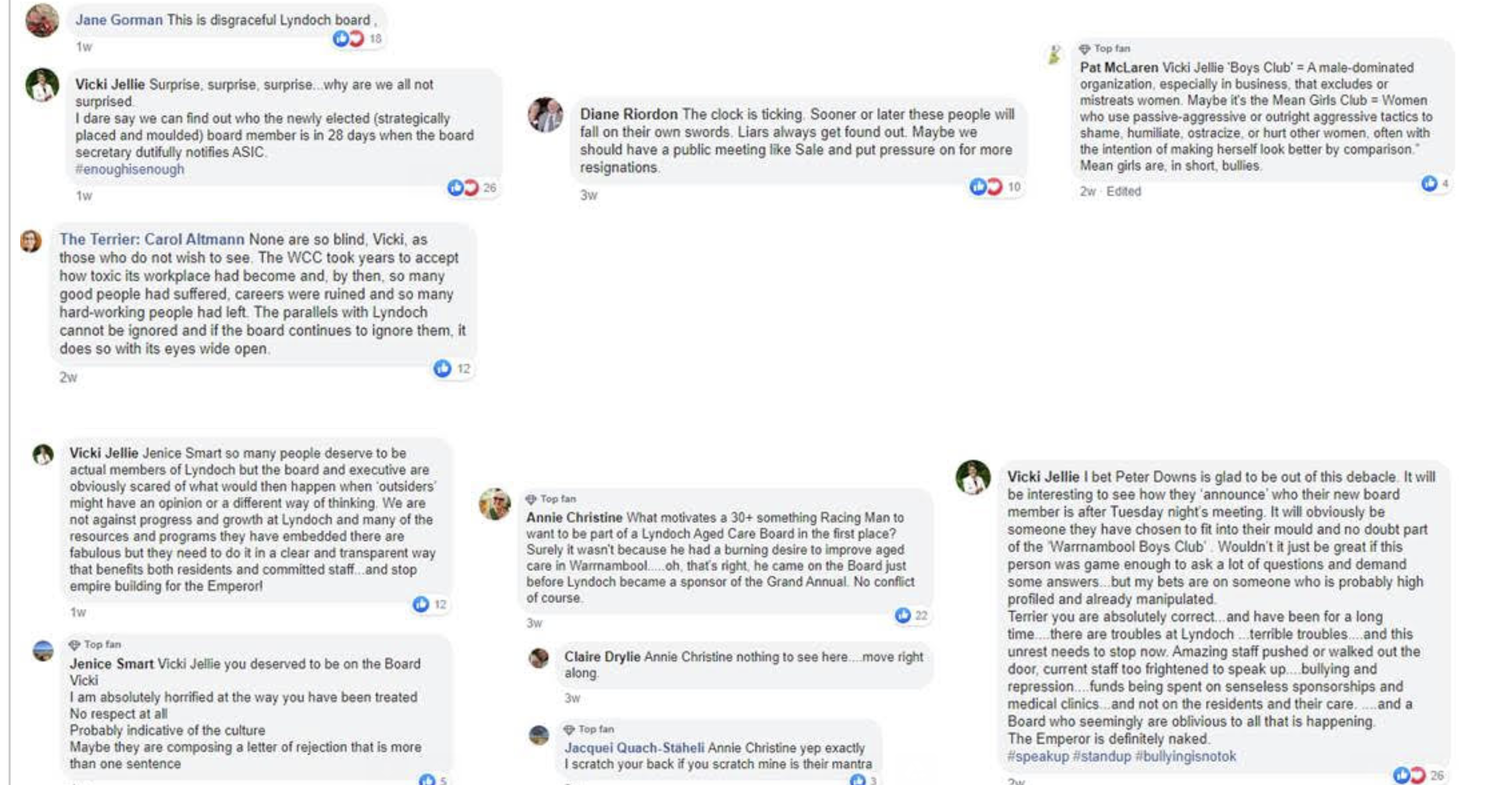
Your right to know: Two weeks ago, I received a letter from my union-appointed lawyers who informed me Lyndoch Living has been monitoring my two Facebook pages, one being my private page and one being this page.
They attached a number of screenshots provided by Melbourne lawyers K&L Gates on behalf of Lyndoch, showing comments by followers and readers of The Terrier.
Those commenting were Warrnambool people expressing their opinion on how every membership application lodged with Lyndoch Living had been rejected.
These comments related to stories I had published on February 16 and 23.
My lawyers also attached a number of quotes from those stories that were highlighted by K&L Gates on behalf of their client.
The recommendation in response to this legal letter from K&L Gates was that I remove the articles and the comments in the screenshots.
The past two weeks has been a time of enormous worry for so many of us because of a resurgence of Covid-19.
It has been so challenging for our aged care homes and their fabulous staff, including those working so hard on the ground at Lyndoch Living.
What I have also found enormously worrying these past two weeks, however, is the rapid erosion of our right to know. Our right to have a say. Of our right to speak up when we see our public institutions being hijacked by vested interests.
Lyndoch Living belongs to us. The Warrnambool City Council is answerable to us. We must never forget this.
And right now, while we are fighting a pandemic, we are being forced to also fight for our democratic rights which are being pulled out from under us one bit at a time.
Secrecy and silence is becoming the new normal.
I’ll be honest, legal letters scare the shite out of me, but I became a journalist for a reason and I am not going to be scared into silence, and, I hope, neither are you.
So we will keep going. We have to, and I want to thank every single one of you who is helping me to make that happen.
If you would like to support the Terrier, you can throw something in the tip jar below.
Silencing councillors tightens grip on public right to know
Speaking to journalists will become much harder for Warrnambool City Councillors if a proposed change to its media policy goes ahead. Image: Third Sector.
ANALYSIS – Carol Altmann
The attempted shaming of three Warrnambool City councillors for speaking to a journalist is yet another step toward shutting off information to the public.
And if you care about freedom of speech and freedom of the media, then the events of the past few days should be very troubling.
First, some background.
Late last week, the agenda for this Tuesday’s council meeting was released and contained a report given to chief executive officer Bruce Anson from the Local Government Investigations and Compliance Inspectorate following its investigation into the leaking of confidential council documents to The Age early last year.
The inspectorate concluded that it could not determine who leaked the documents.
But it did conclude that three councillors – Brian Kelson, Peter Hulin and Peter Sycopoulis – met with a journalist from The Age the night before it ran the first of several stories about links between then-Premier Denis Napthine and Midfield Meats owner, Colin McKenna.
It was not hard to reach this conclusion, because the councillors told the inspectorate about this meeting.
After all, it has never been an offence for an elected official to speak to a journalist and it happens every day.
The assumption, of course, is that the three councillors used this meeting to hand over secret documents, but this is wrong.
The Age journalists, Royce Miller and Ben Schneiders, have issued a statement to say that they were already in possession of the documents before this meeting.
How did they get the documents? Who knows, but in a world dominated by public relations officers and media managers, leaks and whistleblowing are often the only ways that information in the public interest can come to light.
Cr Peter Sycopoulis was one of three councillors being shamed for having met with a journalist from The Age. Image: Warrnambool City Council.
The inspectorate knew the three councillors had done nothing illegal, and it prepared a confidential report naming the three councillors that could only be released with the approval of the CEO, Mr Anson.
Ironically, Mr Anson decided to make this confidential report public, and included it in the agenda. In other words, what is and isn’t kept confidential by council is entirely at Mr Anson’s discretion.
A front page headline by The Standard followed but, in what I believe is unprecedented for a newspaper, it didn’t defend the profession of journalism that relies on research, well-placed sources, whistleblowers and leaks, but instead leapt on the “revelation” that three councillors had met with a journalist, as if this was a crime.
Its sycophantic editorial went even further and defended the former Premier against such “damaging” behaviour, saying that he must “be itching” to ask what was discussed between the councillors and The Age journalists.
This is coming from an organisation that knows the trust between a journalist and a source is fundamental to flushing out what those in power don’t want you to know, but is in the public interest: like the fact – as reported by The Age – Dr Napthine (and our Federal MP Dan Tehan) held shares in a racehorse with Mr McKenna.
A compliant newspaper and a media-managed council is a powerful combination in a regional city, and it could soon get even worse.
The public right to know hinges on the ability of journalists to ask questions of sources. Image: Disclose This.
Lost within the story is a recommendation by the inspectorate that the Warrnambool City Council put its boot even harder on the neck of elected members.
It has suggested – and the council will now consider – changing its media policy so that councillors MUST tell the council’s communications manager, Nick Higgins, when they speak to a journalist, about anything.
What right has a government inspectorate got to try and gag elected councillors?
It is an outrageous recommendation and one designed purely to ensure that the only information released to the media (and therefore, to you, the public) is that which suits the council’s chief executive or the mayor of the day, whoever they may be.
This closing down of voices in local government is a growing trend across Australia, and comes as newsrooms are shrinking.
Indeed academic papers* have been written on this increasing secrecy and the restraining of elected members by tightening a council’s media policy.
We need to ask ourselves, who does such secrecy benefit? It is certainly not intended to benefit you, the humble ratepayer.
No, it is designed for councils to move more and more information behind closed doors so that decisions can be discussed – and made – by those with power without any “distractions” from the public.
We here at Bluestone Magazine have already been cut off by the council’s media unit: our questions now go unanswered and our requests for interviews with certain council staff are denied.
This is what happens when you don’t play by the rules or you refuse to stick to “the message” – but Bluestone will keep investigating nonetheless.
Warrnambool should not be distracted by the public shaming of three councillors for talking to the media – this is not the problem. The much more worrying issue is the move to stop councillors talking to journalists at all.