Petition ask State Govt to press pause on $22m Lyndoch clinic
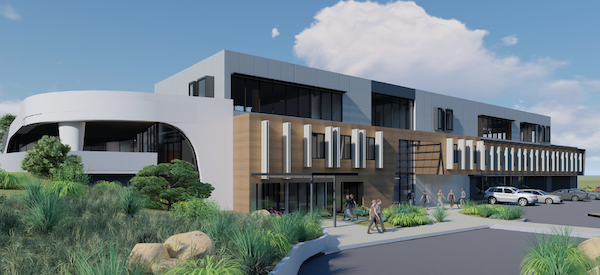
The latest version of the proposed $22m medical clinic at Lyndoch Living. Image: Marchese Partners.
Carol Altmann – The Terrier
A short post tonight.
As we know, the Lyndoch Living board has still not answered a series of questions over its plan to pour $22 million of aged care funds into a medical clinic.
This clinic is one of either two things:
an expensive trophy project that could leave Lyndoch in serious financial stress OR;
a certified winner that will directly improve the lives of the elderly and vulnerable residents of Lyndoch.
We still don’t know which.
The “Keep Lyndoch living” * group has tried to get answers from Lyndoch on behalf of the community, but has heard nothing.
It has now started a Change.org petition asking the State Government to intervene and pause the project until an independent review can address all outstanding concerns and questions.
The group will also shortly launch a Go Fund me campaign to seek a legal opinion on the rights of the community in regard to Lyndoch – a sentence which would have been unimaginable just 10 years ago.
As individuals, we have two choices: we can either join the fight for greater scrutiny of this massive project, or shrug our shoulders and leave Lyndoch to it.
No need to guess what this #justablogger plans to do. Over to you.
*”Keep Lyndoch living” is a grassroots action group formed to become a voice for the community. Its founding members include medical Prof James Dunbar, Helen Bayne (M.Ed. B.Comm) and a former senior investigator for the Inspector-General of Intelligence and Security, Jim Burke.
Lyndoch Living failings in care didn’t get better, but worse
Lyndoch Living says it plans to fix failings identified by the national aged care watchdog, without publicly detailing how.
Carol Altmann – The Terrier
Lyndoch Living’s failure to care for the elderly and frail was kept under wraps for more than a year, during which things didn’t improve – but got worse.
That little bombshell was wrapped up in MP Dan Tehan’s media statement issued in response to The Terrier exclusive on Tuesday night.
Mr Tehan said the nation’s top aged care watchdog visited Lyndoch in response to a complaint way back in February LAST year.
As a result, the Aged Care Quality and Safety Commission slapped Lyndoch with a non-compliance order for Personal and Clinical Care (aka, the very reason an aged care home exists).
Never fear, Lyndoch assured the commission at the time, they had a plan!
Fast forward 12 months to January 2021 and the commission re-visited Lyndoch to find the situation was not better, but far worse.
How is that allowed to happen?
As revealed exclusively here on Tuesday night, Lyndoch failed not one, but three out of four standards, including using chemical restraint without consent, and failing to appropriately monitor residents after serious falls.
And when it came to staffing, the commission could not have been more blunt: “(Lyndoch had) not ensured the delivery of safe care and services”.
If Lyndoch can’t get this right, what is it there for? To sponsor golf and horse racing?
Lyndoch’s three-year accreditation comes around again in August.
Lyndoch told the paper (it doesn’t respond to The Terrier) that it has an “action plan”, none of which has been detailed or publicly costed.
There is no mention of it on its website.
Once again, we are kept in the dark by a board and Lyndoch executive who are failing to deliver Lyndoch’s core business.
If The Terrier had not been tipped off about this latest report, nobody would know a thing about any of this.
“This” is the neglect that follows as a natural consequence of our nursing home not having enough staff, not having enough qualified staff, getting rid of experienced staff, and staff quitting because they are physically and emotionally exhausted.
At least 120 people have left Lyndoch in recent years, from very experienced and senior operators, down to those who only lasted a year or two.
These are the ever-growing band of alumni dismissed by Lyndoch as “disgruntled workers”, when in fact they are soldiers returned from the battlefield with warnings of what lies over the horizon.
“This” is a consequence of changing priorities where Lyndoch will overload itself with executives, but can’t fix the nurse call-bell system that is still unreliable.
“This” is a culture that will happily see Lyndoch go into massive debt for a new $24 million medical clinic based on an invisible business plan, rather than hiring more hands and hearts on the ground.
This is not the fault of the nursing and care staff: the moral collapse starts with the executive and board who set Lyndoch’s vision and priorities.
Don’t just take my word for it.
Take it from former Lyndoch Director of Nursing Penny Iddon who wrote this on the Terrier Facebook page after the breaking story:
“Poor standards of care are a direct result of poor and inadequate management oversight.
“The Board, the CEO and the senior nursing staff must take responsibility for this appalling result. The Board can no longer bury their heads in the sand and the CEO can’t keep passing the buck.
“After all, what the Auditors reported on regarding poor and outdated care practices has been allowed to continue under their watch which indicates a clear breakdown of systems, protocols and values.”
We have now seen in stark detail this week how Lyndoch is breaking down.
It has broken down in its duty of care.
And there are fears if the medical clinic goes ahead at the scale which is planned, it will break down financially.
How ironic, then, to see the Lyndoch CEO listed among the guest speakers jetting off to at an aged care forum next month in Sydney.
The topic?
Attracting and retaining new talent to revitalise your workforce.
Residents’ suffering exposed in report on Lyndoch Living
A performance report from earlier this year reveals Lyndoch Living has failed to meet 3 out of 4 quality standards set by the Aged Care Quality and Safety Commission.
Exclusive
Carol Altmann – The Terrier
A string of failings at Lyndoch Living has been exposed in a damning report by the national aged care watchdog.
A report released by the Aged Care Quality and Safety Commission in March – but which I was alerted to only today – lays out a shocking series of inadequacies recorded after a two-day visit by the commission to Lyndoch in January.
The commission is the peak federal body for assessing and accrediting aged care homes and for handling complaints.
Its assessment team found Lyndoch was non-compliant in three out of four key measures for resident care and staffing.
A separate report released at the same time shows the Lyndoch Hostel section passed on all measures, but an 11-page report into other, unidentified, sections of Lyndoch reveals a story of wounds, falls, pain, lack of consent, outdated records and crying out for help.
The report focusses on five specific residents, and it makes for heart-breaking reading.
Here are some of its findings:
Resident one, who was living with severe dementia, experienced “breakthrough” pain levels daily for three weeks without receiving any further pain medication, pain assessment, monitoring or evaluation;
A pain assessment plan set out by a specialist team was not followed;
The specialist’s recommendation that a pain medication patch be increased was not followed;
This same resident also had several wounds which were not adequately overseen by staff;
In regard to one of the wounds, all four management plans failed to record if the wound was getting better or worse, with boxes on wound size either unchanged or left blank;
Another resident was being given antipsychotic drugs “as required” – which is defined as chemical restraint – with no proof of consent:
“The representative of the [resident] told the Assessment Team that they had not provided consent and were unaware of any potential side effects of the use of the medication,” the report says.
A third resident had a fall and was hospitalised overnight with a significant laceration but, upon returning to Lyndoch the next day, was not reviewed for pain or possible brain injury:
“The Assessment Team found that staff did not undertake a timely review of the consumer’s pain on return from hospital and did not undertake neurological observations.”
This same resident later developed shoulder pain, but an order for stronger pain relief was not processed until two days later, with a GP review three days later.
A fourth resident, who lives with dementia, had an unwitnessed fall, but was not assessed for pain or a possible head injury.
Two days later, the same resident had two more falls which “qualifies” for a CT scan, that occurred.
The report says Lyndoch refuted the assessment team’s statements about this incident and also questioned the accuracy of its findings.
The team, however, stood by its report.
It says “the key points were timeliness of pain review following a fall and whether staff undertook neurological observations. Particularly …. for unwitnessed falls where the consumer could have hit their head…”
A review of records of a fifth resident, who was on psychotropic medication, found the medication records were out of date.
As a result of these incidents, Lyndoch was found to be non-compliant in standards for Personal Care and Clinical Care.
It was also found to be non-compliant in Human Resources and had “not ensured the delivery of safe care and services”.
The assessment team said it witnessed staff rushing tasks and staff walking past a resident who was calling out for help without stopping to offer support or assistance.
A review of the roster across a two-week period found some shifts were unfilled.
It also found failings in infection prevention and control, including:
poor use of personal protective equipment by some staff;
social distancing not always being adhered to by some staff and;
not taking all reasonable steps to prevent visitors who do not meet entry requirements from entering the facility.
Staff shortages and a lack of suitably qualified staff also came under fire:
“the skills of the current mix of staff delivering the care are inadequate and are not meeting the current needs of (residents).”
So there it is in black and white: Lyndoch is failing in its core business of caring for our elderly and frail.
It is failing some of the most vulnerable people in our community and yet there are still those within Lyndoch who will deny, deflect and head to the May Races.
This is not the fault of the exhausted Lyndoch staff.
The buck does not stop with them: it stops with those who decide the priorities of Lyndoch.
Right now, the number one priority for Lyndoch is building a $24 million, 3000sq/m medical clinic with no clear benefit to the residents.
This is how disgracefully lop-sided things have become and how far Lyndoch has drifted from its core purpose.
And so we have reports of wounds, falls, pain, missing records, soreness, sadness and crying out for help.
This is not happening in a private aged care home deep in the outskirts of Melbourne: it is happening in Warrnambool, in a place owned by us, the community.
Why has Lyndoch not told us about this report, apologised for its failings and pledged to do better?
Do we simply shrug our shoulders and say “that’s how it is in aged care” and turn away?
I can’t turn away and I know you can’t too.
We have to be the voice of the voiceless and refuse to accept silence as a solution.
[The commission has set down seven areas in which Lyndoch must improve to avoid any risk to its accreditation. You can read those here. It should be noted the commission says Lyndoch has challenged or refuted many of its findings. You can download the full report here.]
Community (still) owns Lyndoch Living, but does it matter?
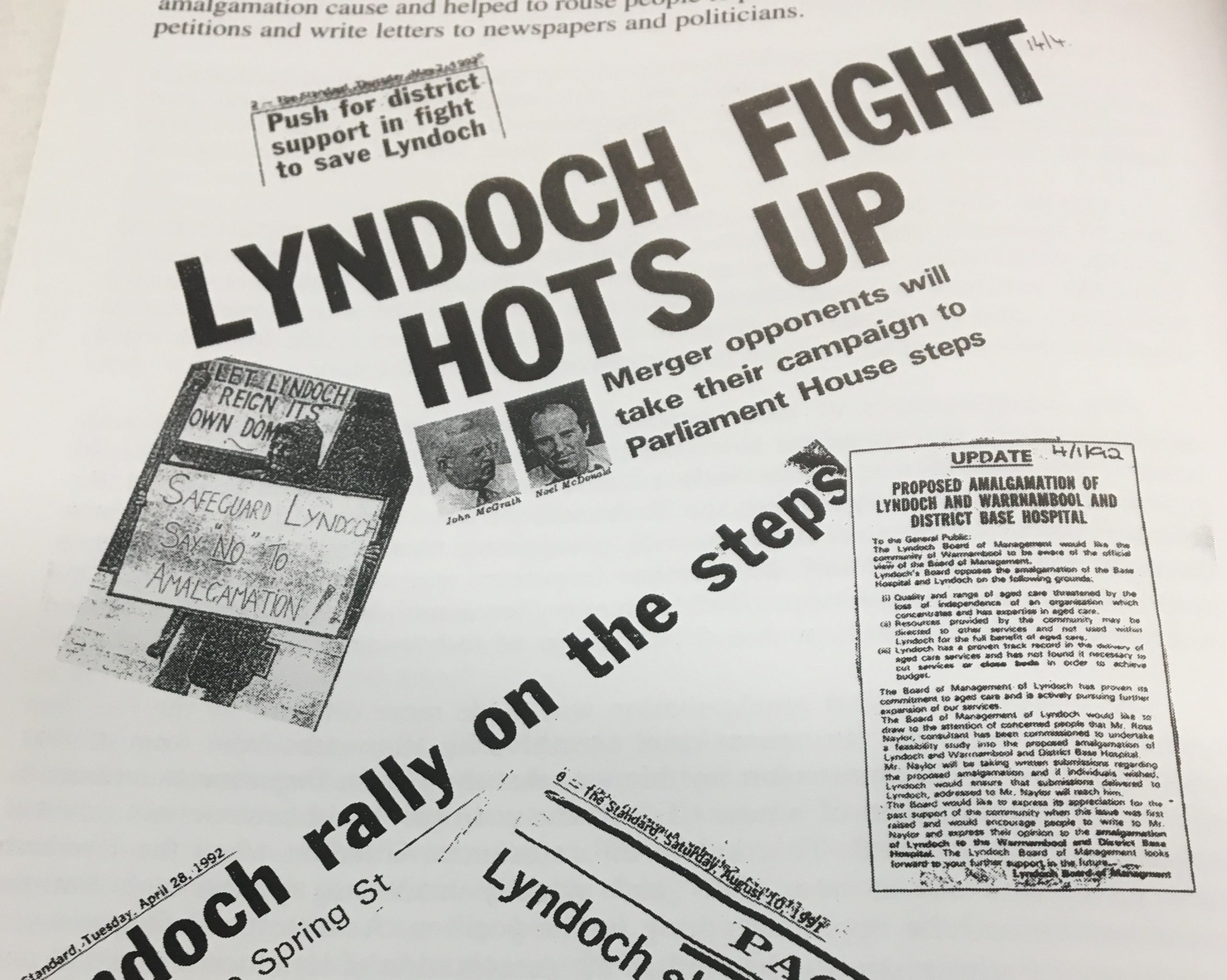
The question of exactly who owned Lyndoch aged care in Warrnambool was challenged during a push to merge with the W’bool Base Hospital. Image: via Peter Yule, Lyndoch: The First 50 Years.
Carol Altmann – The Terrier
Tonight I want to answer a question that just keeps coming up: who owns Lyndoch Living?
The answer is the Warrnambool community.
In fact Lyndoch has been owned by the people of Warrnambool since day one, right back to the time when the “Lyndoch” property was secured by Ern Harris in 1952 and a public fundraiser was held to raise £13,000 toward the £40,000 price tag.
All of the land on which “Lyndoch” sits is also owned by Lyndoch Living, so the community owns that too.
This includes a slice of Scoborio Reserve that was portioned off by the Warrnambool City Council more than 20 years ago so Lyndoch could build the Tomlinson Centre for residents with dementia.
It’s the Tomlinson Centre that was recently bulldozed to make way for a planned $24 million medical clinic that is now at the centre of concerns that it could send Lyndoch broke.
In many ways, the Tomlinson Centre was what Lyndoch used to be all about.
The original building was funded through a generous donation from the Tomlinson family, and later extensions were paid for with the help of the A.L Lane Foundation, the Ray and Joyce Ubergang Foundation, the Ern Hartley Foundation and the Warrnambool Rotary Club.
That’s how Lyndoch used to work.
It used to work hand in glove with the community to raise funds to get things done, through raffles, Christmas parties and by simply asking for the public’s help.
In return, the community showed absolute loyalty to Lyndoch, especially when it was under threat of being merged or privatised, as it was in the 1990s.
The State and Federal governments fund various aspects of Lyndoch, but it is not government owned.
Nor is it privately owned.
Instead, Lyndoch sits in sweet spot of being community owned, but publicly funded.
This unique structure was tested in 1992, when the Labor Government tried to merge Lyndoch with the Warrnambool Base Hospital.
No bloody way, said the locals.
A strong, united, grassroots campaign led by then Lyndoch board members Drs Mike Page and Noel Bayley created multiple headlines and saw the idea wither.
As Peter Yule writes in his 2003 history of Lyndoch, the battle “brought home the value of Lyndoch as a unique community asset”.
This community ownership was tested again in the 1990s, when the Kennett Government planned to privatise all public aged care homes.
Lyndoch sought a legal opinion which confirmed, as Peter Yule writes, its unique legal status as “a community owned facility that provides public services”.
So let’s be clear – the community of Warrnambool owns Lyndoch.
It always has.
But so what?
As it stands, the community is shut off from any meaningful connection with Lyndoch and its decision makers.
We have lost that thread of accountability and mutual loyalty.
The board, which is now hand-picked by insiders, no longer answers questions issued by the media or individuals because, I guess, they dismiss all concerns as a beat-up.
In this new era, a former Acting Chief Financial Officer can raise the alarm over the viability of the $24 million medical clinic and it is met with silence.
This is incredible and, apparently, the new normal.
Gone are the days when we had a Dr Page or a Dr Bayley at the table, speaking up for the community and settling any concerns with straight forward answers.
Gone are the days of CEO Rhys Boyle, who lived in Warrnambool and became a recognisable part of its fabric.
Gone are the days of Lyndoch living within its means because now it doesn’t turn to the community, but to the banks.
Change happens – of course – but one of my biggest concerns when I first started to write about the changing face of Lyndoch Living 18 months ago was that the community would lose control of this valuable community asset.
It appears it already has.
Another board member resigns from Lyndoch Living
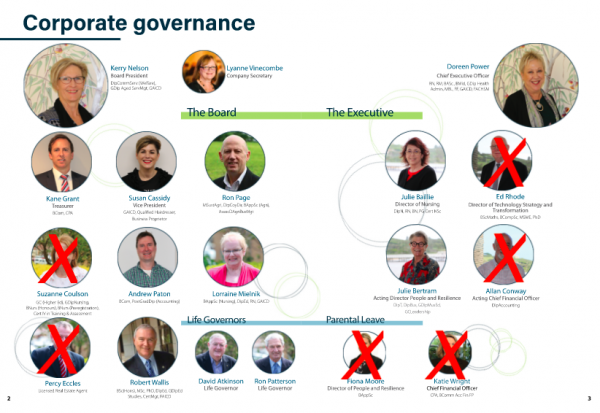
In the past 12 months, six faces have disappeared from the Lyndoch Living board and executive. Image: Lyndoch Living annual report 2020.
Carol Altmann – The Terrier
Another member of the Lyndoch Living board has resigned – the second resignation from the board in two months.
Suzanne Coulson, a researcher and lecturer at Deakin University in the School of Nursing and Midwifery, joined the Lyndoch board in 2017.
I don’t know why Ms Coulson resigned, and I doubt she could speak to me anyway, as all board members are bound by a confidentiality agreement which was introduced after the departure of former CEO Rhys Boyle in 2015.
Ms Coulson’s resignation follows that of veteran board member Percy Eccles, who left in March after serving almost 10 years.
Ms Coulson was one of only two board members with medical qualifications. The other is fellow lecturer in the Deakin School of Nursing and Midwifery, Lorraine Mielnik.
The resignations of both Mr Eccles and Ms Coulson come as Lyndoch Living faces mounting pressure to explain a number of concerns around its plan to build a $24 million medical clinic on site, with fears the project could send Lyndoch broke.
Lyndoch’s former Acting Chief Financial Officer Allan Conway raised the red flag publicly when he said he did not support the clinic project in its current form.
Lyndoch recently appointed its third chief financial officer in five years, with the departures of David Knight and Katie Wright.
Other recent executive resignations include IT director Dr Ed Rhode and Director of People and Resilience Fiona Moore.
A community action group made up of Warrnambool residents concerned for the future of Lyndoch was launched last week – you can follow/like the “Keep Lyndoch living” group on Facebook here.