Taking a stand: “But Carol, where will it end?”

No small irony: Large posters promoting the #16Days of Activism to end violence against women on prominent display at the Lighthouse Theatre, Warrnambool, which also houses a Rolf Harris mural.

I met two unforgettable people last week while collecting signatures to erase the mural by sexual predator Rolf Harris at the Lighthouse Theatre in Warrnambool.

Both of them, one a man, the other a woman, were survivors of child sexual abuse and were, as they described it, “finding their voice” to talk about such a personal atrocity and do everything they could to ensure that no other child would suffer what they had.

They talked quietly, often looking into the middle distance, because the middle distance is a safe space when re-visiting a place of such hurt, such confusion and such silence.

The silence. The being told – constantly – that you must not say anything, that you must not cause trouble, that you must not ruin things, or make things uncomfortable for others by speaking up and out.

But as the man said to me, “you just want to be heard and for someone to do something”.

He was doing something.

That very day as he signed the petition on a wobbly card table on the Civic Green, the Royal Commission into Institutional Responses to Child Sexual Abuse delivered its final report.

This was a devastating report that has been five years in the making and to which this man had given hours of evidence.

Despite having made a contribution to this highest level of investigation, this man still turned up during his lunch hour to sign a little petition to remove a small mural in Warrnambool because he is not done yet.

None of us should be done yet.

And this was how the woman who told me her story, a story she is only now starting to fully articulate, went from talking to me about why removing the Rolf Harris mural didn’t really make a difference, to deciding that it did.

She had come to the Civic Green not to sign the petition, but to explain why she felt covering it up was enough.

We talked about the symbolism of covering things up, about the hard-to-hear argument of separating the sexual abuser from the person, and about this mural – this mural – being a chance for our council to follow the lead of others who painted over their Harris murals right after his conviction two years ago.

After 20 minutes or so she said “I am going to sign”, and she did.

These are the strong faces I see in my mind when people roll out the arguments as to why the mural must stay.

“But Carol, where will it end?” they say.

Apparently if we erase a Rolf Harris mural in Warrnambool, soon we will be pulling down churches and trashing Caravaggios and banning people from watching films and throwing  all manner of books, artworks and music onto a giant pyre, because if we don’t, well, we are being insincere and inconsistent.

Ironically, this fear-mongering and muddying of the waters is what the “yes” voters endured during the same-sex marriage debate.

A simple question – can two people of the same sex marry – descended into a frenzy about ending freedom of speech, people marrying goats, and children being taught in primary school how to use sex toys.

If you said yes to same sex marriage, you were saying yes to all these things too – get it?

Fortunately most of us in Warrnambool were smarter than that.

But we, as a city, own a Rolf Harris mural and it is through this mural we can again make and take a stand. We must make a choice. We either own it fully, and pull down that Perspex, or we roll over it as a symbolic gesture that we stand with survivors 100 per cent: not 50 per cent or 20 per cent.

“But Carol, where will it end?”

Well, I can tell you that for the survivors of predators like Rolf Harris, who use their power and position to abuse children, it never does.

And as the women and men now speaking out around the globe have shown, we are not done yet.

In fact we are just getting started.

The physical petition has closed with more than 100 signatures in five days, which was my goal. The online petition also closed on Wednesday 13/12 at 9am.

The petition will go to Warrnambool City Council for consideration at its first meeting for 2018 in February.


Remembering Eva: an arts matriarch

eva gaspar-bunyon
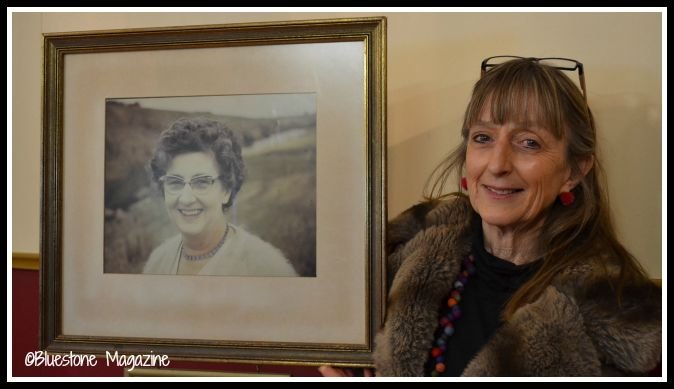
Helen Bunyon, from The F Project and The Artery, with a portrait of the late Eva Gaspar who, like Helen, devoted her life to helping the local arts scene while also being an artist herself.

By Carol Altmann

There is nothing like a tour of the local cemetery to crystallise the mind about how quickly we can forget trailblazers of their time, like Warrnambool musician, photographer and artist Eva Gaspar.

It was during one of family historian Ray Welsford’s gold-coin tours of the Warrnambool Cemetery that I heard Eva’s name raised as one that is slowly vanishing from the landscape since her death in 1978.

Yes, there is a road named in her honour, but perhaps because she was not a sporting hero, never married and never had any children, there are few public memorials to commemorate her enormous – and generous – contribution to developing Warrnambool’s cultural scene in the 50s, 60s and 70s.

eva gaspar_bowes
Warrnambool Art Gallery Acting Director Murray Bowes with a hand-tinted photograph, “Wollaston Bridge”, taken by Eva Gaspar in 1976 and purchased by the gallery in 1977.

It wasn’t always this way.

The original Performing Arts Centre in Warrnambool had the Eva Gaspar Theatre as its centrepiece when it opened in 1983, but the name was dropped when the complex was redeveloped as the Lighthouse Theatre in 2012.

Eva’s portrait is still in the building, but you have to walk to the southern wing to find it, alongside some magnificent tapestries and an assortment of other historic photos.

So who was Eva?

thunder point
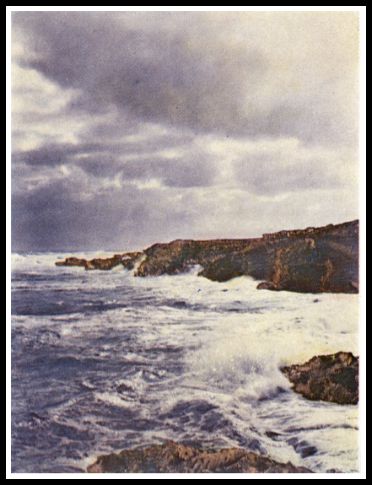
“Thunder Point”, photograph coloured with oils, Eva Gaspar. Reproduced from the catalogue “Exhibiton by Eva Gaspar: Drawings, Photography, Warrnambool Art Gallery, April 1977,” with permission from the Warrnambool Art Gallery and National Library, Canberra.

In contemporary terms, apart from her devout Catholicism and serious perm, she is perhaps best described as the equivalent of today’s Helen Bunyon, from The Artery/F Project: a long-term, tireless and generous volunteer to the arts, who was also an artist herself in music, drawing and photography.

“Eva loved photography – she was part of the very big and very passionate photography scene in Warrnambool in the 1950s and 60s,” recalls photographer John (“Jack”) Wilkins.

That scene, as Jack explains, included his own father, Alex Wilkins and Ralph Illidge who, between them, not only photographed just about every wedding and child born in Warrnambool during that time, but also built an impressive social history archive through photography and film.

eva portrait
A portrait of Eva Gaspar – a copy of which hangs in the Lighthouse Theatre and Mozart Hall.

Eva, Alex and Ralph were all founding members of the City of Warrnambool Camera Club, with Eva holding the presidency from 1954 to 1977, during which time the club hosted the most extraordinary competition of international photography.

“That was in 1964 – it is hard to imagine it now, but they had this whole thing going on in little old Warrnambool and it attracted entries from around the world,” says Jack, in his usual gregarious style.

(Remarkably, some footage from the event is part of the Alex Wilkins’ archive which Jack is now slowly converting to digital and uploading to the internet – he has kindly agreed to us including it here. See below.)

Eva, who later became part of Collett, Bain & Gaspar printers, at one stage worked upstairs in Alex Wilkin’s photography studio in Liebig St (now the office of local MP Denis Napthine), where she would hand-colour the images.

Like any artist, however, she no doubt aspired to holding her own exhibition and through her close connection to the then director of the Warrnambool Art Gallery, John (‘Jack’) Welsh, she finally did so in 1977 – just a year before her death at the age of 65.

The exhibition catalogue (printed by Collett, Bain & Gaspar) lists 39 photographs “coloured with oils”, mostly of local scenes, together with 13 monochromes, again of local scenes, and 10 drawings inspired by religious icons and even Shakespeare.

tower hill
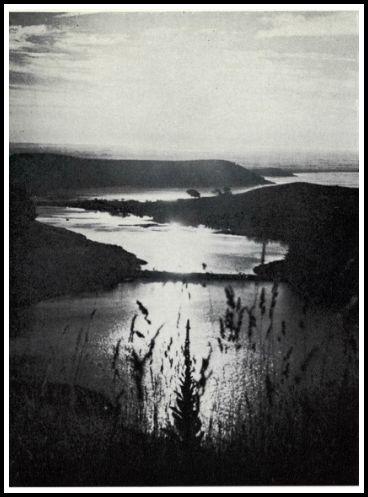
“Tower Hill”, monochrome, Eva Gaspar. Reproduced from the catalogue “Exhibiton by Eva Gaspar: Drawings, Photography, Warrnambool Art Gallery, April 1977,” with permission from the Warrnambool Art Gallery and National Library, Canberra.

Eva was a deeply religious woman from a religious family, with a nun and two priests among her siblings, and she was the organist at the St Joseph’s Catholic Church in Warrnambool for almost 30 years.

It is through her music that Eva Gaspar is most recognised.

According to the Warrnambool Historical Society, she formed her own choir and junior orchestra in 1948 to commemorate the birth of Mozart, and this group not only staged elaborate annual performances of Mozart operas, but went on to become the Mozart Choral Society that still operates from Warrnambool’s cute Mozart Hall today (where you will find another portrait of Eva).

Somewhere in between all of this activity, Eva still found time to teach music to young people for free.

For more than 40 years she taught music, singing, wind and string instruments to a legion of young musicians for whom a keyboard had nothing to do with a computer.

What a generous, creative soul was Eva Gaspar.

eva gaspar_photo
A closer look at the hand-tinted photograph, “Wollaston Bridge” taken by Eva Gaspar in 1976 and purchased by the Warrnambool Art Gallery in 1977.

[box]Bluestone would like to thank Ray Welsford, Jack Wilkins, the Warrnambool Art Gallery and the National Library for their assistance with this story.[/box]

newsletter Why Not StonesYou might also enjoy…


A life behind the lens: Jack Wilkins

Revealing the eye of the tiger: Peter Clayfield

Who is the ‘Granny’ behind Granny’s Grave?

Capturing W’bool’s diverse heart: James Mepham