Weir scandal offers WCC a chance to ditch Levy’s plan
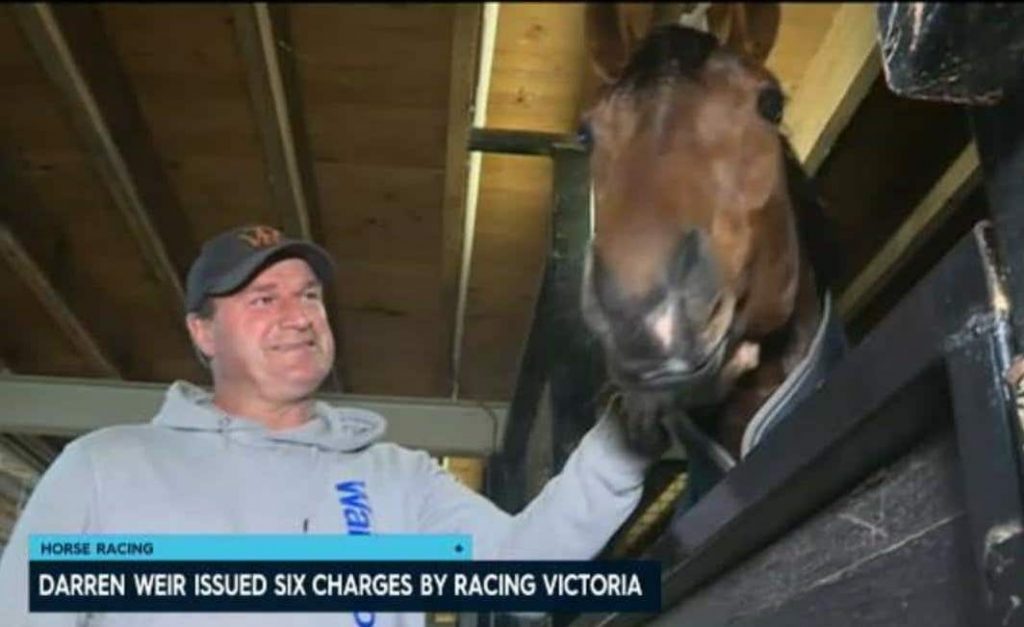
Melbourne Cup winner and racing king pin Darren Weir is facing multiple charges which should prove a game changer for the racehorse training at Levy’s plan. Image: Fox News

Carol Altmann – The Terrier

The Weir-McLean scandal gives the Warrnambool City Council the perfect “out” from the disastrous plan to allow 160 racehorses a day at Levy’s Beach.

As it happens, the council will meet tomorrow night (4/2) to give its consent to another part in the approval process.

This time it must give assurances to the Environment Minister, via a letter to the Warrnambool Racing Club, that the horse training is “consistent” with all coastal and marine management plans and policies for the Levy’s area.

This could be awkward, because as far as I know, nobody has yet produced any evidence to say that it is “consistent”. In fact it appears to be the complete opposite.

This fact is just one more inconvenient truth in a whole string of inconvenient truths which the council has had to overlook and tie itself in knots about.

The entire mess has all come about because of political pressure from the Victoria Racing Club, the Warrnambool Racing Club and Racing Minister Martin Pakula to primarily accommodate the once-powerful Mr Weir, but – like Mr Weir’s career – it could end tomorrow.


The council can stop the charades, dust itself off and start healing an increasingly diverse community that was co-existing quite nicely until it was torn apart by totally unnecessary greed.

Here are 10 more reasons why it should do so:

1. Darren Weir has been winning despite not having access to Levy’s beach since late 2016. (He won more than $31m in 2017-18 alone).

2. Jarrod McLean has been winning despite not having access to Levy’s beach since 2016. (He won the $2 m Mackinnon Stakes last November.)

3. Their claims that access to Levy’s and the dunes gave them an “edge” look doubtful in light of the allegations they are now facing, including the use of electric shocks as part of training.

4. Weir had 77 horses training in W’bool in 2016. He now has more than 100, despite not having had access to Levy’s beach since 2016.

5. All trainers can still apply for access to run and swim their horses at Lady Bay beach from March right through to December. Swimming is all year round.

6. Former MP and racing supporter James Purcell, whose son is a trainer, said in 2017 that no beach dunes should be used for training, anywhere in the reserve.

7. There is no environmental impact study and no “baseline” study of what it looks like now.

8. There is no economic impact statement, showing how the move will increase jobs or the local economy above what racing already provides.

9. Local indigenous people are devastated by the move and senior elders – including 2018 Victorian Senior of the Year Rob Lowe – are fighting to save the reserve.

10. Millions have been spent building a sand track and other facilities at the Warrnambool racecourse.

So much has been written about this ill-advised plan. So many arguments have been raised. And now the racing industry itself is dealing with a scandal of unprecedented proportions.

Surely, surely, tomorrow night offers a chance for this plan to ride off into the sunset and we can then direct our energies into building a sustainable environment and a sustainable, ethical, local racing industry – based on truths and substance.

If you would like to see The Terrier keep digging up, sniffing out and chewing on local issues, please make a small contribution below.
Donate


No racehorses in W’bool City Council’s 1998 plan for Levy’s


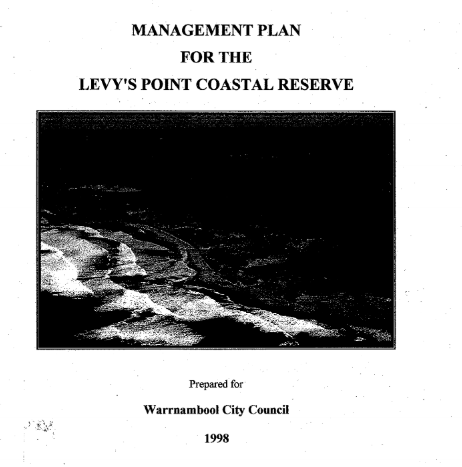
Management Plan for the Levy’s Point Coastal Reserve

Carol Altmann – The Terrier

Here is yet another plan for Levy’s Point that was started, never really finished, and then forgotten.

Warrnambool Mayor Tony Herbert recently claimed that the Belfast Coastal Management Plan was the first plan for the area in 150 years.

This is not true.

There have been several plans, including this one commissioned by the Warrnambool City Council back in 1998.

Nowhere does it mention using the area for large-scale racehorse training.

In fact it doesn’t mention racehorses at all, only recreational horse riding and a small horse riding ring.

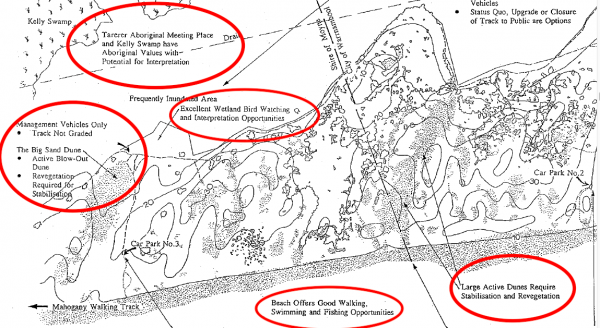
It also mentions the potential for illegal four wheel driving and motorbike riding to worsen, due to numerous management tracks leading into the dunes.

Some of these dunes, the plan says, had already blown out, and other “large, active dunes” needed “stabilisation and revegetation”.

These “large, active” dunes are in the very area where commercial racehorse training will now be permitted – having been illegal –  and up to 40 racehorses a day, five days a week, will be allowed to pound up and down what is called “Hoon Hill”.

How this fits into any plan for “stabilisation and revegetation” is beyond me.


Just the fact that – 20 years on – authorities now refer to this area as “Hoon Hill” says it all really.

Those in charge of looking after Levy’s Point gave up on the place.

The illegal four wheel driving and motorbike riding was not stopped, so it worsened, until it got to the point where some dunes were so damaged that they are now considered suitable only for large-scale racehorse training, which, of course, will ruin them even further.

For any councillor to claim that they did not know the history of this area and the extent of the damage done is ludicrous, unless, like the current President of the United States, they don’t read, don’t research or don’t want to know.

This 1998 plan follows the government’s Land Conservation Council plan of 1978, and pre-dates the council’s Coastal Management Plan of 2013.

They all say the same thing: the need for conservation, restoration, protection, promoting low-impact activities and eco-tourism, controlling four-wheel-drive access, and not repeating the mistakes of earlier times when sand mining and rendering plants were considered okay.

And yet here we are, not only about to repeat a mistake, but doing so with our eyes wide open.


How can racehorse training be approved without an impact study?

Carol Altmann – The Terrier

(Tidbit)

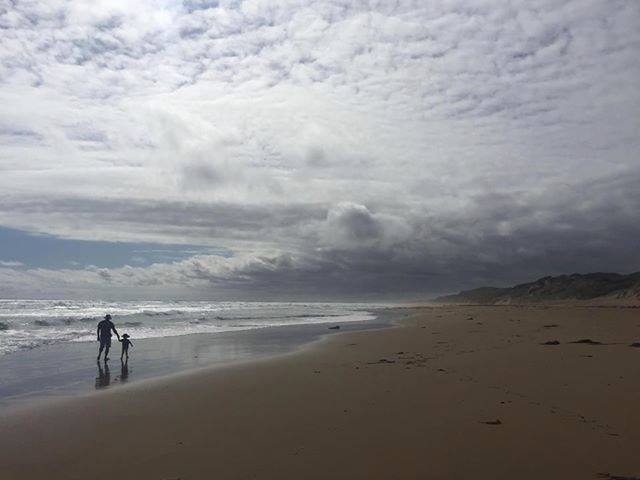
A reader sent me this glorious shot of Levy’s Beach, Warrnambool. This is what passive recreation looks like in a coastal reserve.

One question just keeps rising about the council and State decision to allow up to 160 racehorses a day, five days a week, to train at Levy’s:

Where is the environmental impact statement?

(And where is the baseline study so we can measure the impact on the dunes and foreshore over the next two years?)

www.the-terrier.com.au
#noracehorsesonbeaches
Protect the Belfast Coastal Reserve


WCC breaks its new coastal plan to allow racehorse training

Carol Altmann – The Terrier

Why are so many people determined to save Levy’s Beach?

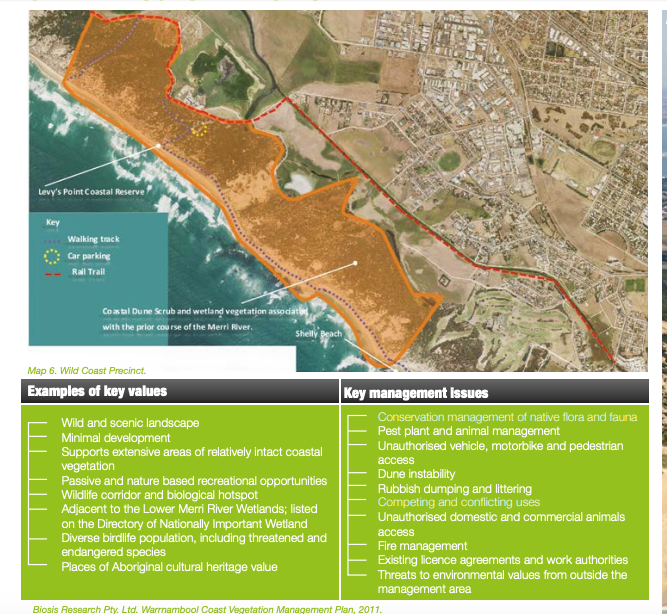
Well, this one page from the W’bool City Council’s 2013 Coastal Management Plan says it all.

It is only five years old, this plan, but already the council has trashed it.

It took many months and no doubt a lot of money to prepare, but it is worthless because it has failed its first real test.

This page, page 20, sets out all that things we cared about and valued at Levy’s, which is part of our wild coast precinct.

It also sets out the challenges and what we need to do to repair it and preserve it for the future.

Despite this, the council has agreed to allow up to 800 racehorses a week to train on the beach, including a large dune, and to come in and out on a track across the dunes (it is the only way they can get in). Dune instability is one of the issues listed in the plan.

Our council has let us down. Our trust in them to protect our wild coast has been betrayed.

But when you are betrayed in this way the only thing you can do is fight back, to restore what was supposed to happen in the first place. So on we go.

www.the-terrier.com.au
#noracehorsesonbeaches


Drawing deep for a long, tough journey

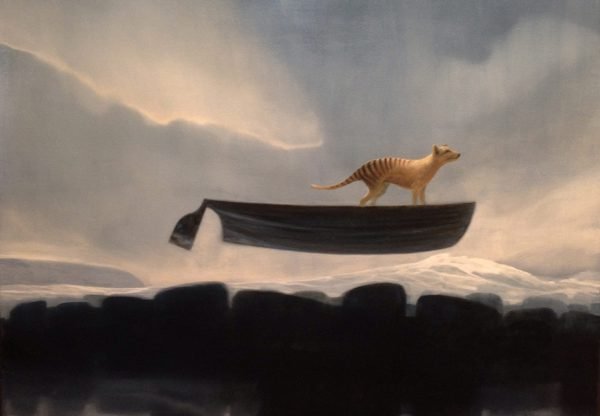
Original painting, oil on canvas, Graeme Altmann. (Altmann Studios, Highett, Melbourne.)

Carol Altmann – The Terrier

On days like this, we need hope.

On days like today, when we see laws passed that allow even greater damage to our wild coast than what we have already inflicted, it would be so easy to just give up, because the battle is exhausting.

But on days like today, when I need to draw deep on hope, I think of my late uncle Alf Altmann.

In March 1970, almost 50 years ago, Alf attempted to become the first person to row solo across Bass Strait, from Tasmania to Victoria, in a home-built kayak.

He built that kayak piece-by-piece in his garage under his home on Riverview Tce, here in Warrnambool.

To train for this epic journey of more than 200km, he would row out to Deen Maar, (Lady Julia Percy Island) and, once or twice, he carried native saplings in his boat to plant on the barren island.

The saplings never survived. Neither did my uncle. His attempt to cross Bass Strait ended just 1.5 miles from the Victorian coast. So near. So close.

And when I think of his story, I think of an anecdote that stays with me each day as I do my bit to try and turn around decisions that hurt our local environment more than protect it.

“Why do you bother taking those saplings with you?” someone asked Alf. “Nobody will see them out there.”

“I see them,” Alf replied. “I know they are there, and that is all that matters.”

This painting is how my artist brother, Graeme Altmann, often captures the essence of Alf’s journey: a boat, suspended above the turbulent sea, with the proud thylacine pointing toward an unknown future.

We can’t change the mistakes of the past. Alf never came home. The thylacine is gone. But I keep trying to do what I can, whatever I can, to turn other mistakes around.

Because we know. And we see. And that is what matters.