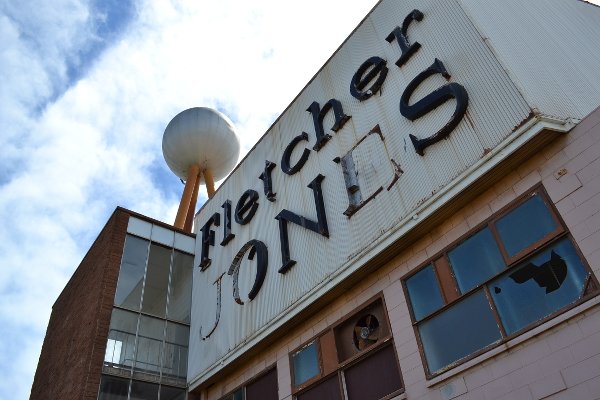
New website captures FJ stories

fj-stories-website
A screenshot from the new Fletcher Jones stories website that is now live at www.fjstories.org.au and captures some of the many stories about the man, the factory, the gardens and iconic silver ball.

By Carol Altmann

[dropcap style=”font-size: 60px; color: #DC943C;”]A[/dropcap]fter almost two years of collecting, organising and editing, some of the many, many wonderful stories about Fletcher Jones are now live on a new website.

The Stories From Our Community website – http://www.fjstories.org.au/ – is another tangible result of the Fletcher Jones stories project that started last year and involved collecting at least some of the stories from those who either remembered Sir Fletcher Jones personally, worked at the Warrnambool Fletcher Jones factory, loved the Pleasant Hill gardens or iconic Silver Ball tower, or maybe a bit of each.

They are stories from another time in which workers were valued as individuals, when customers were treated like kings and when quality – above all else – was what mattered most.

Keep local journalism alive - donate here.
Support Bluestone here

They are also stories from people who did not work at Fletcher Jones, but who remember Christmas parties in the Pleasant Hill gardens, or being married there, or trying to fish the money out of the wishing well using a stick and a piece of chewing gum.

As project co-ordinator Julie Eagles explains, the website is a celebration and living tribute to not only the past, but the present, with the dilapidated Pleasant Hill complex being slowly brought back to life since its purchase by businessman Dean Montgomery in 2014.

“Since mid 2014, we’ve celebrated the sympathetic renewal of Warrnambool’s Pleasant Hill, the Silver Ball and Fletcher Jones Gardens by Dean Montgomery and the FJ Stories project has worked alongside the site renewal now taking place,” Julie says.

fj small ball
A mini Silver Ball used as part of a multi-media installation in 2005 at the back of the Fletcher Jones factory in Warrnambool. (Image supplied by Brenda O’Connor).

[dropcap style=”font-size: 60px; color: #DC943C;”]T[/dropcap]he push to preserve the Fletcher Jones gardens, silver ball and parts of the factory began years earlier when local artists and community groups began to create works of art, share stories and even make movies that recognised the importance of the site to Warrnambool’s character.

At the same time, a group of dedicated volunteers led by Lex Caldwell kept the gardens alive while the factory continued to crumble around them.

By late 2013, the situation looked dire, with nobody seemingly prepared to take on the huge task of bringing the site back to full life. We wrote a story about it (and it is still one of our most popular), which drew upon a report by the Warrnambool Planning and Heritage Group, of which Julie is a member.

Shortly after, in early 2014, the Save the Silver Ball and Fletcher’s Gardens page started on Facebook and the community began to share its connections to the site – and the stories just kept coming and coming.

Everyone, it seemed, had a Fletcher’s story.

david-jones-at-factory
David Jones Jnr (left) and Brenda Anderton/McPeake sit in front of a photograph of them as children, taken at a 1972 FJ Staff Christmas Party in the gardens. Photo: Colleen Hughson/www.fjstories.org.au

[dropcap style=”font-size: 60px; color: #DC943C;”]O[/dropcap]ne of those taking note was Dean Montgomery, who stepped in and bought the site with plans to create a Warrnambool Motor Museum, but who has since also spent a huge amount of money slowly restoring the gardens and factory to their former glory.

The Jones’ family has also reconnected with the site as a result of the community campaign and has funded much of the stories project, while also providing items from their personal collection of memorabilia and photos.

“The website is still being developed and there are still more stories and images to upload,” Julie says.

The site is organised into different themes and, a bit like a rabbit burrow, you can just keep digging deeper and explore all the nooks and crannies.

“Some of the themes currently have little or even no content, while others have lots to explore, learn from and enjoy already,” Julie says.

The website launch follows the unveiling of a story panel at the site last December, and a second panel will be unveiled at this year’s community picnic in the gardens on Saturday December 3.

fj-50s-copy
The late Sir Fletcher Jones whose legacy has driven the spirit of the FJ stories project. Original image from the Jones family.

[box]The FJ Stories Project will finish in December 2016. If you have a story to share, you can contact Julie Eagles directly at  julie.eagles@bigpond.com The next Fletcher Jones community picnic is on Dec 3.[/box]


newsletter Eat And Drink StonesYou might also enjoy…
Rare Fletcher Jones images inspire top artist

Uncovered: Rena Jones’ lovely letter to the people

W’bool losing its character brick by brick

Montgomery buys a slice of ‘Motang’ history


Fishing for great stories from Fletcher Jones

anne skepper_2
Anne Skepper Van Bakel back at the scene of the “crime”, where as a little girl, she was caught red-handed trying to fish coins out of the wishing well at the Fletcher Jones Gardens, Warrnambool. These stories are now being collected as part of a social history project.

By Carol Altmann

[dropcap style=”font-size: 60px; color: #A02F2F;”] T[/dropcap]hey are words that will send a chill into any child’s heart who is up to a bit of mischief: “Oi, what do you THINK you are DOING?”

Anne Skepper van Bakel still remembers the sound of the booming voice, and what she was “doing” was leaning into the wishing well in Warrnambool’s Fletcher Jones gardens, helping her older brother, Bob Markwell, as he tried to pull the coins through the protective grid using a sharp stick topped with a lump of chewing gum.

“As if it was ever going to work,” Anne says, laughing at the 44-year-old memory of getting caught red-handed by Fletcher Jones worker Allan Jennings.

The pair, however, came up with the perfect excuse as to why they were both “fishing” in the wishing well, which is still a feature in the garden’s today and is still used to collect money for charity.

“We told him we were trying to get our chewing gum back!” Anne laughs.

anne skepper
The daily dispatches at Fletcher Jones, written by Eric Tonkin, captured all manner of happenings, including the wishing well “incident” which caused great laughter.

[dropcap style=”font-size: 60px; color: #A02F2F;”] N[/dropcap]either Anne or Bob managed to retrieve either a 20 cent or 10 cent piece which, in 1971, was enough to buy a sizeable bag of lollies and maybe even a pie from the Flaxman St milk bar about 100m down the road.

But their ingenious attempt was enough to warrant the attention of the late Eric Tonkin who, as part of his duties at Fletcher Jones, compiled the daily staff newsletter.

In his recording of the event, Eric describes the culprits as two little girls (young Bob had longish hair) and praises them for their quick comeback line.

“What would a poor silly male say if caught in this impossible situation? He would be absolutely stumped!” he writes.

About 400 of these newsletters have been passed on by Eric’s family to the Fletcher Jones: Stories from our Community project that will kick off later this month in an effort to collect the best of the many thousands of community stories and memories around the Fletcher Jones factory, Pleasant Hill gardens and silver ball water tower.

bun bag
Generosity of spirit: Tim Carlton’s bun bag, kept from when Sir Fletcher had fruit buns flown in from Adelaide for morning tea. Image courtesy Julie Eagles/Tim Carlton.

[dropcap style=”font-size: 60px; color: #A02F2F;”] P[/dropcap]roject coordinator Julie Eagles says it is stories that bring history to life and make a community care about its built heritage.

“The strong community connection to the Fletcher Jones site is what has saved it, in the end, from demolition by neglect,” she says.

“There is something very special and very interesting about this site and it is really a part of people’s lives – not only from the past, but today – so it is not just about telling a story, but making those connections.”

Anne’s wishing well story is just the sort of gem that the storytelling project is hoping to uncover when it holds two sessions at Archie Graham Centre later this month and early September (see full details below).

Another of Julie’s favourite stories is that of Sir Fletcher organising to have freshly baked fruit buns flown from Balfours, in Adelaide, to the Warrnambool factory for a staff morning tea. Thanks to her work with former employee Tim Carlton, who is now 95, there is even a surviving bun bag to prove it.

The project has also uncovered the little known fact that Sir Fletcher converted a school bus that sat on a beachfront block at Port Fairy and was made available free to staff and their children for school holidays.

“We are now at the point where we are ready to start gathering these stories, to see what’s out there, and then we can look at how those stories will be presented,” Julie explains.

Ideas so far include an online archive, a book, and an exhibition, while plans are also afoot to install a 6m photographic panel on the side of the Fletcher Jones factory, showing some aspect of its past.

alex wilkins video
A short video by the late Alex Wilkins which captures factory life. Video courtesy of Warrnambool Historical Pictures: Alex Wilkins Collection.

[dropcap style=”font-size: 60px; color: #A02F2F;”] A[/dropcap]nne, who has just recently returned to live in Warrnambool, has a few more tales of her own, and says growing up on nearby Barkly St meant almost daily visits to the Fletcher Jones gardens, which “we thought of as our backyard”.

“There was one time when I thought it would be a good idea to take a goldfish home from the Fletcher’s goldfish pond – I really wanted a goldfish,” she says.

“So I wrapped it up in my jumper and ran all the way home with it, but when I got home, it was dead as a doornail. I was so disappointed!”

One of Anne’s best stories, however, is from the day the silver ball was hoisted into the sky in 1967 – an event that changed the landscape of Warrnambool.

“A worker told me that it was going to be filled with Coca Cola and I thought, ‘wow, I’ve got the scoop here!’ so I didn’t tell a soul.

“I then kept going back to see if I could catch any drips, but there was never any drips and there certainly wasn’t any Coca Cola.”

The stories project has been funded by a grant from the Gwen and Edna Jones Foundation and by the family of the late Sir Fletcher Jones.

former employees
The stories of the people – workers, families, visitors and all those who have had a connection to the Fletcher Jones site – are now being collected for a new project. Image: Save the Silver Ball and Fletcher Jones Gardens.

[box]What made Fletcher Jones special or interesting? Did you, or someone you know, work there? Bring along a photo or an object or just come and share stories over morning tea – the best stories will become part of a collection and yours could be one of them! Wed Aug 26 and Wed Sept 16 @ 10am, Archie Graham Centre, Timor St, Warrnambool. Bookings essential: (03) 55594892. To keep up to date with this project, join the Silver Ball and Fletcher Jones Gardens Facebook page here.[/box]

[button link=”http://the-terrier.com.au/subscribe-2/” type=”icon” icon=”heart” newwindow=”yes”]Bluestone is aiming for at least 500 subscribers in 2015. If you enjoyed this story, please click here to become one![/button]

newsletter Eat And Drink StonesYou can read more Fletcher Jones related stories here…


No cutting corners: Jack Hancock joins Fabrication II

Fletcher Jones cross will light up again

Motor Museum to revive Fletcher Jones site

All words, no funding, for the Fletcher Jones story


Rare silver ball images emerge from collection

man on ball
Vertigo? What vertigo? One of the rare images of the iconic silver ball water tower being erected at the Fletcher Jones factory in 1967 from the collection of engineer Ralph Jones. (Citation: Ralph Jones Water Tower Submission and Business Papers, 2014.0112, Box 1, University of Melbourne Archives.)

Words: Carol Altmann

[dropcap style=”font-size: 60px; color: #DC943C;”] R[/dropcap]are images of the Fletcher Jones silver ball water tower have emerged from the private collection of engineer Ralph Jones who designed and supervised the construction.

Bluestone Magazine has been privileged to gain access to the images courtesy of the Melbourne University Archives which has been archiving the story behind the iconic silver ball as part of the Ralph Jones Engineering Services collection.

See all of the images here.

MUV archivist Melinda Barrie said the collection – donated by Mr Jones, who is now aged in his late 80s and living in Melbourne – included detailed documents and correspondence from 1965-1967 when the silver ball was being built.

It also includes Mr Jones’s submission to the 1975 Association of Consulting Engineers Australia -Engineering Awards, where his firm hoped to win a prize for the silver ball that, as far as we know, is without peer in Australia. (Unfortunately, the ball missed out on an award).

ball phone book
The brand new water tower, red-legged and silver-topped, graced the cover of the local phone directory the year after it was assembled. Image from the Ralph Jones collection and reproduced courtesy of Melbourne University Archives.

[dropcap style=”font-size: 60px; color: #DC943C;”] T[/dropcap]he documents reveal that Mr Jones’s inspiration for the ball’s design came from US advertisements for water towers made by the Pittsburgh-Des Moine Steel Company, one of which included tripod legs.

The unique design was also borne of necessity because of the “poor mains water pressure” on the east side of Warrnambool at the time, Mr Jones wrote in his submission.

It also had to take into account potential earthquakes – given that the Fletcher Jones factory was in the middle of an area that in 1903 experienced two of the worst earthquakes in modern Australian history – and was built to withstand “moderate” earthquake loading.

With the Ralph Jones Engineering Collection ready to view at MUA, Melinda and her team are now turning their attention to a significant collection of photographs, documents, personal items and archival films donated by the family of Sir Fletcher.

The collection includes more than 3000 photographs – including many from the Warrnambool factory in the 70s, 80s and 90s – all of which will be cleaned and then 300 selected for digitalisation.

Melinda described the contemporary Fletcher Jones story as a vital part of documenting Victoria’s manufacturing industry.

“We view it as very important, as it celebrates the narrative of manufacturing and retail in Victoria…and so many of those stories have been lost,” she said.

Silver lining: Melbourne University Archive academics Melinda Barrie (centre) and Sophie Garrett (centre right) catch up with working party members Mark Rashleigh, Emma Charlton and Julie Eagles (right) - and some of the artwork that has been inspired by Fletcher Jones and the iconic silver ball. Image: Bluestone Magazine.
Silver lining: Melbourne University Archive academics Melinda Barrie (centre) and Sophie Garrett (centre right) catch up with working party members Mark Rashleigh, Emma Charlton and Julie Eagles (right) – and some of the artwork that has been inspired by Fletcher Jones and the iconic silver ball. Image: Bluestone Magazine.

[dropcap style=”font-size: 60px; color: #DC943C;”]M[/dropcap]eanwhile, in Warrnambool, moves are afoot to start documenting the local, personal stories around Fletcher Jones and Pleasant Hill.

A steering committee has come together with representatives from the Save the Silver Ball and Fletchers Gardens group, the Warrnambool Planning and Heritage Group, the Warrnambool Historical Society and the F Project, with MUA also helping out.

The group has already secured $5000 from the Gwen and Edna Jones Foundation (no relation to Fletcher), which will be used to record those stories considered a top priority because of people’s age or health.

“The next step for us is to sit down and determine who these people are and to capture those stories now,” said group convenor Julie Eagles.

The committee has applied for a further $15,000 from the Public Records Office of Victoria for a much broader project similar to the Silver Ball Screening Festival, where workshops are held to help people record their own FJ story, or that of someone they know.

“There is still such a strong connection between Warrnambool and the Fletcher Jones site, both as part of Warrnambool’s history and part of our individual histories,” Julie said.

fletcher jones staff
The staff behind the name: the stories of everyday workers and those with a strong connection to the Fletcher Jones site will be recorded as part of a new project. Image: Save the Silver Ball and Fletcher Jones Gardens.

[dropcap style=”font-size: 60px; color: #DC943C;”]T[/dropcap]he individual projects of MUA and the local group may eventually lead to a collaborative exhibition or something similar in Warrnambool.

“Most of the people behind these great manufacturing stories want to see their stories out there and their work out there,” Melinda said.

“It is also part of our mandate here at MUA to make our collections accessible to the people, otherwise, what is the point?”

Melinda said the combination of the Ralph Jones collection, the personal collection from Sir Fletcher’s family and the work of the local steering committee would create a “well rounded archive” on one of Australia’s iconic businesses.

[button link=”http://the-terrier.com.au/subscribe-2/” type=”icon” icon=”heart” newwindow=”yes”]Bluestone is aiming for at least 500 subscribers in 2015. If you enjoyed this story, please click here to become one![/button]

newsletter Why Not Stones You might also enjoy…


Glorious remnants of ‘Googie’ groove in south-west

Deep into the cellars of KM Lynch

Victoria’s oldest building right in our backyard

Turning in to the Turn In Motel

The enduring legacy of ‘Tag’ Walter


Women shine in W’bool Australia Day awards

1-vicki jellie_4
Warrnambool’s 2015 Australia Day Citizen of the Year, Vicki Jellie. Vicki was recognised for creating the hugely successful fundraising campaign, Peter’s Project, to build a cancer treatment centre in the south-west.

The founder of the hugely successful Peter’s Project fundraising campaign, Vicki Jellie, has topped the list of Warrnambool City Council Australia Day awards for 2015 as one of six women awardees.

Vicki has been named Warrnambool’s Australia Day Citizen of the Year in recognition of her work in driving the fundraising campaign for a cancer treatment centre in south-west Victoria.

“It is really lovely to receive this recognition for my work, but this award belongs to all of the Peter’s Project board and to the community – it is really about the community,” Vicki said.

The other winners include Ann Krause, Megan Nicolson and Julie Eagles, each of whom received a Warrnambool Australia Day Local Achiever Award, together with disability advocate Lorraine De Kok, the inaugural president of the Inner Wheel Club of Warrnambool, Kaye Slater, and firefighter and mentor Wayne Rooke.

Young Citizen of the Year is Sam Maloney who was recognised for his mentoring work with young people through 3WAY community radio and Brophy Youth Services.

It is very different picture to 2014, when the council received only two nominations for women and neither were among the winners. (Teenager Olivia Niddrie was Young Citizen of the Year.)

This prompted a concerted effort within some sections of the the community to ensure that more women were among those in contention for an award in 2015.

Bluestone Magazine was among those to nominate Vicki, Ann, Megan and Julie and encouraged our readers to either do the same, or nominate a woman candidate of their choice.

We are thrilled to see such inspiring women formally recognised for their contribution to our community.

1-Ann Krause_10
Australia Day Local Achiever Award winner Ann Krause, who was recognised for her work with women who have experienced breast cancer.

Ann Krause was recognised for her incredible work with supporting breast cancer survivors, having been diagnosed with breast cancer herself in 2007.

Ann was one of Bluestone’s Quiet Heroes and, as we have written previously, volunteers for a range of breast cancer support groups.

She is the regional community liaison officer for Breast Cancer Network Australia (BCNA), a group that ensures women and their families are given the very best support upon diagnosis, and is also the co-ordinator of the Warrnambool Social Breast Cancer Support Group.

Ann was also the instigator of the Warrnambool South C Dragons women’s paddling group and remains its president. This social group is soon to head to its first Tasmanian regatta.

julie eagles aust day
Winner of a Local Achiever Award, Julie Eagles, was recognised for her involvement in numerous community projects, including lobbying for the preservation of local heritage such as the Fletcher Jones gardens and silver ball. Image: Bluestone Magazine.

Julie Eagles – who was another of Bluestone’s Quiet Heroes – was recognised for her contribution to the conservation and promotion of local history.

The WCC said Julie has been a “tireless campaigner for many years” toward recognising and preserving the city’s built and social heritage and assisted in critical decision making and planning processes around this heritage.

“As a key player in the Warrnambool Heritage and Planning Group, Julie has helped to protect and preserve our irreplaceable built and social heritage for the enjoyment of the community and for generations to come,” the council said in its media statement.

megan nicolson_12
Warrnambool artist Megan Nicolson has been recognised for her contribution to the arts. Image: Bluestone Magazine.

And, as it so happens, local achiever Megan Nicolson was our very first Quiet Hero, way back in September 2013.

As a long-term member of the F Project artists’ collective, Megan was instrumental in establishing The Artery art space in Timor St, which has not only revitalised the local arts scene, but also a key part of Warrnambool’s CBD.

Megan, an artist, has since played a pivotal – and often exhausting – role in the highly successful Fletcher Jones community picnics and arts markets, held at Pleasant Hill last September and December.

Congratulations to all the award recipients, including the Community Event of the Year, the Rotary Hole-in-One Competition.

The award winners will be officially recognised at a ceremony in the Warrnambool Botanic Gardens on Monday, January 26, from 10.30am.


Community vision needs to extend city wide

sandilands2
The imminent sale – and at least partial demolition – of the former Sandilands Hotel/Maddens Lawyers building in W’bool is expected to pave the way for new apartments in the CBD.


OPINION – JULIE EAGLES

A vision without a task is but a dream.  A task without a vision is drudgery.  But a vision and a task are the hope of the world.  – Church in Sussex England, 1730.

[quote]

[dropcap style=”color: #a02f2f;”] I [/dropcap]n 2008, over several months, a great process of community consultation involving hundreds of people developed a community vision for the Warrnambool CBD called the Warrnambool City Centre Structure Plan.  The vision was for an ‘alive, thriving, culturally rich city heart.’

We not only developed a community vision for the CBD, but also community values, community goals, preferred development scenarios and five future directions with strategic objectives – in other words – amazingly, we came up with a detailed framework to work towards achieving our community vision!

The people who facilitated this process were incredibly skilled and experienced. The process was fun, creative and interesting and there were lots of ways to participate.

Perhaps most amazingly – because I had never experienced it in Warrnambool before – was the ongoing and detailed feedback and updates to participants and to the whole community throughout the process.

It was, to quote Tanya Egan, (The Warrnambool City Council’s Business Support Manager)  “the most exhaustive public planning process ever undertaken by Warrnambool City Council……in collaboration with the community.”

It was developed in response to a recognition that people were often “frustrated in the past because they hadn’t been asked for input from the beginning”  – underpinned by the principle “that if a community is to own the plans that will shape their future, then it has to participate in developing them from the outset – not somewhere along the way.”

Very big tick.

laneway festival tafe
The series of W’bool laneway events, like this print workshop run by South-West TAFE Creative Arts students, show what can happen when a community works together.

[dropcap style=”color: #a02f2f;”] I [/dropcap] felt very satisfied with that visioning and planning process six years ago. I am sure I’m not alone, however, in being frustrated that nothing much seemed to happen for a long time afterwards.  Or was it that the communication lines seemed to falter and then stop?

After all, we’ve had the wonderful Lighthouse theatre re-development and then the fantastic laneways festival led by The F Project and supported by Council.

Most recently, in the past month, there’s been a follow up, and by all accounts also a very good, community planning process that honed in on re-designing the streetscape for two blocks of Liebig St stretching from Koroit St to Raglan Pde.

This time I chose not to take part, but I’m glad lots of other people did.  I couldn’t quite understand how this process linked to what we’d done six years ago and so either the communication didn’t convey this clearly enough or I missed it.

It could be that I was just not that interested in redesigning two blocks of Liebig St – we don’t all have to be involved in every plan!


fletcher-gardens_21
The campaign to Save the Silver Ball and Fletcher Jones Gardens grew from concerns about the loss of iconic buildings and structures in Warrnambool.


[dropcap style=”color: #a02f2f;”] I [/dropcap]n 2009, just after the community visioning process for the CBD, I joined the council’s City Development Advisory Committee where we received lots of information and requests for our input into all sorts of plans.

All of these plans were important at various levels, but I got lost in the detail and I couldn’t see the guiding vision and values that held them all together: I was interested in seeing the community vision, values and goals that guided all of these plans.

And this is what I would still love to see and what I think we really need: a community vision that inspires, guides and drives all our plans for development in Warrnambool (and our town centres of Woodford, Dennington and Allansford).  

A community strategic plan, a city wide structure plan… whatever ‘planning speak’ might label it.

Developing a city-wide community vision is about shaping our future within the context of the changing and challenging global, national, regional and local worlds in which we exist.  The people who ran the CBD visioning process six years ago understood this.

One of the questions they asked was – what are the external trends and issues affecting the City Centre today that may influence the future?  The facilitators believed that within any community all the skills, knowledge, passion and capacity necessary to progress already exist.

They were guided by a set of principles for “helping groups move from uncertainty to purpose.”

These include that:

  • Council is part of the broader community team and not the fount of all knowledge and power.
  • Council’s role is to show leadership by bringing people together in an environment where everyone feels secure about sharing their hopes, aspirations and views and that, in a safe space, people will focus on common ground, not on difference.
  •  For things to happen, Council must work collaboratively with all the players in that complex network of organisations and individuals that make the community function every day.

I was always thinking during that process – wouldn’t it be great if we were doing this not just for the CBD, but for the whole of our city!

city warrnambool
A revamp of the northern end of Liebig St is the first major project to grow from the community driven CBD plan developed six years ago.

[dropcap style=”color: #a02f2f;”]A [/dropcap] city wide visioning process would allow community debate and discussion about our strengths and what we think are the key issues and challenges facing our city now and in the future.

It would allow us to talk about our aspirations and dreams and what we most value about our community and our natural and built environments.  To talk about what give us our sense of place and belonging?  What do we want to preserve, what do we want to create, what do we want to change?

Community visioning projects are now fairly commonplace across municipalities around Australia (and the world).  The community visioning process for the CBD, that began 6 years ago, deserves to be replicated to a city wide plan.

In many ways, we can’t afford not to do this.

As somebody said to me recently “if you don’t know where you’re going, you’ll probably end up anywhere.”

[box] Julie Eagles has been a leader of the Warrnambool Planning and Heritage Group (WPHG) since 2006. ‘Save the Silver Ball and Fletcher’s Gardens’ campaign is an offshoot of WPHG and their work to highlight issues that contribute to demolition by neglect of important heritage places.[/box]

[button link=”http://the-terrier.com.au/subscribe-2/” type=”icon” icon=”heart” newwindow=”yes”] Did you enjoy this story? Please subscribe here to help Bluestone thrive.[/button]

newsletter Eat And Drink StonesFind more Opinion pieces here…


Ignore Shaw and focus on the real issues: Roy Reekie

Scrap trader levy and start over

Motor museum to revive Fletcher Jones

Traders are right to be asking questions

Be all things, or stick to the basics?

What is holding Portland back?