“Undesirable” result was the exact opposite: Jim Burke
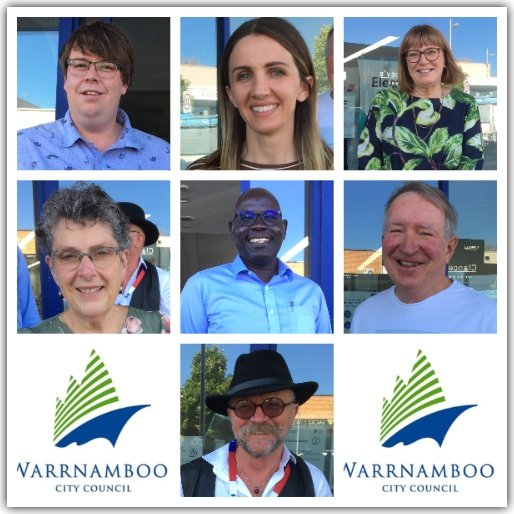
The seven new Warrnambool City Councillors elected in a clean sweep in 2020: Ben Blain, Angie Paspaliaris, Debbie Arnott, Vicki Jellie, Otha Akoch, Max Taylor and Richard Ziegeler.

Terrier guest writer – Jim Burke*

This week the local newspaper reported that three former councillors thought that the outcome of the recent council election was “undesirable” and that a ward system with three councillors in each ward would prevent “undesirable” results in the future.

Really!  Well let’s unpack that.

Firstly, just how was this election result “undesirable”?

The election was a well-run, open, democratic process conducted independently by the Victorian Electoral Commission. The candidates all campaigned in good will and the community seemed to be fully engaged.

The election results were overwhelming, the community wanted a clean sweep: that is what they voted for and that is what they achieved.

It seems clear that the voters understood that they could likely end up with seven councillors who would come to the job with no previous experience.

Is that what happened? Well, actually, no.

The seven new councillors bring a wealth of skills and experience to the table and they have had the benefit of observing their predecessors and an understanding of just what is at stake.

The result of this election was not “undesirable”: it was the exact opposite. It was clearly the result the community desired.

Now, would a system of three wards, electing three councillors each, have changed the election results?

In the case of the 2020 election, I doubt that a ward system would have changed the outcome. There was a strong mood for change, and this can be seen in the voter turnout.

More were enrolled to vote in 2020 than in 2016, and of these, more people actually voted in 2020 as a proportion of those enrolled than was the case in 2016.

The proportion of informal votes also went down, not up, as implied by the former councillors in the newspaper article.
If we had three wards electing three councillors each in 2020, the outcome may have been different, if only because it might have caused a different range of candidates to nominate.

For instance, all of the sitting councillors who sought re-election in 2020 lived and/or worked within a short walk of Liebig Street; do you think that any of them would have been accepted in a ward that included, say, Allansford?

We had no candidate running from Allansford (or Woodford) in 2020, so perhaps under a system of wards, we would see such a candidate.

I would argue that such was the mood for change, the outcome would have been much the same, whether it was a single electorate, or an electorate divided into wards.

The retired councillors also made some further observations that I would like to challenge:

First, that a ward system would have reduced the informal vote from nine per cent to two per cent.

I am not sure what they base this on, or how they arrived at the figure of two per cent, but in any case the assertion is misleading.

If the 2020 election had been held over three wards, the informal vote (nine per cent) divided among three wards would have been three per cent per ward.

Perhaps with fewer candidates per ward, then the informal vote may have been lower. But a whole percentage point?
Secondly, these retired councillors harked back 30 years when there was a ward system, elections were held annually, and one third of the councillors retired each year. The idea being that this would have avoided the “undesirable” outcome of the 2020 election, by reverting to an enforced system of “old and new faces” at the council table.

This is a bogus argument that needs to be debunked right now.

Whatever the merits of the idea, it will not happen now or ever. We would have to endure three months of election activity every year, and the costs to candidates and councils – in cash and personal and professional disruption – would be unacceptable.

In any case, no State Government would ever commit the resources or pay the huge cost of an election in all 79 councils in Victoria every year. It just will not happen.

But change is in the air for the next election in 2024, with Warrnambool set to return to wards in response to a State Government review.

How many wards, their boundaries, names and the total number of councillors (the review recommended nine), will be decided in the coming months.

For now, however, all eyes are on this new council and the fresh start that Warrnambool desired and achieved.

*Jim Burke, a retired naval officer, ran for the WCC election for the first time and finished 11th after preferences. He is a regular fixture in the public gallery at council meetings and continues to run a Facebook page with commentary on civic affairs.


WCC candidate Jim Burke chats with The Terrier

CANDIDATE JIM BURKE

10 QUESTIONS FROM THE TERRIER:

What three main skills could you bring to the Warrnambool City Council as a councillor?

Analysis.  I am an experienced analyst.  This will not necessarily give me the answers I seek but it will allow me to ask the right questions.  This is vital in resolving issues or in predicting unwanted outcomes.

Public Policy.  I have studied public policy for the last ten years.  It is necessary for a Councillor to understand what policy proposals might mean to the community in both the short and longer term.  Councillors need to be able to formulate policy proposals independently.

Governance.  I would bring to the table, years of governance experience.  Local government is a complex beast and Council’s need to ensure that they have the processes in place so that they can be sure that projects they have set in train are being carried out as intended, that they are achieving the intended outcomes and not some other outcome and that the projects remain within budget limits.

Do you see any particular issues, projects or problems in Warrnambool that you would like to work on as a councillor?

The current Council has lost the trust of the community.  This must be redressed so that Council can resume providing the leadership this community needs.  It must become open and engaged and lead by example.  It must learn to trust the community so that the community can trust the Council again.

The Flagstaff Hill issue needs to be resolved.  To this end, I will propose forming a committee to find the way ahead on this long-term project.  This committee would comprise Councillors, Council staff and members of the community and would be funded sufficiently to engage expert advice.

There is a need for the Council to become more involved in the provision of social housing.  Council already owns some housing, though much of it needs repair.  There is room for Council to build or acquire additional social housing which would have the side benefit of employing local people.

Do you think the council could be more “open” with residents and if so, how?

This Council lacks transparency and treats community engagement like a box ticking exercise.  I would change that by making more council information publicly available and in a timely manner.  Council meeting minutes, including those of the Committee of the Whole meetings, should be publicly available within 48 hours of a meeting.  Assemblies of Council must be reported in much greater detail than they are currently.

Council should re-introduce General Business to the agenda for Council meetings so that Councillors can introduce issues that are not otherwise getting any oxygen.  There also needs to be a facility for members of the community to address Council on matters currently before the Council.

The Council should have a policy of only withholding of documents from the community by exception.  As an example, if I am elected, I will argue for the publication of the incoming CEO’s contract to be published.

The next 12 months are going to be challenging due to the impact of Covid-19 – do you have one or two key idea/s for how WCC could support residents and/or businesses?

As the Covid-19 restrictions ease, the Council should initiate or support as many low cost, easy to manage events such as fairs, markets, car shows, art events as they can.  These events would attract our fellow Victorians who, for the foreseeable future, will have limited travel opportunities. The Council should invest in making Warrnambool their preferred destination.

In the summer months, Council should support a Friday or Saturday ‘Party Night’ in the southern end of Liebig Street.  Saturday or Sunday Food and Craft Fairs on the Green to support local producers to attend. Saturday morning markets in Liebig Street between Lava and Koroit Streets where local traders would take goods out into the street and be supported by some light entertainment.

Normal fees and charges usually attached to these events would be waived for at least 12 months and Council should consider financially supporting some of these events by directly employing the light entertainment.

Do you have any ideas on where the council could cut costs, if necessary, to keep rates at the state cap?

To be able to operate within the rate cap, the former CEO was reviewing the organisation structure at Council as the wage bill consumed about 90% of Council’s rates revenue.  This has a seriously limiting effect on Council activity and this review needs to be completed.

In the immediate post future, Council should avoid unnecessary major projects and focus on getting its own budget in hand while doing as much as it can to get the local economy going again.  Council should focus on asset maintenance; by focusing on that, Council will save itself a lot of money in the long term and will employ more local businesses in improving the state of council assets.

Flagstaff Hill needs to be restored as a successful tourist destination which could operate at little or no cost to the community.  This year it is estimated that Flagstaff Hill will cost the community $836,000.

Preferences will decide who is elected to the council. Are you planning to preference most highly new candidates, exisiting candidates or you won’t be putting forward preferences:

I will publish my preferences after nominations have closed.  I will be preferencing the four (councillors who sacked the CEO) last, it is the only way to prevent them from returning, which would be disastrous.

If you were elected, what ways – if any – would you keep residents and ratepayers informed as an individual councillor?

I would keep in touch using social media.  I would publish as much information as I possibly can on my Facebook page.  Here I would discuss matters like the outcomes of Council meetings, the arrival of new planning applications, whether they were going to Council or not, as well as publicising Council and other public events.

Using Facebook would allow me to answer questions on these matters too and participate in public discussion of important or even mundane issues or events.

If you were elected, what would you have liked to have achieved at the end of your four-year term?

I would like to have developed a Council that has gained the confidence to engage with the community honestly and openly, trusting the capacity of our community to respond positively and, in turn, be trusted by the community.

I would also like to achieve a Council that has learned to live within its means, that does not resort to unnecessary rate rises and especially not over the cap rate rises.

These issues are mutually dependent, and I don’t think Council can achieve one without achieving the other at the same time.

Are you a member of any political party? If so, which one?

I have never been a member of any political party or any lobby group.

In the past two years, have you been a member of any local club, organisation or association?

No, none at all.

Closing thoughts or ask and answer your own question here:

Warrnambool has, for some years now, endured a Council it has lost trust in, that has not provided the community the leadership it deserves and now faces the economic impact of Covid-19 as well as the impact of years of economic mismanagement.

The new Council will likely find itself financially constrained and this will impact the community in ways that are not yet clear.  The new Council must earn the trust of the community and should lead the community while remaining a part of the community.

Council is likely to find itself asking the community to accept some level of financial pain and, If that is going to be the case, then the Councillors should lead the way.

As an act of both leadership and faith in the community; I will urge the Council to accept a 20% cut in its remuneration.

You can find Jim’s candidate Facebook page here.