Crikey! The Terrier springs forth as the paper giants fold
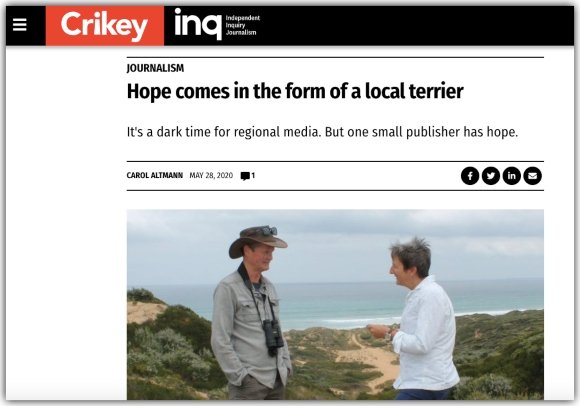
A screenshot from today’s edition of Crikey following the announcement that News Ltd will cut hundreds of jobs from regional newsrooms.

Carol Altmann – The Terrier

[The following piece first appeared in Crikey (www.crikey.com.au) on 28 May 2020. If you are not already a subscriber to Crikey, please give its 21-day free trial a go. Crikey is 20 years young and still a trailblazer in quality, online journalism.]

If the arrival of the internet left regional newspapers staggering and dazed, it will be the fallout from COVID-19 that could finally kill them — after what has already been a long, slow death by a thousand cuts.

And yet there is hope for maintaining a media voice in our country towns and I am proof of that hope.

I returned to my home town of Warrnambool, in south-west Victoria, and started what has since morphed into The Terrier, a wholly online, extremely nimble, one-person operation that I run from the front room of my house.

I use a website and social media to reach my readers, who have grown from a few hundred to more than 4500 followers in a city of 35,000 people, and seen The Terrier move from the periphery to become an influential voice in the community.

The secret to the growing success of The Terrier has been to keep my overheads extremely low and my connection with the readers extremely high.

In so doing, I have had to throw out a lot of my old concepts of what journalism must be and adapt to what the reader now wants it to be, which is to not only tell them what is happening, but why and what — if necessary — we can do about it.

This doesn’t mean throwing out all of the essential skills of journalism — fact gathering, research, interviews, composing well-written pieces without spelling mistakes. What it does mean is no longer being afraid to advocate, or take a side, or express a point of view.

I found this uncomfortable at first, but I have since come to learn that my readers don’t want me to simply repeat what their friends have already “reported” to them on social media about a car accident in the main street; they want me to dig deeper into the power structures of their home town and to be their eyes and ears. To be, in other words, their terrier.

At the same time, I invite the reader in to be part of the chase.

They report to me on what they have found, read, heard and investigated themselves, so that I have not one terrier on the case, but many, with me the ultimate fact checker. We are doing a great job.

In fact two of the biggest stories to come out of Warrnambool in the past 12 months were both products of The Terrier, with one now the subject of an ombudsman’s investigation.

But how do you make any money, I hear you ask? I rely on contributions from readers through my tip jar which has also been gathering strength, but I know such a model needs more than tips to be viable in the longer term.

To me, a combination of dramatically reducing overheads, reader support, government support, tax deductibility and philanthropy holds the key to financial viability.

Resource sharing and collaborations are another critical step that we are yet to take, with old journalistic rivalries given priority over the needs of the readers we purport to serve.

What I have found most interesting through the whole journey of The Terrier, is that the reader doesn’t want more bells and whistles from me in what is already a noisy world.

I don’t use video, I am pondering a podcast, and I don’t even have a regular publishing schedule beyond a loose “two or three times a week”.

The key is that I keep it simple and it works.

This is where regional journalism can go and indeed must go if it’s to survive, and I am loving being a part of it.

Carol Altmann is a journalist and the publisher of The Terrier.


South-west women’s art prize offers hope

heeps
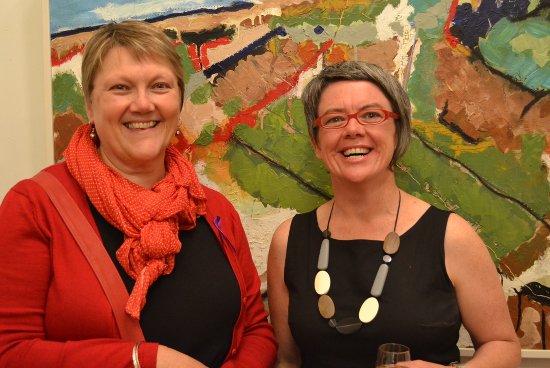
Among the entrants for the 2015 South West International Women’s Day Art Prize was Dianna Heeps, from Hamilton, left, pictured here at the exhibition with friend Maggie Dwyer.

By Carol Altmann

[dropcap style=”font-size: 60px; color: #A5CECD;”] T [/dropcap]he South West International Women’s Day Art Prize is fast becoming one of the premier competitions for women artists across the region, with more than $4000 in prize money for the 2016 event.

Organisers Women’s Health and Wellbeing Barwon South West are offering a $2000 cash first prize – up from $1500 for the inaugural event – with the winning work to be acquired by the group and also featured on the cover of its annual report for 2016-17.

A $1000 cash prize will be awarded to the runner-up, with another $1000 cash prize for best emerging artist.

Bluestone Magazine is also, for the first time, sponsoring the People’s Choice award of $250.

subscribe button10

Emily Lee-Ack, Executive Officer of Women’s Health, said the response to the 2015 inaugural event had been “unexpected and astonishing”, with the group expecting perhaps a dozen entries and receiving more than 70 that responded to the theme of “Women and Place”. (First prize was won by Marion Manifold).

The group is expecting a similar response to the 2016 prize, which has the theme of  “Hope”.

“Hope is a very broad theme that means a lot of different things to a lot of people,” Emily said of the choice.

“It is also a very uplifting and positive theme and we would like to think that there is a growing sense of hope in the community about how things can be changed. Without hope, we are lost,” she said.

nicholson-mahony
Flashback: Deb Nicholson, left, with Emma Mahony from Women’s Health and Wellbeing Barwon South West at the 2015 women’s art prize. The pair are in front of Kate Melican Rollo’s work, ‘Sapphire Views #2, a family connection” which Deb purchased on the night.

[dropcap style=”font-size: 60px; color: #A5CECD;”] E [/dropcap]mily said the prize, which will again be hosted by The Artery, in Warrnambool, demonstrated the commitment of Women’s Health to not only advancing women’s health interests, but also supporting women more broadly.

“The prize is one way of supporting and promoting women in a really positive way…and making their work visible in the community, not only during the exhibition, but with the winning work finding a permanent home in our space,” she said.

“It also reminds us of the great value of women in our community and renders this visible, where they are so often not visible.”

In anticipation of the same response to this year’s prize, a panel will be chosen to select those entries that will make up the 50 or so to be exhibited. A guest judge – who is yet to be finalised – will determine the winners.

The prize is open to women living in the councils of W’bool, Colac-Otway, Glenelg, Southern Grampians, Corangamite and Moyne.

[box]The South West Women’s IWD Art Prize will run at The Artery from February 26 to March 13, 2016. Entries close on January 28. Detailed information about how to enter will be available on the Women’s Health website from Tuesday Sept 29. For further information you can also contact Emma Mahony: emahony@womenshealthbsw.org.au or phone (03) 5500 5490.[/box]

Stones Smile newsletter

You might also enjoy…


Rock my soul: Rosebrook chapel rises again

Raising the bar with children’s book art: Port Fairy

To the lighthouse: a trip to Cape Nelson

Feeling a building in your bones: Donna Monaghan

Fabrication II gives birth to a new life