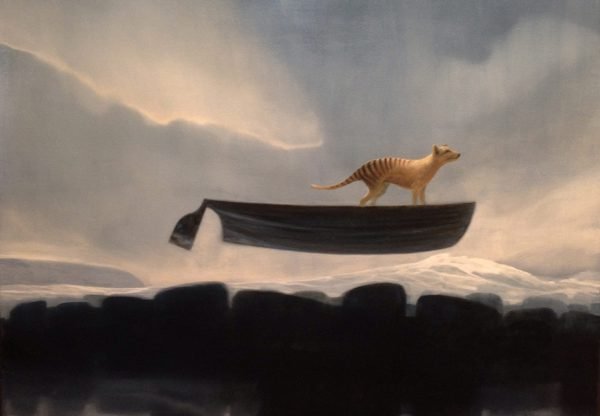
Original painting, oil on canvas, Graeme Altmann. (Altmann Studios, Highett, Melbourne.)
Carol Altmann – The Terrier
On days like this, we need hope.
On days like today, when we see laws passed that allow even greater damage to our wild coast than what we have already inflicted, it would be so easy to just give up, because the battle is exhausting.
But on days like today, when I need to draw deep on hope, I think of my late uncle Alf Altmann.
In March 1970, almost 50 years ago, Alf attempted to become the first person to row solo across Bass Strait, from Tasmania to Victoria, in a home-built kayak.
He built that kayak piece-by-piece in his garage under his home on Riverview Tce, here in Warrnambool.
To train for this epic journey of more than 200km, he would row out to Deen Maar, (Lady Julia Percy Island) and, once or twice, he carried native saplings in his boat to plant on the barren island.
The saplings never survived. Neither did my uncle. His attempt to cross Bass Strait ended just 1.5 miles from the Victorian coast. So near. So close.
And when I think of his story, I think of an anecdote that stays with me each day as I do my bit to try and turn around decisions that hurt our local environment more than protect it.
“Why do you bother taking those saplings with you?” someone asked Alf. “Nobody will see them out there.”
“I see them,” Alf replied. “I know they are there, and that is all that matters.”
This painting is how my artist brother, Graeme Altmann, often captures the essence of Alf’s journey: a boat, suspended above the turbulent sea, with the proud thylacine pointing toward an unknown future.
We can’t change the mistakes of the past. Alf never came home. The thylacine is gone. But I keep trying to do what I can, whatever I can, to turn other mistakes around.
Because we know. And we see. And that is what matters.
Hooded plovers play catch me if you can
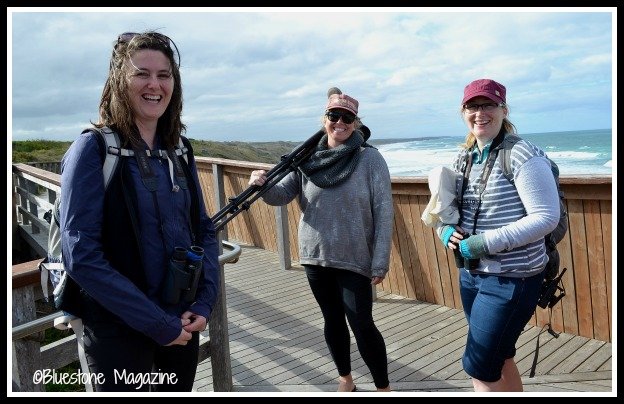
Part of the “hoodie” tag team from BirdLife Australia, Dr Grainne Maguire, (left) Robyn Burns and Renee Mea, armed with telescopes and other gear at Logan’s Beach, Warrnambool.
By Carol Altmann
Imagine trying to catch a tiny bird living on a long stretch of beach with little more than a piece of plastic grid the size of a shoebox?
It sounds like an almost impossible task, but this is exactly what a team of patient and nimble conservationists do each time they visit the south-west coast to tag and flag juvenile hooded plovers.
The tag team from BirdLife Australia has just finished its final session for the season through the area, taking in Logan’s Beach at Warrnambool, Killarney beach and several spots around Port Fairy.
The south-west Victorian coast is home to the largest population of hooded plovers anywhere in Australia because, as we know, the real estate is perfect.
“The habitat is just right,” explains Dr Grainne Maguire, a coast and marine program manager with BirdLife Australia, as she stands on the Logan’s Beach whale platform and surveys the scene below.
“The hoodies love dune protection, and the rocks just offshore and the right diet – arthropods – is here for them too,” she says.
In other words, it is the hooded plover equivalent of finding a comfy, three-bedroom home with an in-ground pool and a fully stocked, double-door fridge: bliss.
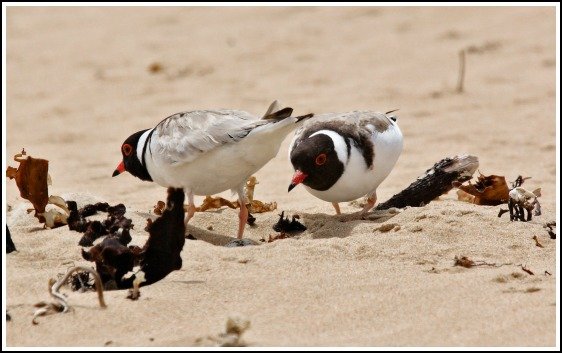
Hooded plovers find the conditions around the Victorian south-west coast perfect for their lifestyle. Image: Glenn Ehmke, BirdLife Australia.
On a good day, particularly at the start of the breeding season in September, the team would spot several juvenile plovers, which can be identified by the smoke-grey plumage on their heads which is yet to turn black.
At that point, as Renee Mead explains, the team dashes down to the beach with its special snare, which is essentially a piece of plastic grid with strings attached.
The idea is for the snare to be laid on the sand and a hooded plover walks across it, temporarily catching its toes.
I look at the beach – the very long stretch of beach – and I look at Renee, who is a Beach-nesting Bird Project officer, and wonder if she is serious, and I realise that she is.
Despite the young birds having literally hundreds of metres of beach on which to roam, they fortunately like to hang around the nesting area. This, with the help of a bit of a seaweed piled into makeshift fences and some gentle corralling, boosts the chances of being able to catch them.
Unfortunately there was only one hooded plover on Logan’s Beach that day, so the team tried Killarney Beach where, Renee later reports, a defiant little plover wandered across the plastic snare a total of 11 times without being caught! Bird conservationists are nothing if not patient.
All of this hard work is designed to help better monitor the movements of the hooded plover, which is officially listed as vulnerable.
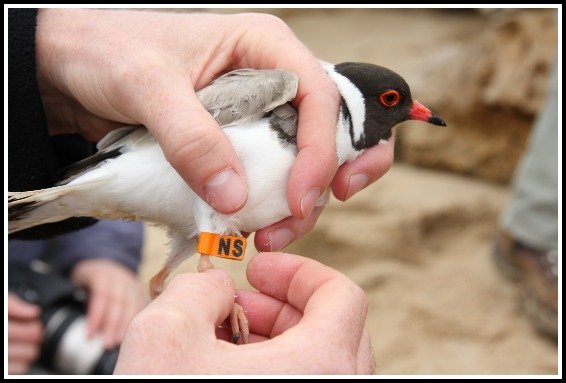
The bright-orange leg tags have a unique combination of letters which help keep track of the hooded plover’s movements. Image: Dr Grainne Maguire, BirdLife Australia.
[dropcap style=”font-size: 60px; color: #A02F2F;”] O [/dropcap]nce a bird is caught, the tag team attaches an ankle band, takes a DNA sample and then adds a tiny metal flag above the knee, with each flag having a unique code. This means if a member of the public spots a “flagged” hooded plover (with the help of binoculars), they can contact BirdLife Australia and report in.
“We had a call from a guy last winter who was having coffee at the Cape Bridgewater cafe and he spotted a flagged plover,” says Grainne.
“It turns out it had come all the way from Apollo Bay and, later, it was spotted at Torquay…and it was only about eight months old.”
(No doubt that plover, like everyone else, had heard how good the coffee was at the Bridgewater Bay Cafe: see our earlier story here).
The program has tagged about 250 hooded plovers since starting in 2010 and is building a valuable database on where the birds go, and who they hang out with when they get there.
“There is a bit of partner swapping that goes on,” says Grainne with a laugh.
“Just like people, I guess, they move on until they find the right one.”
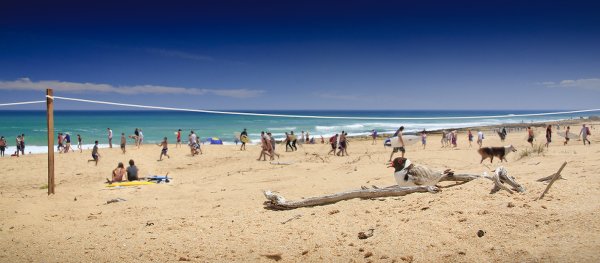
The team is also heartened by a greater awareness of hooded plover conservation programs, such as roped off nesting areas and signage, but off-leash dogs still present a challenge.
“When a person’s dog disturbs a hoodie, they might think it is only their dog, for a short time, and what’s the big deal? But for the hooded plover it is dog after dog after dog: that’s the message we try to get across,” says Grainne.
This time-lapse montage shows how many people would be exposed to the nesting hooded plover over a four-hour period, if not for protective fencing. Image: Glenn Ehmke.
[box]BirdLife Australia is always keen to hear from people willing to volunteer for various projects, including the Beach Nesting Birds project. Read more here or email hoodedplover@birdlife.org.au. You can also find them on Facebook.[/box]