Secrets of an old shoe

ol shoe

[box] Bluestone Magazine recently brought you the story of the rejuvenation of 222 Timor St, Warrnambool. This week, we tell the story of one fascinating find during its restoration.[/box]

[dropcap style=”font-size: 60px; color: #A99E90;”] O [/dropcap]ld shoes, perhaps more than any other item of clothing, have the power to tell stories.

What is the story behind a single shoe discarded by the roadside? Did it land there by accident, through misfortune, or part of prank?

We throw old shoes over powerlines and tie them to wedding cars, and we refer to shoes in our folklore and our fairytales: “if the shoe fits, wear it”; Cinderella and the famous glass slipper.

Old shoes are personal. They hold an imprint – a literal footprint – of their owner that cannot be replicated and makes them so hard to throw away, especially when they were once worn by a loved one who has also gone.

Some shoes can outlive us, surviving for centuries beneath the dirt and rubble of demolished homes and ruined cities until they are at last unearthed by new activity.


222 timor old
How 222 Timor St, Warrnambool, used to look in 1968. (Image: J.T. Collins Collection, La Trobe Picture Collection, State Library of Victoria.)


[dropcap style=”font-size: 60px; color: #A99E90;”] A [/dropcap] shoe that had been hidden for possibly more than 70 years was recently found at my grandmother’s former property at 222 Timor St, Warrnambool, opposite Swinton’s supermarket. It was the house in which my mother spent a large part of her childhood.

It is also one of the oldest commercial buildings in Warrnambool and is believed to have been built around 1850.

As we wrote about earlier this month, the building recently passed into new hands and its long-hidden secrets are being slowly uncovered: a hidden doorway down to the cellar, shoebox-size windows that had been boarded up and wallpapered over, and a child’s single leather boot that had been placed under the floorboards.

The boot is about 18cm long, with tacks around its sole and seven pairs of metal eyelets securing a cloth shoelace.

222 timor st floorboards
The old floorboards in 222 Timor have revealed their own secrets. Image courtesy Luke Taylor.

[dropcap style=”font-size: 60px; color: #A99E90;”] I [/dropcap] thought it might have belonged to my now 89-year-old mother, but when I showed her the boot, she suggested it had most likely been hidden under the floorboards by a boot repairer – a Mr Long – who had rented part of the property from her father in the 1930s.

My mother told me she had read an article in the Reader’s Digest about shoe superstitions, including the placing of a shoe under floorboards for good luck. I couldn’t trace the Reader’s Digest article, but an online article by British shoe historian June Swann confirmed that in Britain, in particular, it was not uncommon for a shoe to be hidden somewhere in a house to bring stability and good luck to the household.

Hiding a child’s shoe – in either a wall, chimney or under the floorboards – was also believed to increase fertility.

Perhaps Mr Long, if he did hide the boot, hoped it would bring prosperity to his business. Or perhaps it wasn’t Mr Long at all, but a previous owner of 222 Timor St who stowed the boot away for good luck.

The full story is yet to be revealed and the boot, of course, is holding its tongue.

[box] A version of this story first appeared in the Warrnambool & District Historical Society newsletter, Warnimble, April 2013. The new owners of 222 Timor St, Luke and Nat Taylor, plan to hide one of their children’s shoes in the restored building…for good luck. [/box]


Colonial oven still makes a crust

dunkeld_small
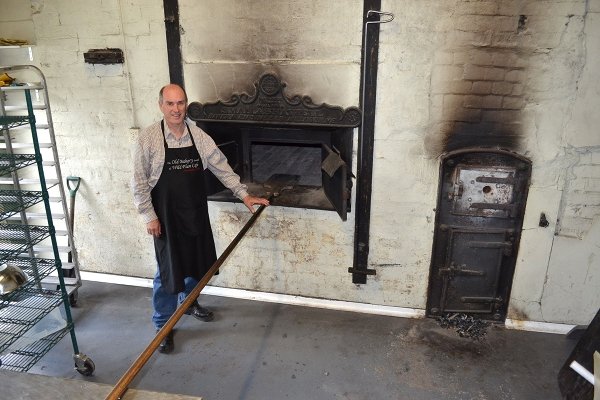
Paul Sanders with the magnificent 135-year-old wood-fired oven that he returned to working order for his Dunkeld cafe.

[dropcap style=”font-size: 60px; color: #A5CECD;”] W [/dropcap]hen Paul Sanders and his wife Pauline Yule moved into an abandoned bakery in Dunkeld, they had no intention of doing anything with the clapped-out, 135-year-old oven that dominated one wall of their bedroom.

In fact when they first bought the Martin St property in 2001, the cast-iron wall oven and firebox were hidden behind workshop shelving. They removed the shelving and converted the whole space into a bedroom, before converting it again into a meditation space as part of their business operating a spiritual retreat: a curtain was draped across the oven to avoid distracting the meditators.

It was only in 2010 when they thought about selling the property that the pair learnt the wood-fired oven might be an under-appreciated gem.

“We had a guy come through from Melbourne who was interested in buying the place as a bakery…we called some wood-fired bakers and soon got a sense that maybe the oven was actually in good nick,” Paul said.

dunkeld_20
The Martin St building has become a favourite among travellers since opening as a cafe last year.

[dropcap style=”font-size: 60px; color: #A5CECD;”] T [/dropcap]he last bakery to operate from the building closed in 1976 when the major bread companies began to buy up country bakeries with the intention of closing them down. As part of the deal, the ovens were supposed to be destroyed.

“But the baker who had this place, Ian McKernan, said he just couldn’t do it, so the oven survived,” Paul said.

Paul and Pauline stayed on and turned the property into accommodation and a gallery, while, behind the scenes, they worked on bringing the oven back to life.

“We fired it up with a fire in it every day for six months and it began to drip tears – it started to cry – as all the moisture that had built up over the years started to come out,” Paul said.

The external thermometer, that also dated back to 1878, also needed a bit of tweaking.

“We worked out that 300 degrees was actually zero and went from there,” Paul said with a laugh.

dunkeld_35
After more than a century of taking the heat, the temperature gauge was a little out.

[dropcap style=”font-size: 60px; color: #A5CECD;”] B [/dropcap]y 2012, the pair had decided to expand the business into a cafe and freshly baked bread, of course, would be a house specialty.

“We tried with (dry) yeast bread at first and it got a bit hairy at a times with black, smelly smoke filling the cafe,” Paul recalls, chuckling.

After weeks of trial and error, the quirks and mysteries of the oven began to be solved, and Paul felt ready to expand into baking wood-fired sourdough bread – made from scratch – that would give the cafe a real point of difference.

There was only one catch: he didn’t know how to make it.

dunkeld_37
Paul Sanders and Pauline Yule ran several businesses from the old Dunkeld bakery before returning it to its roots.

[dropcap style=”font-size: 60px; color: #A5CECD;”] T [/dropcap]he first step was to import a quality leaven (‘starter’) from San Francisco and then enlist the help of a professional sourdough baker who spent a week in Dunkeld showing Paul the process. Paul also hired a baker, Gurwinder Singh, to take over the bread making.

Despite their best efforts, however, the first sourdoughs they made on their own kept falling flat.

“We couldn’t work out what we were doing wrong and kept calling up people for advice, but in the end it was our local yoga teacher here, Frank Jess, who turned out to be the best help,” Paul said.

Frank suggested adding more water to the mix – “we weren’t hydrating it enough” – and making sure the oven was super hot.

“We made our first perfect loaf in May last year and haven’t lost a loaf since,” Paul said with an element of pride.

The oven is capable of baking 300 loaves at a time, but Paul is happy to put through 250-300 loaves a week, most of which are sold at local farmers markets.

For a 135-year-old oven, it’s not a bad way to make a crust.

[box] The Old Bakery & Wild Plum Cafe, 97 Martin St, Dunkeld is open seven days, 9am -5pm. P: 5577 2663. The sourdough bread is available from farmers markets including Port Fairy, Ararat, Hamilton and Daylesford. Paul and Pauline have just listed their business for sale. [/box]

Logo Smile newsletter If you enjoyed this story, you might enjoy…


Secrets of an old shoe 

Restoring a treasure back to life: 222 Timor St Warrnambool


Restoring a treasure back to life

lukefamily
Behind the renovation of 222 Timor St, Warrnambool: Luke and Nat Taylor, with their son Lucas. They have since had another child, Penny.

[dropcap style=”font-size: 60px; color: #A02F2F;”] A [/dropcap]fter years of decay, the old piano shop opposite Swintons, in Warrnambool, is being brought back to life by a young lawyer who has taken on a restoration project of monumental proportions.

Luke Taylor, and his wife Nat, bought the double-storey, derelict building at 222 Timor St more than 12 months ago with the intention of turning it into an investment, but what they didn’t count on was just how much hard work would be involved, or how much they would come to love the old place.

“At first it was very much about building an investment for the future, rather than being passionate about restoring an old building, but that has completely changed,” Luke said.

shop_65
BEFORE: The front left room was restored from top to bottom, including the ceiling, floorboards and walls.

222 after pic
AFTER…

[dropcap style=”font-size: 60px; color: #A02F2F;”] A [/dropcap] turning point was when architect Peter Brooks, from Heritage Victoria, visited for an on-site assessment of the property, which is listed with the National Trust and Heritage Victoria as a significant building. Where most saw a decaying hulk that had to be restored from the ground-up, Peter saw an historic and precious gem.

“He was blown away by it,” Luke explained. “There are basically so few properties like this that are still in their original condition and have not been modified or altered in any significant way. Peter’s enthusiasm and excitement about that was infectious.”

The sandstone building is the oldest, intact commercial building in Warrnambool and dates back to around 1850. It has had many lives since then, including as a piano repair shop owned by my grandfather, Bill Goodall, who bought it in 1932. It was largely because Bill never had an spare money for renovations that the building has remained unchanged, perhaps apart from the wallpaper: Luke removed nine layers from each of the rooms.

shop_64
BEFORE: Layers of wallpaper and plaster had to be removed and damp walls dried out as part of the renovation.

222 after lounge
AFTER…the ‘lounge room’ has been given a new lease of life.

[dropcap style=”font-size: 60px; color: #A02F2F;”] L[/dropcap]uke and a group of skilled, local tradesmen have spent countless hours since February slowly bringing the place back to life, and it has been backbreaking work. Floorboards have been lifted, replaced and then the old ones recycled. Barrow loads of dirt and dust and debri have been removed. Leaks have been plugged, walls re-plastered, windows replaced…and on it goes. And then some.

“The tradesmen have been amazing, because everything was crooked and had to be made square again,” Luke said.

Luke has taken only two weekends off since taking on the project, including one weekend when his second child, Penny, was born.

“I have spent so many hours in the building, and because I have spent so much time there, on my own, I have really come to appreciate it and feel the emotion of it,” he said.

shopfront
BFEORE: The 1850s building was rundown, but still in much of its original condition when the Taylors bought it last year.

222 shop finished
AFTER: Hours of back-breaking work have seen the shop slowly restored to how it would have looked in the mid 1800s, right down to the colour scheme.

[dropcap style=”font-size: 60px; color: #A02F2F;”] I [/dropcap]t is this emotional connection that has pushed Luke through what he calls the “dark times,” when the job ahead seemed overwhelming. He has also applied the same disciplined approach that he uses for his triathlons – one step at a time.

“It has been a huge challenge, a huge amount of work, but we are breathing new life into the building. It may look plain, but it represents an era and reflects that time,” Luke said.

The bottom storey of the building will have a tenant by the end of this month, but it will be another year before a residence and a serviced apartment upstairs are complete. Luke is determined to see it through.

“The way I see it is that if Nat and I can do this, what can’t we do?”

[box] 222 Timor St, Warrnambool had been painted cream for many years, but this was not its original colour. The new salmon-pink and burgundy facade reflects the original colour scheme that was uncovered by peeling back layers of paint. Pig’s blood was often used to tint paint in the 1800s, reflecting a step-up from the whitewash used on working class cottages.[/box]

newsletter Eat And Drink Stones

 If you enjoyed this story, you might enjoy… 


Who is the Granny behind Granny’s Grave?

Art is the heart of old Hawkesdale home

Behold this bluestone beauty: Fennessy’s at Rosebrook

Colonial oven still makes a crust, Dunkeld

‘Glass’ house starts a new life

Restoring the Rosenbloom store in Heywood


Is this the smallest violin you have seen?

violin

[dropcap style=”font-size: 60px; color: #DC943C;”] T [/dropcap]his tiny violin was carved from either ivory or bone or something similar and was made by my late uncle, Ron Goodall, more than 50 years ago.

He lived in the former piano shop at 222 Timor St – featured this week in Places/My Place – and would use pieces of old piano and other materials to make this folk art.

It is in four separate parts, including a miniature scroll top, that have been glued together and finished with four ‘cat gut’ violin strings.

The piece was originally displayed on the end of a toothpick attached to a cork and kept in a glass vial.

I doubt it has played a note, but it is one of my most treasured possessions.

 newsletter Why Not Stones More from Mum’s Drawer…


Do you remember the Drive-In?

To Hoover or not to Hoover?

A well-travelled junket

Bowlin, bowlin’, bowlin’….

Lunch order, 1975?

signed, Fletcher Jones


A long way from suet pudding

suet to saffron


[dropcap style=”font-size: 60px; color: #8F9F59;”] O [/dropcap]ld-fashioned cooking techniques and recipes are making a comeback, although perhaps without the levels of salt, fat and sugar that were all considered normal before a life sitting in front of computers made it harder to work off such nasties.

This week, Michaelie Clark, from Warrnambool Books, has chosen a gem that explores the history of one such book that was a must for all housewives, and yes, most married women were called housewives.

Ahh, those were the days…not! Over to Michaelie…

[dropcap style=”font-size: 60px; color: #8F9F59;”] ‘T [/dropcap]he name of the recently published history of the PWMU Cookbook could not be more appropriate. From Suet to Saffron by Melbourne author Fiona Bligh celebrates the evolution of the book since its first edition was produced by a group of Victorian women in 1904, when offal and raw animal fat were well-loved staples, to the current day, when the menu is infused with multi-cultural cuisine.

As well as giving a good overview of the origins of Australia’s oldest, continuously in-print cookbook and the changes it has undergone to achieve that designation, From Suet to Saffron also provides a snapshot through the ages of our country’s socio-cultural norms and prescribed gender roles.

Amidst advice for ‘invalid cookery’, priceless ‘observations on soup’, recipes for sheep’s head broth and instructions for cleaning ivory are replications of the advertisements that appeared in the book over the last century.

These range from macaroni ads in 1904 which ask ‘Do You Love Your Husband and Children? If so, feed them on Rinoldi’ (with a side serve of house-wifely virtue) to flyers by the State Electricity Commission of Victoria declaring in 1943 that ‘Electric Cooking is Now Every Woman’s Right!’

Whether you’re a long-time fan of the PWMU Cookbook or just want to take a look at Australia’s past from an interesting perspective, From Suet to Saffron is definitely a book you can sink your teeth into.”

fionablight
Melbourne author and historian Fiona Bligh has explored our changing tastes…and gender roles.

[box] Keep up to date with new releases from Warrnambool Books on their Facebook page. [/box]

newsletter Art Music Stones Catch up on our other Bookmarks …


The Dressmaker still winning fans

Preserving Indigenous stories: Fiona Clarke

James Laidler’s star-studded novel

Matt Porter: the lighter side of teaching 

At last, a cookbook you can use! 

Ben Sanders: Retro meets whimsy