Little old shoe leads to a humble war hero

The double-fronted shop at 220-222 Timor St Warrnambool (now BIBA Hairdressing) as it was in 1919 when Robert Long, right, ran his bootmaking business. Image courtesy Helen Thomson.

By Carol Altmann

A child’s boot found during renovations of one of Warrnambool’s oldest commercial buildings has unearthed the remarkable story of a local war hero.

Bluestone Magazine wrote about the shoe being found under the floorboards of 220-222 Timor St in one of our very first editions, way back in November 2013, when we reported on the restoration of the 160-year-old building by owners Luke and Natalie Taylor.

At that time, it was known that one half of the two-storey building had been rented during the 1930s by a bootmaker – a Mr Long – but whether the shoe was connected to him, or any more details about this Mr Long, proved elusive.

Enter Rodney Harris, who recently stumbled across our story and called Bluestone to say that he believed his friend, Helen Thomson, a well-known face in Swinton’s homewares department for many years, could fill in all the gaps.

And she could.

ol shoe
The child’s leather boot that was unearthed during renovations at 222 Timor St Warrnambool in 2013.

Helen, now aged in her eighties, is the daughter of the late Pearl Long whose father, Robert Long, started the original bootmaker’s business at 220 Timor St early in the 1900s.

In one of those priceless moments that history buffs live for, Helen produced a photograph – the only known copy in existence – of her grandfather standing outside the shop in March 1919.

As was common for the time, the extended Long family all lived upstairs from the business and Helen believes the English-style boot may have belonged to one of Robert’s six children (another three children had died).

“I know Mum used to talk about these little English boots that her father would buy for them for school, because they were good quality,” Helen says.

“But Mum hated wearing them, because of course they were not like what the others kids wore,” she adds.

Helen went on to explain how her grandfather’s bootmaking business was later taken over by her uncle, Roy Long, who everybody knew as “Toy”, and this is where the story took an unexpected and remarkable turn.

222 timor toy long005
Roy “Toy” Long as a member of the AIF 2/21 Battalion (Gull Force) who became prisoners of war on the Indonesian island of Ambon for almost four years. Image courtesy Helen Thomson.

When war broke out in 1939, Toy Long left his bootmaking business and joined the AIF as part of the 2/21 Battalion (known as Gull Force) that became prisoners of war on Ambon, Indonesia, following the Japanese invasion of the island in 1942.

Toy, together with other members of his batallion also from Warrnambool, was imprisoned for almost four years in appalling conditions.

During this time, it has now been revealed, Toy risked his life by hiding documents given to him by his commanding officer that would prove crucial in the later trials for war crimes.

Helen has a precious copy of the letter written to Toy by his commanding officer, W.R Scott, after the war.

It reads, in part:

My Dear Long,

The time has now arrived when we are no longer POWs…in Japanese hands. I may therefore without risk of your being deprived of your life, write and thankyou for the way and the risks of death you knowingly and yet willingly took secreting most important documents, holding them in your care for a long period of time, during which, I may add, there were two searches carried out by Japanese troops…

“You took all the risks, knew it meant death for you if you were discovered, and I now thankyou on behalf of us for the gallant manner in which you completed the task. I wish you all the best of luck for the future.”

letter
A copy of the letter written to Toy Long by his commanding officer which reveals the great risk he took in hiding documents that would later prove critical in war trials. Reproduced courtesy of Helen Thomson.

After returning from the war, Toy lived with Helen and her parents, and other members of the extended family, in their house in Kruger St.

“My mother was cleaning up one day and found this letter and started to read it, but Toy snatched it out of her hand. He didn’t want anybody to know about it,” Helen says.

Years later, however, one of Helen’s aunts had possession of the letter and typed out a copy for Helen. The original is now in the Canberra National War Memorial.

“He (Toy) never talked about the war, but he had the most horrendous nightmares, yelling out in his sleep,” Helen recalls.

Toy resumed his trade as a bootmaker after the war, opening a shop in the former Market Arcade in Lava St (and, later, opposite the Regal Shoppe in Timor St), and despite his horrific experiences – or perhaps because of them – he embraced life to the full.

“He was always such a kind and generous man and always had something for us kids when he came home from work, sweets or glass beads or something like that,” Helen says, laughing.

Toy later married and had one stepson. He died in 1990.

A humble shoe retrieved from the rubble has revealed the story of a brave and humble man.


Sovereign Hill strikes gold as ‘Flaggy’ struggles

pan-for-gold-sovereign-hill-2880
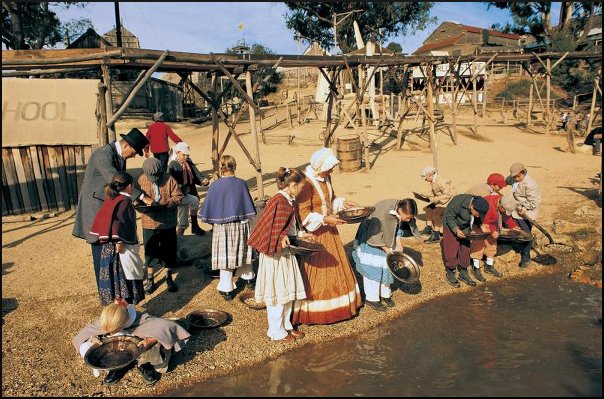
Children dressed in period costume pan for gold at Sovereign Hill: just one of the many daily activities for visitors to the site. Image: Sovereign Hill.

Analysis: Carol Altmann

Why is Sovereign Hill in Ballarat still booming after 45 years and Flagstaff Hill in Warrnambool is struggling to survive?

Both are in regional Victoria, both opened in the early 70s and both rely on a mix of reality and fiction to capture our colonial past – yet their individual fortunes could not be more different.

The numbers for Sovereign Hill are simply staggering: in 2013-14 it recorded 731,000 visitors of which more than 100,000 came from overseas.

Flagstaff Hill recorded less than 60,000.

In 2013-14, Sovereign Hill turned over $24 million in revenue and recorded an operating profit of $775,000. It employs 360 staff and has 250 volunteers.

By contrast, Flagstaff Hill has gone from making a profit to running at loss of around $500,000 a year, it employs only 13.5 staff and has 135 volunteers.

The first response might be, oh, Sovereign Hill must receive more government funding. No, it relies on generating its own income to survive.

Oh, but it is only 90 mins from Melbourne! Yes, but Flagstaff Hill is only an hour from the 12 Apostles, one of the top tourist attractions in Australia.

Perhaps the entry fees are cheaper at Sovereign Hill? No, in fact they are more than double the entry fees to Flagstaff Hill at $49.50 adult/$22 child/$122 family.

To my mind, the difference comes down to two critical things: i) Sovereign Hill has aggressively and successfully gone after the lucrative Asian tourist market and ii) Sovereign Hill itself is full of life, characters and things to do.

Flagstaff hill
While Flagstaff Hill Maritime Village occupies one of the best spots in Warrnambool, it is a largely static museum whose fortunes are flagging. Image: Bluestone Magazine.

In his submission to a recent state parliamentary inquiry into heritage and eco tourism, Sovereign Hill Chief Executive Officer Jeremy Johnson laid out some startling facts.

Having sniffed the wind early on the growing Asian tourism market, Sovereign Hill now employs four staff in China to sell itself as a destination direct to the Chinese. (In January it hosted a hugely successful 1850 fashion show and competition in Shanghai. See here.)

It also hires 17 Mandarin and Cantonese speaking tour guides on site – and has used such guides for 20 years.

Incredibly, one in three Chinese tourists to Victoria now visit Sovereign Hill.

Of course Flagstaff Hill has known about the burgeoning Asian market too, but only now is it lumbering into life to do anything about it, with an upgrade of its sound and light show that will be multi-lingual.

When I visited Flagstaff Hill a few weeks ago, there were no multi-lingual maps or signage, and the introductory film shown to all visitors is in muffled and difficult “olde” English (being extracts from a colonial diary).

There were certainly no Mandarin-speaking guides about, in fact there were very few people (visitors or volunteers) about at all, despite it being the height of the school holidays.

Which brings me to the second point. Flagstaff Hill is more static now than it was 30 years ago.

Tourists love things to see, do, touch and listen to, and this is where Sovereign Hill leaves Flagstaff Hill in the shade.

sovereign hill xmas july
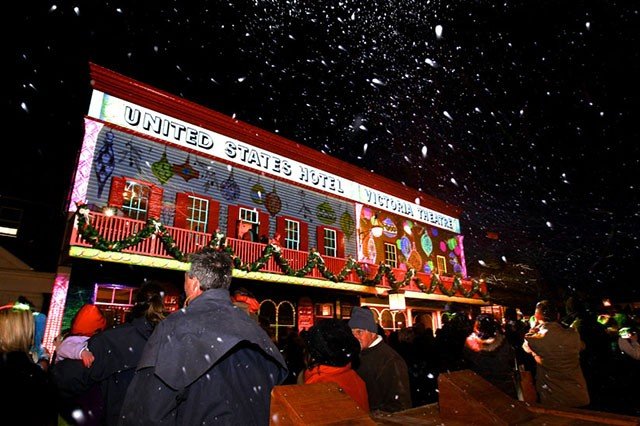
The winter blues have been transformed into a tourism winner at Sovereign Hill with its “Christmas in July” event that taps into the White Melbourne light show theme. Image: Sovereign Hill.

It Sovereign Hill, visitors can pan for gold, have their name printed on a “Wanted” poster, buy some Raspberry drops from the boiled sweet shop, or watch a building “burn” down, and on it goes…

At Flagstaff Hill, the visitors walk into the re-created shops, bar and blacksmiths etc expecting to see someone doing something and – apart from one or two exceptions such as the boatbuilders – there is nobody doing anything.

One more example: Ballarat is freezing in winter, even colder than Warrnambool. But Sovereign Hill turned this down-time into an up-time by launching a two-week Christmas in July event across the school holidays.

Among other things, they light up buildings, create fake snow, run plays by the local theatre group and, last year, the crowds reached a record 42,000. In other words, almost as many people visited Sovereign Hill in those two weeks than for two-thirds of the year at Flagstaff Hill.

So what is Flagstaff Hill doing in response to its troubles?

Well, it is about to spend another $3 million (on top of the $5.7m spent in 2003) “refreshing” the sound and light show ($2m), adding a handful of holograms rather than real people to its buildings – which sounds like a maintenance nightmare – and upgrading the wharf and main entrance.

According to its own masterplan, a full makeover of the village will cost up to $15 million, so rather than throw $3 million into it for little impact, we could try to do more with what we already have.

For example, if the council is persisting with the Fun4Kids Festival, why not hold it at Flagstaff Hill, refocus it with a strong maritime theme (pirates, stowaways, shipwrecks…) move it to the early January school holidays when – compared to events in Port Fairy, Warrnambool is dead – and run special trains from Melbourne (The Shipwreck Express?) that deliver visitors virtually to the door.

And why not offer studio space at Flagstaff Hill to the many artists and crafts folk around the area who do metal work, wood work, glass work, textiles and so forth, so that they get exposure (and sales) and visitors can see people in action?

And why not consolidate all of our historical artefacts in one place, rather than have them spread between Flagstaff Hill and History House (that few visitors even know exists), so that people can see, touch and learn about them?

Flagstaff ingots_10
Despite having historic lead ingots from the Loch Ard on loan from the Federal Government, there is not one sign at Flagstaff Hill explaining what they are or where they come from. Image: Bluestone Magazine.

Lastly, and most importantly, why not make more of the treasures at Flagstaff Hill, such as the Loch Ard ingots which, according to a report in the local paper, Flagstaff Hill founding member John Lindsay thinks are no longer that important at all.

Despite having several hundred of these lead ingots on site, there is not one explanatory sign telling visitors what they are or where they came from.

During my last visit to Flagstaff Hill I was in the Reginald M, that houses some of these ingots, and a young boy asked his mother what they were. She didn’t know, so I said that they had come off the Loch Ard shipwreck and he should try and lift one to see how heavy it was.

His eyes opened wider and he tried to lift one end.

“Orrrrrr.”

History comes alive in those moments – and, as Sovereign Hill well knows, they don’t cost a fortune, but they are pure gold.


Granny rises from the grave for Women’s Day

1-parlour granny_13
Warrnambool textile artist Louise Parlour with her work inspired by the story of Agnes Ruttleton: the ‘Granny’ behind the famous Granny’s Grave.

By Carol Altmann

[dropcap style=”font-size: 60px; color: #8F9F59;”] A [/dropcap]lmost 170 years after she was laid to rest somewhere in the Warrnambool sand dunes, Agnes Ruttleton – the “Granny” behind Granny’s Grave – is to get her name back.

The Warrnambool City Council has followed through on its plan to have a plaque recognising pioneer Agnes Ruttleton added to the famous Granny’s Grave site at the east end of Lady Bay and has installed it in time for March 8: International Women’s Day.

Until now, Agnes has been incorrectly known only as Mrs James Raddleston, “the first white woman buried in Warrnambool” and thousands of locals and tourists have walked past her memorial in the dunes not knowing anything more about her.

Last year, however, Bluestone Magazine ran a story on the research of local historian Jenny Fawcett that revealed so much more about the life and times of Granny Ruttleton, who died in 1848 at the age of 60. It remains one of our most popular stories and you can read it here.

1-parlour granny_11
The headstone in detail, created using 10.5km of cotton and finished with real lichen picked from the roof of Louise’s home.

[dropcap style=”font-size: 60px; color: #8F9F59;”] A [/dropcap]mong those inspired by Agnes’ story was Warrnambool textile artist Louise Parlour, who used the imagery of the Granny’s Grave bluestone headstone for her entry in the inaugural South West International Women’s Day Art Prize.

“The theme for the art prize was ‘Women and Place’ and I think the Granny’s Grave story fits that so perfectly,” Louise said.

“So many people walk past that site and never really stop to look. Plus (Agnes) is not actually buried there and they have her name wrong, so it is like she is invisible, despite being one of the first pioneering women of Warrnambool.”

Louise photographed the headstone and used this to create a template from dissolvable plastic. Around this template she freehand embroidered the headstone using the closest colour she could find to bluestone.

The work took about 50 hours and 10.5 km – yes, 10.5 km – of cotton to complete.

“I think I bought about every batch of that cotton I could get my hands on in Warrnambool,” Louise laughed.

1-parlour granny_3
The completed work, including a poem about Agnes Raddleton’s life inside a piece of recycled marine ply.

[dropcap style=”font-size: 60px; color: #8F9F59;”] T [/dropcap]he gravestone’s green lettering was then stencilled on to the work, some real lichen added from Louise’s roof at home and the whole thing covered with a thin coat of PVC glue to hold it together once the dissolvable plastic was removed.

The headstone itself is surrounded by sand and pussy willows, boxed by recycled fence pickets from a friend.

“I wanted it to look like I imagine it did when it was first erected, not with the modern handrails and things around it,” Louise said.

As part of sharing Agnes’s story with the public, Louise wrote a poem encapsulating what is known of her life and included this in her piece, tucked inside a piece of weathered marine ply.

“I want people to pick it up, read it and go away knowing a bit more about Agnes,” she said.

[learn_more caption=”You can read Louise’s poem here:”]

Where is this woman?

Laid to rest

Windswept dunes

Leaving no remnants

No trace……………

No photos to be found

Only our imaginations

Giving Granny a face.

A pioneer woman of her day

A township of 100 people

So they say…..

Makeshift homes set up

Enduring the wind and rain

On Flagstaff Hill

Where the sheep today roam.

So who is this Granny?

Encapsulated in time

A bluestone grave

Neither reason nor rhyme

Standing all alone

Standing the test of time……

Not much is known about Granny

And her pioneer days

Agnes sailed by sea

From Tasmania

Aboard the Essington

Wife of James

No record of children

The colony of New South Wales

Town of Warrnambool……

Worked hard for a quid

Odd jobs and selling crays

Headstone depicts wrong name

Should read – Mrs Agnes Ruttleton

Second white woman

To be buried in Warrnambool

First believed to be buried on an island

Off the Hopkins River

Granny was admired by one Richard Osburne

Known as a publisher and local historian

Paid for her burial

In the sand dunes……

Returning some years later

To no avail

Could not find her marker

And all efforts failed

Richard Osburne fought

Council decided to erect a headstone

The one that stands today All alone……..

Louise Parlour 2015

(I would like to acknowledge Bluestone Magazine and their article “Who is the “Granny” behind Granny’s Grave?” published February 9, 2014, and local researcher Jenny Fawcett who uncovered the story of the “real Granny”.) [/learn_more]

[dropcap style=”font-size: 60px; color: #8F9F59;”] T [/dropcap]he marine ply was found at Levy’s Beach where she occasionally walks with her father, who visits the area regularly in search of that other Warrnambool legend: the Mahogany Ship.

It is the first time Louise has entered her work in an exhibition, but unfortunately, after our interview, she learned that she had missed out in the selection process (the prize attracted more than 70 entries, of which only 50 could be selected).

Despite missing out, Louise remained upbeat, saying she had thoroughly enjoyed creating the work. We think Agnes would be pretty chuffed too.

In the meantime, the council plaque – which has been added to the viewing platform next to the grave – provides details about Agnes and her challenging life as one of the first non-Indigenous people to settle in the area.

A council spokesman said the full text of the plaque, which can be found at the end of this story, was developed with the assistance of Elizabeth and (the late) Les O’Callaghan and the Warrnambool Historical Society, in conjunction with historian Dr Helen Doyle.

granny plaque
The plaque created by the Warrnambool City Council that has been added to the viewing platform at Granny’s Grave at Lady Bay. Image: Warrnambool City Council.

[learn_more caption=”Read the full text on the grave plaque here:”] Who was Granny? Granny’s Grave marks the burial site of Agnes Ruttleton, who died in December 1848. Agnes Ruttleton, known as “Granny”, was recorded as “the first white woman to be buried in Warrnambool”.

Agnes arrived in Warrnambool with her husband James Ruttleton in the late 1840s (probably both ex-convicts from Van Diemen’s Land) and lived in humble conditions, occupying a tent or hut at the base of Flagstaff Hill. It is believed they made a living catching crayfish. Exposed to unpredictable weather and with few physical comforts, they would have had a tough life.

In Warrnambool’s early days many settlers experienced similar hardship and made meagre incomes from fishing and beachcombing. In an 1850 census, eight men gave their place of residence as ‘at the jetty’, another five were described as ‘Fishermen at the Hummocks’.

Upon Agnes’ death in 1848, a group of leading Warrnambool citizens, including Richard Osburne, who would later publish The Examiner, Gilbert Nicol, Mark Nicholson, John Hollins Craig, John Moffat Chisholm and Thomas Denny, rallied to provide a decent burial ceremony for her.

Rev. Thomas Slattery, the Catholic priest from Belfast (Port Fairy), was brought across to officiate at a ceremony held at the sand hummocks and to consecrate the ground where she was buried. [/learn_more]

[box]The South West International Women’s Day Art Prize will be launched Thursday March 5 at 6pm at The Artery, 224 Timor St, Warrnambool. Live music. Judging by internationally recognised Portland artist Carmel Wallace.[/box]

subscribe

newsletter Art Music StonesYou might also enjoy…


A fence full of happy soles at Tyrendarra

Victoria’s oldest building right in our backyard

Deep into the cellars of KM Lynch

Turning into the Turn In Motel

Biblio Art Prize remains an open book


Montgomery buys a slice of ‘Motang’ history

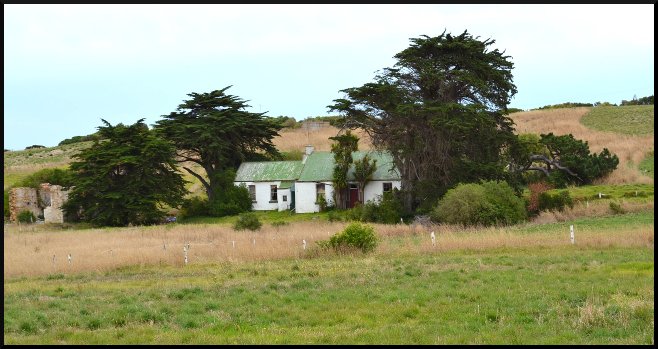
The original sharefarmer's cottage on the 'Motang' estate, Hopkins Point Road, which has been bought by Fletcher Jones factory owner, Dean Montgomery. Image: Bluestone Magazine.
The original sharefarmer’s cottage on the ‘Motang’ estate, Hopkins Point Road, which has been bought by Fletcher Jones factory owner, Dean Montgomery. Image: Bluestone Magazine.

[dropcap style=”font-size: 60px; color: #8F9F59;”] H [/dropcap]aving changed the future of one Warrnambool landmark with his purchase of the former Fletcher Jones factory, Hong Kong-based businessman Dean Montgomery has bought another significant property.

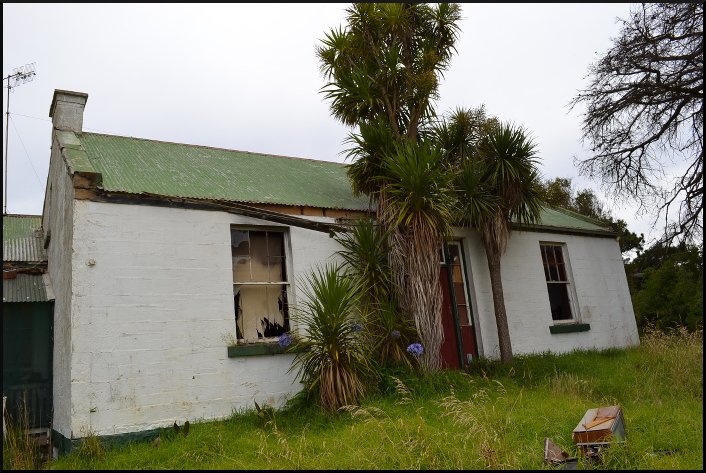
Bluestone has learnt that Mr Montgomery is the new owner of the 140-year-old ‘Motang’ stone house and surrounding 58-acres that occupies a slice of prime land between the beach and Hopkins Point Road, at the eastern entrance to Warrnambool.

The homestead dates back to the 1870s and was originally owned by the pioneering Thomas Manifold, who in the 1850s bought several hundred acres that made up the ‘Motang’ estate on both sides of Hopkins Point Road.

According to historians Helen Doyle, Louise Honman and Richard Aitken*, Thomas and his wife, Jane Manifold, may have used the property as a summer retreat, but the house itself was most likely built by a sharefarmer tenant at the Manifold’s expense, as was a common arrangement at the time.

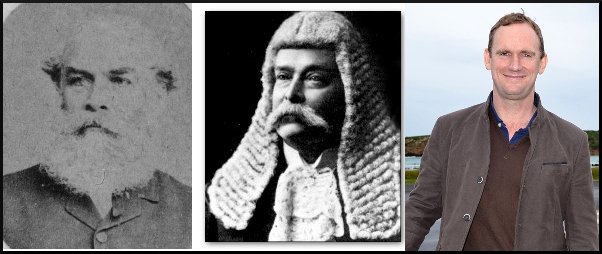
montgomery-manifold
Dean Montgomery, right, may have to grow a handlebar moustache if he wishes to follow the tradition of former ‘Motang’ owners Thomas Manifold, far left, and son, Sir Walter. Images: Australian Dictionary of Biography/Bluestone Magazine.

[dropcap style=”font-size: 60px; color: #8F9F59;”] S [/dropcap]ir Walter Synnot Manifold, the son of Thomas, inherited the property after the death of his parents, but apparently never lived there.

He instead resided in the family home at Wollaston, from where he maintained his busy life as a state politician representing the Western Province in the Legislative Council. Like Sir Fletcher Jones, Sir Walter was a man of the people and well-respected for his inclusive approach to business.

Sir Walter, who died in 1928, put the entire ‘Motang’ estate up for auction in 1906 at a reserve of £40 an acre. It was passed in, but sold shortly after to John Wilson Younger, from Younger’s store fame in Warrnambool, who was also a former mayor.

The property has since been progressively divided up and held by different owners over the years, with farming brothers Edward and William Tomlinson among those to own the portion that included the eight-room homestead and outbuildings.

They auctioned off 100 acres in 1934 to the Ryan family, when the asking price for the “marine frontage” was £1 an acre! The Ryan family later used the property to raise racehorses.

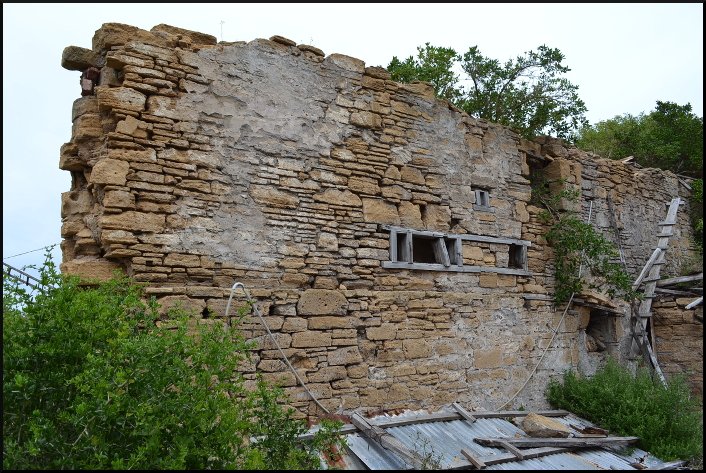
motang_4
A magnificent sandstone wall is about all that remains of the original barn on the property. Image: Bluestone Magazine.

[dropcap style=”font-size: 60px; color: #8F9F59;”] M [/dropcap]r Montgomery could not be contacted for comment, but it is understood he intends to retain and restore as much of the original homestead and outbuildings as possible.

The white-washed homestead is derelict and, like the Fletcher Jones building, has suffered at the hands of squatters, but still retains much of its character.

Historians suggest it was modelled on Scottish/Irish farmhouses of the time, and built from stone quarried on the land.

A sandstone wall is just about all that remains of the original barn, but it also still captures the building techniques of the period.

As it happens, another significant chunk of the Manifold’s original ‘Motang’ property is for sale across the road from Mr Montgomery’s purchase.

That 70-hectare property is owned by the family of the late Dan Madden, a Warrnambool solicitor, and – unlike the homestead portion – falls within the town boundary for subdivision.

The asking price is believed to be around $20 million: a little more, to say the least, than the £40 per acre that Sir Walter was asking for…

motang_1
The derelict stone house has been vacant for many years, but will eventually be restored. Image: Bluestone Magazine.

[box]*Helen Doyle, Louise Honman and Richard Aitken, ‘Warrnambool Heritage: A report on selected sites in Allansford, Bushfield, Farnham and Woodford’, prepared for Warrnambool City Council, November 2001.[/box]

Bluestone Magazine would like to thank historian Dr Helen Doyle (Context) and Steve Myers (Warrnambool City Council) for their invaluable help in retrieving a copy of the above report which provided the historical information for this story.

[button link=”http://the-terrier.com.au/subscribe-2/” type=”icon” icon=”heart” newwindow=”yes”]Bluestone needs at least 500 subscribers in 2015. We need your support. It’s how we survive: subscribe here[/button]

newsletter Art Music StonesYou might also enjoy…


Capturing the story of FJ’s silver ball

Subscribers only: rare images of the silver ball emerge

Who is the ‘Granny’ behind Granny’s Grave?

Art is the heart of old Hawkesdale home

Behold this bluestone beauty: Fennessy’s at Rosebrook

Secrets of an old shoe 


Rare silver ball images emerge from collection

man on ball
Vertigo? What vertigo? One of the rare images of the iconic silver ball water tower being erected at the Fletcher Jones factory in 1967 from the collection of engineer Ralph Jones. (Citation: Ralph Jones Water Tower Submission and Business Papers, 2014.0112, Box 1, University of Melbourne Archives.)

Words: Carol Altmann

[dropcap style=”font-size: 60px; color: #DC943C;”] R[/dropcap]are images of the Fletcher Jones silver ball water tower have emerged from the private collection of engineer Ralph Jones who designed and supervised the construction.

Bluestone Magazine has been privileged to gain access to the images courtesy of the Melbourne University Archives which has been archiving the story behind the iconic silver ball as part of the Ralph Jones Engineering Services collection.

See all of the images here.

MUV archivist Melinda Barrie said the collection – donated by Mr Jones, who is now aged in his late 80s and living in Melbourne – included detailed documents and correspondence from 1965-1967 when the silver ball was being built.

It also includes Mr Jones’s submission to the 1975 Association of Consulting Engineers Australia -Engineering Awards, where his firm hoped to win a prize for the silver ball that, as far as we know, is without peer in Australia. (Unfortunately, the ball missed out on an award).

ball phone book
The brand new water tower, red-legged and silver-topped, graced the cover of the local phone directory the year after it was assembled. Image from the Ralph Jones collection and reproduced courtesy of Melbourne University Archives.

[dropcap style=”font-size: 60px; color: #DC943C;”] T[/dropcap]he documents reveal that Mr Jones’s inspiration for the ball’s design came from US advertisements for water towers made by the Pittsburgh-Des Moine Steel Company, one of which included tripod legs.

The unique design was also borne of necessity because of the “poor mains water pressure” on the east side of Warrnambool at the time, Mr Jones wrote in his submission.

It also had to take into account potential earthquakes – given that the Fletcher Jones factory was in the middle of an area that in 1903 experienced two of the worst earthquakes in modern Australian history – and was built to withstand “moderate” earthquake loading.

With the Ralph Jones Engineering Collection ready to view at MUA, Melinda and her team are now turning their attention to a significant collection of photographs, documents, personal items and archival films donated by the family of Sir Fletcher.

The collection includes more than 3000 photographs – including many from the Warrnambool factory in the 70s, 80s and 90s – all of which will be cleaned and then 300 selected for digitalisation.

Melinda described the contemporary Fletcher Jones story as a vital part of documenting Victoria’s manufacturing industry.

“We view it as very important, as it celebrates the narrative of manufacturing and retail in Victoria…and so many of those stories have been lost,” she said.

Silver lining: Melbourne University Archive academics Melinda Barrie (centre) and Sophie Garrett (centre right) catch up with working party members Mark Rashleigh, Emma Charlton and Julie Eagles (right) - and some of the artwork that has been inspired by Fletcher Jones and the iconic silver ball. Image: Bluestone Magazine.
Silver lining: Melbourne University Archive academics Melinda Barrie (centre) and Sophie Garrett (centre right) catch up with working party members Mark Rashleigh, Emma Charlton and Julie Eagles (right) – and some of the artwork that has been inspired by Fletcher Jones and the iconic silver ball. Image: Bluestone Magazine.

[dropcap style=”font-size: 60px; color: #DC943C;”]M[/dropcap]eanwhile, in Warrnambool, moves are afoot to start documenting the local, personal stories around Fletcher Jones and Pleasant Hill.

A steering committee has come together with representatives from the Save the Silver Ball and Fletchers Gardens group, the Warrnambool Planning and Heritage Group, the Warrnambool Historical Society and the F Project, with MUA also helping out.

The group has already secured $5000 from the Gwen and Edna Jones Foundation (no relation to Fletcher), which will be used to record those stories considered a top priority because of people’s age or health.

“The next step for us is to sit down and determine who these people are and to capture those stories now,” said group convenor Julie Eagles.

The committee has applied for a further $15,000 from the Public Records Office of Victoria for a much broader project similar to the Silver Ball Screening Festival, where workshops are held to help people record their own FJ story, or that of someone they know.

“There is still such a strong connection between Warrnambool and the Fletcher Jones site, both as part of Warrnambool’s history and part of our individual histories,” Julie said.

fletcher jones staff
The staff behind the name: the stories of everyday workers and those with a strong connection to the Fletcher Jones site will be recorded as part of a new project. Image: Save the Silver Ball and Fletcher Jones Gardens.

[dropcap style=”font-size: 60px; color: #DC943C;”]T[/dropcap]he individual projects of MUA and the local group may eventually lead to a collaborative exhibition or something similar in Warrnambool.

“Most of the people behind these great manufacturing stories want to see their stories out there and their work out there,” Melinda said.

“It is also part of our mandate here at MUA to make our collections accessible to the people, otherwise, what is the point?”

Melinda said the combination of the Ralph Jones collection, the personal collection from Sir Fletcher’s family and the work of the local steering committee would create a “well rounded archive” on one of Australia’s iconic businesses.

[button link=”http://the-terrier.com.au/subscribe-2/” type=”icon” icon=”heart” newwindow=”yes”]Bluestone is aiming for at least 500 subscribers in 2015. If you enjoyed this story, please click here to become one![/button]

newsletter Why Not Stones You might also enjoy…


Glorious remnants of ‘Googie’ groove in south-west

Deep into the cellars of KM Lynch

Victoria’s oldest building right in our backyard

Turning in to the Turn In Motel

The enduring legacy of ‘Tag’ Walter