Community (still) owns Lyndoch Living, but does it matter?
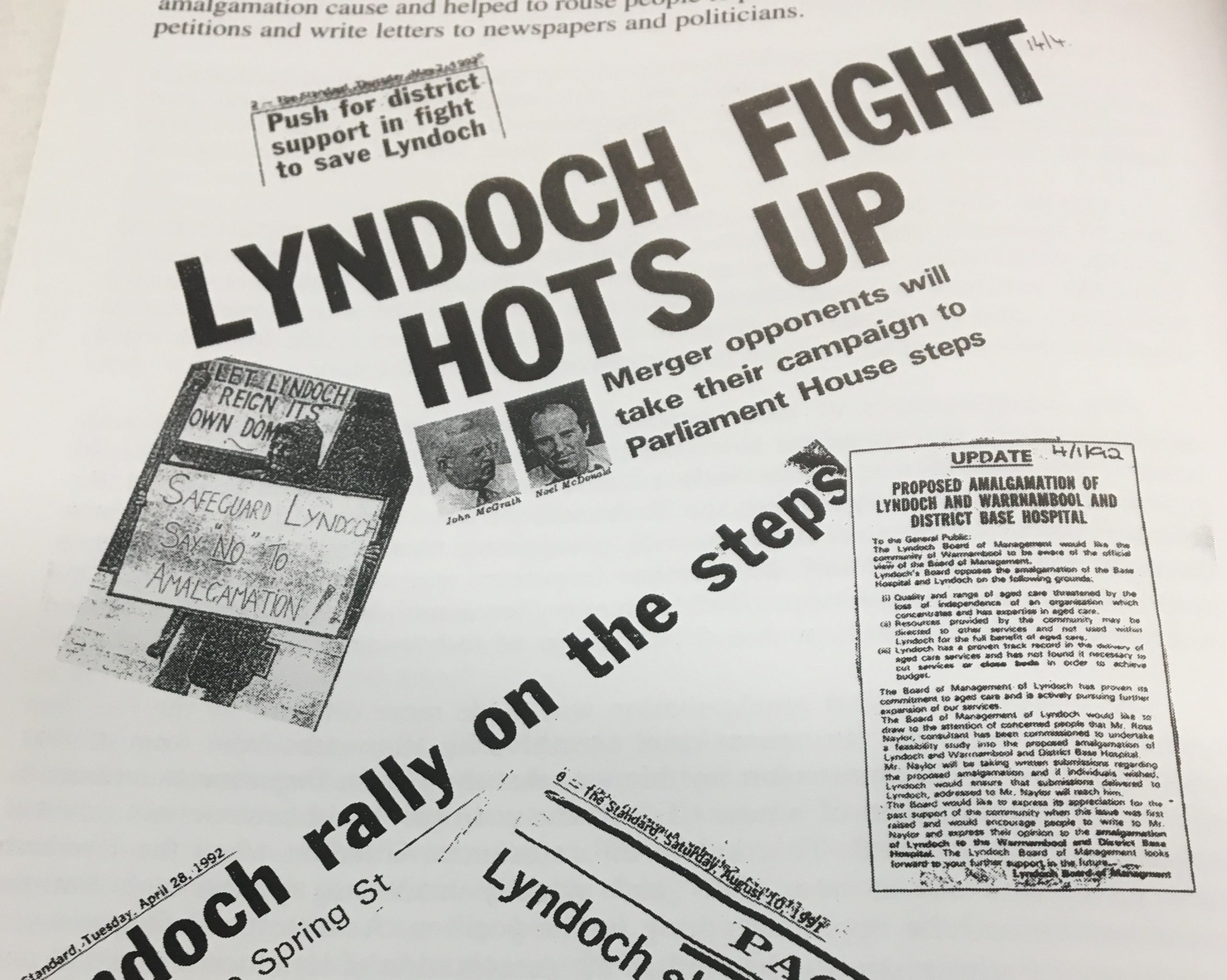
The question of exactly who owned Lyndoch aged care in Warrnambool was challenged during a push to merge with the W’bool Base Hospital. Image: via Peter Yule, Lyndoch: The First 50 Years.
Carol Altmann – The Terrier
Tonight I want to answer a question that just keeps coming up: who owns Lyndoch Living?
The answer is the Warrnambool community.
In fact Lyndoch has been owned by the people of Warrnambool since day one, right back to the time when the “Lyndoch” property was secured by Ern Harris in 1952 and a public fundraiser was held to raise £13,000 toward the £40,000 price tag.
All of the land on which “Lyndoch” sits is also owned by Lyndoch Living, so the community owns that too.
This includes a slice of Scoborio Reserve that was portioned off by the Warrnambool City Council more than 20 years ago so Lyndoch could build the Tomlinson Centre for residents with dementia.
It’s the Tomlinson Centre that was recently bulldozed to make way for a planned $24 million medical clinic that is now at the centre of concerns that it could send Lyndoch broke.
In many ways, the Tomlinson Centre was what Lyndoch used to be all about.
The original building was funded through a generous donation from the Tomlinson family, and later extensions were paid for with the help of the A.L Lane Foundation, the Ray and Joyce Ubergang Foundation, the Ern Hartley Foundation and the Warrnambool Rotary Club.
That’s how Lyndoch used to work.
It used to work hand in glove with the community to raise funds to get things done, through raffles, Christmas parties and by simply asking for the public’s help.
In return, the community showed absolute loyalty to Lyndoch, especially when it was under threat of being merged or privatised, as it was in the 1990s.
The State and Federal governments fund various aspects of Lyndoch, but it is not government owned.
Nor is it privately owned.
Instead, Lyndoch sits in sweet spot of being community owned, but publicly funded.
This unique structure was tested in 1992, when the Labor Government tried to merge Lyndoch with the Warrnambool Base Hospital.
No bloody way, said the locals.
A strong, united, grassroots campaign led by then Lyndoch board members Drs Mike Page and Noel Bayley created multiple headlines and saw the idea wither.
As Peter Yule writes in his 2003 history of Lyndoch, the battle “brought home the value of Lyndoch as a unique community asset”.
This community ownership was tested again in the 1990s, when the Kennett Government planned to privatise all public aged care homes.
Lyndoch sought a legal opinion which confirmed, as Peter Yule writes, its unique legal status as “a community owned facility that provides public services”.
So let’s be clear – the community of Warrnambool owns Lyndoch.
It always has.
But so what?
As it stands, the community is shut off from any meaningful connection with Lyndoch and its decision makers.
We have lost that thread of accountability and mutual loyalty.
The board, which is now hand-picked by insiders, no longer answers questions issued by the media or individuals because, I guess, they dismiss all concerns as a beat-up.
In this new era, a former Acting Chief Financial Officer can raise the alarm over the viability of the $24 million medical clinic and it is met with silence.
This is incredible and, apparently, the new normal.
Gone are the days when we had a Dr Page or a Dr Bayley at the table, speaking up for the community and settling any concerns with straight forward answers.
Gone are the days of CEO Rhys Boyle, who lived in Warrnambool and became a recognisable part of its fabric.
Gone are the days of Lyndoch living within its means because now it doesn’t turn to the community, but to the banks.
Change happens – of course – but one of my biggest concerns when I first started to write about the changing face of Lyndoch Living 18 months ago was that the community would lose control of this valuable community asset.
It appears it already has.
Racehorses: respecting Country and a crucial council vote
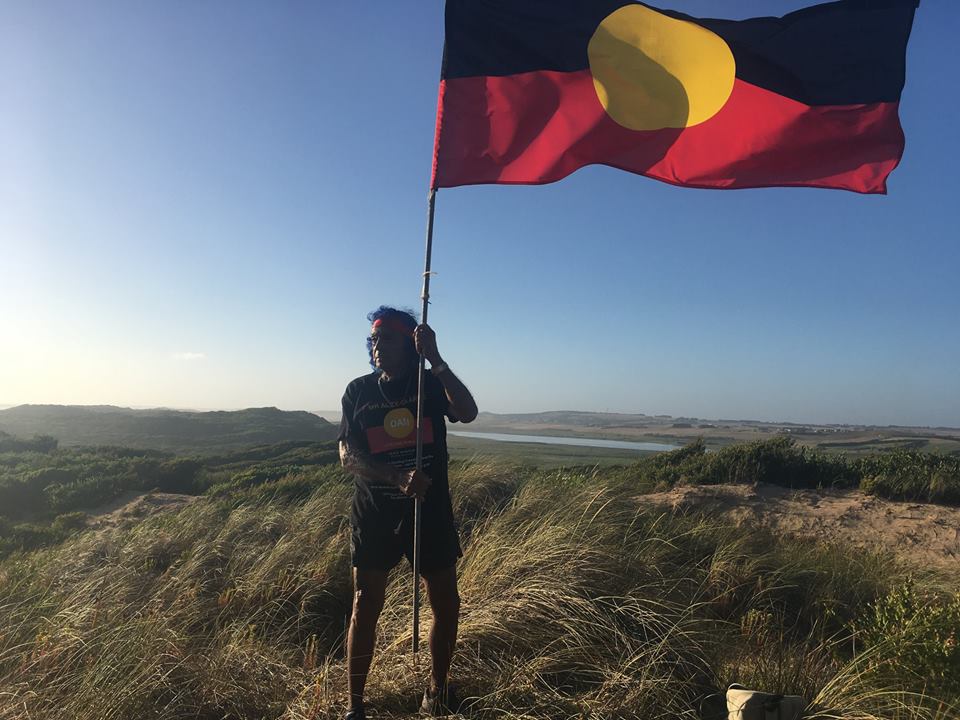
Uncle Alby Clarke is among the traditional owners who are fighting to stop large-scale racehorse training on the Tarerer coast (Levy’s Beach). Image: Shane Howard.
Carol Altmann – The Terrier
The push to allow large-scale racehorse training at Levy’s Beach will return to the Warrnambool City Council again next Monday night (3/2) for a crucial vote that goes far beyond horse racing.
It is, instead, a line in the sand: a time to decide whether Warrnambool is prepared to step into a new way of thinking – a bold Warrnambool – or to remain stuck in the past, as an old Warrnambool.
On the surface, the seven councillors will effectively be asked again whether they support or reject large numbers of racehorses – up to 120 a day on the beach and 40 on a dune – being able to train in the coastal reserve at Levy’s Beach/Spookies Beach all year-round. (This would be in addition to training at Lady Bay for nine months of the year.)
But this vote is also a test of whether, in 2020, we, as a city, are prepared to continue to ignore the wishes of the traditional custodians, the Eastern Maar peoples, for whom the coast around Levy’s is known as Tarerer.
I find it incomprehensible that the council would even consider such a move when traditional custodians are against it, as was first made clear when the consultation process began more than two years ago.
We are all living on Aboriginal land and yet we still find this concept discomforting, rather than a privilege.
Indeed one of the arguments used by Racing Victoria is that horse training on Warrnambool’s beaches goes back to the 1800s – and this is supposed to be a persuasive argument – yet the indigenous connection to this coast stretches back at least 60,000 years and possibly 120,000 years.
Think about that for one second.
Despite this incredible history, it is the European connection through racehorses, a mere speck of sand by comparison, that is held up as evidence of a rich tradition, a deep heritage and a right of passage.
How demeaning this is to the traditional custodians; how gutting.
Like so much of south-west Victoria, Warrnambool has a shocking history around the treatment of indigenous peoples and the destruction of an ancient culture, none of which we learnt about at school, and which contributed to local, white kids like me growing up with a fear and suspicion of Aboriginal people.
I knew nothing until I was old enough to read this history for myself and to learn about the full impact of dispossession and discrimination.
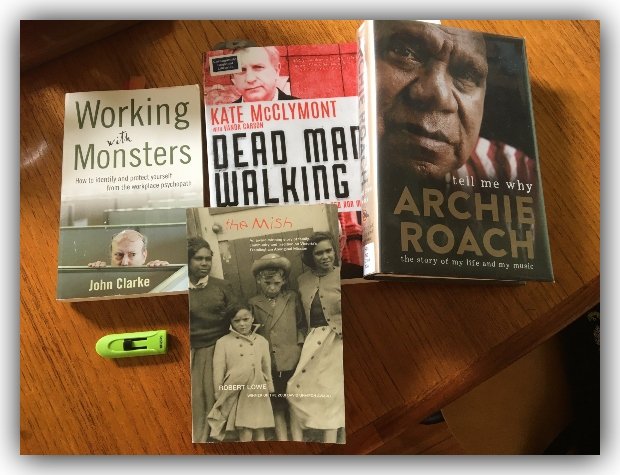
Part of the summer reading list included unforgettable books by Archie Roach and Robbie Lowe Snr.
I am still reading. Over the Christmas holidays I devoured Archie Roach’s magnificent autobiography, Tell Me Why, and Robbie Lowe Snr’s book, The Mish, which spoke of a Warrnambool where I grew up, but barely recognised, because as a middle-class, white kid, I had no idea how life was for those living in Framlingham, just 20kms from Warrnambool, but as far away from my daily life as Mars.
We can no longer use the excuse of ignorance and say that we don’t know, or don’t understand, the indigenous connections to Country.
Times are changing.
Indeed our council includes a Welcome to Country at civic events, and a smoking ceremony at its Australia Day function, and takes great pride in paying its respects to indigenous elders (“past and present”) at the start of each council meeting.
How can our councillors accept all of the above, yet fail to listen to the elders trying to protect and restore a precious slice of Tarerer coast that, even under council laws, is classed as a coastal reserve?
It’s not enough to fly the Aboriginal flag outside the council chambers in Liebig St, or to have a striking Adnate mural of Bernice Clarke and Rylan Miller on the side of South-West TAFE.
These are all important, symbolic gestures that make us feel good, but unless we are prepared to change our thinking around our decision-making, that is all they will be: symbolic.
The Eastern Maar have been fighting to be heard and surely now is the time to listen and to act or we will remain stuck under the heavy shadow of colonialism that has burdened Warrnambool for so long.
Monday night will be a critical test of where we stand as a city and where we are headed, and I, for one, am not going to miss it.
The meeting is at the WCC chambers, 25 Liebig St, starting at 5.45pm.
This article is part of an ongoing series supported by the Walkley Foundation, including funding Freedom of Information applications and other research tools.
If you would like to support the Terrier, you can throw something in the tip jar below.
Edna Jones’ baby: a story of shame, secrets and setting things right
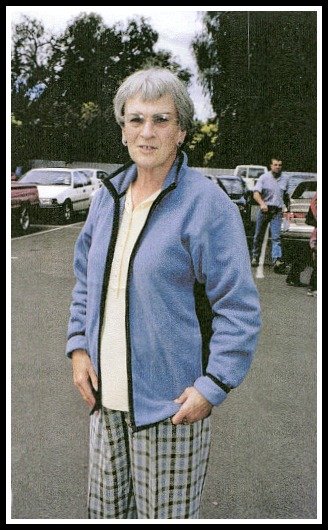
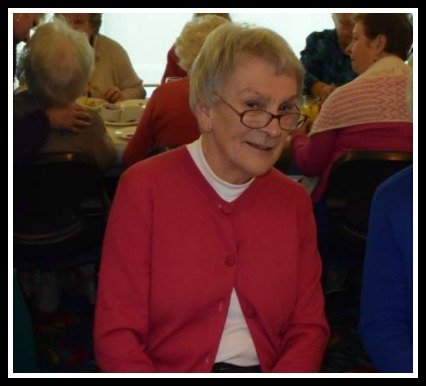
Marilla Lenne, the daughter of Edna Jones, who was adopted out after her birth in 1940. Image: supplied.
By Carol Altmann
Meet Marilla Lenne, the “secret” daughter of Edna Jones, one of the two “Jones Girls” who for decades owned and operated one of south-west Victoria’s most desirable grazing properties, The Union Station, at Woolsthorpe, and who left a legacy worth millions.
Until now, only a small group of people – among them some well-known names in our community – have known of Marilla’s existence, with both Edna and her older sister, Gwen Jones, widely thought to have died unmarried and childless.
Indeed The Gwen and Edna JonesFoundation was established as a private charity to handle the sisters’ multi-million dollar estate because, according to its website, “neither sister (had) an heir to whom they could bequeath their considerable assets”.
The Foundation, which in 2016 had assets worth more than $15 million, was launched after Gwen’s death in 2000.
It has since donated hundreds of thousands of dollars to local projects and made significant contributions to the Presbyterian Church, particularly in its support of Warrnambool’s King’s College and, most recently, its purchase of several church buildings in Warrnambool.
But Edna, who died in 1995, did have a child at the age of 30.
The baby was a girl, born in a Melbourne hospital on 28 October 1940 and given up immediately for private adoption.
The fact Edna had a baby may be a surprise, but the adoption less so. While the circumstances of Edna’s pregnancy remain unknown, the moral standards of the time stood in harsh judgement of women and girls who had babies out of wedlock.
It is worth remembering that this was an era when family skeletons were tucked firmly into closets.
What is harder to understand more than 70 years later – in 2017 – is the apparent reluctance of the Gwen and Edna Jones Foundation to formally acknowledge Marilla’s existence, despite some of its board members knowing about her for more than 20 years.
Some members, including Foundation chairman and high-profile Warrnambool lawyer James Tait, have even met her personally.
To the Foundation board, Marilla is no longer a skeleton in the closet but, for some inexplicable reason, her place in the Jones family story has remained untold.
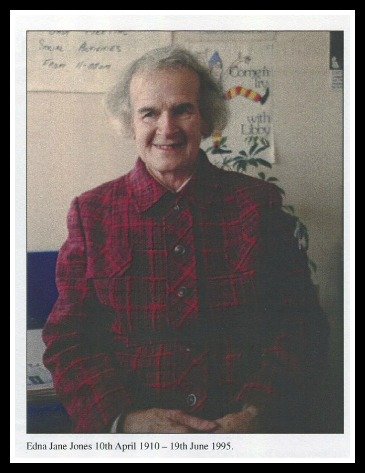
Edna Jones in her senior years, taken from Janet Paisley’s book, The Jones Girls’ Bounty. Copyright: Janet M Paisley.
I first learned of Edna’s baby through a casual remark in an email from a former foster carer,which I then repeated to another ex-Warrnambool friend, Bruce Macrae, who I knew was familiar with the history of the Jones’ girls.
“Apparently Edna Jones had a child,” I asked him. “Could that be true?”
“Oh yes,” Bruce said, “I have met her”.
“What!”
And so began my quest to find Marilla, and to talk to her myself.
Bruce pointed me in the direction of Barwon Heads author Janet Paisley, who is a cousin of the Jones’ girls and who was commissioned by the Foundation board to write the Jones’ story, The Jones Girls’ Bounty. Her book was published in 2005.
Talking to Janet revealed the full extent of an unresolved story about social class, loss and grief for Edna, but also the quiet determination of Marilla who, having confirmed her mother’s identity in 1995, set out to remove all the shadows of guilt and shame around her birth.
By the time Janet and Marilla connected, Janet was deep into the research for her book which, of course, provided the perfect opportunity to acknowledge Edna’s “secret” child.
To be part of the official family story would connect Marilla back to her birth family in a way that was both dignified and healing.
But the Foundation decided that there would be no mention of Marilla in the 2005 book and, instead, a chapter might be published in later editions as an epilogue.
With this in mind, Janet interviewed Marilla and has since written an entire chapter about Edna’s baby.
But despite the book being printed 12 years ago and numerous follow-up inquiries by both Janet and Marilla since, they are still waiting for this missing chapter to be published.
As it stands, The Jones Girls’ Bounty contains just 22 words that refer to Edna being involved in “an incident” when she was a young woman.
“I am the incident,” Marilla, who is now in her 70s, tells me by phone, somewhat sardonically.
Gwen and Edna Foundation chairman and lawyer James Tait. Image: Tait’s Legal, Warrnambool.
The stonewalling by the Foundation is one thing, but then there is this: an inexplicable sentence in the book’s foreword, written by James Tait in February 2005:
“They (Gwen and Edna Jones) had no one within a close degree of relationship,” he writes (my emphasis).
When this was written, the board had known of Marilla for years and James had had several contacts with her, including sending her a catalogue for the auction of The Union Station and Gwen and Edna’s possessions in late 2001.
(The Union was sold to Midfield Meats founder and racing identity, Colin McKenna, in November 2001 for more than $7 million.)
Given the board knew of Marilla, why, in early 2005, would its chairman write such a sentence?
I asked James this, together with several other questions that relate to his role as Foundation chair, but have had no reply.
Taits were the Jones’ family lawyers for years, they documented the rules for the Foundation and prepared both Gwen and Edna’s wills, and James has been chair of the Foundation since it began.
He joins other long-serving directors, retired accountant John Hunt, from Coffey Hunt and Co, who were the Jones’ accountants, and retired bank manager and former Warrnambool Citizen of the Year Eric Williams. Thefourth, and most recently appointed director isformer head of the Warrnambool Racing Club, Margaret Lucas.
This is the group that, for reasons unknown, have so far refused to offer any public acknowledgment of Marilla.
“That recognition is really important to Marilla,” Janet says, “it would offer a closure, of sorts, and it is what she has been waiting for, for many years”.
It is not known if the Foundation directors have even read Janet’s “missing” chapter about Edna’s baby.
They did, however, send Marilla a complimentary copy of the book when it was published.
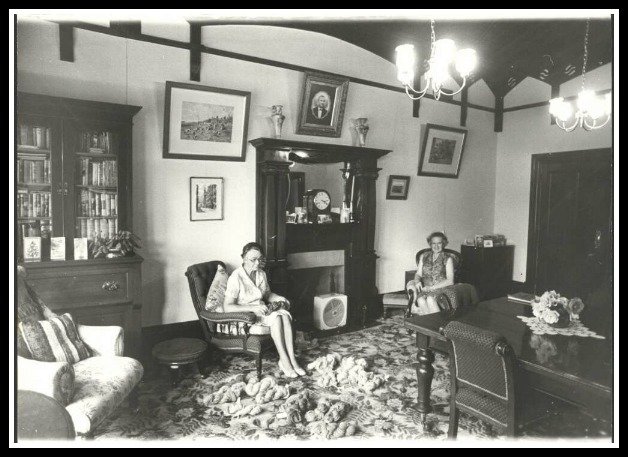
Gwen, left, and Edna Jones in the lounge and dining room of The Union Station, Woolsthorpe, circa 1975. Image: Copyright National Library of Australia. Object No: 147727624.
It is partly because of Marilla’s quiet patience and good humour, no doubt, that the Foundation board has been able to continue its stonewalling.
Having spoken to her several times now, Marilla strikes me as someone who has enjoyed a simple, hard-working life (she pursued a nursing career) and is not interested in engaging lawyers, publicly challenging authority, or making a fuss.
She lost her partner early, to cancer, and never had children, so her retired life is one of community work, golf and travelling with friends.
As the years tick past, however, neither Marilla nor Janet, who is now in her 80s, can afford to show endless patience.
“Here we are, 22 years on from when all of this came to light, and we are no closer to a resolution, really,” Marilla says.
“I am experiencing what a lot of adopted people experience when they find their birth parents…but what every adopted person really wants to know is that at least they were wanted”.
As Janet’s chapter outlines, Marilla was denied the opportunity to reconnect with Edna, even though she was alive when Marilla had confirmation that Edna was her birth mother.
Marilla Lenne pictured at a Legacy social lunch in 2015. Image: Merimbula News Weekly.
Shortly after tracking down her birth certificate in early 1995, Marilla wrote Edna a letter c/o The Union, Woolsthorpe.
Gwen Jones replied on her sister’s behalf, saying it was best if Marilla did not see her mother, who by then was in the late stages of dementia, saying it would be upsetting. She enclosed an earlier photograph of Edna.
“I got the sense that Gwen did not want to have any involvement whatsoever,” Marilla said.
Edna died in June 1995.
“If I had been able to see her, I would have just thanked her for my life and set her free,” Marilla tells me.
Reading Janet’s book about the Jones’, there is a pervading sense that the fun-loving Edna got to make very few decisions about her life, but was instead guided by her older sister who promised their father, Robert, that she would always take care of her.
And so it makes sense that even though Edna may have gone along with the decision to give up her baby in 1940, she never forgot her.
As Edna developed dementia in the years before her death at the age of 85, those long-buried emotions around Marilla’s birth were no longer constrained.
She was sometimes seen searching the shelves of Swinton’s supermarket for “the baby”, or would follow a mother pushing a young child in a supermarket trolley, or, as one woman told me, she would “come alive” when talking about babies or if a baby was brought into the room.
Despite these very public displays of grief and confusion, Edna’s “baby” was thought by most people to be purely imaginary.
Even Janet, a relative of the family, didn’t know the truth about Marilla until after Gwen’s death in 2000.
The formerly “unknown” father of Marilla Lenne: his identity and the story behind how Marilla met his family is contained in Janet Paisley’s chapter. Image: Grasmere Presbyterian Church newsletter, supplied.
It is since Gwen’s death that Marilla has been given certain access into the Jones’ world, but still not a seat at the main table, so to speak.
In 2001, Marilla was invited by the Foundation to look over The Union before the sale of its contents which were, at the time, being sorted and packed by staff from Coffey Hunt in preparation for one of the most highly anticipated auctions in years.
A few small items that belonged to her mother have since been passed on to Marilla – a cup, saucer and plate – and connections made to lost cousins.
Another particularly poignant moment came in 2011 when Marilla was invited to visit The Unionfor afternoon tea by Colin McKenna and his partner, Janice, who, Marilla says, “was delightful and very welcoming”. How strange it must have been, however, for Marilla to sit in the historic, blue-chip property that was once half-owned by her birth mother, but to which she had no claim.
In Australia, adopted children have no legal right to the estates of their birth parents, but for Marilla, it has never been about estates.
Instead, her gentle persistence has been driven by the desire to be recognised and have her story – and therefore Edna’s story – brought out of the shadows and into the light.
There was to be no more shame.
Until now, such a wish depended on the decisions of the Foundation, but both Janet and Marilla have now given me permission to publish the draft chapter here, see the link at the end of this story.
This “missing chapter” also reveals the identity of Marilla’s father and the incredible story about how she connected to his family in the south-west.
I thank Janet and Marilla for trusting me with their story and words.
A screenshot from the new Fletcher Jones stories website that is now live at www.fjstories.org.au and captures some of the many stories about the man, the factory, the gardens and iconic silver ball.
By Carol Altmann
[dropcap style=”font-size: 60px; color: #DC943C;”]A[/dropcap]fter almost two years of collecting, organising and editing, some of the many, many wonderful stories about Fletcher Jones are now live on a new website.
The Stories From Our Communitywebsite – http://www.fjstories.org.au/ – is another tangible result of the Fletcher Jones stories project that started last year and involved collecting at least some of the stories from those who either remembered Sir Fletcher Jones personally, worked at the Warrnambool Fletcher Jones factory, loved the Pleasant Hill gardens or iconic Silver Ball tower, or maybe a bit of each.
They are stories from another time in which workers were valued as individuals, when customers were treated like kings and when quality – above all else – was what mattered most.
As project co-ordinator Julie Eagles explains, the website is a celebration and living tribute to not only the past, but the present, with the dilapidated Pleasant Hill complex being slowly brought back to life since its purchase by businessman Dean Montgomery in 2014.
“Since mid 2014, we’ve celebrated the sympathetic renewal of Warrnambool’s Pleasant Hill, the Silver Ball and Fletcher Jones Gardens by Dean Montgomery and the FJ Stories project has worked alongside the site renewal now taking place,” Julie says.
A mini Silver Ball used as part of a multi-media installation in 2005 at the back of the Fletcher Jones factory in Warrnambool. (Image supplied by Brenda O’Connor).
[dropcap style=”font-size: 60px; color: #DC943C;”]T[/dropcap]he push to preserve the Fletcher Jones gardens, silver ball and parts of the factory began years earlier when local artists and community groups began to create works of art, share stories and even make movies that recognised the importance of the site to Warrnambool’s character.
At the same time, a group of dedicated volunteers led by Lex Caldwell kept the gardens alive while the factory continued to crumble around them.
By late 2013, the situation looked dire, with nobody seemingly prepared to take on the huge task of bringing the site back to full life. We wrote a story about it (and it is still one of our most popular), which drew upon a report by the Warrnambool Planning and Heritage Group, of which Julie is a member.
Shortly after, in early 2014, the Save the Silver Ball and Fletcher’s Gardens page started on Facebook and the community began to share its connections to the site – and the stories just kept coming and coming.
Everyone, it seemed, had a Fletcher’s story.
David Jones Jnr (left) and Brenda Anderton/McPeake sit in front of a photograph of them as children, taken at a 1972 FJ Staff Christmas Party in the gardens. Photo: Colleen Hughson/www.fjstories.org.au
[dropcap style=”font-size: 60px; color: #DC943C;”]O[/dropcap]ne of those taking note was Dean Montgomery, who stepped in and bought the site with plans to create a Warrnambool Motor Museum, but who has since also spent a huge amount of money slowly restoring the gardens and factory to their former glory.
The Jones’ family has also reconnected with the site as a result of the community campaign and has funded much of the stories project, while also providing items from their personal collection of memorabilia and photos.
“The website is still being developed and there are still more stories and images to upload,” Julie says.
The site is organised into different themes and, a bit like a rabbit burrow, you can just keep digging deeper and explore all the nooks and crannies.
“Some of the themes currently have little or even no content, while others have lots to explore, learn from and enjoy already,” Julie says.
The website launch follows the unveiling of a story panel at the site last December, and a second panel will be unveiled at this year’s community picnic in the gardens on Saturday December 3.
The late Sir Fletcher Jones whose legacy has driven the spirit of the FJ stories project. Original image from the Jones family.
[box]The FJ Stories Project will finish in December 2016. If you have a story to share, you can contact Julie Eagles directly at julie.eagles@bigpond.com The next Fletcher Jones community picnic is on Dec 3.[/box]
A portrait of German chemist Justus Von Liebig by Wilhelm Trautschold. Image: Artspot.
By Carol Altmann
Liebig St is one of those quirky Warrnambool things – a main street that nobody pronounces properly, named in honour of a guy that few locals have ever heard of.
Certainly Justus von Liebig is not a name that rolls off the tongue and, when it does, we locals insist on saying Lie-Big instead of the correct Lee-Bick or Lee-Bish, depending on just how German you like to go with your accent.
This battle with the pronunciation is not unexpected because Justus von Liebig was a German chemist and had absolutely nothing to do with Warrnambool, other than in the same way as someone like Microsoft founder Bill Gates or the late Steve Jobs from Apple.
Like Gates and Job, Liebig’s most famous works had a global, transformative impact.
Do you use fertiliser on your garden? You can thank Liebig for working out the benefits of nitrogen to soil.
Do you use beef stock or baking powder in your cooking? You can thank Liebig for “inventing” those too.
And if you have ever stepped inside a chemistry lab, with its test tubes, Bunsen burners and rows of students in white lab coats pouring this into that, you can also give a nod to Liebig for inventing the whole concept of a chemistry lab (but perhaps not the white coats, they were invented by diet guru Jenny Craig, I am sure of it).
Beef bullion was one of Liebig’s many contributions to science.
So why is the main street in a city at the bottom of Australia, at the bottom of the world, thousands of miles from Europe, named for one of Germany’s great chemists?
RMIT Professor of Design Paul Carter has written an entire academic essay on his thinking behind why surveyor William Pickering, who laid out the grid of Warrnambool streets in 1843, chose two German scientists – the other was astronomer Johannes Kepler – among his selection of highly unusual street names.
As Prof Carter points out, most early street names were reserved for royalty, nobility or colonial officials and certainly not names like Kelp, Japan, Banyan, Lava and Timor (the latter of which, just like Liebig, has suffered from years of mispronunciation to become Tie-More rather than Tea-More).
According to Prof Carter, the choice of Liebig is inextricably linked to his work with improving soils.
“Two aspects of Liebig’s life had struck me as relevant to his commemoration in Warrnambool,” Prof Carter writes.
“Firstly, his invention of nitrogen-based fertilisers and, secondly, the assertion that his interest in securing agricultural production had been stimulated by the experience of living through the ‘year without a summer’ (that happened in 1816).”
In other words, the terrible weather conditions that inspired Liebig to pursue ways of improving farming by improving soils wasn’t lost on Pickering as he laid out a new town in blustery, blowy, unpredictable south-west Victoria.
Warrnamboolians may love Liebig, but few residents (or visitors) have any idea why the main street of the city is called Liebig St.
Healthy soil meant Warrnambool’s early settlers had a better chance of surviving whatever nature threw at them and Pickering’s choice of Liebig was almost certainly a tribute to his contribution.
“….On this basis I had surmised that William Pickering, the government surveyor to whom we owe Warrnambool’s street names, had an agenda: soil improvement as a driver of economic growth,” Prof Carter writes.
Prof Carter also explores a theory that Pickering’s choice of Liebig was not in isolation, but part of a “cryptic crossword puzzle” where Warrnambool’s first street names inter-connected, with Liebig, Kepler, Lava and Kelp the science-and-soil cluster.
“A genius was not required to design this cryptic crossword puzzle, simply a well-informed, scientifically-inclined professional in the right place at the right time – with perhaps a certain determination to…shake off the expectations of family and government,” he writes.
As it happens, this digging into Warrnambool’s early street names was inspired by the Warrnambool City Council’s plan to revitalise Liebig St – now due to start next year – and provides the perfect opportunity to reflect not only the past but the future.
Just as Pickering’s street names reflected a vision of growth for Warrnambool, what is our vision now and can we dare to be anywhere as creative as Pickering was, for his time, in his thinking?
Could some of Pickering’s innovative and creative thinking in naming Warrnambool’s early streets apply to the revitalisation of Liebig St?



 You might also enjoy…


