Pleasant Hill in its prime in the 1970s. Image: Corangamite Regional Library Corporation. Copyright 2004.
It says a lot about the importance of the Fletcher Jones gardens to Warrnambool that even though the Raglan Parade factory has fallen silent and into disrepair, the gardens continue to hold on.
“Pleasant Hill” was once a major tourist attraction for the city, with busloads of visitors pulling up to the kerb and pouring out to take photographs, while locals all have their favourite memories of the beautifully landscaped gardens: the fish pond, the stepping stones, the wishing well, the sun-warmed cement turtle, the archways, the mosaic ‘basket’ garden bed, the tall man in the white trousers who advertised Fletcher Jones menswear.
The gardens were established over a period of years after Fletcher Jones first selected the site – a disused quarry – for his factory in 1948. And while they are a shadow of what they were in their prime, when up to eight full-time gardeners were employed, the fact they are maintained at all is quite incredible.
Fletcher Jones gardens volunteers: Lester Campbell (left), Philomena Headen, Don McLean and Lex Caldwell.
[dropcap style=”font-size: 60px; color: #A02F2F;”] F [/dropcap]or this we can thank our Quiet Heroes for the week: Lex Caldwell, who oversees the gardens in exchange for living in a cottage on site, and a small, rotating team of volunteers who turn up each Tuesday morning to weed, mulch, mow or do whatever else needs to be done.
When we visited, the volunteer crew included Don McLean, Lester Campbell and Philomena Headen who were hard at work weeding one of the garden beds and picking up bits of broken glass.
Imagine how the place would look without them?
[box]The FJ gardens crew will receive a coffee and cake voucher from Lozzar’s Lounge Cafe, 52a Kepler St Warrnambool. Thankyou to owners Loretta and Phil for supporting this week’s Quiet Heroes.[/box]
A labour of love: Ben and Helen Fennessy spent a year measuring up what lay ahead before deciding to take on the restoration of a rundown Rosebrook property that is now their home.
[dropcap style=”font-size: 60px; color: #A5CECD;”]T[/dropcap]aking on the restoration of a bluestone cottage in a rugged coastal landscape may sound romantic, but it is not a task to be taken lightly.
Artist Ben Fennessy and his wife Helen, who writes, spent a year deciding whether or not to buy a ramshackle, rundown dump on five acres that overlooked the Belfast Lough at Rosebrook, near Port Fairy, and turning it into a home.
The historic bluestone cottage and assorted add ons and out-buildings had been on the market for five years – five years! – when the Fennessy’s happened upon it during one of their visits to Port Fairy from their former home in the Otways.
The house sat unloved for years before the Fennessy’s took over.
The original kitchen …
The same space as it looks today.
[dropcap style=”font-size: 60px; color: #A5CECD;”] I [/dropcap]t took a special vision to see the beauty beneath the ugliness of the place, which had suffered from a combination of poor building extensions, a lack of maintenance and a series of tenants that showed little respect for the property, if not outright neglect.
(The state of the house was summed up when the Fennessy’s later removed boards covering the fireplaces and found piles of dirty nappies).
“It was very, very rundown and fairly hideous when we first saw it six years ago,” Ben said.
“We walked away for a year, but we kept coming back to it in our minds, thinking that it had really great potential, but that it would take a lot of work.”
The extent of the task ahead was laid bared in an Archicentre report that, Helen said, “ran to several pages”.
“The roof was being held up by tomato stakes,” she said, laughing at the memory.
Out with the Besser block extension: Helen Fennessy hard at work during the renovations…
And in with a light-filled, bluestone extension designed by Tim McLeod and that overlooks the Belfast Lough.
[dropcap style=”font-size: 60px; color: #A5CECD;”] U [/dropcap]nderneath all of the half-baked renovations, however, sat a sweet, four-room bluestone cottage that, despite all of its terrible makeovers, was as solid as the day it was built some time in 1856 as the engineer’s house for the local mill at Rosebrook.
“The original bluestone was actually in good nick, so we brought it back to that original footprint,” Ben said.
Over a two-year period, the Fennessy’s tore down a parasitic, 1970s extension at the rear of the cottage, restored the original cottage and added a magnificent big-windowed, light-filled space – designed by Warrnambool architect Tim McLeod – that overlooks the lough.
The result is a character-filled blend of the very old and the ultra modern – but the story doesn’t end there.
Clare meet Rosie, Rosie meet Clare: an old railway building and carriage have been converted into a self-contained living space.
[dropcap style=”font-size: 60px; color: #A5CECD;”] B [/dropcap]en’s eye for the quirky has seen two more fascinating additions that, together, form a separate, self-contained living space for their daughter and ceramic artist,Clare Fennessy.
Clare’s lounge room, small kitchen and bathroom is housed in a pre-fab railway building originally from the Warrnambool Railway Station that, when Ben found it, was being used as a hayshed out in a paddock.
“Rosie”, as the railway shed is now known, snuggles neatly against an antique railway carriage that dates back to 1911 and was once used to transport refrigerated goods. It is now Clare’s bedroom, complete with a roof insulated by horse hair.
“I’d seen it sitting in a paddock at Illowa and so I approached the owners and asked if they wanted to sell it,” Ben explained.
“It was being used as a fertiliser shed at the time.”
With the property finished, and two alpacas installed in the surrounding paddocks to keep the grass down, the Fennessys need only enjoy the inspiring space: perfect for such creative souls.
After many years of hard work, the renovation and restoration is complete.
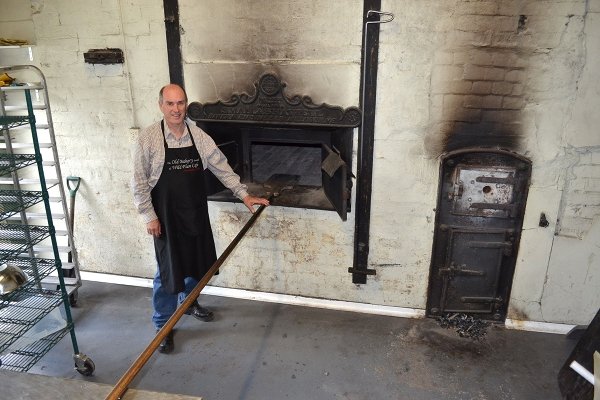
Paul Sanders with the magnificent 135-year-old wood-fired oven that he returned to working order for his Dunkeld cafe.
[dropcap style=”font-size: 60px; color: #A5CECD;”] W [/dropcap]hen Paul Sanders and his wife Pauline Yule moved into an abandoned bakery in Dunkeld, they had no intention of doing anything with the clapped-out, 135-year-old oven that dominated one wall of their bedroom.
In fact when they first bought the Martin St property in 2001, the cast-iron wall oven and firebox were hidden behind workshop shelving. They removed the shelving and converted the whole space into a bedroom, before converting it again into a meditation space as part of their business operating a spiritual retreat: a curtain was draped across the oven to avoid distracting the meditators.
It was only in 2010 when they thought about selling the property that the pair learnt the wood-fired oven might be an under-appreciated gem.
“We had a guy come through from Melbourne who was interested in buying the place as a bakery…we called some wood-fired bakers and soon got a sense that maybe the oven was actually in good nick,” Paul said.
The Martin St building has become a favourite among travellers since opening as a cafe last year.
[dropcap style=”font-size: 60px; color: #A5CECD;”] T [/dropcap]he last bakery to operate from the building closed in 1976 when the major bread companies began to buy up country bakeries with the intention of closing them down. As part of the deal, the ovens were supposed to be destroyed.
“But the baker who had this place, Ian McKernan, said he just couldn’t do it, so the oven survived,” Paul said.
Paul and Pauline stayed on and turned the property into accommodation and a gallery, while, behind the scenes, they worked on bringing the oven back to life.
“We fired it up with a fire in it every day for six months and it began to drip tears – it started to cry – as all the moisture that had built up over the years started to come out,” Paul said.
The external thermometer, that also dated back to 1878, also needed a bit of tweaking.
“We worked out that 300 degrees was actually zero and went from there,” Paul said with a laugh.
After more than a century of taking the heat, the temperature gauge was a little out.
[dropcap style=”font-size: 60px; color: #A5CECD;”] B [/dropcap]y 2012, the pair had decided to expand the business into a cafe and freshly baked bread, of course, would be a house specialty.
“We tried with (dry) yeast bread at first and it got a bit hairy at a times with black, smelly smoke filling the cafe,” Paul recalls, chuckling.
After weeks of trial and error, the quirks and mysteries of the oven began to be solved, and Paul felt ready to expand into baking wood-fired sourdough bread – made from scratch – that would give the cafe a real point of difference.
There was only one catch: he didn’t know how to make it.
Paul Sanders and Pauline Yule ran several businesses from the old Dunkeld bakery before returning it to its roots.
[dropcap style=”font-size: 60px; color: #A5CECD;”] T [/dropcap]he first step was to import a quality leaven (‘starter’) from San Francisco and then enlist the help of a professional sourdough baker who spent a week in Dunkeld showing Paul the process. Paul also hired a baker, Gurwinder Singh, to take over the bread making.
Despite their best efforts, however, the first sourdoughs they made on their own kept falling flat.
“We couldn’t work out what we were doing wrong and kept calling up people for advice, but in the end it was our local yoga teacher here, Frank Jess, who turned out to be the best help,” Paul said.
Frank suggested adding more water to the mix – “we weren’t hydrating it enough” – and making sure the oven was super hot.
“We made our first perfect loaf in May last year and haven’t lost a loaf since,” Paul said with an element of pride.
The oven is capable of baking 300 loaves at a time, but Paul is happy to put through 250-300 loaves a week, most of which are sold at local farmers markets.
For a 135-year-old oven, it’s not a bad way to make a crust.
[box] The Old Bakery & Wild Plum Cafe, 97 Martin St, Dunkeld is open seven days, 9am -5pm. P: 5577 2663. The sourdough bread is available from farmers markets including Port Fairy, Ararat, Hamilton and Daylesford. Paul and Pauline have just listed their business for sale. [/box]
Behind the renovation of 222 Timor St, Warrnambool: Luke and Nat Taylor, with their son Lucas. They have since had another child, Penny.
[dropcap style=”font-size: 60px; color: #A02F2F;”] A [/dropcap]fter years of decay, the old piano shop opposite Swintons, in Warrnambool, is being brought back to life by a young lawyer who has taken on a restoration project of monumental proportions.
Luke Taylor, and his wife Nat, bought the double-storey, derelict building at 222 Timor St more than 12 months ago with the intention of turning it into an investment, but what they didn’t count on was just how much hard work would be involved, or how much they would come to love the old place.
“At first it was very much about building an investment for the future, rather than being passionate about restoring an old building, but that has completely changed,” Luke said.
BEFORE: The front left room was restored from top to bottom, including the ceiling, floorboards and walls.
AFTER…
[dropcap style=”font-size: 60px; color: #A02F2F;”] A [/dropcap] turning point was when architect Peter Brooks, from Heritage Victoria, visited for an on-site assessment of the property, which is listed with the National Trust and Heritage Victoria as a significant building. Where most saw a decaying hulk that had to be restored from the ground-up, Peter saw an historic and precious gem.
“He was blown away by it,” Luke explained. “There are basically so few properties like this that are still in their original condition and have not been modified or altered in any significant way. Peter’s enthusiasm and excitement about that was infectious.”
The sandstone building is the oldest, intact commercial building in Warrnambool and dates back to around 1850. It has had many lives since then, including as a piano repair shop owned by my grandfather, Bill Goodall, who bought it in 1932. It was largely because Bill never had an spare money for renovations that the building has remained unchanged, perhaps apart from the wallpaper: Luke removed nine layers from each of the rooms.
BEFORE: Layers of wallpaper and plaster had to be removed and damp walls dried out as part of the renovation.
AFTER…the ‘lounge room’ has been given a new lease of life.
[dropcap style=”font-size: 60px; color: #A02F2F;”] L[/dropcap]uke and a group of skilled, local tradesmen have spent countless hours since February slowly bringing the place back to life, and it has been backbreaking work. Floorboards have been lifted, replaced and then the old ones recycled. Barrow loads of dirt and dust and debri have been removed. Leaks have been plugged, walls re-plastered, windows replaced…and on it goes. And then some.
“The tradesmen have been amazing, because everything was crooked and had to be made square again,” Luke said.
Luke has taken only two weekends off since taking on the project, including one weekend when his second child, Penny, was born.
“I have spent so many hours in the building, and because I have spent so much time there, on my own, I have really come to appreciate it and feel the emotion of it,” he said.
BFEORE: The 1850s building was rundown, but still in much of its original condition when the Taylors bought it last year.
AFTER: Hours of back-breaking work have seen the shop slowly restored to how it would have looked in the mid 1800s, right down to the colour scheme.
[dropcap style=”font-size: 60px; color: #A02F2F;”] I [/dropcap]t is this emotional connection that has pushed Luke through what he calls the “dark times,” when the job ahead seemed overwhelming. He has also applied the same disciplined approach that he uses for his triathlons – one step at a time.
“It has been a huge challenge, a huge amount of work, but we are breathing new life into the building. It may look plain, but it represents an era and reflects that time,” Luke said.
The bottom storey of the building will have a tenant by the end of this month, but it will be another year before a residence and a serviced apartment upstairs are complete. Luke is determined to see it through.
“The way I see it is that if Nat and I can do this, what can’t we do?”
[box] 222 Timor St, Warrnambool had been painted cream for many years, but this was not its original colour. The new salmon-pink and burgundy facade reflects the original colour scheme that was uncovered by peeling back layers of paint. Pig’s blood was often used to tint paint in the 1800s, reflecting a step-up from the whitewash used on working class cottages.[/box]
[dropcap style=”font-size: 60px; color: #DC943C;”] T [/dropcap]his tiny violin was carved from either ivory or bone or something similar and was made by my late uncle, Ron Goodall, more than 50 years ago.
He lived in the former piano shop at 222 Timor St – featured this week in Places/My Place – and would use pieces of old piano and other materials to make this folk art.
It is in four separate parts, including a miniature scroll top, that have been glued together and finished with four ‘cat gut’ violin strings.
The piece was originally displayed on the end of a toothpick attached to a cork and kept in a glass vial.
I doubt it has played a note, but it is one of my most treasured possessions.


 Meet some of our other quiet heroes…