Artery is pumping and here’s what’s next…

By Carol Altmann
[dropcap style=”font-size: 60px; color: #A02F2F;”] T[/dropcap]he success of The Artery art space in Warrnambool since opening just over two years ago has been nothing short of extraordinary, and it is getting bigger.
The F Project – the volunteer art collective behind The Artery – already manages 30 artist studios, a community gallery space and a retail shop and, before the end of the year, it will take over the five-bedroom, top floor of the Timor St building to accommodate a visiting artists and artists-in-residence program.

As F Project president Dr Emma Charlton explains, the expansion is the next step in a five-year plan to build The Artery into a dedicated arts space that serves local artists and visiting artists, while at the same time building a strong arts presence in the community.
“A large part of The Artery is about getting art out into the community and to develop an appreciation of the arts in our community, and I think we are certainly achieving that,” she says.
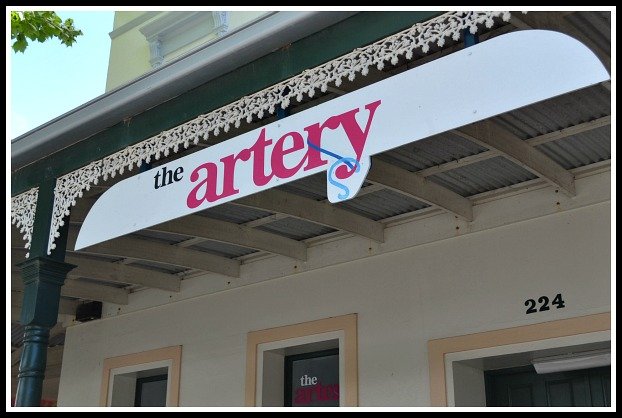
[dropcap style=”font-size: 60px; color: #A02F2F;”] P[/dropcap]rior to leasing the former Guyett’s funeral home at 224 Timor St, the F Project – which started in 2008 – had a less prominent space upstairs in what was the old Fletcher Jones shop on the corner of Liebig and Koroit streets.
But as vice president Helen Bunyon says, creating a new, street-front premises has been a game-changer.
“It really has created a central contact point for the arts in this community and has taken off like topsy. We always have people dropping in, coming to ask questions, or wanting to become involved,” she says.
Emma adds that The Artery has become a way for new artists who arrive in town to find an immediate audience and creative network.
She gives the example of artist Caroline Healey, originally from the UK, who recently moved to Warrnambool and volunteers as the group’s public relations officer. Largely through her connections with the F Project/Artery, Caroline has already established a following for her work and will soon hold an exhibition.

[dropcap style=”font-size: 60px; color: #A02F2F;”] A[/dropcap]s it happens, the gallery space – which is hired out to artists and hosts various art events such as the South-West International Women’s Day Art Prize – has a fully booked calendar for 2016.
As such, it has virtually replaced the original intention of the Alan Lane Community Gallery at the Warrnambool Art Gallery.
The 30 studios wax and wane in occupancy and some artists have moved on to set up their own professional studios at places like Factory Arts, in the former Fletcher Jones factory.
There is no doubt, however, that the F Project has become integral to just about every community arts event in Warrnambool.
This includes the Warrnambool City Council’s ‘Hidden Histories’ project that saw 10 different events held in the city’s laneways, to Arts on the Grass, to the murals appearing in laneways, the Fletcher Jones Christmas picnics, the refurbishment of Patloch Lane, numerous arts markets, and even the replacement of the city’s tired Christmas decorations.
But is it too much for a volunteer group?

[dropcap style=”font-size: 60px; color: #A02F2F;”] U[/dropcap]nlike the Julia St Creative Space in Portland, The Artery/F Project receives no council funding other than that provided to fulfil specific projects such as the laneways.
Julia St is also volunteer based, but has a part-time Community Arts Officer employed by the Glenelg Shire Council and operates in a council-owned building.
The WCC no longer has a community arts officer, but is reaping the many benefits of having the F Project/Artery fill the gap for free.
Neither Emma or Helen wish to get into the politics of council funding, but Emma acknowledges the dependency on volunteers and says the group plans to apply for an Australia Council grant next year to employ a part-time coordinator.
When I asked how many hours they each devote to the Artery/F Project each week, both Helen and Emma answer “between 10 and 20”, although I know they are being modest.
Both are keen to stress that the workload is shared among many.
“We have people involved who bring a whole range of different skills and, for others, it is a way of developing those skills,” Helen says.
“It is a lot of responsibility,” Emma adds. “But the negatives are far out-weighed by the coolness.”
[box]The Artery is at 224 Timor St, Warrnambool and is open from Wed-Sun 10am to 4pm. The retail area sells works by local artists. The current exhibition is Small Gems, the F Project Members Christmas Show, until 3 January. You can find The Artery on Facebook here. P: (03) 55 62 1109 [/box]
 You might also enjoy…
Discovering the voice of Vanessa Parkinson
No shying away from social commentary: Megan Cheyne
Broken link prompts a fresh start: Jenny Altmann
The quiet contemplation of still life: Jan Allan
Dynamic duo step out on their own: Glenn Morgan & Barry Tate


