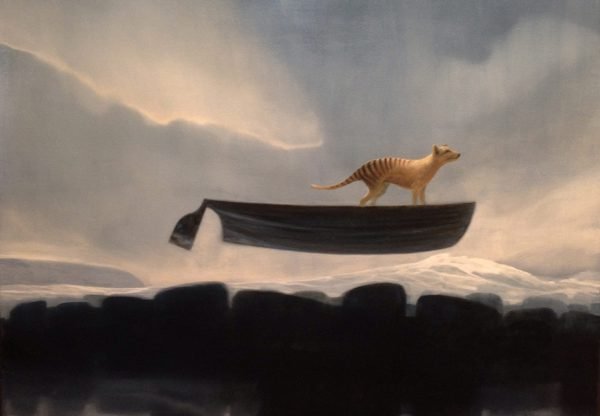
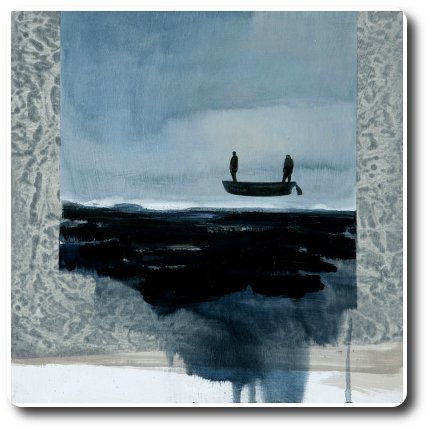
Original painting, oil on canvas, Graeme Altmann. (Altmann Studios, Highett, Melbourne.)
Carol Altmann – The Terrier
On days like this, we need hope.
On days like today, when we see laws passed that allow even greater damage to our wild coast than what we have already inflicted, it would be so easy to just give up, because the battle is exhausting.
But on days like today, when I need to draw deep on hope, I think of my late uncle Alf Altmann.
In March 1970, almost 50 years ago, Alf attempted to become the first person to row solo across Bass Strait, from Tasmania to Victoria, in a home-built kayak.
He built that kayak piece-by-piece in his garage under his home on Riverview Tce, here in Warrnambool.
To train for this epic journey of more than 200km, he would row out to Deen Maar, (Lady Julia Percy Island) and, once or twice, he carried native saplings in his boat to plant on the barren island.
The saplings never survived. Neither did my uncle. His attempt to cross Bass Strait ended just 1.5 miles from the Victorian coast. So near. So close.
And when I think of his story, I think of an anecdote that stays with me each day as I do my bit to try and turn around decisions that hurt our local environment more than protect it.
“Why do you bother taking those saplings with you?” someone asked Alf. “Nobody will see them out there.”
“I see them,” Alf replied. “I know they are there, and that is all that matters.”
This painting is how my artist brother, Graeme Altmann, often captures the essence of Alf’s journey: a boat, suspended above the turbulent sea, with the proud thylacine pointing toward an unknown future.
We can’t change the mistakes of the past. Alf never came home. The thylacine is gone. But I keep trying to do what I can, whatever I can, to turn other mistakes around.
Because we know. And we see. And that is what matters.
Reunion exhibition a 4-tifying experience
Warrnambool print maker and photographer Peter Bryant, who will be part of a reunion show by four artists who are exhibiting for the first time in 27 years. “It’s a bit like getting the band back for one more gig.”
By Carol Altmann
[dropcap style=”font-size: 60px; color: #A02F2F;”]W[/dropcap]hen artists Peter Bryant, Chris Small, Tony Neylan and Graeme Altmann first decided to exhibit together as the “Gang of 4”, the idea was to do so regularly.
That first exhibition in Warrnambool was way back in 1988 – when Bob Hawke was Prime Minister – and their second will be held this week (opens July 17), a full 27 years later.
(Mental note: do not hire these guys to organise your wedding.)
It has taken a little longer than planned, but the quartet – only Peter and Chris remain in Warrnambool – are eagerly anticipating reuniting at The Artery, which is only a few blocks west of where they held their first group show.
“It’s a bit like getting the band back for one more gig,” says Peter, a print maker and photographer.
“But the question is whether anybody else will give a s***,” he adds, letting out an infectious laugh that sums up how these four artists have always got along.
A newspaper clipping from the original “Gang of 4” show in 1988 when Chris Small, Peter Bryant, Graeme Altmann and Tony Neylan were all final-year art students.
[dropcap style=”font-size: 60px; color: #A02F2F;”]T[/dropcap]he four first met in 1985 as first-year art and design students at what was then the Warrnambool Institute of Advanced Education and were part of a colourful, crazy, but supremely talented group of young artists (and lecturers) who are all still connected, and still producing great work, today.
This week’s exhibition, 4tified, will provide a snapshot of that creativity, including Graeme’s works on paper and up-cycled boat sculptures, Tony’s delicate, Japanese-influenced ceramics, Chris’s slow-fired raku ceramics and Peter’s limited edition prints and photos, most of which have been created specifically for the show.
For Peter, who runs Shipwreck Coast Art & Design, it is a refreshing return to exhibiting. It has been 12 years since his last show, which was also with Chris Small.
“It’s a bit of an adjustment to go from screenprinting as a business, to screenprinting my own art again, but one that I am enjoying…I think,” he says, with a grin.
Peter’s studio is tucked down a laneway behind the former Fletcher Jones factory, with the famous silver ball water tower a constant backdrop. Not surprisingly, it features prominently in his work.
“Yes, there are some very strong Warrnambool references, for sure, but also a few surprises,” he smiles.
With a studio across the road from the Fletcher Jones silver ball, it is not surprising to see the icon reflected in Peter’s new work.
[dropcap style=”font-size: 60px; color: #A02F2F;”]A[/dropcap]s we move through the flotsam and jetsam of Peter’s studio, where he picks up various pieces of work-in-progress, you can’t escape the sense that 4tified is more than just an exhibition.
It is also a time for reflection – although not necessarily a quiet one – on each artist’s journey since they were 20-something-year-old graduates, full of hope about their creative futures and dreaming of lives as professional artists.
But as for so many young artists, the other diamonds and demons of life disrupted the best laid plans. Families, mortgages and the need to make a decent living have meant that art has often had to take second place.
4tified, however, has provided a renewed focus.
“I am looking forward to the moment when I can step back from it, because it’s done, but at the same time it is a really good thing that this exhibition has forced me to get back into it and to prepare works by a deadline,” explains Peter, who now has four young children.
“It’s a return to form for me and maybe if I can continue to do this, then who knows what might happen as I get toward retirement: there are now entirely new ways of selling and promoting your work that didn’t exist when we first started.”
You have been 4warned, the Gang of 4 will be back.
Artists Tony Neylan, Peter Bryant, Graeme Altmann and Chris Small as they are today, reuniting for the 4tified exhibition.
[box]4tified runs at The Artery, 224 Timor St, from Wed July 15 until August 1 with the official opening by Glenn Morgan on Friday July 17 at 6pm. Another Deakin/WIAE alumni, Kathryn Ryan, opens her show, A Quiet Place, at the W’bool Art Gallery on Sat, July 18 at 6pm.[/box]
[button link=”http://the-terrier.com.au/subscribe-2/” type=”icon” icon=”heart” newwindow=”yes”]Bluestone needs at least 500 subscribers in 2015. If you read us, please support us.[/button]
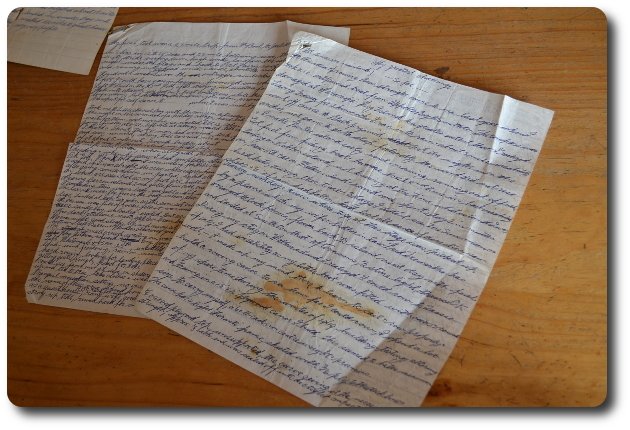
Last week we brought you the full story of Alf Altmann’s ill-fated attempt to row solo from Tasmania to Victoria in 1970. Alf, of Warrnambool, kept notes during his journey and at least a portion of these were found in a waterproof section of his kayak after it was retrieved off the Gippsland Lakes. His son, Alan, transcribed them in 2004. This is the first time they have been published.
“My Greatest Challenge”
– So Far –
The idea of rowing Bass Strait came to me last year when I took a 10’ outboard powered boat from Apollo Bay to Smithton.
The compass was damaged at Naracoopa, King Island to a greater extent than I realised. Leaving Grassy for 3 Hummocks Is. I ran into rain & about 3 miles visibility went off course to Black Pyramid, put the night in on the anchor, not game to sleep, fortunately the wind did not rise & I made Hunter island early next morning, running out of fuel.
Got fuel from fishing boat & became lost a second time in bad visibility, landing on Robbins island, not knowing at the time which island I was on, (I) saw old car on Walker island and rowed over, spent 2 days in mutton bird huts, during this time – 3 days – I didn’t see the sun, moon or stars & 6” of rain had fallen, had lost all sense of direction.
Saw Stanley (Tasmania) next day and knew where to go, at this stage was picked up by a plane which my wife & brother in law Fred Trewartha had arranged to look for me, flown back to (Robbins) island next day with fuel and landed at Smithton that afternoon, ½ stone light otherwise OK.
During my stay on Walker island I realised I could row to Tassie if only I had visibility, as my little boat was fitted with oars & rowed well.
I made up my mind there to learn to sail & row properly, build a rowing canoe to see how far I could row.
I spent a lot of my spare time during the winter of 1969 building – testing – altering and training in a 15’ by 2’ plywood canoe I built. This seemed to be the minimum size to carry myself, a 60 lb cast iron centre weight & provisions.
The canoe has a light ‘Meranti’ frame, sheeted with 3/16 ply to the deck line & 1/8 curved plywood top, unsupported, the curve giving it the necessary strength. Approx. 1/3 each end was sealed off into airtight compartments to assure floatation with airtight hatches to hold food, clothes & equipment and finally filled with plastic bottles.
I also packed foam floatation in the centre compartment where I rowed, this was fitted with a well, to house the centre-weight, which I bolted in. If the centre-weight was lost in this narrow craft, one would hardly survive at sea. After all this is a survival craft, not a showpiece.
Waiting for high tide, by Graeme Altmann. Graeme, who is Alf’s nephew, has drawn upon Alf’s story for a series of works depicting men at sea.
I learnt to sail it, it ran well with the wind and I could do a fair reach with a small sail & jib. To cut down equipment I rigged an extension to an oar for a mast, one could be under sail in about 10 minutes, but this was only to run back if I struck strong head winds.
The idea was to be the first to row Bass Strait.
During tests I found out I could not capsize the craft and it would ride out strong winds & big seas, however it was possible to have it blown over with too much sail, with an unexpected gust.
I found out one could get out and soon get in the lee side, the craft righting itself, however I almost made as much speed with the wind with the oars running with the wind without much effort, without the risk of capsizing.
The rudder fitted keeps the craft on a much more even course, particularly running with fresh winds and big swells. Also set for beam winds to avoid rowing on one oar to keep on course which is tiring.
I purchased a pair of broken teak oars from our rowing club for $1 which when repaired were long enough for my craft. Light & strong!
I carry 2 sea anchors – essential for offshore boating, $1 each at disposals. A sand pick and 200’ rope, 2 smoke, 2 flame & 1 parachute flares, torch, alarm clock, floating fish knife, compass, tent, 2 sails, canvas cover which allows me to sleep in boat, tommy axe, multi grips & screwdriver, camera, 1 aluminium saucepan, 1 spoon. Yellow windcheater & trousers which I row in, in rough or cold weather, sleeping bag, plywood, copper tacks & ‘Pabco’ for repairs, one can tack 3/8” copper tacks through 1/8” ply for temporary repairs straight onto existing plywood & clinch them over making fast waterproof repairs.
Only enough clothes to be acceptable when landing & to keep warm. About 2 lb’s of bran biscuits, I have been eating these for 37 years, I must have eaten tons of them by now, a terrific health food, dried fruit, honey, powdered milk, nuts, ‘Granose’ biscuits & water. These are my main foods.
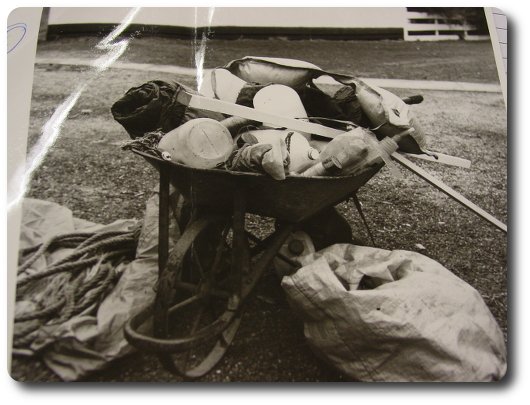
Equipment salvaged from Alf’s kayak after it was retrieved from the ocean off Snake Island, Gippsland.
I also carry flour, rice and cheese in case one is stuck on an island, fishing lines to catch fish, can usually get mutton birds this time of year. I carry a survival bag in case I have to leave the boat, this would be the last resort, I would only leave it if I looked like getting washed onto rocks.
In the bag, a complete wet suit, which keeps one afloat and warm. I feel I would always make it to land in one of these, also about 2 days supply of food and water with a knife, and a 30” beach ball which can be blown up to attract attention.
My final test was a 27 mile trip from Warrnambool to Julia Percy island in 7 hours in 12’ to 15’ seas and 25 mile following seas. The canoe took it in it’s stride surfing down high swells, landed on the island, slept the night under the stars and back to Port Fairy the next day in 90° heat and running into head winds & swell, about 14 miles return. I found out a weakness in the outrigger rowlocks, otherwise all OK. I felt I could have gone as far again, however got some chafe on legs from rolling seat.
Left Warrnambool on the 23rd of February, after studying our weather for years feel from late Feb. into March – we get our best conditions while the days are still reasonably long & warm.
Put the canoe on the ‘Empress’ & got a cabin, arrived at Burnie and got train transport for self and canoe to (illegible), where I was met by Jim Petrio of Gladstone who took me to Little Mussel Bay with the canoe on a trailer, unloaded near beach & slept waiting the night on the verandah of a holiday cottage.
Hard bed, little sleep, TV asked me to wait for them next morning, so waited till 12, and was about to go when I heard a shout, the TV man had arrived, took film for 10 to 15 minutes, got away, good seas, no wind, strong tide carried me a mile or two to west before I got out of it about 5 miles out.
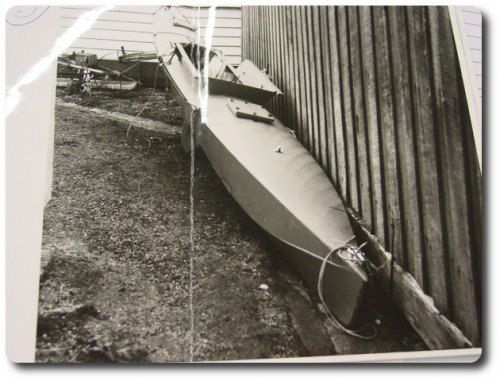
The home-made kayak that was tested off the waters of Warrnambool and Port Fairy before the Bass Strait crossing.
Rowed briskly, about (illegible) miles to go, late start, about ½ way to Barren Island, my first stop, saw some big fishing boat which swung my way, he swung in a wide arc following and finally blew his whistle for me to slow down. When alongside the ‘Skipper’ asked me where I was heading & when he saw I had completely stripped he said only 2 words ‘Oh God’.
When I told him I was making for Cape Barren island he appeared concerned & asked if I was alright, the crew were eagerly hanging over the side having a good look. After some directions we parted, rowed all day in the raw, only sand shoes on which are essential as my feet are built in to give power on the rolling seat.
Nearing Barren island 2 seagulls flew over, one turned back & had a second look, I concluding this was a lady seagull and it was time I put clothes back on. The less one wears the freer the body moves, also my swimming trucks where chaffing my legs.
Landed at Cape Sir John as the sun set, only about 3 miles from the settlement, but as the sea was full of rocks felt it was unsafe to go any later, pulled canoe up in nice sandy bay, unloaded and erected tent as fast as possible in sheltered scrub. Now dark, ate some nuts, apples & bran biscuits & honey, drink of water & off to bed. Warm night, good sleep.
Up and away at 7 a.m., lumpy & easterly winds funnelling between Cape Barren & Flinders, otherwise good run, some wind assistance, landed at Whitemark 1 p.m., small crowd waiting on wharf, a good welcome, stayed at Interstate Hotel. Left Whitemark 8-15 a.m. on 25th, unsettled weather, headwinds, can always turn back or land, wind freshening, rain on mountains, wind change to west, now beam on, hard rowing, looking for landing places, strong rip at (illegible), decide to press on.
The Sweep, another of Graeme Altmann’s works that reflect the relationship between the ocean and man.
Getting quite rough, head for Cape (illegible), finally land at Pine scrubs near a road I could see from out at sea on sheltered beach, easy to land, no breakers, pull canoe up and tie to tree, take clothes & walk up road, over hill. See large home in beautiful tranquil mountain setting, no one home, so sunbake.
Mr. & Mrs Syd Millyard of Leeka, the name of this area, arrived home about 6 p.m., had been shopping, they ran home as a guesthouse. ABC rang for news, rang wife, good nights rest, left for Kelliecrankie at 8-15, thru a strong rip tide, rowed hard for some 20 minutes and got thru, was baling out, looked up and found out I was being swept back at about 4 knots almost back into tidal rip, around Cape Frankland, almost hit sunken rock, it suddenly uncovered about 8’ away.
Good run along coast with some wind assistance to Killiecrankie, children waiting on beach, a very pretty sheltered little bay. Met Alf Stackhouse & wife, also local people, very friendly. Alf had full knowledge of all the islands & landing place right thru to the mainland. Also had his private plane, stayed the night with them. ABC reporters rang up.
Decided to miss Craggy island after seeing it and discussing it with Alf. Stayed the night with them, no sleep, thinking of 38 mile (illegible), hadn’t been this far before, arranged with Alf to fly over about 4p.m.
Set alarm for 3 a.m., in water at 3-20 a.m., can see Deal (Island) light flashing & head for it. Conditions good, slight side winds off Craggy island at 7 a.m., pleased with progress.
Winds freshening, thinking what have I done to deserve this, pray for good conditions.
Sighted Deal Island at 8 a.m., quite high in haze, winds dropping off (illegible) rock at 10 -15 a.m., strong tide pull… [notes end]
Postscript: The notes finish about half way through Alf’s journey which came to a fatal end on March 6, 1970, just 2km from the Gippsland Lakes. Before his death, Alf was already plotting his next adventure: to row from mainland Australia to Papua New Guinea.
End of the line for fine art at Sherwood Park
Last man standing: Graphic design and illustration lecturer Mark Rashleigh is the only staff member remaining in the former School of Art and Design at Sherwood Park, Warrnambool. (Artwork: Untitled (landscape), Martin Jones).
[dropcap style=”font-size: 60px; color: #A5CECD;”] M [/dropcap]ark Rashleigh is the last man standing at what was once a flourishing School of Art and Design at Sherwood Park, Warrnambool, and, come mid next year, he too will be gone.
It is indicative of how much things have changed that Mark, a lecturer in graphic designer and illustration, now has an office in the Faculty of Business and Law at the Deakin University campus because the former visual arts studios are closed due to various structural concerns.
A similar, if metaphorical, corrosion has also claimed the art school that will officially end next year after starting life under the former Warrnambool Institute of Advanced Education in Timor St (now South-West TAFE) in the late ’60s, before relocating to the Sherwood Park campus in the 1980s. There, as a university degree, it became part of the Deakin merger.
“When I first started here, in 1985, there were about 13 staff teaching a very broad visual arts degree that included painting, sculpture, art history, photography, print making, graphic design and ceramics,” Mark, who will retire in June, said.
At that time, the teachers – most of whom were established artists – would mount joint exhibitions, maintaining a tradition that began when the school first started.
A document held by the National Libraries of Australia, for example, records some of the names in a joint staff/student exhibition held at the City of Hamilton Art Gallery in November 1970 and it reads as a virtual who’s who of the early South-West Victorian arts scene: Ken Daniel** (lecturer), Ron Quick (lecturer), Graeme Birt (lecturer), David Wormald, John Elphick, Jill Fitzgerald, Jennifer McConnell, Christine Taylor, Ken Saddler, John Rogers, Trevor Morrison, Peter Bond, Lilian Baxter, Alan Murdoch, Frank O’Brien, Chris Carroll, Gary Sparks, Judith Lovell, Gary Heath, Lorrain Callow, Michele Hill.
Beginnings; A teenage Graeme Altmann surrounded by some of his early paintings created in the former School of Art and Design studios at Sherwood Park. Photo: John (Jack) Wilkins.
[dropcap style=”font-size: 60px; color: #A5CECD;”] I [/dropcap]n its prime, the airy studio space at Sherwood Park was alive with the sound, movement and colour of artists in action and gave the campus its energetic heart, usually to the beat of a paint-splattered cassette player set up in a corner.
Students pursuing somewhat more subdued degrees in economics, marine biology or primary school teaching could wander over and see what the “hippies” of the campus were up to.
The halcyon days of the 70s, 80s and 90s, however, crashed into the economic rationalism of the 2000’s when university degrees around Australia were no longer about providing knowledge and skills, but also a financial return.
In this new climate, art schools were in a hopeless position.
And while Mark can’t speak about Deakin directly, he can reflect on the challenge facing all visual art degrees.
“A visual arts degree is a quasi-industrial process: they cost a lot to run. There is the high cost of the studio spaces, and the high cost of running courses for small groups of students, because that is how the learning happens, in small groups, not in a large lecture theatre,” he said.
Skilled staff who leave or retire are not replaced, and, suddenly, painting is no longer available, or sculpture, or perhaps print making, and the degree is reduced to a husk.
Room to move: Artist Barbara Fulton with some of her large canvases in the painting studio in the 1980s. Image: John (Jack) Wilkins.
[dropcap style=”font-size: 60px; color: #A5CECD;”] A [/dropcap]t the same time, Australians love art: according to the ABS, more than a quarter of us visit a gallery or museum at least once a year.
“The returns on the investment in art schools and courses cannot be measured in dollars, but in what we get back – as a culture – from the artist,” Mark said.
Yet Mark remains optimistic. As he closes the door on his career, and that of the school, South-West TAFE is refocussing its visual arts courses at its new location in the Timor St complex.
The wheel has turned full circle.
“Art changes its address, but it’s not going away,” Mark said.
** Ken Daniel established the art school at WIAE in 1970. When the school amalgamated with Deakin University around 1985, he was appointed Dean of the fine arts across all Deakin campuses.