From a rock to our best-known sculpture

original piece of stone- ulmann
From this – a massive piece of bluestone weighing more than 10 tonnes… (Image courtesy of Glenn Morgan via the late David Jones).

By Carol Altmann

One of the many great things about Bluestone Magazine has been our recording of the revival of the Fletcher Jones factory and gardens in Warrnambool (having been part of the campaign to save it in the first place) and the many wonderful stories that have emerged about its past.

One of those wonderful stories is this one: the making of the bluestone sculpture commissioned by the Jones family as a tribute to the late Sir Fletcher, created by the late artist Robert Ulmann.

ulmann sculpture at fjs
To this…..the completed Robert Ulmann sculpture that pays tribute to the ethos of the late Sir Fletcher Jones. (Image courtesy of Glenn Morgan via the late David Jones).

[dropcap style=”font-size: 60px; color: #A02F2F;”] T[/dropcap]he sculpture, which is now a prominent and much-loved feature of the Pleasant Hill gardens, was hewn from two massive pieces of bluestone selected by Robert from the Panmure quarry.

The two pieces together weighed more than 20 tonne and, over the course of four months from July to October 1977, Robert reduced them to two pieces weighing five tonne.

This meant, of course, hacking away 15 tonnes of solid rock in a make-shift workshop at his Naringal property (later lost in the Ash Wednesday fires).

In our March edition we revealed a rare archive of images from the personal files of David Jones, son of Sir Fletcher, who gave them to local artist Glenn Morgan eight years ago for use as inspiration in his quirky works.

Within these more than 100 images are those capturing the making of the Ulmann sculpture and most likely taken by the Ulmann family (see our slideshow a little further on in this story).

ulmann starts work
Putting his back into it: the late artist Robert Ulmann gets stuck into the bluestone with a jack hammer at his Naringal property, later lost in the Ash Wednesday fires. (Image courtesy of Glenn Morgan via the late David Jones).

[dropcap style=”font-size: 60px; color: #A02F2F;”] S[/dropcap]uch was the excitement around the commissioning of the sculpture – which came just a few months after Sir Fletcher’s death in February 1977 – a memo and photographs were sent around all of the Fletcher Jones factories and shops to keep staff updated.

The finished sculpture may look like a hand holding a sewing needle, which fits with the Fletcher Jones story, but in fact it represents a germinating seed.

Working Drawings2
Robert Ulmann’s preliminary sketches for the sculpture that represents a germinating seed. (Image courtesy of Glenn Morgan via the late David Jones).

The plaque next to the sculpture explains more:

“Viewed from the ends, the form suggests the shape of a seed – the germination of an idea and the inspired determination to develop it.”

The three-metre long “needle” points to limitless potential.

“The horizontal lines of the straight stone suggest infinite potential for exploration and expansion of the initial ideals,” the plaque reads.

The sculpture will be 40 years old next year and stands as solid and true (and as popular with climbing kids) as it did on the day it was unveiled while a new chapter of the Fletcher Jones factory unfolds around it.

Watch our one-minute slideshow of the sculpture being created below:


 newsletter Eat And Drink StonesYou might also enjoy…


Remembering the art of Robert Ulmann

Questions and stories arising from clay

Recycled timber shapes a new life: Sarah Carrucun

Taking a walk on the wild side: Brett Jarrett


Fascinating images from FJ archive

[box]We would like to thank Warrnambool artist Glenn Morgan for sharing these extraordinary images of the Fletcher Jones’ story with Bluestone Magazine. The images, given to Glenn by the late David Jones, capture the FJ manufacturing story from the early 1900s through to the 1980s. Here follows just a sample from the dozens of images provided to Glenn. You can return to that story here.[/box]

Opening 3
Sea views: The grand opening of the Fletcher Jones factory at Warrnambool in 1948.

Between Mt Gambier and Penola 1923
Just begging to be interpreted by Glenn Morgan: Fletcher Jones on the road between Mt Gambier and Penola 1923.

join-us2

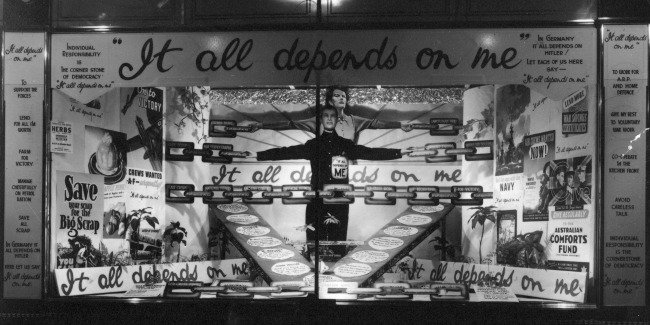
WW 2 Window III
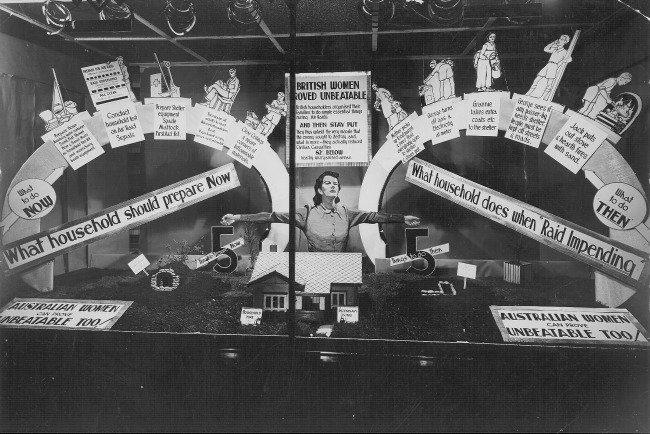
A classic World War II window display in the Fletcher Jones Man’s Shop.

Truck 1920
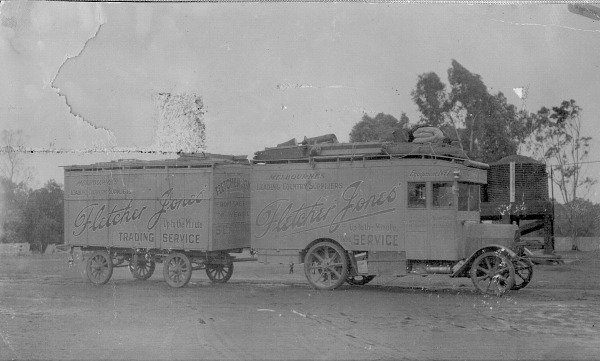
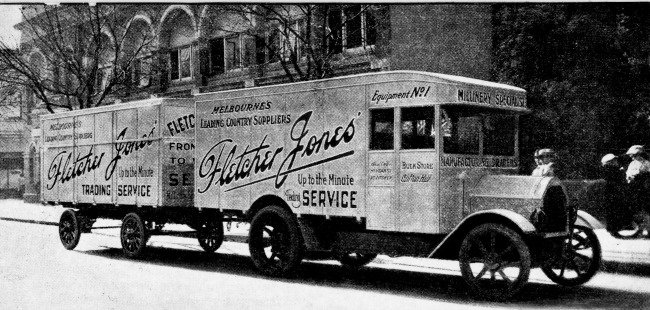
On the road in 1920: Fletcher Jones began his clothing empire as a travelling salesman.

Parade 30s - 2
Scenes from a Fletcher Jones fashion parade in Warrnambool in the 1930s.

Trade Exhibition
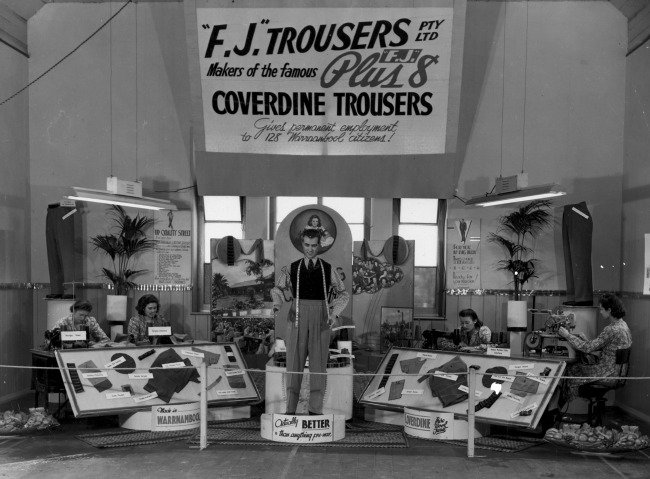
The Fletcher Jones display at a Melbourne trade exhibition: and the models are real!

B ball Team 1946
The Fletcher Jones basketball team in 1946. Do you recognise any of these faces? If so, Glenn Morgan would love to know!

Garden 1954
Smaller than today, but radiant. The Fletcher Jones factory and gardens at Pleasant Hill in 1954.

WW2 window
Another ‘call to action’ window display in the Fletcher Jones Man’s Shop during World War 2.

Jan 1960 - 2
Mad Men eat your heart out: an advertising image from Fletcher Jones in the 1960.

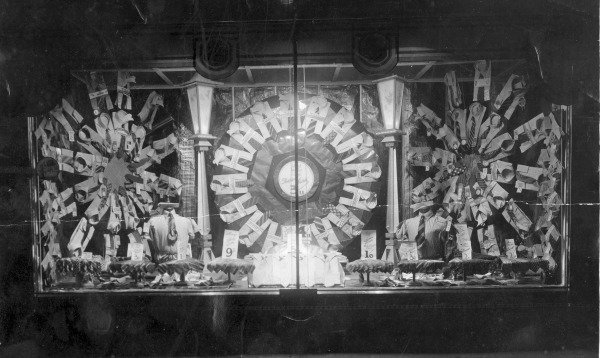
Window - 6
What you can do with a well presented shirt…or several. The window displays in the Man’s Shop were as memorable as the clothing itself.

B Ball Premiers 45
Premiers: The Fletcher Jones basketball team took the crown in 1945. Do you know any of these faces?

Window - 4
Pure style. A striking display of men’s evening wear at the Man’s Shop.

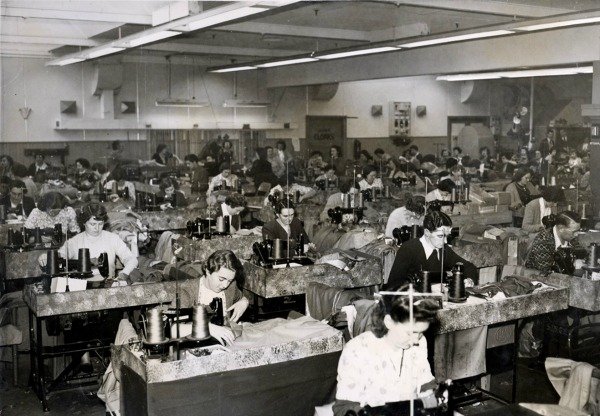
Main Sewing Room
Heads down in the main sewing room at the newly opened Fletcher Jones factory, Pleasant Hill, in the late 1940s.

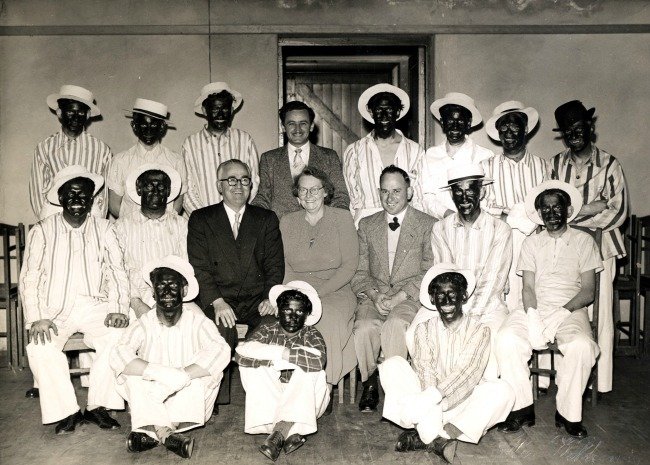
Minstrel Party 50s
Minstrel parties were quite common in the 1950s – Fletcher and Rena Jones are pictured in the centre of this staff photo from 1950.

Jack Grayson - Wbool Shop
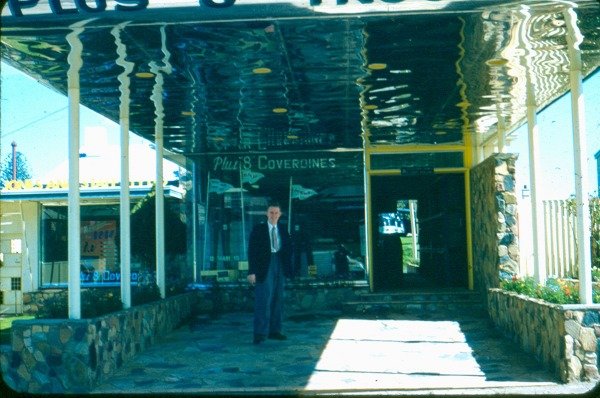
A man identified as Jack Grayson outside the former Fletcher Jones shop on Raglan Parade, Warrnambool. The stylish shop unfortunately no longer exists.

MC room 1948
Young migrants were among the earliest workers at the Fletcher Jones factory after it opened in 1948.

Xmas Part 1950 II
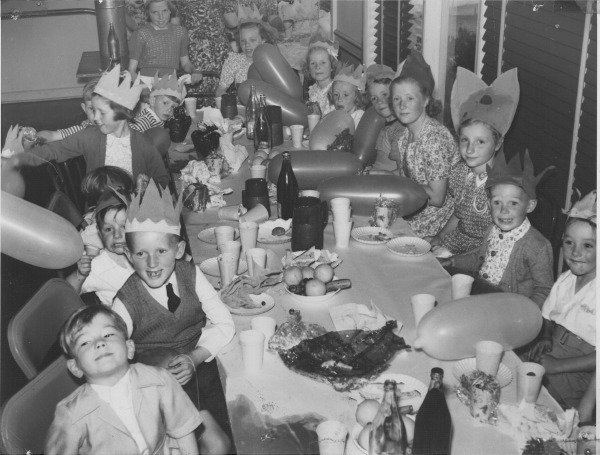
The annual Fletcher Jones’ Christmas party became legendary: here is a snap from the 1950 event. Do you recognise any of these faces? Most would now be aged in their 60s and 70s.

jones gardens
Picture perfect: the Fletcher Jones gardens, factory and silver ball looking at their best in the early 1970s. The ball is 50 years old next year.

[box]If you can help identify any of the people in these photos, please drop a comment in the comments box below and we can pass the information on to Glenn. [/box]


Rare Fletcher Jones images inspire top artist

[printfriendly]

MC room 1948
Just one of the wonderful images: Workers in the main sewing room at the then-newly opened Fletcher Jones factory at Pleasant Hill, Warrnambool, in 1948.

By Carol Altmann

[dropcap style=”font-size: 60px; color: #A02F2F;”] A[/dropcap] treasure trove of rare images capturing the lifespan of the Fletcher Jones story is poised to be the focus of a series of artworks by noted Warrnambool artist, Glenn Morgan.

More than 100 images are contained on three CDs given to Glenn by the late David Jones – son of Sir Fletcher – about eight years ago when the pair were sitting on the Warrnambool Art Gallery Advisory Board.

join us2

“I’d made a couple of pieces around the Fletcher Jones theme and so David turns up with these three discs of images that he said I could have, so I put them to one side thinking I would take a proper look one day,” Glenn explains.

[box]Subscribers can access more images from this extraordinary archive here.[/box]

“I have always been interested in doing a sculpture reflecting the Fletcher Jones’ floats in the Florado festival (an annual Warrnambool street festival that started in the late 1950s) and so I started browsing the images on the discs and thought, bloody hell, there is some good stuff in here!”

Parade 30s - 2
“A dash of Cold War spy”: a Fletcher Jones’ fashion parade in the 1930s, possibly staged at the Warrnambool Town Hall?

[dropcap style=”font-size: 60px; color: #A02F2F;”]G[/dropcap]lenn is not exaggerating.

The photographs provide a literal snapshot of the growth and the hey-day of the Fletcher Jones story, from Sir Fletcher’s humble beginnings as a hawker, to the beginning of the last great years of the Pleasant Hill factory the late 1980s.

There are images of window displays, fashion parades, staff parties, the legendary Christmas picnics, the construction and opening of the Pleasant Hill site, family shots, staff shots, FJ sports teams, samples of early advertising and some of the many social and community causes that the Jones’ family supported.

“There is some really interesting stuff and it takes in not only Warrnambool, but Fletcher Jones in Adelaide, in Hobart, in Collins St,” Glenn says.

“The more you delve into it, the story just gets richer and richer.”

B ball Team 1946
The Fletcher Jones basketball team from 1946. Do you recognise any of these faces? If so, let us know in the comments box below.

[dropcap style=”font-size: 60px; color: #A02F2F;”]G[/dropcap]lenn has already started to seek private and public funding to build a new body of work from a series of images he has selected from the 100-plus.

“I would, ideally, like to spend a couple of years just working purely on this project – an FJ project – leading up to an exhibition at the factory itself, and then touring to Melbourne and Sydney,” he says.

“Funding, of course, is always the issue but I am applying for grants as we speak and hope to get some funding on board.”

glenn_morgan
Artist Glenn Morgan, known for his quirky sculptures, hopes to produce a body of work around the rare Fletcher Jones images.

The art project would also sit alongside the ongoing Fletcher Jones community storytelling project, coordinated by Julie Eagles, and the archiving of the Fletcher Jones industrial story by Melbourne University Archives, led by Melinda Barrie.

“It is such a great story, a very Warrnambool story, and I would love to be able to tell a part of it,” Glenn says.

Glenn and fellow artists Barry Tate and Jenny Altmann all run individual art classes at the former Fletcher Jones factory, with Jenny and Barry recently launching the Outlaw Gallery in the same space.

[box]Read our earlier profile on Glenn Morgan here.[/box]

newsletter Eat And Drink StonesYou might also enjoy…


Rare images of the FJ silver ball

Uncovered: Rena Jones’ lovely letter to the people

W’bool losing its character brick by brick

Montgomery buys a slice of ‘Motang’ history


From artist to children’s author: Fiona Clarke

fiona clarke-jack wilkins
“When I was growing up, the only children’s books were fairytales or stories about a big ship and a fella called Captain Cook”. Portrait of Fiona Clarke by Warrnambool photographer John (Jack Wilkins).

By Carol Altmann

[dropcap style=”color: #a5cecd;”] W[/dropcap]hen Fiona Clarke was a little girl growing up in the 60s, most picture books were either British, based on fairytales, or about “a big ship and a fella called Captain Cook”.

“And Dr Seuss – he was good, I liked him,” Fiona says, laughing.

There were certainly very few children’s books that told stories from Aboriginal culture and none that reflected Fiona’s heritage as part of the Kirrae Whurrong clan in South-West Victoria.

In the second half of her life, Fiona has found herself at the forefront of changing all that, having published her first children’s book in late 2012 and starting work on a second.

smiley-face-small
DONATE 

As an established visual artist, Fiona, who lives in Merrivale, is best known for her paintings, sculptures and tapestries, but she is now bringing her storytelling and fine artistic ability together through books.

“It was something that I always wanted to do, but I didn’t know where to start, like how to find a publisher when they all say ‘no’,” she says.

fiona clarke_10
Fiona in her studio (aka the kitchen table) with copies of her first book, Minkgill Chases the Rainbow, and the blank canvas for her second book that is based around the rainbow serpent.

[dropcap style=”color: #a5cecd;”] E [/dropcap]arly-childhood educator Claire Jennings became the bridge between Fiona’s talent and the publishing world and persuaded her to write and illustrate Minkgill Chases the Rainbow, published by One Day Hill (which has also published work by Derek Guille, Shane Howard and Archie Roach).

Minkgill is the Kirrae Whurrong word for “star” which she discovered after Shane Howard and her late brother, Ian, individually insisted that she read the classic book about Aboriginal culture in South-West Victoria by James Dawson, first published in 1881.

Shortly after the book was published, Fiona embarked on a series of storytelling workshops around Warrnambool and Melbourne, where she was met with a rapturous response by her young audience.

At the end of one storytelling session, a little girl approached Fiona and, with her hands across her heart, declared it was “the best story I’ve heard in my whole life!”

fiona- culture victoria
The artist becomes the subject: a portrait of Fiona by the late Brian Dunlop (1938-2009), Sundown, Sunrise, 1993. Image: Culture Victoria and the Warrnambool Art Gallery.

[dropcap style=”color: #a5cecd;”] T [/dropcap]his time, the inspiration for Fiona’s second book has come from her great-niece, Meekah Merriman, who is just starting to read. Fiona tells a story about how Meekah walked up to her mother, lifted her shirt to show her rainbow-coloured Dora the Explorer belt, and said “the rainbow serpent is coming”.

That simple sentence settled in Fiona’s mind and she began to pen a story around the title.

The Rainbow Serpent is Coming has come out as an environmental story, about the land and how we are treating the land,” she says.

With the writing almost finished, Fiona is turning her mind to the illustrations that need to be painted for each page. A blank canvas – literally – is spread out on her kitchen table, which she uses as a studio.

It is a space she shares with her teenage daughter, Patricia, who is a keen artist, and her husband Ken McKean, whom she first met as a five or six year old after talking about the “walking fish” in his parent’s pet shop; they have been married more than 30 years.

fiona clarke_2
Fiona’s father, the late Banjo (Henry) Clarke as a young man. He continues to inspire Fiona’s creative work, including her decision to write books for children.

[dropcap style=”color: #a5cecd;”] F [/dropcap]iona’s birth family also continues to have a pervasive influence on her work.

As the youngest of six children born to the late Audrey and “Banjo” (Henry) Clarke, a respected elder of the Kirrae Whurrong, Fiona grew up surrounded by the energy and chatter of a large family.

“My father loved children,” she says.

“He always loved to hear the sound of the children’s laughter and said how much he missed hearing that when they were gone, grown up and moved away.”

Fiona tells how Banjo often described children’s laughter as “bringing colour to the world”.

“They bring brightness to the world and Dad always talked about that, right up until the day he died, actually.

“This is why the pictures in my books are always bright – not too much earthy brown stuff,” she laughs.

[box] Fiona recently completed a mural, with Bronwyn Ferguson, at the entrance to Warrnambool College. You can find out more about Fiona’s artwork on her website here and see her talk about her work hereMinkgill Chases the Rainbow is available through Warrnambool Books. [/box]

[button link=”http://the-terrier.com.au/subscribe-2/” type=”icon” icon=”heart” newwindow=”yes”] Did you enjoy this story? Please subscribe here to help Bluestone thrive.[/button]

Stones Smile newsletterYou might also enjoy…


Writing from the heart about ADHD: Wendy Coyle

A love story built on literary lives: Wendy and Allan Scarfe

Bool Belles Review: Mullumbimby, Melissa Lucashenko

Bool Belles Review: A Question of Travel, Michelle De Krester


Art as medicine: Glenn Morgan

glenn_morgan_1
Warrnambool artist Glenn Morgan has inspired many students to explore their creativity.

AS one of South-West Victoria’s most successful and prolific artists, Glenn Morgan could have easily become pompous and aloof, but instead he remains refreshingly down to earth and committed to his home town.

Glenn’s quirky style is instantly recognisable, with many of his paintings and sculptures exuding a whimsical, cartoon-like quality that belies the often serious political or social message within.

Others capture our national obsession with sport – an obsession Glenn shares when it comes to the Geelong Football Club – and many are witty or off-beat, like Glenn himself. But while Glenn’s talent has been well documented, Bluestone wanted to ask him about the importance of inspiring and supporting emerging artists.

1-Morgan-Black-Caviar
Sport features in many of Morgan’s works, including this piece: ‘Black Caviar’s too bloody good’ (2013).

It is a topic for which he is well qualified, as in addition to his own art career, Glenn taught art at both secondary school and tertiary level in Warrnambool and encouraged dozens of students to develop their artistic talents.

As a result, rarely do you meet an artist from South-West Victoria who has not been taught by Glenn, knows him as a friend, or used his story as inspiration.

“I have always considered teaching to be a privilege. Not just because it was a job – and you can’t take that for granted – but because it sharpens your brain as an artist,” he said.

“When you are working among students, solving problems, it soon makes you realise that you are learning as much from them as they are from you.”

9-Morgan-Smokers
‘Smokers’ (2012) acrylic on board.

Glenn, who was born in Allansford, remembers his own student days at the Warrnambool Institute of Advanced Education (now South-West TAFE) when the art class would do some of their best thinking and sharing of ideas in the pub across the road.

“It is that communal thing. My best classes, as a teacher, were the ones where we were all jammed in a classroom, sharing ideas, talking about ideas: that’s where the good stuff happens.”

Watching students being “bitten on the arse by the art bug” was one of his greatest pleasures as a teacher.

“Art is medicine. It gives people something to do with their head. To work things out.

“I remember my father-in-law would make furniture. He would disappear into the shed and be completely lost in it. We all need something like that.”

4-Morgan-Turning-Our-Backs on the Needy-
‘Australia Turning Its Back on the Needy’, (2013) Tin, wood, wire and enamel paint.

One of the critical elements of Glenn’s teaching was to urge students to step out into the world and take a show to Melbourne.

“By getting out there and seeing that your work is just as good, if not better, than anybody else’s…it makes a huge difference. I wanted my students to see Melbourne as just another place.”

Glenn lived in Melbourne for three years, as a post-grad student, but secured his first teaching post back in Warrnambool and has never left. He loves the lifestyle and the friendliness of the community.

The community, in turn, loves him back.

In 2009, one of Glenn’s favourite works – Banjo’s Funeral, which captured the funeral of local Aboriginal elder Banjo Clarke – was being sold by a Queensland couple who had bought it several years earlier.

A public fundraiser was held to try and buy the piece for the community and so many people made donations, some of the money had to be returned. The work is now held by the Warrnambool Art Gallery.

newsletter Eat And Drink Stones

 If you enjoyed this story, you might enjoy…


Merran Koren: Carving out a creative life

From Panmure to Dubai: the art of Kathryn Ryan

Life through a surrealist lens: Berit Hampel

The sublime, intricate drawings of Ella Webb

Inspired by clay: the face behind Claybody ceramics