The fashionable world of Suzi Walter

[printfriendly]

suzi walter_smaller
Suzi Walter, the fashion designer behind the Sweezy label, has successfully revived a career that once saw her named among the best young designers in Australia.

Words and photos by Carol Altmann

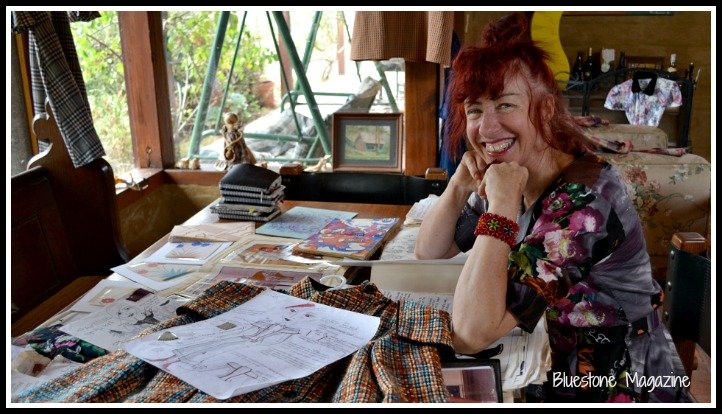
[dropcap style=”font-size: 60px; color: #DC943C;”] ‘W [/dropcap]e are so lucky, aren’t we? Doing jobs we love,” says Warrnambool fashion designer Suzi Walter as she spreads out the scrapbooks and patterns, drawings and diaries, samples and swatches, from a lifetime of work that has unfolded in two chapters.

Chapter 1, for Suzi, who owns the Sweezy label, began as a teenager living in Adelaide in the 1960s, when she was Sue Bell and sewing her own clothes using popular patterns from big names like Butterick, Simplicity, Vogue and McCalls.

join us2

“I would take one of these patterns and tweak it a bit because I didn’t like the collar, or how the pleat fell or something like that,” she laughs, which is something Suzi does often, and infectiously.

These tweaks revealed an early talent for design and turning a standard pattern into a striking original.

suzi young
A 16-year-old Sue Bell, right, who was still a student at Seacombe High School when she won a competition to design three outfits for 60s pop star, Bev Harrell, left.

Her first real ‘break’, however, came when the young Suzi entered a competition to design three outfits for 1960s pop singer Bev Harrell (you can see Bev in action on Youtube here) and won. The prize opened up the opportunity to work with Adelaide-based designer Bruce Westwood, so at 16, Suzi quit school and did just that.

Westwood saw her potential early: “She always had a flair for designing..always,” he was later quoted as saying.

“She has her own flair, she will go a long way,” he said.

And he was right.

suzi walter dress
Suzi’s winning design for the label, Emma, on the right, took out the Australian Wool Award ahead of a design by fashion giant, Norma Tullo, centre.

[dropcap style=”font-size: 60px; color: #DC943C;”] S [/dropcap]uzy enjoyed a career trajectory that would see her work in the heart of the thriving fashion industry around Flinders Lane in Melbourne during the vibrant early 70s when women like Prue Acton, Norma Tullo and Adele Palmer were taking Australian designs to another level.

“I worked on the Emma range that was sold through Myer, and Sportsgirl and pretty much had free rein to design what I wanted, but a particular favourite was hotpants,” Suzi laughs.

In 1971, although still a relative newcomer to the fashion scene, Suzi won the top Australian Wool Fashion Award – the “Golden Ram” – with an Emma Aztec-printed hooded bean pole dress, beating a Norma Tullo designed dinner dress.

Where does a young, world-at-their feet designer go from there? London, of course!

“I had some money from another prize I won (the Adelaide Festival of Arts Fashion Award) which I knew would pay for my fare, so off I went,” Suzi explained.

I assumed she meant by plane. But no. She and seven other adventurous souls bought a Kombi van and drove it to Perth, where they loaded it onto a ship and sailed across to India from where they drove to London.

“We travelled through Nepal, India, Madras, Pakistan, Afghanistan, Istanbul, Iran…all the way through Europe and across, finally, to London,” Suzi says, showing me the notebooks she kept along the way that are jammed with sketches and jottings: the mind of an artist at work.

“These little books became my bibles for ideas,” she says.
suzi walter desk
Suzi decided to get back into fashion after designing a dress that drew multiple compliments during a visit to Bali: “It got me thinking that, hey, I can still do this.”

[dropcap style=”font-size: 60px; color: #DC943C;”] S [/dropcap]uzy spent three years in London as a freelance designer, including working for Jane Carlin, in Bond Street, on high-fashion items destined for places like George’s in Collins St, Melbourne. This was a world where zips and hems were hand-stitched, and some garments were taken by Suzi to the Queen’s beader.

After meeting the man who would become her husband, Andy Walter, Suzi returned to Australia – via a road trip through Africa – and the pair settled in Melbourne to start a furniture business and a family. It would be another 25 years – in 2005 – before Suzi, as Sweezy, would return to fashion.

“It really began again with a design I called my ‘shoplifting’ dress,” Suzi says, before going on to explain that she made a one-off dress with a large bustle, that drew dozens of compliments during a trip to Bali.

“It got me thinking that, hey, I can still do this – I can still make really interesting clothing that people are drawn to.”

Suzi and Andy saw an opportunity to not only revive Suzi’s fashion skills, but to also help the Indonesian people.

suzi walter_7
Up close: just a small sample of the designs and swatches Suzi prepares to send to her team in Indonesia where they are created into garments.

[dropcap style=”font-size: 60px; color: #DC943C;”] H [/dropcap]ow it works is this: Suzi and Andy travel to Bali twice a year to select high quality, eye-catching and beautiful fabrics, often the whole stock if they love it enough, as Andy did with a fine red-and-black Japanese silk.

They then work with two Balinese men who, it is easy to see, have become a very special part of Suzi’s life: Gunter who cuts the patterns from her unique designs she sends to him via email, and Made, who does the sewing.

“When we first met Gunter, he had an old sewing machine out on his verandah and when it rained he would pull the whole lot in,” Suzi says.

Guntur has since built a new house, on the back of his work for several designers, including Suzi.

The Sweezy label (which is Andy’s nickname for Suzi) produces between 400-500 garments a year sold through Melbourne, Ballarat and Warrnambool and has built what Suzi describes as a “beautiful story” between the Walter’s and their Indonesian friends.

“When I first said I wanted to get back into fashion, I was warned not to, that it was no longer what is used to be. Well, of course, that only made me more determined to do it,” Suzi laughs.

suzi walter_35
Suzi with a dress made from the stunning Japanese silk fabric her husband, Andy, spotted on one buying trip to Indonesia: “He took the lot!”

[box]The Sweezy Emporium is located in Warrnambool at the end of Ozone Walk, off Koroit St. You can also find Sweezy on Facebook here. Suzi can be contacted on 0439 415 713. [/box]

newsletter Why Not StonesYou might also enjoy…


No cutting corners: designer Jack Hancock

Powerful family ties behind every stitch: Sue Ferrari

A softie at heart: Megan Nicolson

Reviving classic Australian furniture by hand: Be Seated


No cutting corners: Jack Hancock joins Fabrication II

jack hancock_6
Coup: Melbourne-based clothing designer Jack Hancock will be making a bespoke jacket from Fletcher Jones fabric for the upcoming Fabrication II auction.

By Carol Altmann

[dropcap style=”font-size: 60px; color: #DC943C;”] A [/dropcap]mong the remarkable array of items being created from Fletcher Jones fabric for this year’s Fabrication II auction will be something truly special: a hand-crafted garment by emerging Melbourne designer Jack Hancock.

The supremely talented 25-year-old, who grew up – and first learnt to sew – in Warrnambool, was encouraged by a friend and member of the F Project arts collective, Madeleine Peters, to enter a piece for the September event which serves as a major fundraiser for The Artery.

The auction, now in its second year, involves creators making something from pieces of old but unused Fletcher Jones fabric salvaged by the F Project after the closure of the Fletcher Jones factory in 2009.

Jack used a recent visit back home to rummage through the many boxes of fabric and was stunned to find offcuts of top quality, pure wool fabric made by British company, Dormeuil.

“It is beautiful, even after all this time, and too good to be just thrown away, as it was once going to be,” Jack says.

IMG_5344-full-body
One of the stunning pieces Jack created for his graduate portfolio under the theme, Japonism. Image by Olivia Tran, reproduced courtesy of Jack Hancock.

[dropcap style=”font-size: 60px; color: #DC943C;”] T [/dropcap]his Dormeuil material, among others, will be used by Jack to create a unique jacket featuring different panels of fabric, with the rivers of Warrnambool superimposed in contrasting materials across the back.

Some people are already dubbing it “A jacket for Dean Montgomery” – in honour of the man who has revived the fortunes of the former Fletcher Jones site – but Jack is keeping it a little more generic.

The pattern will be based on a Gerber pattern, which was cutting edge, computer-based technology introduced to the Fletcher Jones company in its later years.

“I have managed to get hold of the Gerber pattern for a Fletcher Jones coat thanks to the F Project, so even though I am calling my piece a jacket, it will be from that coat design,” Jack explains.

“Actually it was the Gerber patterns that in a way led to the demise of Fletcher Jones as it was forced to compete in a world of cheap, mass produced clothing, so there is some irony there.”

jack hancock_30
Jack with a mannequin made for the Melbourne Myer Emporium in the 1930s: a time when clothes were made to last. Jack purchased this mannequin during his visit to the FJ Markets and has since renamed it Daisy.

[dropcap style=”font-size: 60px; color: #DC943C;”] T [/dropcap]he global shift from producing and buying clothes that lasted for years, to mass-produced items that barely see out a season, is one that Jack rails against daily.

Indeed he doesn’t particularly like “fashion” – and its built-in expiry dates – but instead likes to talk about “clothing”: quality garments carefully designed and made from quality materials.

“I am fascinated by how textiles are produced and have been produced through history…and the structure and integrity of a particular garment,” he says.

“It is also, for me, about creating sustainable clothing, not just in terms of where the fabric has come from and how it is produced, but that it will last and not be thrown away, just as a pair of Fletcher Jones’s trousers would last a lifetime.”

Rory_2_Small_Warmed
Objects of great beauty: natural wool is one of Jack’s favourite fibres. Image by Olivia Tran, reproduced courtesy of Jack Hancock.

[dropcap style=”font-size: 60px; color: #DC943C;”] W [/dropcap]hile Jack doesn’t consider himself an artist, but “someone who just makes clothes”, his eye for design emerged at a young age.

Former Warrnambool College art teacher Ollie Morgan was an early influence while he was at school and, as a teenager, he completed a two-year Certificate in Clothing Production through South-West TAFE that at that time held classes in the former Fletcher Jones factory.

“I did work experience with Hemden tailors, in Melbourne, and worked next to the guy who tailored the Fletcher Jones trousers, so there are all sorts of connections to Fletchers,” Jack says, smiling.

Jack’s impressive portfolio of work led to him being accepted into RMIT to study a Bachelor of Design (Fashion), from where he graduated with first class honours and was invited to show his work in the national graduate showcase at Melbourne Fashion Week.

It was to be the first of many such endorsements for his work.

jonascolour
Colonial meets couture: another of Jack’s creations for his graduate portfolio that demonstrates his creativity and skill. Image by Olivia Tran, reproduced courtesy of Jack Hancock.

[dropcap style=”font-size: 60px; color: #DC943C;”] S [/dropcap]ince graduating, Jack has been developing his own label, Tack Jancock, and has worked with the Melbourne dance outfit, Chunky Move.

His work for Chunky Move dancer and choreographer Benjamin Hancock (no relation) was this year recognised with a prestigious Green Room Award for best visual design for the show, Princess.

And when we meet, Jack is recovering from what sounds like a marathon effort to produce costumes for wait staff at the spectacular Dark MOFO festival, held in Hobart each winter.

“It was a fantastic opportunity, but I think I am still recovering!” he says, rubbing his eyes.

While much of Jack’s work to date might be described as theatrical – particularly that he designed for his RMIT graduate year – he is moving toward a collaboration with fellow designer, Domenic Coloca, to create clothes for the everyperson.

tack jancock -japonism
Gender fluidity in fashion. Image by Olivia Tran, reproduced courtesy of Jack Hancock.

[dropcap style=”font-size: 60px; color: #DC943C;”] T[/dropcap]hese are clothes that will be less theatrical and more about people feeling like themselves. The starting point is the human body, and how it moves in the world,” he explains.

Again, however, the focus is on creating unique, durable, distinctive clothing that could even be considered collectable.

“Just as people collect pottery or work by particular crafts people, I see clothing can be a part of that, where you look for a particular designer who has created a one-off piece,” Jack says.

With this in mind, the bidding for Jack’s Fabrication II entry is sure to be spirited – and lead to someone sporting one of the best jacket’s in town.

jack hancock_36
Jack Hancock, pictured here in the FJ Markets, was born – and learnt to sew – in Warrnambool. He is now one of the most exciting emerging designers in Melbourne.

[box]You can see more of Jack’s exquisite work at the Tack Jancock website here. Fabrication II will be exhibited and auctioned at The Artery, 224 Timor St, Warrnambool on Saturday Sept 19 from 6pm. For full details about the event and how to be involved, please email f4u@fproject.org.au[/box]

[button link=”http://the-terrier.com.au/subscribe-2/” type=”icon” icon=”heart” newwindow=”yes”]Bluestone needs at least 500 subscribers in 2015. If you wish to support independent media, please click here to become one.[/button]

newsletter Why Not StonesYou might also enjoy reading…


Stitch Up: Fabulous Fabrication on again

Powerful family ties behind every stitch: Sue Ferrari
A softie at heart: Megan Nicolson

Biblio-Art Award another triumph