Priceless Fletcher Jones coat that fits us all

jack with coat
Designer Jack Hancock brings out his bespoke Fletcher Jones Memorial Coat as part of the fashion parade before the Fabrication II auction. Image: Kim Sargent-Wishart.

By Carol Altmann

[dropcap style=”font-size: 60px; color: #DC943C;”] M [/dropcap]oments of magic happen when they are least expected which is, of course, what makes them so special.

And such a moment happened Saturday night (19/9), under the stars, in the chilly breezeway next to The Artery, in Warrnambool, when a small group of people bought a coat for the community.

This was no ordinary coat.

Like all of the other items up for sale at the Fabrication II auction that night, the coat was made of unwanted offcuts of vintage Fletcher Jones fabrics that had been retrieved by members of the art collective, The F Project, after the Fletcher Jones factory closed.

subscribe button10

Except these offcuts were made of the finest cashmere and wool, designed and made in the United Kingdom exclusively for Fletcher Jones’ suiting when the company was at its heights and known for its clothing of enduring quality.

back of coat
The Merri and Hopkins rivers on the back of the coat: Image Jack Hancock.

[dropcap style=”font-size: 60px; color: #DC943C;”] Y [/dropcap]oung clothing designer Jack Hancock, who grew up in Warrnambool and is now finding his way in Melbourne, knew this fabric was special and the mere thought of it being destined for a dumpster made him almost weep.

Jack took these offcuts and created something exquisite: a single-button, double-breasted coat that fitted across the shoulders, but was deliberately “shapeless” across the hips so that it could be worn by either a man or a woman. The collar flipped up to reveal a splash of bright orange, a daring bolt of colour.

Turned, the back of the coat revealed an aerial view of the veins of Warrnambool – its waterways – the Merri and Hopkins rivers flowing toward the sea.

Each river was hand-sewn, stitch by gorgeous stitch, using silk thread.

This was a coat of fairytales, of fantasy and of Fletcher Jones.

[learn_more caption=”Read more about the coat here”] ….The internal structure of this wool/cashmere garment is supported by woven horsehair canvas, a traditional suiting canvas used to maintain form. Unlike contemporary suiting and coating construction, these breast plates were mounted against the wools by hand, using needle and thread. The lining is a combination of silk fabrics for the body and shirting for the sleeve. As part of my own process, I strive to maintain these traditional technqiues whilst experimenting with new themes. This coat could be worn casually on a day to day basis or kept as a special garment. It is intended to last for a long period of time and does not draw themes from fashion or trends. Investing in a coat like this could be likened to the purchase of a set of fine silver cutlery or a tea service of fine bone china. Both should be used and enjoyed, and with care, will one day be given to somebody else who will do the same. [/learn_more]

Jack, who is 24, stood nervously to the side, shifting from foot to foot, as he waited and waited and waited for his coat, the last item of the night, to go under the hammer. Would it sell?

young fj
A young Fletcher Jones in his days as a hawker. Image: Screen Australia.

[dropcap style=”font-size: 60px; color: #DC943C;”] A [/dropcap]t 24, Jack is one year older than Sir Fletcher was when he set out in a hawker’s van to sell his wares around Victoria, having been entranced by the world of the tailor.

“The first time I saw a tailor, tape around the neck, pin cushion clipped on his forearm, a chest full of tape and scissors and things, I was spellbound,” Sir Fletcher wrote in his memoir, Not by Myself.

To see Jack standing on the sidelines last night, doubting himself, wondering what would unfold, was to see a 2015 version of a young Fletcher Jones about to set forth on his destiny.

Auctioneer Gary Webb opened the bidding at $500. It then climbed to $800, $1000 and stalled, still below the reserve.

And then the magic happened.
coat
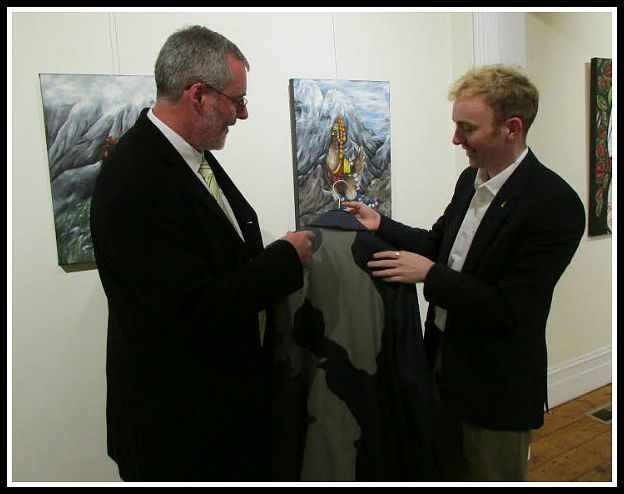
Roy Reekie, left, inspects the exquisite coat made by Jack that he helped purchase for the community. Image: Madeleine Peters.

[dropcap style=”font-size: 60px; color: #DC943C;”] W [/dropcap]arrnambool identity Roy Reekie, together with a bidder who would prefer to remain unnamed, and Bluestone Magazine, all decided there and then that this coat needed to be bought and it needed to be owned by the community.

The three of us all bid independently, but knowing we would all contribute to the final cost – $1400, $1500, $1800, $1900….$1995…sold!

And with the fall of the gavel Warrnambool now has a very special coat – the Fletcher Jones Memorial Coat – that personifies all that Sir Fletcher stood for: quality, care, community, endeavour and taking time.

Jack, it must be said, was shaking.

It is a coat that, both Jack and the buyers hope, will eventually be displayed at the former Fletcher Jones factory but, as Jack insists, in the meantime it “must be worn”.

And it will be worn.

But by whom? When, and where?

Wait and see.

[box]While Bluestone would love to say we made a major contribution to this coat, in reality we only made a small contribution. Roy Reekie and the other donor were the major contributors. The Fabrication II auction is a major fundraiser for The Artery and F Project.[/box]

[button link=”http://the-terrier.com.au/subscribe-2/” type=”icon” icon=”heart” newwindow=”yes”]Please click here to subscribe and support Bluestone Magazine.[/button]

newsletter Why Not StonesYou might also enjoy reading…

Fabrication II gives birth to new life: Delise Oldfield

No cutting corners: Jack Hancock joins Fabrication II
FJ studio proves to be a real plus: Danielle O’Brien

The twists and turns of textiles: Ruby Richardson


Unravelling the mystery of public art commissions

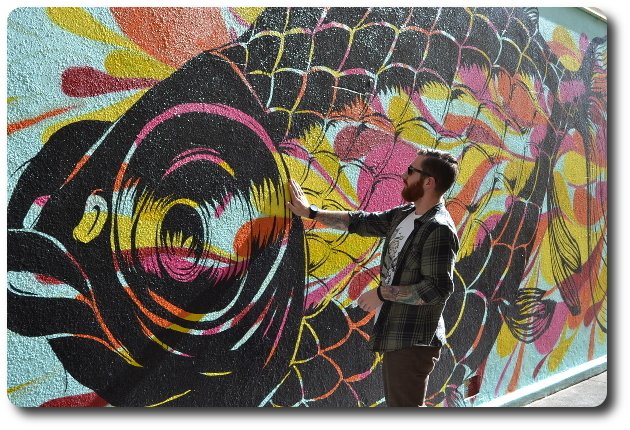
scottie neoh mural
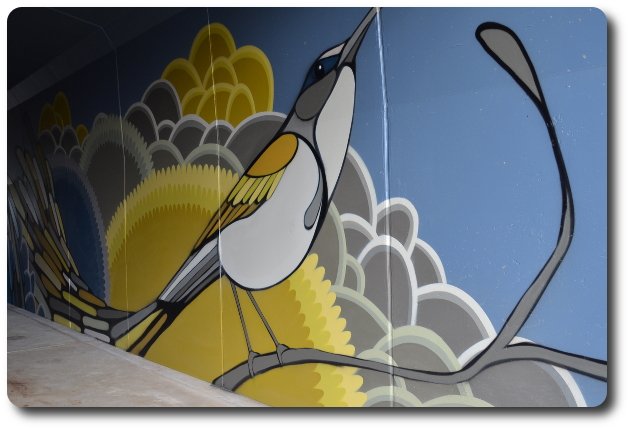
Part of the Mortlake Rd pedestrian tunnel mural by Drysdale artist Scottie “Bonsai” Neoh for which he was paid $15,000 by the Warrnambool City Council.

OPINION

If you are an artist living in south-west Victoria, the chance for a big commission only comes along once in a while, so why do so many of Warrnambool’s most lucrative public art projects go to artists who live elsewhere?

The answer appears to be that the pool of local talent is not yet deep enough, or that artists don’t know about the projects in the first place.

Our interest in this question was piqued by the Warrnambool City Council’s recent unveiling of the Mortlake Rd pedestrian tunnel mural painted by Drysdale professional mural artist Scottie “Bonsai” Neoh, who grew up in Warrnambool.

There is no doubt it is a spectacular work, but what is surprising is that only a handful of people within the local arts community appeared to know about the impending project, despite the commission being worth $15,000.

Bonsai was paid another $2000 for a separate mural at Lake Pertobe that he also completed recently.

The selection of Bonsai follows the awarding of a $20,000 commission to Melbourne artist Ewan Coates in 2010 for his sculpture The Three Pillars of Gratification, on the corner of Liebig and Koroit streetsand another $20,000 commission in 2011 that was won by Ballan artist Velislav Georgiev for his work Chance Encounter, that sits on the corner of Lava and Liebig streets.

In both of those cases, however, and unlike the $17,000 paid to Bonsai, the commission was open to expressions of interest and the winner was chosen by the council’s City Art Advisory Committee. This committee, made up of council and non council people, was disbanded in May last year after running for more than 20 years*.

So what has happened on the ground since?

artery-nathanpye_19
Warrnambool artist Nathan Pye with his fish mural, painted as part of the laneways festival, for which he received $1500 plus the cost of materials.

Well, a string of murals have popped up around Warrnambool in the past eight months thanks to the work of members of the The Artery/The F Project art collective, but these were far from lucrative commissions: they were more like labours of love.

The F Project received $30,000 in council funds to run the Hidden Histories Laneways Festival made up of 10 separate events, including the painting of five murals.

You can do the math, but $30,000 split between 10 events and five murals does not equal a big budget, but, even so, The F Project called for expressions of interest and selected a range of local artists to complete works of various sizes and complexity.

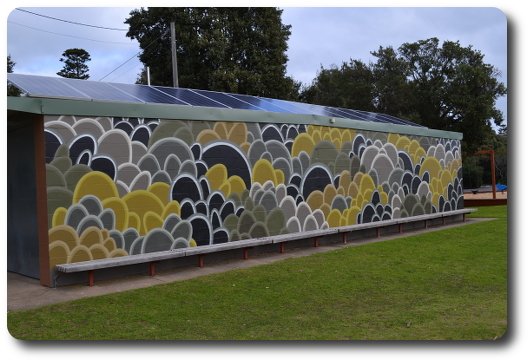
The three smallest murals, in Ozone Walk, were completed for about $1000, while one of the largest, in Patloch Lane by Nathan Pye, had a budget of $1500 plus materials.

The largest of all – a 25 m wall off Timor St – was completed by David Higgins for $2000 (including paints) with another $2000 chipped in by the owner of the wall to help cover costs.

All up, these five murals cost around $5000 in public funds, thanks to the generosity and community spirit of the artists prepared to effectively donate a lot their time.

So how did Bonsai end up with $17,000 for two murals without any call for expressions of interest?

murals_1
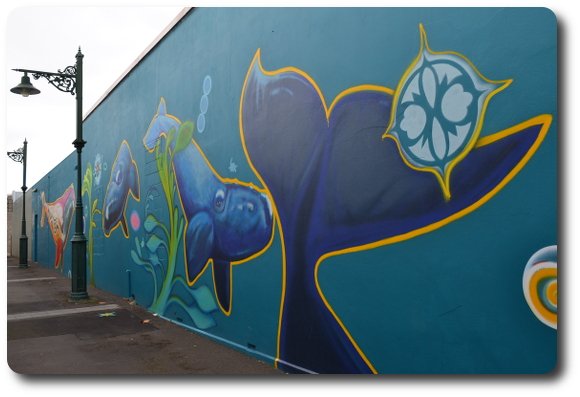
The grand-daddy of them all: the 25m mural by Warrnambool artist David Higgins, which took a couple of weeks to complete, at a cost of $4000 including $2000 donated by the owner of the wall.

Gareth Colliton, the Warrnambool Art Gallery’s curator of exhibitions and outreach, is more than happy to explain, because he played a major role.

It should be said that Gareth, who is an artist himself and one of those who completed a laneway mural for little charge, is seen as a major supporter of the local arts community, was a key figure in establishing The Artery, and is a very affable and popular person in the arts scene.

His involvement in the Bonsai project falls in line with the powers that he has been given in his role with WAG and the council.

As he explains it, the Bonsai project is part of a new way of approaching community art projects that he believes will be of long-term benefit to the 250 local artists on the council’s database.

First, the mural was funded as part of civic infrastructure – the building of the Mortlake Rd drain – and Gareth hopes that public art will be included in more infrastructure projects, such as the design of a roundabout, for example, and that local artists will see more commissions, not less.

For this particular project, Gareth says, Bonsai was considered the best choice: he had the skills, the availability and the local connection (he is also a cousin of Mayor Michael Neoh, but Gareth says Mayor Neoh was completely removed from the process. The selection was made by Gareth, WAG director John Cunningham and Infrastructure head Peter Robertson).

Second, the commission was a “carrot” for Bonsai to run a series of workshops later in the year for local artists who wish to learn from a top street artist. The council is seeking funding to pay Bonsai for the workshops, so that they can be offered free or at low-cost.

murals_3
The Lake Pertobe mural recently completed by Drysdale artist Scottie “Bonsai” Neoh for $2000.

But why not call for expressions of interest, just to see who and what pops up?

Gareth put it this way:  “In the short term, that would be like giving a man a fish or teaching him to fish.”

“We could have given someone this opportunity immediately and it would have been done (but) there are also only a few people in town who have the technical skills to do a work of that scale.

“Far more important is teaching all of those other artists how to do this. Rather than see only the two, three or four that are out there at the moment, I want to see 30 or 40…”

Maybe so, but there are also artists keen to be considered for the talents that they already have.

As one said in an email to Bluestone this week: “I would jump at $15,000. I have been painting for years and have never been paid that much…us local artists seem to find out (about these opportunities) once the bloody project is up.”

(* The council has since confirmed that WAG is investigating setting up a new industry advisory group to provide expert advice on the delivery of its programs and its five-year plan.)


New business levy to raise $600k for what?

public-art-2
A proposed new levy will raise $600k to promote Warrnambool, but would it not be better spent on actual projects, like funky public art such as this in London?


OPINION

[dropcap style=”color: #abccab;”] I [/dropcap]t’s a rare day when businesses ask other businesses to pay more – not less – council rates, but that is exactly what is happening in Warrnambool.

A group called Commerce Warrnambool has asked the Warrnambool City Council to introduce a special levy that would see 1300 commercial and industrial businesses each pay between $100 and up to $6000 a year for the next five years, with the first year expected to raise $600,000.

The levy, based on capital improved property value*, would rise by 5 per cent each year for the next 5 years.

And what would all this money be used for?

Well, according to the Commerce Warrnambool business plan, the first $200,000 will be used to employ a chief executive ($90,000) and associated support staff ($110,000), with the remaining $400,000 being spent on what can best be described as a huge public relations exercise.

Commerce Warrnambool, which started as a voluntary organisation in 2010 and has about 100 members, effectively wants to professionalise its role in promoting Warrnambool as “a great place to live, work and invest” (the same old mantra) and be paid to do so.

There are already at least three other marketing and public relations bodies that are funded to perform this task, including within the Warrnambool City Council, the Great South Coast Group and the Great Ocean Road Regional Tourism Board, but Commerce Warrnambool clearly feels there is room for even more.


artery-nathanpye_19
Instead of spending more money on trying to convince people to invest in Warrnambool, why not invest in the things – like public art – that make a city appealing?


[dropcap style=”color: #abccab;”] T [/dropcap]he group will also, among other things, lobby the council (in other words, the council will collect a levy that will be partly used to lobby itself) and help to promote events such as the May Racing Carnival, Port Fairy Folk Festival, Fun for Kids and the Allansford Speedway.

From from what I have seen, these events already have significant marketing budgets and, between them, attract tens of thousands of people.

Given the record number of empty shops in downtown Warrnambool, a proposed 5.5 per cent hike in council rates, and the economic times that trouble most traders, I thought the idea of forking out money for yet another public relations and marketing project would be shot down in flames.

But no.

Commerce Warrnambool says it has contacted at least 900 businesses and received between 250-300 letters of support. This means that only a third of those surveyed like the idea, but I am stunned that it is even that high.

The council, sensing an opportunity to partially outsource another of its functions, has seized on the idea and recommended that the special levy go ahead: the councillors will vote on it Monday night (May 19).

But let’s think about this for a moment.

Do we really need a special levy to promote how wonderful Warrnambool is? Why not spend the money – if we are going to travel down this path – to improve what people actually see and experience when they come here?

Perhaps, for example, some of the $600,000 could be used to help sustain The Artery, which has given a heartbeat back to the lower end of Timor St, but is largely funded by volunteers and artists paying what little they make to hire an exhibition or studio space.

Or maybe it could be used as a building restoration fund, where property owners are given an incentive to freshen up the many tired, peeling and grubby shop facades around the city.


streets_3
Telling people to work, live and invest in Warrnambool is one thing, but ensuring the city looks fresh and inviting is quite another.


[dropcap style=”color: #abccab;”] O[/dropcap]ne of the Commerce Warrnambool arguments is that other regional cities have set up a business fund, so why don’t we? It lists Ballarat, Shepparton, Swan Hill and Mildura among its examples of similar schemes, yet if we pick just one of these – Mildura – there is a cautionary tale to be heard.

The Mildura Rural City Council collects a special levy on behalf of the Mildura Development Corporation and Mildura Tourism – both of which are subsidiaries of the council – to be used for the very sort of activities outlined by Commerce Warrnambool.

Last year, however, the council swiped $100,000 from the special levy fund to use for other purposes so that it could keep its overall rates down. Ouch.

Imagine, for a moment, if instead of Commerce Warrnambool fronting up with this levy idea, it was The F Project – the local artists’ collective that started in 2008 and has around 150 members.

I am trying to picture the F Project president, instead of Commerce Warrnambool president Tony Herbert, asking the council to tax every business owner for a special public art fund that would raise $600,000 a year.

This fund, instead of being used for promotion and lobbying, would be used to commission artists from around South-West Victoria to create new works of public art (including murals, street furniture, sculptures etc) that would be installed around the the city each year.

Such a fund would buy a lot of public art and produce tangible, highly-visual results, yet there is little doubt The F Project would be laughed out of the council offices for suggesting such an “indulgence”.

Yet it is the tangible things – not just more words – that will ultimately make a difference to people wanting to visit, or move, to Warrnambool. There is no small irony in the council spruiking its Liebig St renewal plans from an empty shop in Liebig St, which is next to another empty shop, which is a few doors from another empty shop…

Money needs to be injected urgently into physical projects that will bring the city back to life – and we don’t need to pay $600,000 a year for somebody to tell us that.

[*The original version of this piece said the levy was based on 3 per cent of property value, which is incorrect. The levy will be calculated as a rate in the dollar based on CIV.]

[button link=”http://the-terrier.com.au/subscribe-2/” type=”icon” icon=”heart” newwindow=”yes”] Did you enjoy this story? Please subscribe here to help Bluestone thrive.[/button]

 Stones Smile newsletter You might also enjoy…


A little less conversation, a little more action

Be all things, or stick to the basics?

What is holding Portland back?

We still have jumps racing? Can’t get over it.

Having a year of your life back

David Jones Jr on the future of the FJ site


Conservation and creativity in the same basket

cherree densley_4
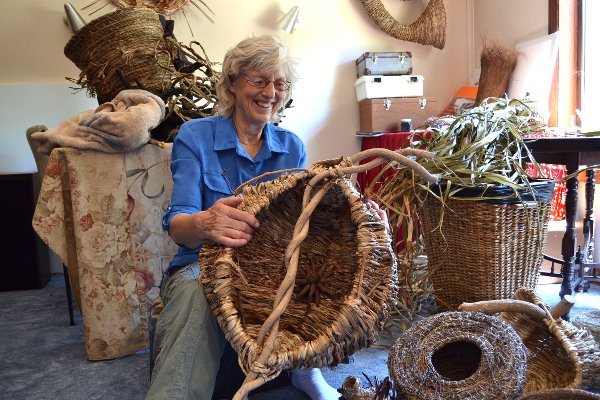
Cherree Densley in her Killarney studio – a re-commandeered bedroom – where she creates baskets using the timeless techniques of many cultures.


[dropcap style=”font-size: 60px; color: #A02F2F;”] B [/dropcap]ushwalking with Cherree Densley would be an eye-opening experience, as not only does she know the names of hundreds of native plants, she can also see the potential for each to be the inspiration for a stunning work of art.

Since retiring from her 30-year career as a secondary school teacher about 10 years ago, Cherree has devoted a large portion of her life to plants and, through them, tapped into her twin loves of conservation and creativity.

On the outside, the garden of her Killarney home is a two-acre sanctuary of low-water succulents, bulbs, native plants and perennials while inside, the remnants and off-cuts of native plants and grasses are transformed into beautiful baskets and fibre sculptures.

Cherree recently reclaimed her son’s old bedroom to create a simple, sun-filled studio in which she spreads out the seed pods, grasses, leaves, prunings and various fibres that she has collected in her travels, or from her own land, and that would normally be composted or left to rot on the ground.

From this raw harvest, she creates the designs that she has sketched in her journals as part of daily ritual that keeps her disciplined and captures inspirational ideas before they float away.

[quote]

I find it is a lovely thing to be able to make something useful or beautiful from things that might normally be thrown away,” Cherree explains. [/quote]

“You can take this discarded material and turn it into something entirely new: you can make an object that is not just creative, but which also has a purpose.”

cherree densley_19
The exquisite range of baskets reflect the raw materials from which they are made.

[dropcap style=”font-size: 60px; color: #A02F2F;”] C [/dropcap]herree’s range of baskets and fibre sculptures is astonishing and shows influences from her fascination with how baskets have been used in various cultures for thousands of years.

Some of her work reflects the baskets and eel traps made by Indigenous Australians, others have a distinct African style, while others are uniquely her own.

“I collect books on basket-making and was reading just the other day how an African community used tightly woven baskets to store their beer,” she says.

“With almost any culture, you only have to scratch the surface and there is a history of basket-making there.”

cherree densley_6_01
“I find it is a lovely thing to be able to make something useful or beautiful from things that might normally be thrown away.”


[dropcap style=”font-size: 60px; color: #A02F2F;”] C [/dropcap]herree also makes much larger sculptural works using fibres and found objects and is currently preparing for a second exhibition with her sister, painter Di Holland, who lives near Edenhope. The pair held their first SisterShow in 2012 at the Warrnambool Art Gallery.

The SisterShow2 exhibition will be held at CEMA, Portland, from March 24-April 29  and will again see Di’s meticulous wildlife paintings paired with Cherree’s sculptural works. The 2012 show included, for example, a large painting of a platypus by Di that was exhibited alongside a metre-long platypus nesting burrow woven by Cherree.

This time, the challenge includes enhancing Di’s painting of a Southern Right whale, but Cherree is already well underway with a piece that reflects the whale’s ‘song lines’. The sisters plan to exhibit 25 large paintings and 3o sculptural works in total.

cherree densley_20
This delicate basket made of New Zealand flax was part of an exhibition held at Whalebone Gallery, Port Fairy.


[dropcap style=”font-size: 60px; color: #A02F2F;”] P [/dropcap]erhaps not surprisingly, the sisters come from a line of grandparents and great grandparents who loved gardens and crafts – textiles, leatherwork, basketry, mosaics, floristry, spinning and dyeing wool – and both grew up in bushland near Heywood.

Cherree used her superannuation to return to those roots by buying a rare slice of 200 acres of native bushland near Portland that is protected with a covenant to ensure its preservation into the future. Since buying the property, Cherree has recorded 299 individual plant species growing on the property.

“I am really struggling to reach the 300, but I think I may have found a native mint that will take me over the line,” she says, laughing.

cheree baskets_6
To market, to market: some of Cherree’s work at the recent Port Fairy farmers markets.

[box] Cherree Densley’s work is often for sale through the Port Fairy markets and F Project pop-up markets at The Artery, 224 Timor St, Warrnambool. Cherree also offers basket making classes at her home for individuals or up to groups of eight. You can contact her on 55 68 7226 or via cherree@hotkey.net.au for more details.[/box]

newsletter Eat And Drink Stones  You might also enjoy…


Home is where the art is: Karen McKenzie

Heather Wood: art springs from the heart of Seaview.

Revealing the layers of a sapphire: Kate Melican Rollo

Smooth lines inspired by the ocean: Damian McDonald

Hot glass melts hearts: Robert Gatt and Freya Marriott