Shrinking or growing? Crunching the numbers on Lyndoch
Carol Altmann – The Terrier
Lyndoch Living is definitely getting bigger, but is it getting better? The numbers say no.
The reason I keep writing a lot about our community-owned aged care home is to put on the public record what is happening under the change of leadership and change of direction since 2015.
It’s important that we – as the community who own Lyndoch – keep track of what is going on, because nobody else is telling us.
We are the custodians of Lyndoch and the community will be here way past whoever happens to be in charge, so yes, we need to keep track of what is going on.
We owe it to Lyndoch, the residents, the staff, and those who helped create Lyndoch more than 50 years ago.
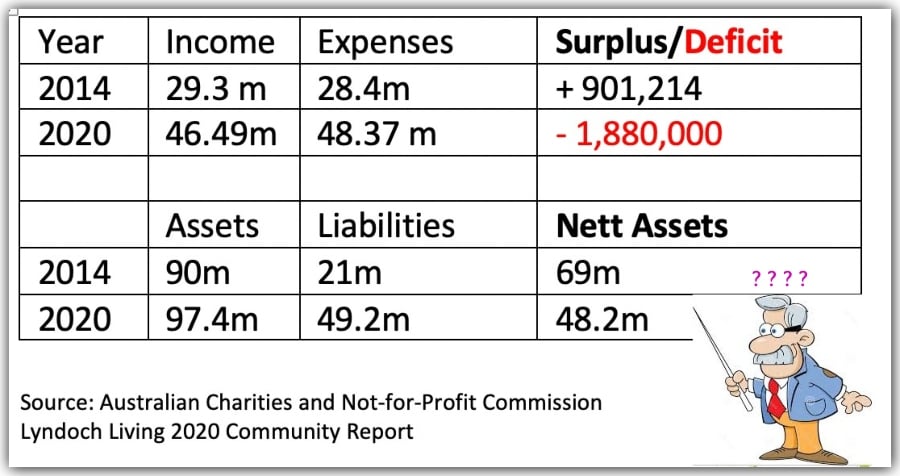
This is why tonight I am running this little chart, because it captures how Lyndoch is travelling financially.
It shows that before 2015, Lyndoch ran at a small profit/surplus or was break even.
This year, it posted its biggest loss – close to $2 million.
Lyndoch has run at a loss for five of the past six years. From my research, this is unprecedented in recent times.
At the same time, its assets have gone up, but so have expenses – they have more than doubled.
This has meant a $20m cut to its net assets in just six years.
Is this visionary? It is sustainable? And why, when it comes to cost cutting, do we hear of cuts at the coalface, and not in the corporate?
Speaking of which, it’s worth remembering that the very first thing to happen under the $100m masterplan now being rolled out by Lyndoch was an upgrade of the corporate area.
Out with former CEO Rhys Boyle’s old wooden furniture and in with the fingerprint resistant glass table.
We still don’t know how much that corporate re-vamp cost but it was an early sign of the shifting priorities.
We still don’t know, exactly, how much the Swinton Wing re-vamp and extension cost, but estimates are it blew out by $2m to $13 million.
And coming up next is a new two-storey medical clinic to be built next to Scoborio Reserve with, it is said, radiology, pathology, acute care and educational facilities alongside up to 20 GPs.
Lyndoch will bulldoze Tomlinson Wing and its gardens to make way for more glass and cement.
How much will that all cost to build and set up? We don’t know.
Is this all necessary? Is it all sustainable?
These are the questions I would like to ask the board – our eyes and ears at the table – and I am sure you would like to ask too.
In the face of their silence, we just keep pressing.
Artery is pumping and here’s what’s next…
Some of the faces of the F Project: president Dr Emma Charlton and vice president Helen Bunyon, who are part of the seemingly tireless team operating The Artery in Warrnambool.
By Carol Altmann
[dropcap style=”font-size: 60px; color: #A02F2F;”] T[/dropcap]he success of The Artery art space in Warrnambool since opening just over two years ago has been nothing short of extraordinary, and it is getting bigger.
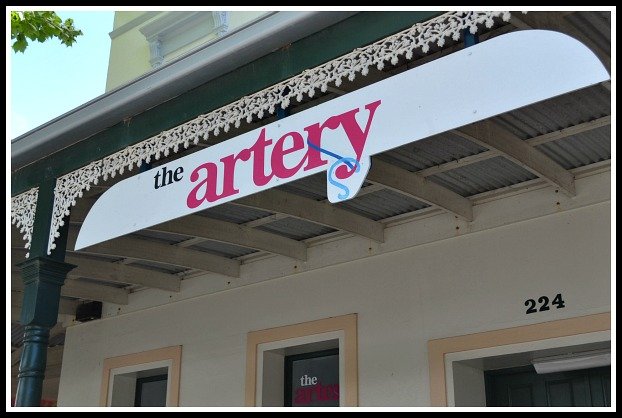
The F Project – the volunteer art collective behind The Artery – already manages 30 artist studios, a community gallery space and a retail shop and, before the end of the year, it will take over the five-bedroom, top floor of the Timor St building to accommodate a visiting artists and artists-in-residence program.
As F Project president Dr Emma Charlton explains, the expansion is the next step in a five-year plan to build The Artery into a dedicated arts space that serves local artists and visiting artists, while at the same time building a strong arts presence in the community.
“A large part of The Artery is about getting art out into the community and to develop an appreciation of the arts in our community, and I think we are certainly achieving that,” she says.
The F Project has hit it straps since leasing the former funeral home in Timor St and creating, The Artery.
[dropcap style=”font-size: 60px; color: #A02F2F;”] P[/dropcap]rior to leasing the former Guyett’s funeral home at 224 Timor St, the F Project – which started in 2008 – had a less prominent space upstairs in what was the old Fletcher Jones shop on the corner of Liebig and Koroit streets.
But as vice president Helen Bunyon says, creating a new, street-front premises has been a game-changer.
“It really has created a central contact point for the arts in this community and has taken off like topsy. We always have people dropping in, coming to ask questions, or wanting to become involved,” she says.
Emma adds that The Artery has become a way for new artists who arrive in town to find an immediate audience and creative network.
She gives the example of artist Caroline Healey, originally from the UK, who recently moved to Warrnambool and volunteers as the group’s public relations officer. Largely through her connections with the F Project/Artery, Caroline has already established a following for her work and will soon hold an exhibition.
The striking kookaburra mural by Nathan Pye and Jim Sargent outside The Artery: one of many murals around the city that have been coordinated by the F Project.
[dropcap style=”font-size: 60px; color: #A02F2F;”] A[/dropcap]s it happens, the gallery space – which is hired out to artists and hosts various art events such as the South-West International Women’s Day Art Prize – has a fully booked calendar for 2016.
As such, it has virtually replaced the original intention of the Alan Lane Community Gallery at the Warrnambool Art Gallery.
The 30 studios wax and wane in occupancy and some artists have moved on to set up their own professional studios at places like Factory Arts, in the former Fletcher Jones factory.
There is no doubt, however, that the F Project has become integral to just about every community arts event in Warrnambool.
This includes the Warrnambool City Council’s ‘Hidden Histories’ project that saw 10 different events held in the city’s laneways, to Arts on the Grass, to the murals appearing in laneways, the Fletcher Jones Christmas picnics, the refurbishment of Patloch Lane, numerous arts markets, and even the replacement of the city’s tired Christmas decorations.
But is it too much for a volunteer group?
[dropcap style=”font-size: 60px; color: #A02F2F;”] U[/dropcap]nlike the Julia St Creative Space in Portland, The Artery/F Project receives no council funding other than that provided to fulfil specific projects such as the laneways.
Julia St is also volunteer based, but has a part-time Community Arts Officer employed by the Glenelg Shire Council and operates in a council-owned building.
The WCC no longer has a community arts officer, but is reaping the many benefits of having the F Project/Artery fill the gap for free.
Neither Emma or Helen wish to get into the politics of council funding, but Emma acknowledges the dependency on volunteers and says the group plans to apply for an Australia Council grant next year to employ a part-time coordinator.
When I asked how many hours they each devote to the Artery/F Project each week, both Helen and Emma answer “between 10 and 20”, although I know they are being modest.
Both are keen to stress that the workload is shared among many.
“We have people involved who bring a whole range of different skills and, for others, it is a way of developing those skills,” Helen says.
“It is a lot of responsibility,” Emma adds. “But the negatives are far out-weighed by the coolness.”
[box]The Artery is at 224 Timor St, Warrnambool and is open from Wed-Sun 10am to 4pm. The retail area sells works by local artists. The current exhibition is Small Gems, the F Project Members Christmas Show, until 3 January. You can find The Artery on Facebook here. P: (03) 55 62 1109 [/box]




 You might also enjoy…