South-west women’s art prize offers hope

heeps
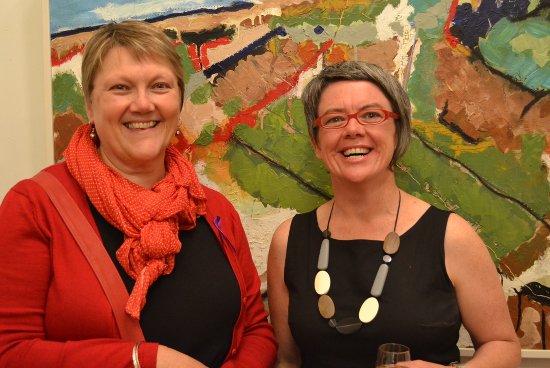
Among the entrants for the 2015 South West International Women’s Day Art Prize was Dianna Heeps, from Hamilton, left, pictured here at the exhibition with friend Maggie Dwyer.

By Carol Altmann

[dropcap style=”font-size: 60px; color: #A5CECD;”] T [/dropcap]he South West International Women’s Day Art Prize is fast becoming one of the premier competitions for women artists across the region, with more than $4000 in prize money for the 2016 event.

Organisers Women’s Health and Wellbeing Barwon South West are offering a $2000 cash first prize – up from $1500 for the inaugural event – with the winning work to be acquired by the group and also featured on the cover of its annual report for 2016-17.

A $1000 cash prize will be awarded to the runner-up, with another $1000 cash prize for best emerging artist.

Bluestone Magazine is also, for the first time, sponsoring the People’s Choice award of $250.

subscribe button10

Emily Lee-Ack, Executive Officer of Women’s Health, said the response to the 2015 inaugural event had been “unexpected and astonishing”, with the group expecting perhaps a dozen entries and receiving more than 70 that responded to the theme of “Women and Place”. (First prize was won by Marion Manifold).

The group is expecting a similar response to the 2016 prize, which has the theme of  “Hope”.

“Hope is a very broad theme that means a lot of different things to a lot of people,” Emily said of the choice.

“It is also a very uplifting and positive theme and we would like to think that there is a growing sense of hope in the community about how things can be changed. Without hope, we are lost,” she said.
nicholson-mahony
Flashback: Deb Nicholson, left, with Emma Mahony from Women’s Health and Wellbeing Barwon South West at the 2015 women’s art prize. The pair are in front of Kate Melican Rollo’s work, ‘Sapphire Views #2, a family connection” which Deb purchased on the night.

[dropcap style=”font-size: 60px; color: #A5CECD;”] E [/dropcap]mily said the prize, which will again be hosted by The Artery, in Warrnambool, demonstrated the commitment of Women’s Health to not only advancing women’s health interests, but also supporting women more broadly.

“The prize is one way of supporting and promoting women in a really positive way…and making their work visible in the community, not only during the exhibition, but with the winning work finding a permanent home in our space,” she said.

“It also reminds us of the great value of women in our community and renders this visible, where they are so often not visible.”

In anticipation of the same response to this year’s prize, a panel will be chosen to select those entries that will make up the 50 or so to be exhibited. A guest judge – who is yet to be finalised – will determine the winners.

The prize is open to women living in the councils of W’bool, Colac-Otway, Glenelg, Southern Grampians, Corangamite and Moyne.

[box]The South West Women’s IWD Art Prize will run at The Artery from February 26 to March 13, 2016. Entries close on January 28. Detailed information about how to enter will be available on the Women’s Health website from Tuesday Sept 29. For further information you can also contact Emma Mahony: emahony@womenshealthbsw.org.au or phone (03) 5500 5490.[/box]

Stones Smile newsletter

You might also enjoy…


Rock my soul: Rosebrook chapel rises again

Raising the bar with children’s book art: Port Fairy

To the lighthouse: a trip to Cape Nelson

Feeling a building in your bones: Donna Monaghan

Fabrication II gives birth to a new life


Reunion exhibition a 4-tifying experience

peter bryant
Warrnambool print maker and photographer Peter Bryant, who will be part of a reunion show by four artists who are exhibiting for the first time in 27 years. “It’s a bit like getting the band back for one more gig.”

By Carol Altmann

[dropcap style=”font-size: 60px; color: #A02F2F;”]W[/dropcap]hen artists Peter Bryant, Chris Small, Tony Neylan and Graeme Altmann first decided to exhibit together as the “Gang of 4”, the idea was to do so regularly.

That first exhibition in Warrnambool was way back in 1988 – when Bob Hawke was Prime Minister – and their second will be held this week (opens July 17), a full 27 years later.

(Mental note: do not hire these guys to organise your wedding.)

It has taken a little longer than planned, but the quartet – only Peter and Chris remain in Warrnambool – are eagerly anticipating reuniting at The Artery, which is only a few blocks west of where they held their first group show.

“It’s a bit like getting the band back for one more gig,” says Peter, a print maker and photographer.

“But the question is whether anybody else will give a s***,” he adds, letting out an infectious laugh that sums up how these four artists have always got along.

clipping
A newspaper clipping from the original “Gang of 4” show in 1988 when Chris Small, Peter Bryant, Graeme Altmann and Tony Neylan were all final-year art students.

[dropcap style=”font-size: 60px; color: #A02F2F;”]T[/dropcap]he four first met in 1985 as first-year art and design students at what was then the Warrnambool Institute of Advanced Education and were part of a colourful, crazy, but supremely talented group of young artists (and lecturers) who are all still connected, and still producing great work, today.

This week’s exhibition, 4tified, will provide a snapshot of that creativity, including Graeme’s works on paper and up-cycled boat sculptures, Tony’s delicate, Japanese-influenced ceramics, Chris’s slow-fired raku ceramics and Peter’s limited edition prints and photos, most of which have been created specifically for the show.

For Peter, who runs Shipwreck Coast Art & Design, it is a refreshing return to exhibiting. It has been 12 years since his last show, which was also with Chris Small.

“It’s a bit of an adjustment to go from screenprinting as a business, to screenprinting my own art again, but one that I am enjoying…I think,” he says, with a grin.

Peter’s studio is tucked down a laneway behind the former Fletcher Jones factory, with the famous silver ball water tower a constant backdrop. Not surprisingly, it features prominently in his work.

“Yes, there are some very strong Warrnambool references, for sure, but also a few surprises,” he smiles.

peter bryant_15
With a studio across the road from the Fletcher Jones silver ball, it is not surprising to see the icon reflected in Peter’s new work.

[dropcap style=”font-size: 60px; color: #A02F2F;”]A[/dropcap]s we move through the flotsam and jetsam of Peter’s studio, where he picks up various pieces of work-in-progress, you can’t escape the sense that 4tified is more than just an exhibition.

It is also a time for reflection – although not necessarily a quiet one – on each artist’s journey since they were 20-something-year-old graduates, full of hope about their creative futures and dreaming of lives as professional artists.

But as for so many young artists, the other diamonds and demons of life disrupted the best laid plans. Families, mortgages and the need to make a decent living have meant that art has often had to take second place.

4tified, however, has provided a renewed focus.

“I am looking forward to the moment when I can step back from it, because it’s done, but at the same time it is a really good thing that this exhibition has forced me to get back into it and to prepare works by a deadline,” explains Peter, who now has four young children.

“It’s a return to form for me and maybe if I can continue to do this, then who knows what might happen as I get toward retirement: there are now entirely new ways of selling and promoting your work that didn’t exist when we first started.”

You have been 4warned, the Gang of 4 will be back.

4tified-small
Artists Tony Neylan, Peter Bryant, Graeme Altmann and Chris Small as they are today, reuniting for the 4tified exhibition.

[box]4tified runs at The Artery, 224 Timor St, from Wed July 15 until August 1 with the official opening by Glenn Morgan on Friday July 17 at 6pm. Another Deakin/WIAE alumni, Kathryn Ryan, opens her show, A Quiet Place, at the W’bool Art Gallery on Sat, July 18 at 6pm.[/box]

[button link=”http://the-terrier.com.au/subscribe-2/” type=”icon” icon=”heart” newwindow=”yes”]Bluestone needs at least 500 subscribers in 2015. If you read us, please support us.[/button]

newsletter Eat And Drink Stones

 You might also enjoy…


Surveying a quiet place for new show: Kathryn Ryan

Dynamic duo step out on their own

Broken link prompts a fresh start

Clay shapes a new life: Peter Austin


Young creatives: the mythology of Alex Jones


alex jones_26
Brauer College Year 11 student Alex Jones with the work of his fellow art students behind him. Alex’s work is part of the school’s Art & Design exhibition at the Lighthouse Theatre.

Words and photos by Carol Altmann

[dropcap style=”font-size: 60px; color: #DC943C;”] A [/dropcap]lex Jones is one of those young creatives who has been drawing for as long as he can remember and whose natural talent just oozes out of him, much like the images he creates.

The Year 11 Brauer College student from Bushfield is making his mark as a young artist to watch, with his exploration of life, death, mythology and the darker, surreal elements of fantasy and reality.

“Ever since I was little I have loved books about mythology and fantasy and using my own imagination to create those worlds,” Alex, 17, says.

 “I have always drawn pretty dark stuff, much to the disgust of my grandmother,” he adds, laughing.

alex jones_10
A digitally manipulated image – featuring Alex’s father and golden labradors.

alex jones_2
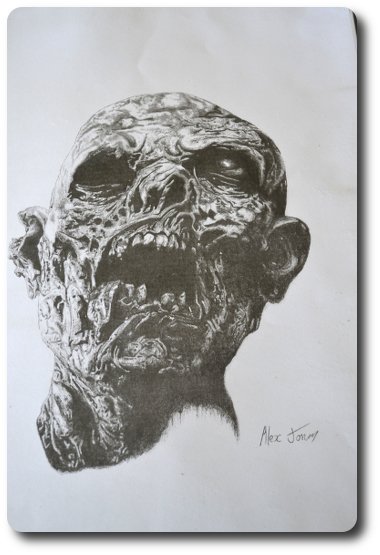
Perhaps not one for Grandma, but the detail in Alex’s drawing is remarkable and won the people and staff choice awards in the 2013 WRAD Art in Schools Competition

[dropcap style=”font-size: 60px; color: #DC943C;”] A [/dropcap]lex works across a range of mediums, including pencil, paint, sculpture, photography and printing, to create images that are often morbid or foreboding, yet mesmerising.

“I like to convey messages about life and death and different ways of looking at life, while also making the work really detailed,” he says.

Alex’s favoured themes are a stark contrast to his cheerful disposition and love of the sea, and he laughs as he admits that most of his work is not displayed at home (his mother, Yvonne Lefebure, is a textiles teacher at Brauer).

But his attention to detail and a willingness to explore different approaches and techniques is inspiring.

At an age when most young artists are still mimicking the work of others until they find their own style, Alex will take an idea and then push it, pull it and stretch it around until it becomes his own.

alex jones work2
Alex’s roadkill lantern, which is part of an installation at the Brauer Art & Design Exhibition.

alex jones_12
Life, death and decay are common themes in Alex’s work, including this photograph of a fungi that is reproduced in a scratch drawing.

[dropcap style=”font-size: 60px; color: #DC943C;”] G [/dropcap]ail Higgins, head of the Brauer Art Department and one of Alex’s teachers, tells a story of how he found some roadkill, let it dry out, and used the skull together with moulded, clay horns and bits of fur to create a new work.

“He puts a great deal of thought into how he approaches each piece,” Gail says.

And Alex himself explains how he experimented with making his own paint pigments from wine, blueberries and raspberries which he then used for a printmaking piece on the crucifixion of Christ.

But perhaps his most striking work is one of three that are included in the Brauer College Art & Design Exhibition now showing at the Lighthouse Theatre, Warrnambool (until Nov 16).

It is a highly detailed eagle that has been etched onto individual panes of painted perspex that are mounted into a vintage window frame.

alex jones bird
Alex’s winning work from the Portland Rotary Art Show: the eagle etched into panels of painted perspex (detail).

[dropcap style=”font-size: 60px; color: #DC943C;”] T [/dropcap]he majestic bird has its wings outstretched, as if in flight, but its head flops to one side and a medieval sword runs down the centre of its body.

“The window symbolises the interface between life and death,” Alex explains.

“You only get to see glimpses from one side – not the whole picture. And the sword, well it symbolises mans killing of an innocent creature.”

Gail is right: Alex puts a lot of thought into each of his pieces.

The eagle image recently won best contemporary painting at at the Portland Rotary Art Show and Alex’s work has also been recognised with a people’s choice and staff choice award in the 2013 Western Region Drug and Alcohol Art in Schools competition.

Despite his talent and love of art, however, Alex intends to put his attention to detail and inquisitive mind to work in another career, as a scientist.

Given the synergies between science, life and death, it seems the perfect fit.

alex jones_4
Alex experimented with making his own pigments using blueberries, wine and raspberries for this work on the crucifixion of Christ.

[box]The Brauer College Art & Design Exhibition is open until Sunday November 16, Lighthouse Theatre, Warrnambool. It was curated by Gareth Colliton, from the Warrnambool Art Gallery, with the assistance of two Brauer College students Gemma Stormer and Emily Bakic. Free entry.[/box]

[button link=”http://the-terrier.com.au/subscribe-2/” type=”icon” icon=”heart” newwindow=”yes”]Bluestone needs 500 subscribers to thrive. If you enjoyed this story, please click here to become one![/button]

newsletter Why Not StonesYou might also enjoy…


Young creatives: Indigo Crabbmor a year on…

The magic of the Coorong: Port Fairy exhibition

New women’s art prize unveiled for IWD

Capturing Warrnambool’s diverse heart

Developing a passion for vintage cameras: Denise Regan

Just the kit for Portland culture: Culture Kit


Revealing the eye of the tiger: Peter Clayfield

peter clayfield
Photographer – and collector – Peter Clayfield in his mini musuem of a lounge room: “I have always been what you might call acquisitive”.

[dropcap style=”color: #a5cecd;”] P[/dropcap]hotographer Peter Clayfield lives on the edge of a cliff which, on a clear day, has the sort of view that stretches all the way to Tasmania – well, almost.

The invisible thread that connects his home overlooking the Southern Ocean to the rugged coastline of north-west Tasmania is symbolic, as Peter has a self-confessed obsession with the thylacine (Tasmanian tiger) and has devoted a large part of his life to collecting imagery of the animal.

“It started when I was about 15 and my parents bought me a book about the thylacine and from that point I was hooked,” he says.

Peter now owns more than a dozen books on the subject and, perhaps more importantly, a couple of hundred pieces of thylacine imagery including lithographs, 19th Century etchings, hand-coloured engravings, antique prints and more modern incarnations that he has collected from around the world.

“The thylacine is a very potent symbol of the environmental movement and this is part of its appeal to me, that symbolism,” he explains.


peter clayfield_16
The poster to be used for Peter’s collection of thylacine material that will be exhibited at the Warrnambool Art Gallery later this month.


[dropcap style=”color: #a5cecd;”] A[/dropcap] substantial chunk of Peter’s collection is now with the Warrnambool Art Gallery in preparation for his exhibition that opens on July 25 and will run concurrently with the Glenn Morgan retrospective.

Recapturing the tiger: a personal collection of thylacine imagery from past and present” is a departure from what most people have come to expect from Peter’s exhibitions, which normally showcase his exquisite photography.

An alumni of the now defunct Warrnambool Institute/Deakin University Diploma of Visual Art, Peter has exhibited over the past 30 years in just about every gallery in Warrnambool – past and present – and is known for his ability to transform every day urban landscapes, people and objects.

“Those art classes in the 80s opened up a new world to me about the possibilities with photography, especially by being exposed to the great photographers and artists in the US and Europe,” he explains.

Peter recalls, in particular, how the head photography lecturer Ian Cosier would stock the campus library with books by photographers that came to be major influences on his work, including Diane Arbus, Henri Cartier Bresson and the wonderfully named Ralph Eugene Meatyard.


peter clayfield_14
Peter’s photography is known for capturing the unusual in the usual, like these topiaries draped in protective netting.


[dropcap style=”color: #a5cecd;”] P[/dropcap]eter now has a collection of books by these same artists, among many others, that line the walls of his cosy lounge-room which is, in itself, a work of art because of the many rare and beautiful objects that he has accumulated. Thylacines are only a part of it.

“I have always been what you might call acquisitive,” he says with a soft laugh.

It is difficult to describe the scope and diversity of what has caught Peter’s eye over the years, but imagine squashing the Smithsonian Institute into a small cottage and you are getting close.

Among his eclectic tastes are tribal masks and carvings, delicate silver spoons, palm-sized ceramic bowls, select pieces of Australian pottery, charms, chimes and dozens of animal and religious bells that create the most wonderful sounds.


peter clayfield_32
Peter’s house on the edge of the world where, on a good day, you can almost spot Tasmania.


[dropcap style=”color: #a5cecd;”] T[/dropcap]he complete Peter Clayfield Collection may well be an exhibition of the future, and deservedly so, but for the moment the spotlight will remain on the thylacine which, some believe, still exists in parts of north-west Tasmania.

Does Peter?

He pauses to consider his answer.

“Definitely in the 60s and 70s, yes, but those areas in which it was living have since been heavily logged,” he says.

“I guess I have a faint hope that it might still be surviving in those very remote areas, but it is only a faint hope.”

[box] Recapturing the tiger will be officially opened at the W’bool Art Gallery on July 25 by Dr Carol Freeman, author of Paper Tiger: a visual history of the thylacine.[/box]

[button link=”http://the-terrier.com.au/subscribe-2/” type=”icon” icon=”heart” newwindow=”yes”] Did you enjoy this story? Please subscribe here to help Bluestone thrive.[/button]

Stones Smile newsletter You might also enjoy…


A sculptor with the heart of a Lyon: Jon Dixon

Shaking the ocean to see what falls out: Carmel Wallace

An intricate webb: the art of Ella Webb

Inspired by clay: the face behind Clare Claybody

Family ties behind every stitch: Sue Ferrari