From this – a massive piece of bluestone weighing more than 10 tonnes… (Image courtesy of Glenn Morgan via the late David Jones).
By Carol Altmann
One of the many great things about Bluestone Magazine has been our recording of the revival of the Fletcher Jones factory and gardens in Warrnambool (having been part of the campaign to save it in the first place) and the many wonderful stories that have emerged about its past.
One of those wonderful stories is this one: the making of the bluestone sculpture commissioned by the Jones family as a tribute to the late Sir Fletcher, created by the late artist Robert Ulmann.
To this…..the completed Robert Ulmann sculpture that pays tribute to the ethos of the late Sir Fletcher Jones. (Image courtesy of Glenn Morgan via the late David Jones).
[dropcap style=”font-size: 60px; color: #A02F2F;”] T[/dropcap]he sculpture, which is now a prominent and much-loved feature of the Pleasant Hill gardens, was hewn from two massive pieces of bluestone selected by Robert from the Panmure quarry.
The two pieces together weighed more than 20 tonne and, over the course of four months from July to October 1977, Robert reduced them to two pieces weighing five tonne.
This meant, of course, hacking away 15 tonnes of solid rock in a make-shift workshop at his Naringal property (later lost in the Ash Wednesday fires).
In our March edition we revealed a rare archive of images from the personal files of David Jones, son of Sir Fletcher, who gave them to local artist Glenn Morgan eight years ago for use as inspiration in his quirky works.
Within these more than 100 images are those capturing the making of the Ulmann sculpture and most likely taken by the Ulmann family (see our slideshow a little further on in this story).
Putting his back into it: the late artist Robert Ulmann gets stuck into the bluestone with a jack hammer at his Naringal property, later lost in the Ash Wednesday fires. (Image courtesy of Glenn Morgan via the late David Jones).
[dropcap style=”font-size: 60px; color: #A02F2F;”] S[/dropcap]uch was the excitement around the commissioning of the sculpture – which came just a few months after Sir Fletcher’s death in February 1977 – a memo and photographs were sent around all of the Fletcher Jones factories and shops to keep staff updated.
The finished sculpture may look like a hand holding a sewing needle, which fits with the Fletcher Jones story, but in fact it represents a germinating seed.
Robert Ulmann’s preliminary sketches for the sculpture that represents a germinating seed. (Image courtesy of Glenn Morgan via the late David Jones).
The plaque next to the sculpture explains more:
“Viewed from the ends, the form suggests the shape of a seed – the germination of an idea and the inspired determination to develop it.”
The three-metre long “needle” points to limitless potential.
“The horizontal lines of the straight stone suggest infinite potential for exploration and expansion of the initial ideals,” the plaque reads.
The sculpture will be 40 years old next year and stands as solid and true (and as popular with climbing kids) as it did on the day it was unveiled while a new chapter of the Fletcher Jones factory unfolds around it.
Watch our one-minute slideshow of the sculpture being created below:
[box]We would like to thank Warrnambool artist Glenn Morgan for sharing these extraordinary images of the Fletcher Jones’ story with Bluestone Magazine. The images, given to Glenn by the late David Jones, capture the FJ manufacturing story from the early 1900s through to the 1980s. Here follows just a sample from the dozens of images provided to Glenn. You can return to that story here.[/box]
Sea views: The grand opening of the Fletcher Jones factory at Warrnambool in 1948.
Just begging to be interpreted by Glenn Morgan: Fletcher Jones on the road between Mt Gambier and Penola 1923.
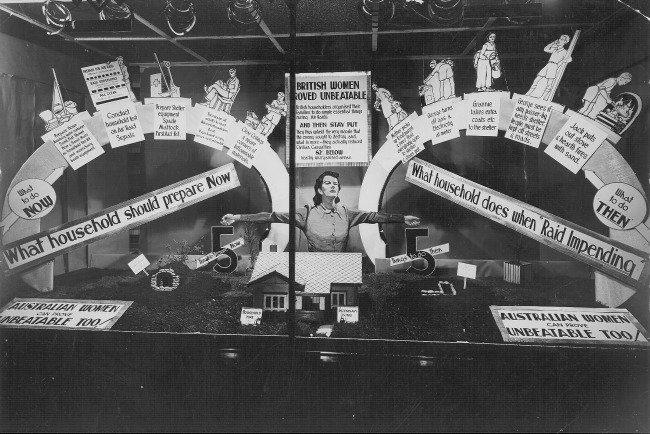
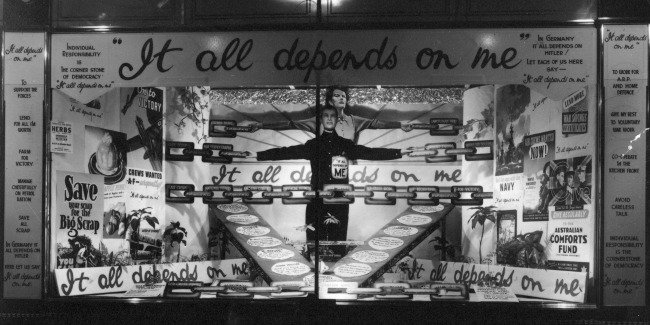
A classic World War II window display in the Fletcher Jones Man’s Shop.
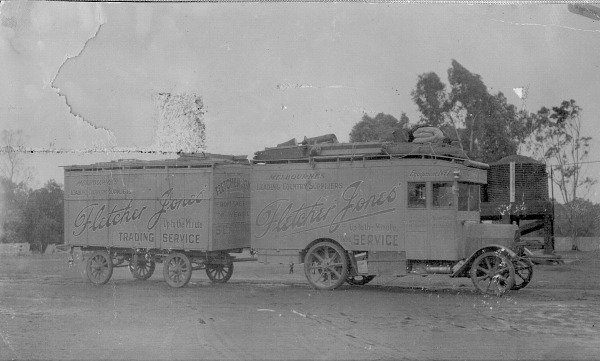
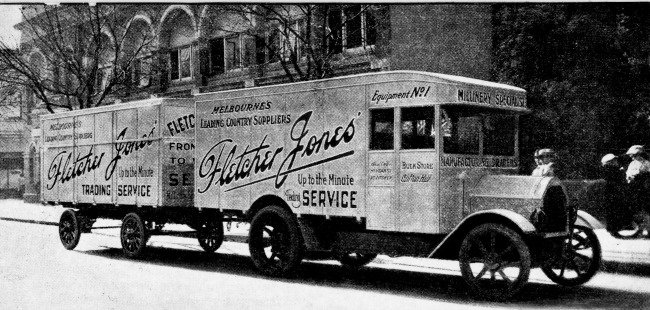
On the road in 1920: Fletcher Jones began his clothing empire as a travelling salesman.
Scenes from a Fletcher Jones fashion parade in Warrnambool in the 1930s.
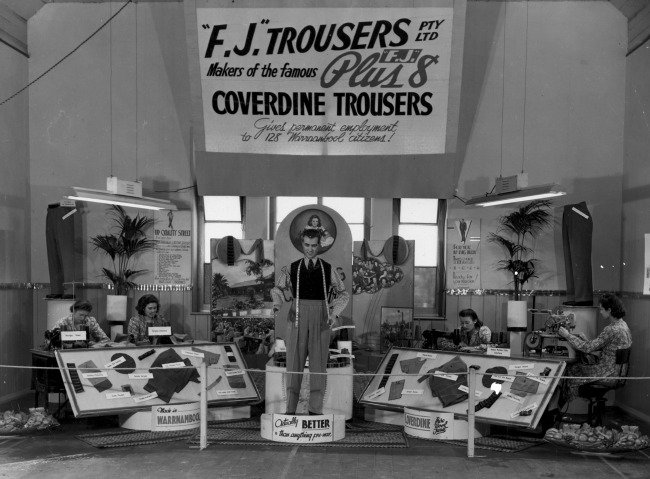
The Fletcher Jones display at a Melbourne trade exhibition: and the models are real!
The Fletcher Jones basketball team in 1946. Do you recognise any of these faces? If so, Glenn Morgan would love to know!
Smaller than today, but radiant. The Fletcher Jones factory and gardens at Pleasant Hill in 1954.
Another ‘call to action’ window display in the Fletcher Jones Man’s Shop during World War 2.
Mad Men eat your heart out: an advertising image from Fletcher Jones in the 1960.
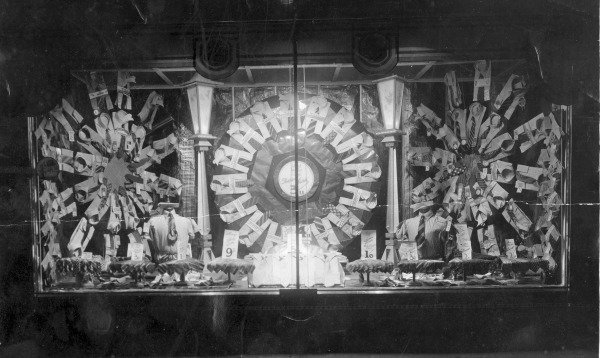
What you can do with a well presented shirt…or several. The window displays in the Man’s Shop were as memorable as the clothing itself.
Premiers: The Fletcher Jones basketball team took the crown in 1945. Do you know any of these faces?
Pure style. A striking display of men’s evening wear at the Man’s Shop.
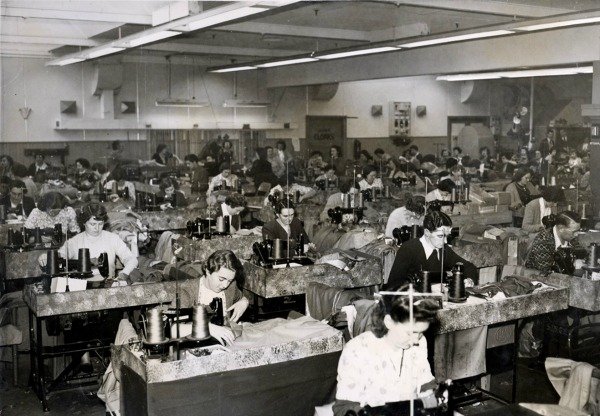
Heads down in the main sewing room at the newly opened Fletcher Jones factory, Pleasant Hill, in the late 1940s.
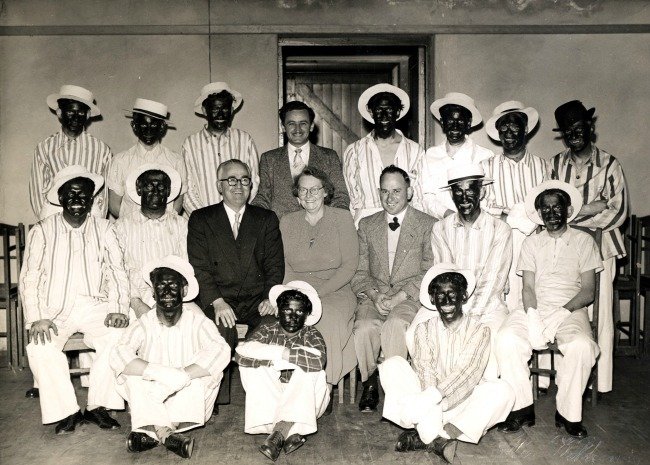
Minstrel parties were quite common in the 1950s – Fletcher and Rena Jones are pictured in the centre of this staff photo from 1950.
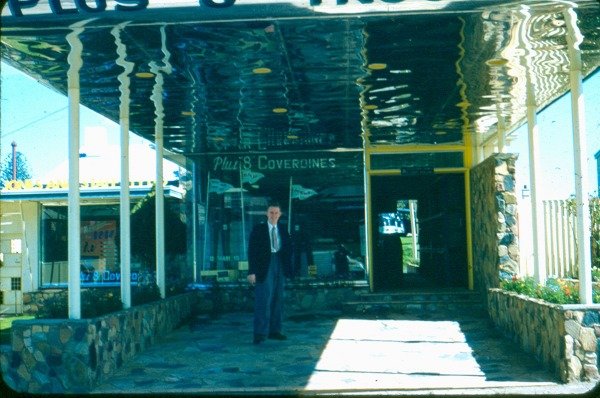
A man identified as Jack Grayson outside the former Fletcher Jones shop on Raglan Parade, Warrnambool. The stylish shop unfortunately no longer exists.
Young migrants were among the earliest workers at the Fletcher Jones factory after it opened in 1948.
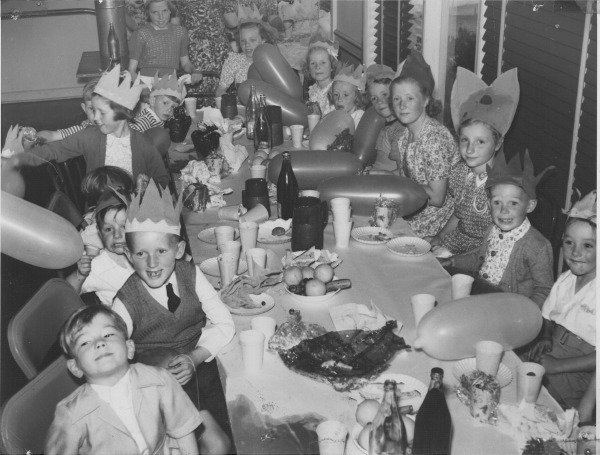
The annual Fletcher Jones’ Christmas party became legendary: here is a snap from the 1950 event. Do you recognise any of these faces? Most would now be aged in their 60s and 70s.
Picture perfect: the Fletcher Jones gardens, factory and silver ball looking at their best in the early 1970s. The ball is 50 years old next year.
[box]If you can help identify any of the people in these photos, please drop a comment in the comments box below and we can pass the information on to Glenn. [/box]
Rare Fletcher Jones images inspire top artist
[printfriendly]
Just one of the wonderful images: Workers in the main sewing room at the then-newly opened Fletcher Jones factory at Pleasant Hill, Warrnambool, in 1948.
By Carol Altmann
[dropcap style=”font-size: 60px; color: #A02F2F;”] A[/dropcap] treasure trove of rare images capturing the lifespan of the Fletcher Jones story is poised to be the focus of a series of artworks by noted Warrnambool artist, Glenn Morgan.
More than 100 images are contained on three CDs given to Glenn by the late David Jones – son of Sir Fletcher – about eight years ago when the pair were sitting on the Warrnambool Art Gallery Advisory Board.
“I’d made a couple of pieces around the Fletcher Jones theme and so David turns up with these three discs of images that he said I could have, so I put them to one side thinking I would take a proper look one day,” Glenn explains.
“I have always been interested in doing a sculpture reflecting the Fletcher Jones’ floats in the Florado festival (an annual Warrnambool street festival that started in the late 1950s) and so I started browsing the images on the discs and thought, bloody hell, there is some good stuff in here!”
“A dash of Cold War spy”: a Fletcher Jones’ fashion parade in the 1930s, possibly staged at the Warrnambool Town Hall?
[dropcap style=”font-size: 60px; color: #A02F2F;”]G[/dropcap]lenn is not exaggerating.
The photographs provide a literal snapshot of the growth and the hey-day of the Fletcher Jones story, from Sir Fletcher’s humble beginnings as a hawker, to the beginning of the last great years of the Pleasant Hill factory the late 1980s.
There are images of window displays, fashion parades, staff parties, the legendary Christmas picnics, the construction and opening of the Pleasant Hill site, family shots, staff shots, FJ sports teams, samples of early advertising and some of the many social and community causes that the Jones’ family supported.
“There is some really interesting stuff and it takes in not only Warrnambool, but Fletcher Jones in Adelaide, in Hobart, in Collins St,” Glenn says.
“The more you delve into it, the story just gets richer and richer.”
The Fletcher Jones basketball team from 1946. Do you recognise any of these faces? If so, let us know in the comments box below.
[dropcap style=”font-size: 60px; color: #A02F2F;”]G[/dropcap]lenn has already started to seek private and public funding to build a new body of work from a series of images he has selected from the 100-plus.
“I would, ideally, like to spend a couple of years just working purely on this project – an FJ project – leading up to an exhibition at the factory itself, and then touring to Melbourne and Sydney,” he says.
“Funding, of course, is always the issue but I am applying for grants as we speak and hope to get some funding on board.”
Artist Glenn Morgan, known for his quirky sculptures, hopes to produce a body of work around the rare Fletcher Jones images.
“It is such a great story, a very Warrnambool story, and I would love to be able to tell a part of it,” Glenn says.
Glenn and fellow artists Barry Tate and Jenny Altmann all run individual art classes at the former Fletcher Jones factory, with Jenny and Barry recently launching the Outlaw Gallery in the same space.
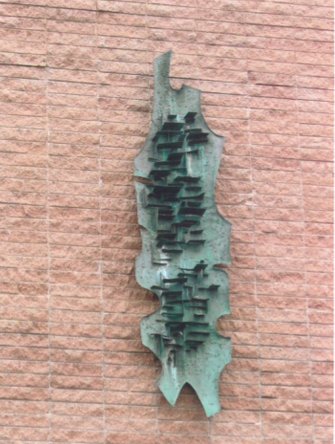
Metamorphosis, by Derek Giles, as it was on the side of the Fletcher Jones factory in Warrnambool. Image courtesy of the Warrnambool Art Gallery.
By Carol Altmann
A simple question – “what ever happened to…” – has uncovered a story about the retrieval of a well-known sculpture taken from Warrnambool, while also shining a light on the artist who made it.
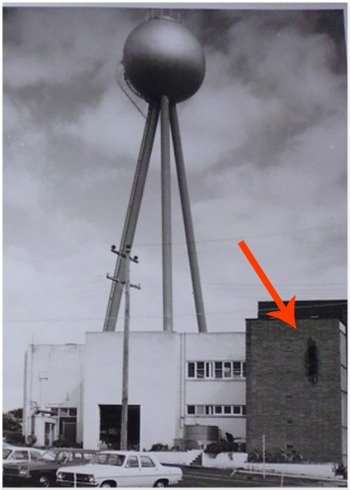
The 3 metre tall copper sculpture, Metamorphosis, was installed on the eastern wall of the Fletcher Jones factory in Warrnambool on August 1, 1967 – the same year as the famous silver ball water tower was built just metres away.
The pair looked down on the factory workers, East Warrnambool school kids and passersby for more than 25 years until the collapse of Fletcher Jones saw the business taken over by Pelaco and the buildings sold to the Warrnambool City Council.
Bluestone recently posted a 1967 photo of the silver ball and sculptureto the Facebook page, Save the Silver Ball and Fletchers Gardens, which prompted a question from one follower: “whatever happened to that sculpture?”
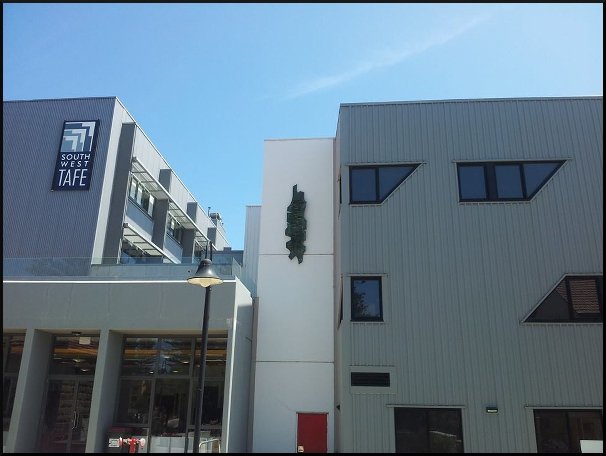
Before long, the answer was provided by Lesena Selvage: it sits on an eastern wall of the South-West TAFE building, overlooking Gilles St, which is just one letter away from the name of the artist who created Metamorphosis, Derek Giles.
But what has never been revealed, until now, is that the sculpture was taken from Warrnambool to Melbourne and it was only through the dogged determination of the late David Jones, son of Sir Fletcher, that it was returned.
The Metamorphosis sculpture shortly after being installed on the site in August 1967 – the same year as the silver ball water tower was built. Image: Ralph Jones collection, courtesy of Melbourne University Archives.
Letters penned by David Jones reveal that he became aware by early 2007 that the sculpture had been removed by Pelaco and shipped to its factory in Maidstone, Melbourne.
While David didn’t name Pelaco, he urged the council to do all it could to ensure the sculpture was returned from “the company”.
“As chairman of (the City Art Advisory) committee and because of my past association with the Pleasant Hill establishment, I express my deep concern that this object has been taken from Warrnambool,” he wrote to then chief executive of council, Lindsay Merritt in February 2007.
“My understanding of the sale of the Pleasant Hill site to the WCC in the early 90s was that the infrastructure including the buildings and the gardens were transferred into the ownership of the city. I cannot imagine why the company could or should have formed the view that they had ownership of this sculpture.
“I request that you take whatever action is necessary to recover the sculpture and that the City Art Committee select a new site for the work.”
By December that same year, little progress had been made, despite the issue being raised by the City Art Committee at least four times.
Since 2009, the sculpture has been on permanent loan from the Warrnambool City Council to South-West TAFE and now overlooks Gilles St. Image: Lesena Selvage.
It appears a clearly frustrated David Jones did what any self-respecting supporter of local arts would do and approached the media to apply a little more heat to the flame.
A story ran in the local newspaper on 28 December 2007, asking people to help locate one of the city’s “most unusual artworks” that had “gone missing”.
“It’s 40 years old, a unique piece and worth several thousand dollars, but more importantly it’s owned by the citizens of Warrnambool and we should make every attempt to recover it,” David is quoted as saying.
The story ended with a request for “anyone with information” to contact the council or David, even though both knew exactly where the sculpture was.
David’s tactic clearly worked, because within 12 months the sculpture was back home – we are not sure how it was finally retrieved – and discussions were underway with the City Art Committee as to where it should be displayed.
South-West TAFE was chosen because of Derek Giles’ links to the art school.
It has long been thought that Derek Giles was an art teacher at the Warrnambool Technical College (now TAFE), but in fact he was a primary school teacher who lived with his wife and young family near the Fletcher Jones factory and who studied art as a mature-age student.
The artist, primary school teacher Derek Giles, with his wife Meryl, who worked for David Jones, and his young family around the time of the commission. David Giles is next to his father. Image courtesy of David Giles.
I actually helped Dad build it,” said Derek’s oldest son, David Giles, by phone from Melbourne.
“It was put together in our garage (in Emma Ave) and I would hold bit this and that bit, while Dad kept saying ‘don’t look at the flame, don’t look at the flame,'” he laughed.
David, one of four children, was in Grade 6 at the time and, from what he understands, the commission came about through his mother, Meryl.
“My mother worked as a secretary to David Jones for about 12 months and I think one of Dad’s penultimate assignments for his art course was to produce a work, so Mum approached David to see if Dad could make him a sculpture,” he said.
Derek Giles, who was born in Melbourne, taught in primary schools around the south-west in the 1960s, including Port Fairy Consolidated and Warrnambool Primary School, but always had a penchant for art and worked across a range of mediums.
“Metamorphosis is a wonderful connection to Warrnambool for the whole family: it is a real focal point,” David said.
“As kids, we always thought of it as Dad’s sculpture…(but) not really being art aficionados, we joked that he had made a high-rise for the birds, because they used to love to roost in the horizontal panels when it was mounted on the wall.”
Derek Giles died in 1993, at the age of 58.
There is little doubt that had David Jones not pushed for the return of Metamorphosis, it would have been gone for good, with the Pelaco factory at Maidstone since closed.
Later this year the Giles family will complete the final vision that both they, and David, had for the sculpture, which is to install a simple plaque naming him as the artist.
I would like to acknowledge retired art academic Ross Gray and Warrnambool Art Gallery Curator Murray Bowes for their assistance with this story.
David Jones Jr on the future of the FJ site
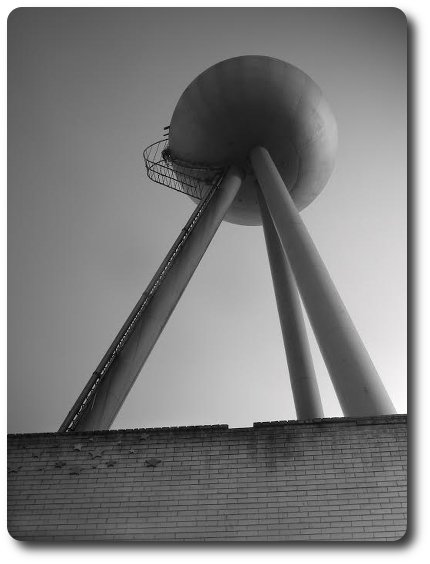
This stunning image of the Fletcher Jones’ silver ball was taken by Deakin University fine art academic Mark Rashleigh who has kindly given us permission to reproduce it here. It depicts the tower with its ladder and railings intact.
OPINION
[dropcap style=”font-size: 60px; color: #ABCCAB;”] A [/dropcap]s Heritage Victoria prepares to inspect the dilapidated Fletcher Jones factory in Warrnambool next Monday (7/4), the grandson of Fletcher Jones said his family would be delighted to see something “creative” happen with the site.
In so saying, however, David Fletcher Jones Jr said that his family fully appreciated the complexity of the situation that has developed since the current owner, Daramking (owned by failed Geelong businessman Ian Ballis), went into receivership in 2012.
“I am anxious to stress that we recognise how challenging this all is,” Mr Jones said in an exclusive interview with Bluestone.
Mr Jones is the son of the late David and Isobel Jones and lived in Warrnambool until his teenage years. As a result, he is keenly aware of the connection that many people feel to the Fletcher Jones factory site because of the high esteem in which his grandfather was held.
“How the site looks today is very sad,” he said.
“Everyone would like to see something better done with it.”
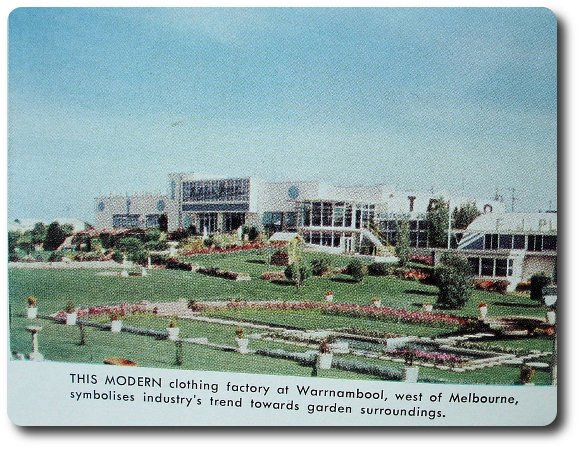
Fletcher Jones factory, Warrnambool circa 1950’s. Photo source: Land of the Southern Cross Australia. Published by The Australian Publicity Council. Private collection.
[dropcap style=”font-size: 60px; color: #ABCCAB;”] M [/dropcap]r Jones, who with his sisters, Susan and Anne, oversees the philanthropic FJ Foundation, said the debate around the future of the site reinforced that there was no easy answer and a solution would require a “thorough engagement with the council and the community”.
“Quite a complex and thoughtful solution is going to be needed,” he said.
“And we would be excited if something thoughtful and appropriate could be done.”
While Mr Jones did not wish to specify what sort of development he would like to see on the site, he agreed that a project that linked to the broader community would certainly reflect the values of his grandfather.
The Jones’ family have had no direct involvement in the FJ factory site since the company was sold in 1995, but the personal links remain strong.
The water tower was designed by Fletcher Jones’ son, Ralph, who was a consulting engineer and is now aged in his 80s. The Pleasant Hill gardens, meanwhile, were designed by Fletcher Jones’ brother-in-law Darby Boucher.
The heritage-listed water tower, gardens and other key elements of the iconic site have been central to recent discussions between Heritage Victoria, the Warrnambool City Council, the administrators and the mortgagors as to who has responsibility for maintaining these historic elements.
[dropcap style=”font-size: 60px; color: #ABCCAB;”] I [/dropcap]n the meantime, the various tenants occupying different parts of the building are still paying rent and, in most cases, repairing what they can as the building continues to crumble around them.
The Triton Woodworkers Club, for example, pays around $9000 a year for a space directly under the silver ball that is substantial in size, but leaks like a sieve whenever it rains.
The club has rigged up an improvised internal drainage system that keeps most of the rain off their equipment – if not the floor – but an outsider can’t help wondering why they are being charged anything at all, especially as a not-for-profit community group who, simply by being there, help to keep the vandals out.
So where does the long-term solution to the site lie?
Hopefully a constructive plan will emerge from the talks between the various parties, but, in the meantime, it is worth revisiting a key recommendation of the 2003 consultants’ report, commissioned by the council, into the site’s future.
It suggested the council, even if it no longer owned the site, keep the dialogue open between the community, any developer and the council to ensure its future life was in keeping with community expectations.
To date, this has not happened. This may change and, if it does, we may be on our way to the “thoughtful and appropriate” solution that such a high-profile and important site deserves.
[box] Postscript: According to the Warrnambool City Council, it spent almost $160,000 on the Fletcher Jones site between 2002 and 2008. A breakdown of this figure was unavailable, but it included repairs on the silver ball after an assessment in 2004.[/box]


 You might also enjoy…










 More on the Fletcher Jones campaign…