The community is knocking, but will Lyndoch open the gate?
Carol Altmann – The Terrier
More than 100 membership applications* for Lyndoch Living will be hand-delivered to Lyndoch on Friday by Jim Burke, thanks to those who have stepped forward and signed up.
The next step is for the Lyndoch board to decide who from the community, if anyone, is accepted.
This is an opportunity for the board to right a wrong, because surely it is wrong that there is not one single member of the general community among Lyndoch’s current membership. Not one.
And, as far as I know, Lyndoch’s membership still doesn’t include any residents, or family of residents.
This means that aside from a handful of executive staff (about six) and the seven people on its board, Lyndoch doesn’t have any other members.
If that situation has changed in recent times, we don’t know about it.
The situation at Lyndoch is very different to other community owned, not-for-profit residential homes like, for example, Boandik in Mt Gambier.
Members of Boandik (which is about half the size of Lyndoch) are those who have donated to its work in the past fin year, or are a resident.
In theory, you can apply to become a member of Lyndoch if you are over 18, of sound mind, and agree to its main objectives.
In practice – for the last couple of years – anyone who has applied without being invited has been rejected.
Lyndoch now has 100-plus chances to change that.
[*The final figure will be known by Friday when last-minute forms roll in. What a great effort by everyone who has been involved.]
Why is Lyndoch Living so scared of the community?
In recent years, Lyndoch Living aged care has increasingly cut itself off from community scrutiny. Original photo: CuriousMax
Carol Altmann – The Terrier
A simple but unsettling question underpins this Sunday’s membership drive for Lyndoch Living: why is Lyndoch so scared of the community it serves?
Why has it not allowed one single person from outside Lyndoch to join its membership ranks in the past two years, if not longer?
A not-for-profit, community owned organisation is normally hunting like a hungry Scottie for members who care enough to at least, on a good day, turn up to the AGM.
And why, in the past two years, has Lyndoch not advertised to fill any board vacancies as they arise?
Every single vacancy has been filled by invitation only.
Is it you?
Is it, gulp, me?
Are we so terrifying that we must be kept at arm’s length from poking around and tearing a hole in the delicate fabric of the Lyndoch Living image?
Surely the community is not that scary, after all, we are talking about the same people whose parents, aunts, uncles, friends and families helped to create Lyndoch in the first place.
Without the community, there would be no Lyndoch.
Believe it or not, the community still owns it.
Admittedly, I don’t expect to be on Lyndoch’s Christmas drinks list. I have never met the CEO and I have never received, like one journo, a string of love hearts on Facebook from a board member. I get that I am never going to be allowed in.
But YOU – as a member of the wider Warrnambool community – YOU should be welcomed with open arms.
So why has Lyndoch – metaphorically – gone and changed the locks while you weren’t looking?
Perhaps, and this is only a theory, Lyndoch is nervous of the potential power of members.
Under its constitution, members can, if they like, ask questions.
Maybe Lyndoch is also twitchy about members being able to call general meetings, where they can pass resolutions, like, say, a vote of no confidence.
Members don’t have to do these things…but they can.
Members, as a group, can be powerful.
Perhaps that’s why Lyndoch is so scared of the community it serves, because its comfort zone has become a place of total control and losing control is, well, terrifying.
If you apply to become a member of Lyndoch on Sunday, and I really hope you will, this theory will be tested.
Applying to become a member does not mean you will be accepted, and therein lies the challenge.
We shall see how many, if any, make it through.
[The sign-up will be held this Sunday, August 15, Civic Green, 11am to 1pm. No fee required. Forms provided. Bring a pen, wear a mask. You can find a membership form in advance here, and the Lyndoch constitution here.]
Community (still) owns Lyndoch Living, but does it matter?
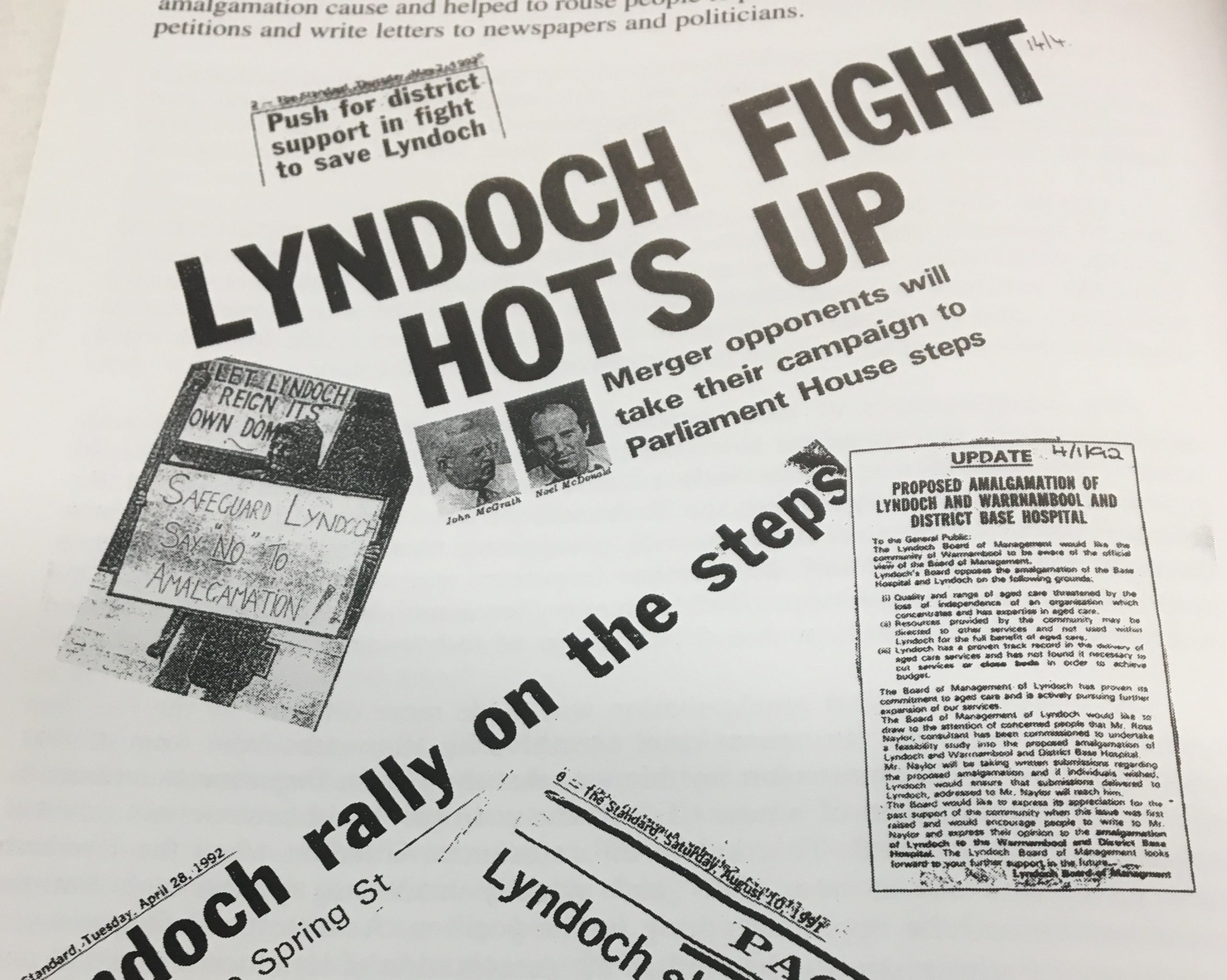
The question of exactly who owned Lyndoch aged care in Warrnambool was challenged during a push to merge with the W’bool Base Hospital. Image: via Peter Yule, Lyndoch: The First 50 Years.
Carol Altmann – The Terrier
Tonight I want to answer a question that just keeps coming up: who owns Lyndoch Living?
The answer is the Warrnambool community.
In fact Lyndoch has been owned by the people of Warrnambool since day one, right back to the time when the “Lyndoch” property was secured by Ern Harris in 1952 and a public fundraiser was held to raise £13,000 toward the £40,000 price tag.
All of the land on which “Lyndoch” sits is also owned by Lyndoch Living, so the community owns that too.
This includes a slice of Scoborio Reserve that was portioned off by the Warrnambool City Council more than 20 years ago so Lyndoch could build the Tomlinson Centre for residents with dementia.
It’s the Tomlinson Centre that was recently bulldozed to make way for a planned $24 million medical clinic that is now at the centre of concerns that it could send Lyndoch broke.
In many ways, the Tomlinson Centre was what Lyndoch used to be all about.
The original building was funded through a generous donation from the Tomlinson family, and later extensions were paid for with the help of the A.L Lane Foundation, the Ray and Joyce Ubergang Foundation, the Ern Hartley Foundation and the Warrnambool Rotary Club.
That’s how Lyndoch used to work.
It used to work hand in glove with the community to raise funds to get things done, through raffles, Christmas parties and by simply asking for the public’s help.
In return, the community showed absolute loyalty to Lyndoch, especially when it was under threat of being merged or privatised, as it was in the 1990s.
The State and Federal governments fund various aspects of Lyndoch, but it is not government owned.
Nor is it privately owned.
Instead, Lyndoch sits in sweet spot of being community owned, but publicly funded.
This unique structure was tested in 1992, when the Labor Government tried to merge Lyndoch with the Warrnambool Base Hospital.
No bloody way, said the locals.
A strong, united, grassroots campaign led by then Lyndoch board members Drs Mike Page and Noel Bayley created multiple headlines and saw the idea wither.
As Peter Yule writes in his 2003 history of Lyndoch, the battle “brought home the value of Lyndoch as a unique community asset”.
This community ownership was tested again in the 1990s, when the Kennett Government planned to privatise all public aged care homes.
Lyndoch sought a legal opinion which confirmed, as Peter Yule writes, its unique legal status as “a community owned facility that provides public services”.
So let’s be clear – the community of Warrnambool owns Lyndoch.
It always has.
But so what?
As it stands, the community is shut off from any meaningful connection with Lyndoch and its decision makers.
We have lost that thread of accountability and mutual loyalty.
The board, which is now hand-picked by insiders, no longer answers questions issued by the media or individuals because, I guess, they dismiss all concerns as a beat-up.
In this new era, a former Acting Chief Financial Officer can raise the alarm over the viability of the $24 million medical clinic and it is met with silence.
This is incredible and, apparently, the new normal.
Gone are the days when we had a Dr Page or a Dr Bayley at the table, speaking up for the community and settling any concerns with straight forward answers.
Gone are the days of CEO Rhys Boyle, who lived in Warrnambool and became a recognisable part of its fabric.
Gone are the days of Lyndoch living within its means because now it doesn’t turn to the community, but to the banks.
Change happens – of course – but one of my biggest concerns when I first started to write about the changing face of Lyndoch Living 18 months ago was that the community would lose control of this valuable community asset.