Changing lives, one story at a time: celebrating Jess Chatfield
Carol Altmann – The Terrier
Tonight is an exciting night, because this old terrier gets to showcase the very first work by a new, young storyteller, Jess Chatfield, from the Framlingham Aboriginal community.
Jess is a proud Gunditjmara woman, part of the Maar nation, who grew up at Framlingham about 20kms north east of Warrnambool, and has since returned to live there with her own two children and her extended family.
Jess is the recipient of The Terrier digital indigenous storytelling mentorship, a project made possible thanks to the Judith Neilson Institute for Journalism and Ideas – a national philanthropic fund based in Sydney which, quite frankly, is breathing life into independent, regional journalism in Australia.
Thanks to the support of JNI, I was able to bring Jess together with arguably our best local videographer, Colleen Hughson, from First Ladies Productions, who creates strong, visual stories that empower people and their communities.
As readers of The Terrier know, Colleen’s work has been a game changer in creating local awareness and energy around how we treat our beautiful beaches.
Jess, I have since learned, has that very same fire in her belly that drives storytellers who hope to make a difference, however small, and to inspire their community to find their voice.
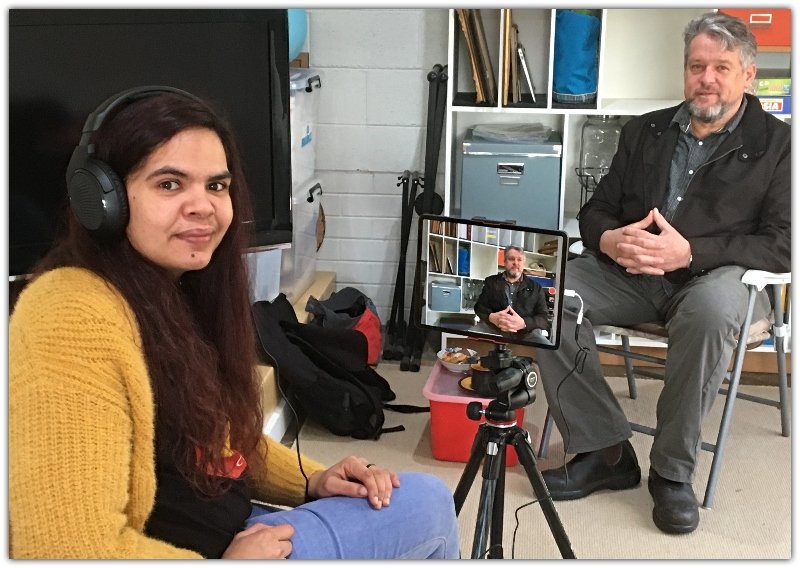
The beginning: Jess Chatfield in the first days of the mentorship, interviewing Geoff Rollinson from Save the Hopkins River- Stop the Quarry.
In these past months, our best laid plans for this mentorship – like those of the entire world – were knocked sideways by Covid-19.
We had planned to start in March, using space kindly offered by Brophy Family and Youth Services in Warrnambool, until the shutdown hit with full force.
We eventually started in June, from a room at the back of my house that was hastily converted into “an office”, complete with a curious Scottish Terrier pup peering through the door.
A plague. Lockdowns. Zoom. Masks. Social distancing. Floods.
How on earth a journalism mentorship could even get off the ground in such a climate is beyond me, but our little trio has pressed on and we have made it work.
This first video is based on Jess’s own family, and the story of her mother, Louise, an inspiring woman, a true matriarch, for whom family is everything.
It’s also a story about the importance of Country, the power of the magnificent Hopkins River, the connection to the Framlingham bush, and the safety and security of “home”.
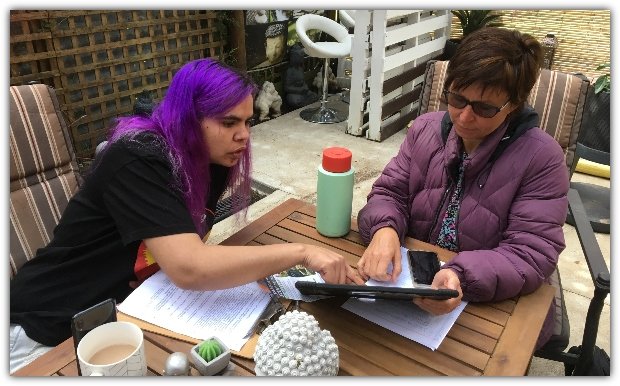
A change of hair colour and a change of location: Jess Chatfield editing with Colleen Hughson at Jess’s home in Framlingham.
Under Colleen’s guidance, Jess has planned, shot and edited every piece of Leenyaar. Warran Pookar. Thookay. (Grandmother. River. Children.)
In so doing, Jess has moved from knowing very little about digital media storytelling, to creating a finished work under the most trying of conditions.
Her second project is now well underway: a narrative of Jess becoming involved in the fight to stop a bluestone quarry near the Hopkins River, not far from the Framlingham forest.
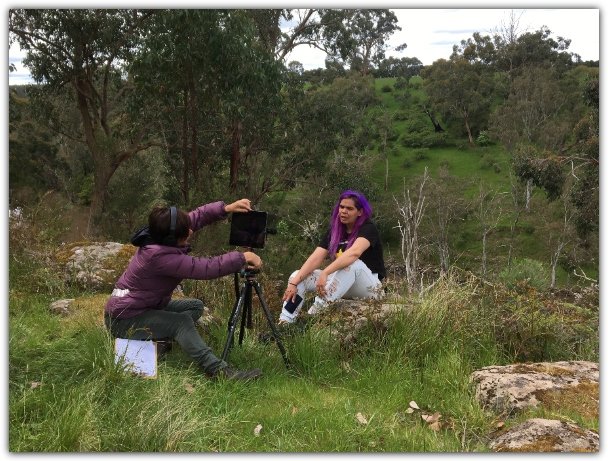
On location: Colleen Hughson and Jess Chatfield setting up a shot in the Framlingham forest, overlooking the Hopkins River.
I asked Jess to write some words that I could send to JNI about this whole experience and this is part of what she wrote:
“Since doing this mentorship, I have developed a love for journalism, I love all the different ways of it.
“I have learnt how to use an Ipad (properly). I also learnt how to plan before I make a documentary, I have learnt the importance of the message you get across to your audience…”
And then this wonderful kicker:
“I have been thinking after my mentorship I would love to continue my love for journalism by doing a diploma next year at Deakin University.
“I have found my passion in life.”
Jess is a natural storyteller and I want to say thankyou to Jess, and her family, for sharing so many of these stories with Colleen and I as we bumped along the backroads of Fram.
On we go, Jess, on we go.
This project has been supported by the Judith Neilson Institute for Journalism and Ideas.
EPA puts Wannon Water under the pump over ocean outfall
Carol Altman – The Terrier
Happy news: I am supposed to be taking a break…but there has been a breakthrough with the fight to stop Wannon Water’s plans to continue to pour effluent into our ocean off Thunder Point for the next 20 years.
Before this $40m, more-of-the-same project goes any further, the EPA has asked WW to provide a whole raft of extra, expert detail on, among other things:
1. Public Health Concerns, including assessing pathogens in the wastewater and the impact of humans being exposed to these bacteria and viruses in the ocean, including through seafood.
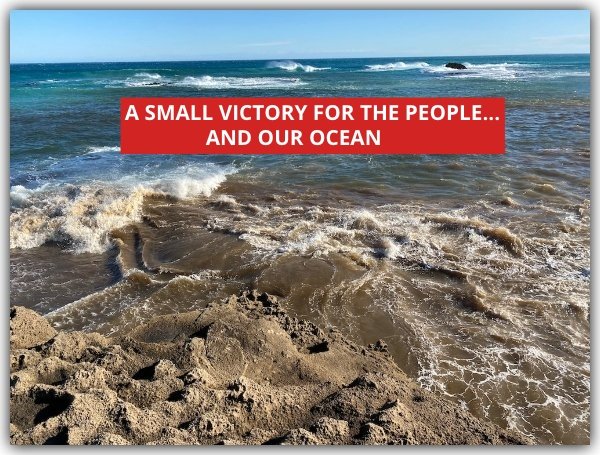
2. A health risk assessment of the ‘dirty decants’ (like that pictured) where solids and untreated waste water are released into the ocean.
3. Marine discharge concerns, including phosphorous levels.
4. Treatment process concerns, including the dirty decants that the EPA agrees have happened “multiple times in the past two years” and how these will be prevented.
5. Preventing the discharge of microplastics and;
6. Responding to each of the 83 public submissions received on this proposal, of which 78 were against the plan as it stood.
The fight is not over, but my word, this is a victory for the voices and for Colleen Hughson’s bravery in the face of immense corporate pressure, and for all of those people who took the time and effort to say ‘not good enough’ to Wannon Water.
We care about our ocean and we don’t want some cheap option that “will do” for the next 20 years.
Industry needs to sort out its own pollution and not expect to use Thunder Point as a dumping ground, or they should pay more toward making sure this is a first class/tertiary treatment plant that disposes only clean water into the sea.
Our kids and grandkids will thank us for this fight.
(If you haven’t watched the community video yet, tonight is the night. Most people have/had no idea what is happening out there near Shelly Beach, but they do now.)
https://vimeo.com/432157740
Plastic dump investigation needs a whistleblower
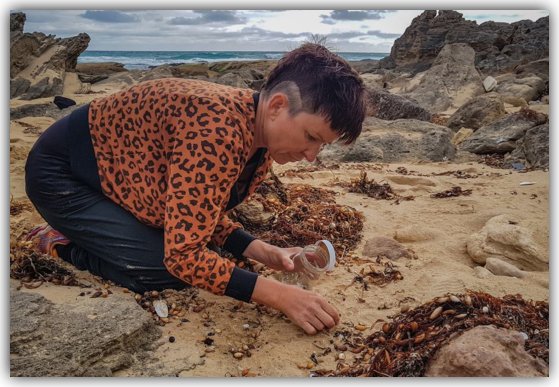
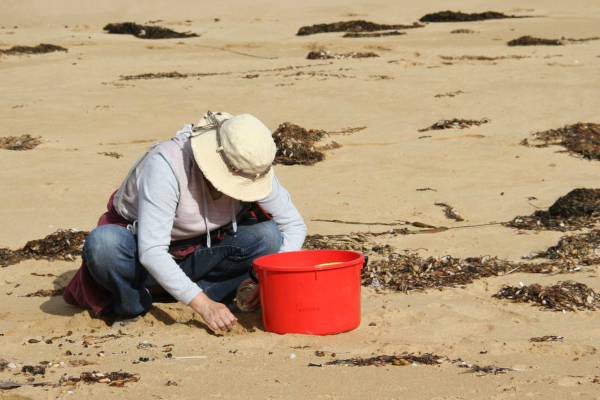
Warrnambool film maker and environmental activist Colleen Hughson, meticulously collecting tiny plastic ‘nurdles’ that were illegally dumped through the Wannon Water system last November. Photo: Rosana Sialong.
By Carol Altmann
Every time I look at the above photo of Warrnambool woman Colleen Hughson, I am struck by the humility of it.
There is Colleen, at Shelly Beach, on her knees, deeply focussed, picking up tiny plastic beads – aka an environmental nightmare called “nurdles” – between her fingertips, one by one by one by one….the number appears to be endless.
That shaved spot you can see above her right ear was where she had surgery to remove a brain tumour not long before this photo was taken by fellow ‘nurdler’ Rosana Sialong*.
I am sure surviving a brain tumour must change you. It would make some of us, I suspect, become more selfish. In Colleen’s case, however, it has made her generous spirit even more generous.
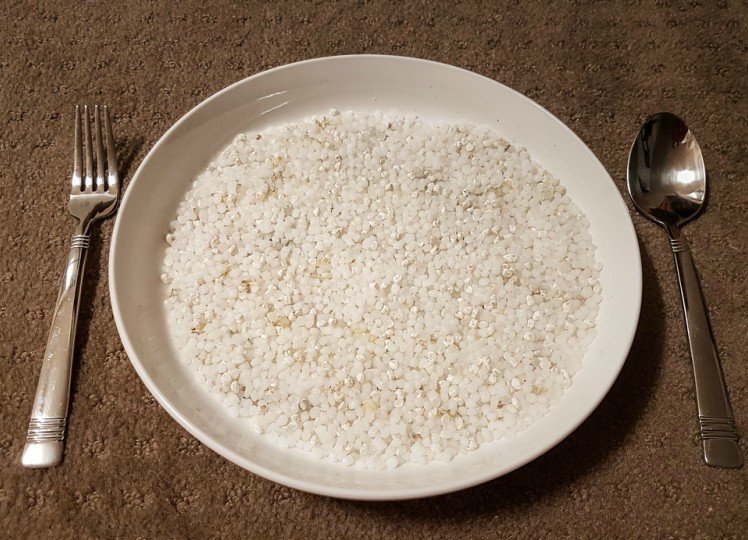
When Colleen, a film maker, discovered that tens of thousands of nurdles had been illegally dumped through the local Wannon Water sewerage system last November, she started a community action and clean-up group, Good Will Nurdle Hunting, that is still going gangbusters today.
Colleen and Rosana and dozens of others have now been cleaning up this plastic pollution for months, including days of blazing heat and finger-freezing cold.
So far, they have picked up more than 650,000 nurdles from our local beaches and it ain’t over yet. They just keep coming.
Wannon Water has also been cleaning up this mess for months.
It recently announced it had so far spent $334,000 on collecting nurdles: imagine the cost if Good Will Nurdle Hunting was not helping out for free? It would probably be at least $500,000.
What happened here was a major environmental crime.
A crime that is equivalent to someone stealing half a million bucks from a bank, except unfortunately crimes against the environment are not measured that way.
And yet nobody has been held responsible and nobody will because Wannon Water, despite its best efforts, has run out of leads.
I asked Wannon Water’s general manager (service delivery) Ian Bail a bunch of questions about where the investigation was up to and, in a nutshell, this is what he said:
20 sites have been visited. There are no more visits to come;
the nurdles have been inspected by two independent labs and they still don’t know what specific type of plastic it is or what it might be used for;
investigator and retired police officer Mick Fennessy, who was hired by Wannon Water, has finished his immediate task;
the multi-million dollar upgrade to the Warrnambool Sewage Treatment Plant will include a new system for accepting sludge which, hopefully, means this won’t happen again.
Wannon Water is keeping the investigation open. It still hopes for a breakthrough, but that won’t happen unless someone who knows what happened speaks up.
And somebody knows.
The person who poured the zillions of the nurdles into the system knows.
The person who delivered the sludge to Wannon Water’s treatment plant containing all of these zillions of nurdles also knows, or should know.
Was somebody paid to look the other way?
Somebody knows.
And while we wait for somebody to grow a conscience, people like Colleen and Rosana and Keith and Brenda and Donna and Luke and Megan (the list of names goes on), will keep picking up the pieces.
*Rosana’s photo provided the inspiration for this year’s Warrnibald portrait prize winner, Megan Nicolson, who reproduced it in needlepoint.
If you would like to see more stories like this, please consider making a small contribution below.
It will soon cost $70 to register your dog – and here’s why
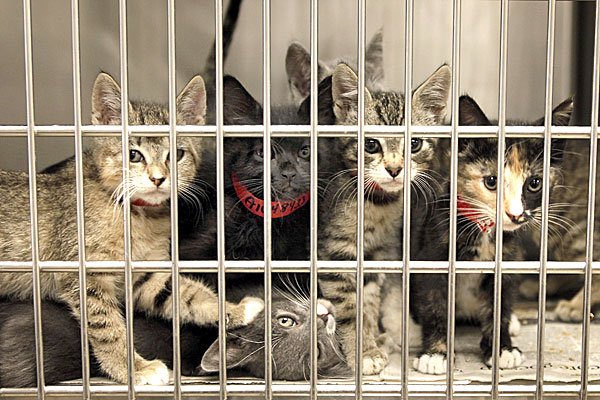
More than 10,000 cats a year are left at the RSPCA across Victoria, part of the reason for a 300% increase in pound management fees. Image: Stockimage.
The Terrier – Carol Altmann
WARRNAMBOOL ratepayers are in for a shock next year (2019) when it comes to putting out their rubbish and registering their pet, as the rising cost of our throwaway society starts to bite.
As has been reported elsewhere, garbage collection fees in Warrnambool are set to climb by $70 to $356 a year, while in neighbouring Moyne Shire the fee is rising by $21 to $493 a year*.
On top of this, pet owners in Warrnambool are expected to see dog and cat registration fees rise by up to almost 40%.
If the draft Warrnambool City Council budget goes ahead, in 2019 it will cost $70 to register your desexed dog and $59 for a desexed cat. (Last year it cost $52 and $41.)
The fee for a non-desexed dog will rise from $166 to $210 and a non-desexed cat will cost $177, up from $130.
And herein lies the problem, because these fee hikes are directly connected to the cost of keeping animals that are either discarded, given up, or need to be rehoused via the Warrnambool pound.
(I hasten to add that not all animals passed to the RSPCA are ‘unwanted’, including those that need to be rehoused due to changing personal circumstances such as illness or divorce.)
While WCC owns the Braithwaite St pound, it has for many years been out-sourced to the RSPCA and late last year the RSPCA dropped a bomb: it was no longer going to run its pound services at a loss and its fees were going up by 300%.
300%!
As council spokesman Nick Higgins explained, the WCC was paying around $112,000 a year, but under its new contract with the RSPCA this will almost triple to $328,632 in the next financial year**.
The following year it will rise to $413,016 and by 2020-21 it will be around $425,000.
This is getting close to half a million dollars a year to run the pound and, it appears, the cost will only keep rising.
So while it might be $70 to register your dog next year, by 2020-21 it could feasibly be $100.
There is no doubt it is expensive to humanely care for and re-house animals and the RSPCA says it had little choice but to reflect this in its fees.
RSPCA Victoria Head of Operations, Tegan McPherson:
“Over the past two years, RSPCA Victoria has been carefully analysing every council pound contract we tender for, and submitting tenders with a pricing structure that reflects the true cost of caring for animals admitted from each municipality and shire.
This represents a change from our previous approach, which was to share the cost of care with councils.
We are committed to ensuring that we run every council pound contract on terms that enable us to provide outstanding animal welfare on a cost-neutral basis. This way, we can ensure our limited funds are best invested in reducing cruelty and neglect, and cutting the number of surrendered and homeless animals right across Victoria.”
So what is the answer here?
Do we keep upping the fees and fines in Warrnambool each year to cover what will soon be a half million dollar a year operation, or do we look at this problem more broadly, and find other ways to encourage registration and de-sexing?
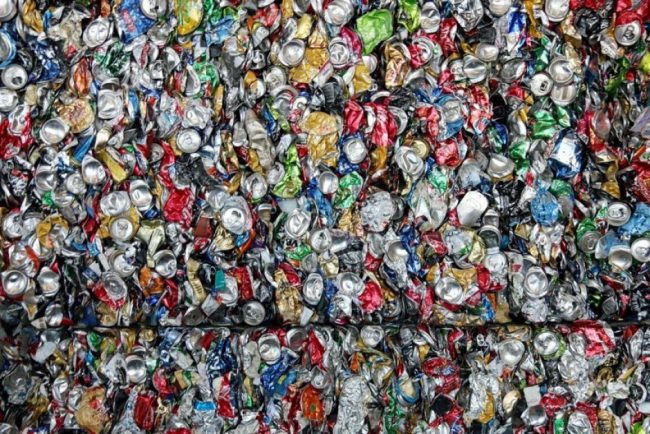
Recycling is no longer seen as a long-term solution to our growing waste problem, as international markets dry up. Image: ABC Radio
AT the moment, it seems, those who do register their pets will be seriously subsidising those who don’t: animal registrations will bring in $270,000 this financial year and, with the fee increase, $445,000 in the next.
I can’t help but see the parallels between our seeming inability – as a wider community – to value animals enough to ensure they don’t end up producing litters of unwanted offspring or not getting a dog that we have no time to train, or buying a kitten that is ignored once it grows into a cat…and our producing increasing tonnes of garbage.
In both cases, we expect someone else to deal with what we discard.
Recently there has been a lot of talk about the recycling crisis and China refusing to take our recyclable plastics and paper.
To be precise, China has refused to take recyclables that are even slightly contaminated (ie.mixed in with other stuff).
But the question remains as to why we would want to keep relying on China, or any other country, to keep taking our waste? If they pull the pin, what do we do then?
The answer, which some states are taking more seriously than others, is to no longer see recycling as the God of waste management, but to stop the waste being produced in the first place.
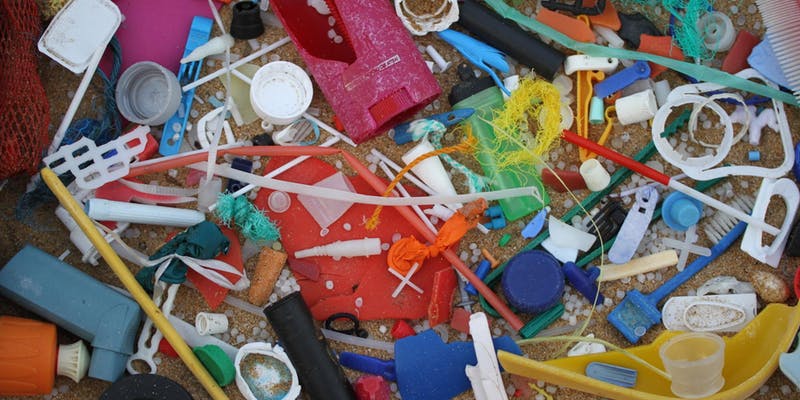
Plastics are flooding our oceans and need to be stopped at the source by changing manufacturing and consumer habits. Image: Good Will Nurdle Hunting/Tangaroa Blue
THE WCC put out its waste management strategy last December, which reflects this idea and covers everything from reducing plastic bags to the simple act of picking up your dog’s poop. It will also shortly start a trial of the organics composting service, FOGO, which is already up and running in Moyne Shire and Bendigo and elsewhere.
As the wheels grind slowly within government, the good news is that good stuff continues to happen at a grassroots, community level.
Colleen Hughson, who I wrote about recently in a piece on the plastic pollution spill at Shelly Beach, is now part of a project involving the global environmental group Tangaroa Blue, and others, to look at the plastics turning up on our local beaches.
A series of public workshops will be held in Warrnambool and Portland from later this month to talk about where the plastics are coming from, and how we can help stop it at the source. You can find out how to get involved here.
Tackling environmental waste and animal welfare issues is not new, but the dramatic fee rises we are seeing at a local level provides a serious wake-up call that we all need to get involved with finding the solutions – or expect to pay a price.
* Less than half of Moyne’s ratepayers use the garbage collection due to their remote locations. The higher cost compared to WCC reflects a wide geographic area with fewer customers.
** Moyne Shire used to share the cost of the WCC pound but, following a request from WCC to contribute significantly more from 2018-19, is now using the Southern Grampians Shire pound.
How can you dump piles of deadly plastic without detection?
Pollution in disguise: Millions of micro plastic ‘nurdles’ were illegally dumped into the Warrnambool sewerage treatment plant last November. This image by Rosana Sialong shows how easily they can be mistaken by coastal wildlife for food. Image: Good Will Nurdle Hunting.
By Carol Altmann
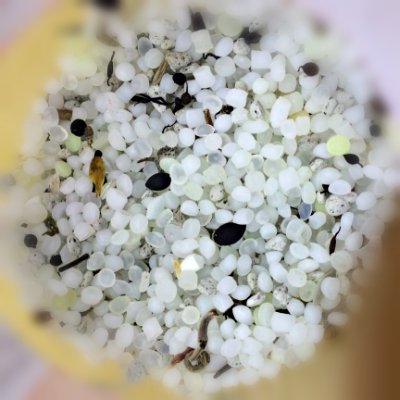
LAST November, millions of tiny plastic pellets (nurdles) were dumped illegally into Warrnambool’s sewerage treatment system – polluting our beaches all the way from Thunder Point to Yambuk – and still nobody has been found responsible.
How can this be?
This was a criminal act, but as Bob Brown said recently, crimes against the environment don’t attract police cars with their lights flashing and sirens roaring.
It was also, I suspect, one of the largest pollution spills ever recorded in Warrnambool and one from which it will take months if not years to recover.
Even as I write this, the Good Will Nurdle Hunting action group – set up by film maker Colleen Hughson – and others, are still laboriously picking up thousands of nurdles to avoid them getting stuck in a seabird’s gut and killing them.
And yet five months on, Wannon Water, who is responsible for accepting and treating the waste that comes into the Warrnambool plant, appears no closer to finding a culprit.
In these days of swipe cards, security codes, security cameras, trade waste controls, random testing, checklists, computerised logistics and god knows what else, this seems inconceivable, but it is the current reality.
It is also astonishing that Wannon Water didn’t know exactly what was being poured into its treatment plant on or around November 16.
This might be a harsh assessment if we were talking about the general sewerage system that caters for tens of thousands of customers from across the south-west, including those stupid enough to flush all manner of junk down the loo.
But in this case, the search is not a needle-in-a-haystack scenario, but actually quite narrow.
Local artist Megan Nicolson collected almost 2000 nurdles in one sweep around Shelly Beach on April 17, and they just keep coming. Image: Good Will Nurdle Hunting
BEAR with me for a second while I lay this out, because it is critical as to why this spill is considered by many to have been avoidable and why so many people are still angry and demanding answers.
Wannon Water has confirmed that the plastics came into its plant through what is called a Sludge Acceptance Point (SAP). This is where authorised tankers deliver gunk collected from authorised customers. You need a key and a swipe card to get in. In other words, it is not open to just anybody.
As Wannon Water managing director Andrew Jeffers said by email, “WannonWater’s system is secure and only able to be accessed by approved customers. Volumes received at this point are only a very minor proportion of the total volume of sewage treated at the Warrnambool plant.”
Of these SAP customers, Wannon Water has identified 20 sites that were inspected as part of its investigation, including some sites that might use nurdles or raw plastic.
Yet despite nailing it down to just 20 likely sources, none of these inspections, it seems, has come to anything.
Knees down, back bent, nurdle collector Rosana Sialong is one of the many locals still trying to remove the nurdles from the Shelly Beach area. Image: Good Will Nurdle Hunting.
WANNON Water declined to list the 20 sites inspected, or to reveal much of anything about its ongoing investigation, so I asked five local, large industries directly if they had any knowledge of the spill.
Here is what they said:
Midfield Meats: “Midfield doesn’t use nurdles in any processes.”
Murray Goulburn: ‘MG does not use Wannon Water for its effluent disposal. We have our own wastewater treatment system and spray irrigate on to our farmland. In addition, MG does not use a product of this nature in any aspect of its manufacturing.’
Beach Energy: (owners and operators of the Port Campbell gas field, formerly operated by Origin Energy): “No nurdles are used in production on site.”
Fonterra: “I’ve spoken to our site environment manager and can advise that we don’t use nurdles in our production processes”.
Saputo/Warrnambool Cheese and Butter: The questions have been sent to Saputo communications in Canada – still waiting a response.
And what about two of Warrnambool’s septic and trade waste collection services, Berminghams and Sergeants? What do they know?
Sergeants: “As the records would state (we) didn’t dispose of any liquid waste at the Warrnambool facility during the months of October, November or December”.
Berminghams: “We have nothing to tell you about that.” The person said on the end of the phone before ending the call.
Lastly, I called Bartlett’s Environmental in Geelong.
Bartlett’s are contracted to clean the Wannon Water sewer pump stations and truck the sludge to the SAP, so maybe they unknowingly sucked up a load of nurdles around November 16 last year?
At first Barlett’s offered to look into it, and then, a day later, its general manager John McCoy emailed: “For all matters regarding contract work undertaken by Bartlett’s Environmental for Wannon Water, please refer all questions directly to Wannon Water.”
Mr Jeffers, who declined to be interviewed directly for this piece, said via email that Wannon Water had since ruled out the plastics coming in via sludge from a sewer pump station.
So around and around and around we go.
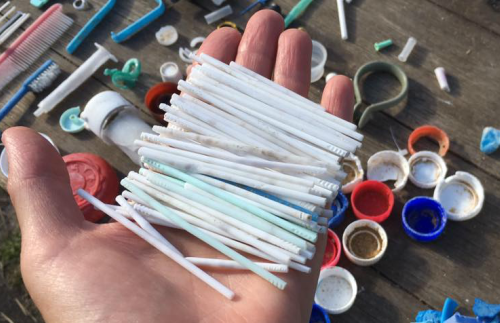
Thousands of cotton ear bud sticks, like these collected on April 20, were considered by many to be the canary in the coal mine on the pollution problem. Image: Pick Up Sticks Facebook Group.
WANNON Water appears keen to find out who has caused it such grief.
It is even using the skills of a private investigator, retired police officer Mick Fennessy, who is a big, no-bullshit kind of guy, to try and flush out the truth.
But what this spill has exposed is not only an environmental vandal in action, but a gaping hole in how the Warrnambool treatment plant has operated – quite legally – to date.
Wannon Water has now realised that its screening systems were not good enough, both before sludge was poured into its plant, and once it passed through.
What has happened since this spill is that two, finer screens have been installed at the treatment plant to catch anything larger than 1.5mm before it reaches the ocean.
Wannon Water is also “now supervising all loads coming in” to the SAP, according to Mr Jeffers.
Both of these are important changes but, some argue, they should have been made immediately when thousands of cotton bud sticks appeared at Shelly Beach en masse in 2015 and turned up in vast numbers again last August.
The slim white sticks were considered to be the canary in the coal mine, sending a highly visual warning that thousands of litres of small plastic could be passing through the Warrnambool treatment plant to the ocean.
Nothing, however, was done, despite Wannon Water being told about the pollution.
“Both the Environmental Protection Authority and Wannon Water were informed by myself and others of the sticks, but they either didn’t believe me or were unwilling to do anything about it,” said Luke Foster, a local plumber and member of Good Will Nurdle Hunting.
If the new 1.5mm screen had been installed before November 16 last year, the argument goes, very few of the millions of dumped nurdles would have made it to the ocean.
“I am happy there is now a 1.5mm screen at the end of the waste water treatment plant to capture these plastics. However, it may be a long time before we are able to remove the majority of plastics that remain in the marine environment from past pollution,” Mr Foster said.
Mr Jeffers, however, has distanced Wannon Water from any responsibility for the cotton bud sticks.
“WannonWater does not believe the cotton buds were related to the current sewage treatment plant nor the nurdle incident,” he wrote.
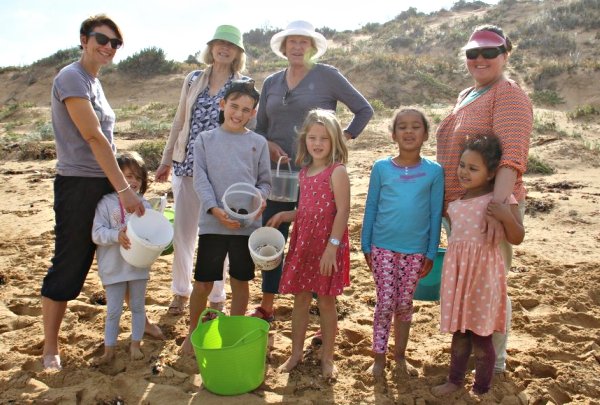
Some of the many Warrnambool locals who have joined he clean up effort at local beaches. Image: Good Will Nurdle Hunting.
THERE is a lot at stake for Wannon Water from this pollution problem, with the EPA continuing its own investigation into potential breaches of the Environment Protection Act by the treatment plant.
As EPA South West manager Carolyn Francis outlined, the maximum penalty through the courts for a breach of an EPA licence is $380,568. The EPA can also directly issue Infringement Notices of $7729.
There is also, of course, the need to reassure the public that Wannon Water is top of its game when it comes to handling pollutants: preventing them from entering the system in the first place and catching them – and the polluters – when they do.
Catching the nurdle culprit so long after the event, however, appears increasingly unlikely and yet time alone, surely, cannot be an excuse to give up the search. We deserve answers.
In the meantime, Colleen Hughson, who really got the ball rolling on the public clean-up, says she has been amazed by the community response.
“The most heartening thing about the nurdles spill is the amount of ‘good will’ the community has shown in coming together to clean the mess up.
“(It) has also highlighted the bigger issue of marine plastic pollution and many people in my community have been inspired to look into ways of curbing their own consumer habits to stop the flow of plastic waste. It’s brought about conversations, generosity and a willingness to take positive action.”
Do you know anything about the illegal dumping of the nurdles? If you do, contact me at altmanncarol@gmail.com
For information on Wannon Water’s response to the nurdle spill, including media releases, clean-up activities and ongoing updates, visit its dedicated webpage here.